Gravitational fields · 引力场
| English | 中文 | Pinyin · 拼音 |
|---|---|---|
| gravitational field/ˌɡrævɪˈteɪʃənl fiːld/ | 重力场 | zhòng lì chǎng |
| gravitational field strength/ˌɡrævɪˈteɪʃənl fiːld streŋθ/ | 重力场强度 | zhòng lì chǎng qiáng dù |
| field lines/fiːld laɪnz/ | 场线 | chǎng xiàn |
| point mass/pɔɪnt mæs/ | 质点 | zhì diǎn |
| radial/ˈreɪdɪəl/ | 径向 | jìng xiàng |
| uniform field/ˈjuːnɪfɔːm fiːld/ | 匀强场 | yún qiáng chǎng |
| test mass/test mæs/ | 检验质量 | jiǎn yàn zhì liàng |
The same pull, near and far
- An apple falls; the Moon circles the Earth. Both feel the same pull.
- A gravitational field 重力场 is any region where a mass feels a gravitational force.
- We measure its strength with one simple idea.
远近都是同样的拉力
- 苹果落下;月球绕地球转。两者感受到的是 同一种 拉力。
- 重力场(gravitational field) 是质量会受到引力作用的任何区域。
- 我们用一个简单的想法来衡量它的强弱。
Field strength
- Gravitational field strength 重力场强度 is the force per unit mass: $g = \dfrac{F}{m}$.
- It is a vector, pointing toward the source mass. The exam definition is "the gravitational force per unit mass at that point".
Saturn, its rings and moons all held in orbit by gravity
场强
- 重力场强度(gravitational field strength) 是单位质量所受的力:$g = \dfrac{F}{m}$。
- 它是一个 矢量,指向产生场的质量。考试定义是"该点处 单位质量所受的 引力"。

土星、它的光环和卫星都被引力维持在轨道上
Gravitational fields · 引力场
g ∝ M / r²
Gravitational field strength obeys the inverse-square law — halve the distance and it quadruples. · 引力场强度服从 平方反比定律——距离减半,它就变为四倍。
Gravitational field strength is the force per unit: · 引力场强度是每单位什么上的力:
$g = \dfrac{F}{m}$ — the gravitational force on each kilogram of a small test mass. · $g = \dfrac{F}{m}$——作用在一个小检验质量每千克上的引力。
A familiar number
- The unit is $\dfrac{\text{N}}{\text{kg}}$ — exactly the same as $\dfrac{\text{m}}{\text{s}^2}$.
- So $g$ is just the acceleration of free fall in the field.
一个熟悉的数
- 单位是 $\dfrac{\text{N}}{\text{kg}}$——与 $\dfrac{\text{m}}{\text{s}^2}$ 完全相同。
- 所以 $g$ 就是场中的 自由落体加速度。
A $2.0\ \text{kg}$ mass feels a gravitational force of $20\ \text{N}$. What is $g$ there? · 一个 $2.0\ \text{kg}$ 的质量受到 $20\ \text{N}$ 的引力。那里的 $g$ 是多少?
$g = \dfrac{F}{m} = \dfrac{20}{2.0} = 10\ \dfrac{\text{N}}{\text{kg}}$. · $g = \dfrac{F}{m} = \dfrac{20}{2.0} = 10\ \dfrac{\text{N}}{\text{kg}}$。
The unit N/kg is the same as m/s². · 单位 N/kg 和 m/s² 相同。
Yes — $g$ is also the acceleration of free fall, so its units are equivalent. · 是的——$g$ 也是自由落体加速度,所以它们的单位是等价的。
Match each term to the definition the examiner marks. · 把每个术语与评分认可的定义配对。
Field strength is force per unit mass; potential is WORK done per unit mass. Swapping those two phrases loses both marks at once. · 场强是单位质量所受的力;势是单位质量所做的功。把这两句话对调,两个分同时丢掉。
Field lines 场线
- Around a point mass 质点 or sphere: lines are radial 径向, pointing inward.
- Near a surface (small region): lines are parallel — a uniform field 匀强场. Closer lines = stronger field.
场线
- 在 质点(point mass)或球体 周围:场线是 径向 的,指向内。
- 靠近表面(小区域):场线 平行——匀强场。场线越密 = 场越强。
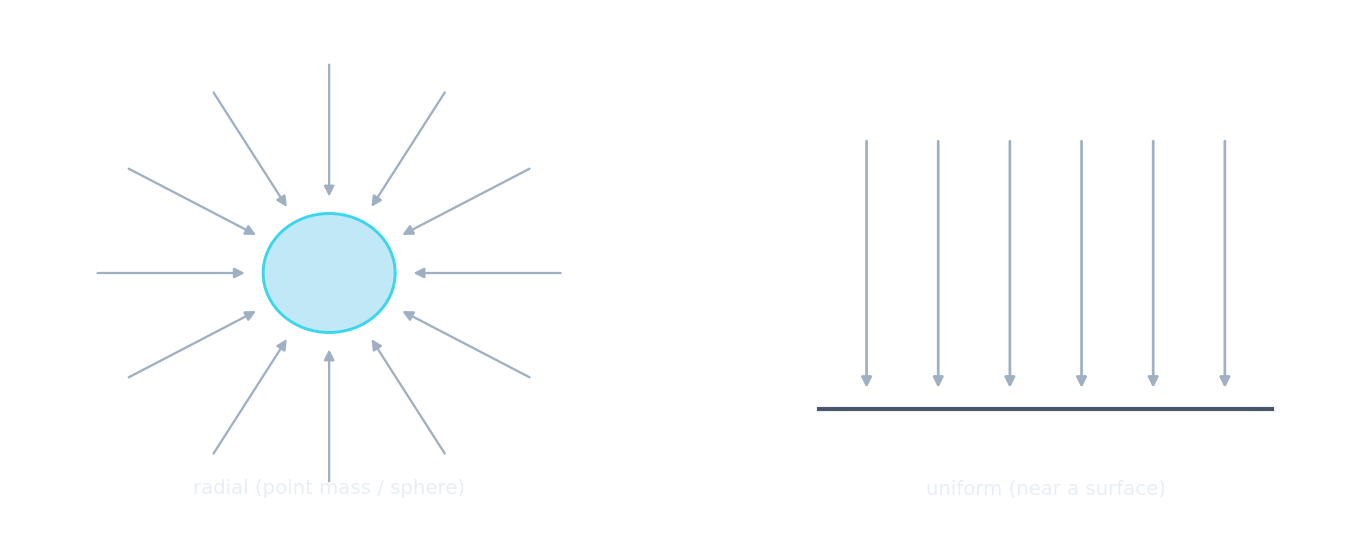
Around a sphere (seen from outside), the gravitational field lines are: · 围绕一个球(从外面看),引力场线是:
Gravity always attracts, so the lines point inward toward the centre, like a point mass. · 引力总是吸引,所以场线指向中心,就像一个点质量。
Field lines drawn closer together represent a ____ field. · 画得更密的场线代表一个 ____ 的场。
Line spacing shows strength — closer lines mean a stronger field. · 场线的间距表示强度——线越密表示场越强。
Deriving $g$ for a point mass
- Put a test mass 检验质量 $m$ at distance $x$ from a mass $M$. The force on it is $F = \dfrac{GMm}{x^{2}}$.
- Field strength is force per unit mass: $g = \dfrac{F}{m} = \dfrac{GM}{x^{2}}$.
- The test mass cancels — the field belongs to $M$ alone — and $g$ points towards $M$. Name $G$ as the gravitational constant when the question asks you to identify symbols.
推导质点的 $g$
- 把一个 检验质量(test mass) $m$ 放在离质量 $M$ 距离 $x$ 处。它受的力是 $F = \dfrac{GMm}{x^{2}}$。
- 场强是单位质量所受的力:$g = \dfrac{F}{m} = \dfrac{GM}{x^{2}}$。
- 试探质量 被消去——场只属于 $M$——而且 $g$ 指向 $M$。当题目要求指明符号时,说明 $G$ 是引力常量。
For a satellite 300 km above the Earth, the r in $GM/r^2$ is 300 km. · 对于地球上空 300 km 的卫星,$GM/r^2$ 中的 r 是 300 km。
r is measured from the CENTRE, so add the Earth's radius: about 6670 km. Using the height alone is the standard error and gives a field strength hundreds of times too large. · r 是从地心量起的,所以要加上地球半径:约 6670 km。只用高度是标准错误,会让场强大出几百倍。
Worked example: two points, two spheres
(a) P is at distance $x$ from a point mass; Q is at $\dfrac{x}{2}$ on the opposite side. Compare the fields. (b) Two identical uniform spheres of radius $R$ have their centres a distance $L$ apart. Sketch $g$ along the line between them.
- (a) Size: $g \propto \dfrac{1}{x^{2}}$, so halving the distance gives four times the field strength at Q.
- (a) Direction: both fields point towards the mass, and the points are on opposite sides, so the two fields are in opposite directions.
- (b) Ends: at the surface of each sphere the field is the surface value $g_{0}$, pointing into that sphere — so the graph runs from $-g_{0}$ at $x = R$ to $+g_{0}$ at $x = L - R$.
- (b) Middle: the two pulls are equal and opposite at $x = \dfrac{L}{2}$, so the curve passes through zero there.
- (b) Shape: each field falls as $\dfrac{1}{r^{2}}$, so the curve is steep near each surface and shallow in the middle.
- Check: field strength is a vector — between two masses you subtract, and a point of zero field always exists somewhere between them.
例题:两个点,两个球
(a) P 离一个质点的距离为 $x$;Q 在 另一侧,距离 $\dfrac{x}{2}$。比较两处的场。(b) 两个半径为 $R$ 的相同均匀球体,球心相距 $L$。画出两球之间连线上 $g$ 的变化。
- (a) 大小: $g \propto \dfrac{1}{x^{2}}$,所以距离减半,Q 处的场强是 四倍。
- (a) 方向: 两处的场都指向质量,而两点在相反的两侧,所以两个场 方向相反。
- (b) 两端: 在每个球的表面,场是表面值 $g_{0}$,指向那个球——所以图线从 $x = R$ 处的 $-g_{0}$ 到 $x = L - R$ 处的 $+g_{0}$。
- (b) 中间: 在 $x = \dfrac{L}{2}$ 处两个拉力大小相等、方向相反,所以曲线在那里经过 零。
- (b) 形状: 每个场都按 $\dfrac{1}{r^{2}}$ 减弱,所以曲线在每个球面附近陡、在中间平缓。
- 检查: 场强是 矢量——在两个质量之间要相减,而且两者之间总有一处场为零。
The gravitational field strength at distance $x$ from a point mass is $g$. What is the field strength, as a multiple of $g$, at distance $\dfrac{x}{2}$? · 离一个质点距离 $x$ 处的重力场强度为 $g$。距离 $\dfrac{x}{2}$ 处的场强是 $g$ 的多少倍?
$g \propto \dfrac{1}{x^{2}}$: halving the distance multiplies the field strength by $2^{2} = 4$. · $g \propto \dfrac{1}{x^{2}}$:距离减半,场强乘以 $2^{2} = 4$。
A planet has mass 6.0e24 kg and radius 6.4e6 m. What is the field strength at its surface, in N/kg? (G = 6.67e-11) · 某行星质量 6.0e24 kg、半径 6.4e6 m。它表面的场强是多少 N/kg?(G = 6.67e-11)
g = GM/r^2 = 6.67e-11 x 6.0e24 / (6.4e6)^2 = 9.8 N/kg, which is why that number is familiar. Square the radius, not just the mantissa. · g = GM/r^2 = 6.67e-11 x 6.0e24 / (6.4e6)^2 = 9.8 N/kg,这就是这个数眼熟的原因。半径要整个平方,不是只平方尾数。
Field strength is force per unit mass, in $\dfrac{\text{N}}{\text{kg}}$ — writing "the force on a mass" loses the definition mark. Its direction is towards the mass producing it. And a field is only "uniform" near a surface because the region considered is tiny compared with the planet's radius; over any real distance it weakens as $\dfrac{1}{r^{2}}$.
场强是 单位质量 所受的力,单位 $\dfrac{\text{N}}{\text{kg}}$——写"某个质量所受的力"会丢掉定义分。它的方向 指向 产生它的质量。而且场只有在靠近表面时才"均匀",因为所考虑的区域与行星半径相比极小;在任何真实距离上它都按 $\dfrac{1}{r^{2}}$ 减弱。
Adding two fields
- Fields are vectors, so at a point between two masses the resultant is the difference of the two pulls.
- The neutral point, where they cancel, lies closer to the smaller mass — its weaker pull needs a shorter distance to match.
- On the far side of either mass the two fields add.
两个场相加
- 场是矢量,所以在两个质量之间的一点,合场是两个拉力的 差。
- 两者抵消的 中性点 更靠近 较小 的质量——它较弱的拉力需要更短的距离才能相当。
- 在任一质量的外侧,两个场相加。
Two identical spheres are a distance apart. Which statements about the gravitational field on the line between them are true? Select all that apply. · 两个相同的球体相隔一段距离。关于它们之间连线上的重力场,哪些说法正确?选出所有正确的。
Each sphere pulls towards itself, so between them the fields oppose and cancel at the midpoint; each field grows as $\dfrac{1}{r^{2}}$ towards its own surface. · 每个球都把物体拉向自己,所以在两球之间两个场相反并在中点抵消;每个场朝各自的球面按 $\dfrac{1}{r^{2}}$ 增强。
You've got it
- gravitational field strength $g = \dfrac{F}{m}$ (force per unit mass, a vector toward the mass)
- $\dfrac{\text{N}}{\text{kg}} = \dfrac{\text{m}}{\text{s}^2}$ — $g$ is the free-fall acceleration; for a point mass $g = \dfrac{GM}{x^{2}}$
- field lines: radial for a sphere, uniform near a surface; between two masses the fields subtract and cancel at a neutral point
你掌握了
- 重力场强度 $g = \dfrac{F}{m}$(单位质量所受的力,指向质量的矢量)
- $\dfrac{\text{N}}{\text{kg}} = \dfrac{\text{m}}{\text{s}^2}$——$g$ 是自由落体加速度;质点的 $g = \dfrac{GM}{x^{2}}$
- 场线:球体是 径向 的,靠近表面是 均匀 的;两个质量之间场相减,在中性点抵消