Turning effects of forces · 力的转动效果
| English | 中文 | Pinyin · 拼音 |
|---|---|---|
| pivot/ˈpɪvət/ | 支点 | zhī diǎn |
| centre of gravity/ˈsentə ɒv ˈɡrævɪti/ | 重心 | zhòng xīn |
| moment/ˈməʊmənt/ | 力矩 | lì jǔ |
| perpendicular distance/ˌpɜːpənˈdɪkjʊlə ˈdɪstəns/ | 垂直距离 | chuí zhí jù lí |
| line of action/laɪn ɒv ˈækʃn/ | 作用线 | zuò yòng xiàn |
| couple/ˈkʌpl/ | 力偶 | lì ǒu |
| torque/tɔːk/ | 力偶矩 | lì ǒu jǔ |
Why the handle is far from the hinge
- A door handle sits as far from the hinges as possible.
- The same push, applied further from the pivot 支点, turns the door more easily.
- Turning effect depends on force and distance.
为什么门把手离铰链很远
- 门把手装在尽可能远离铰链的地方。
- 同样的推力,作用在 离转轴更远 的地方,能更容易地转动门。
- 转动效果取决于力 和 距离。
Centre of gravity 重心
- The whole weight of an object can be treated as acting at one point: its centre of gravity.
- For a uniform, regular shape it sits at the middle.
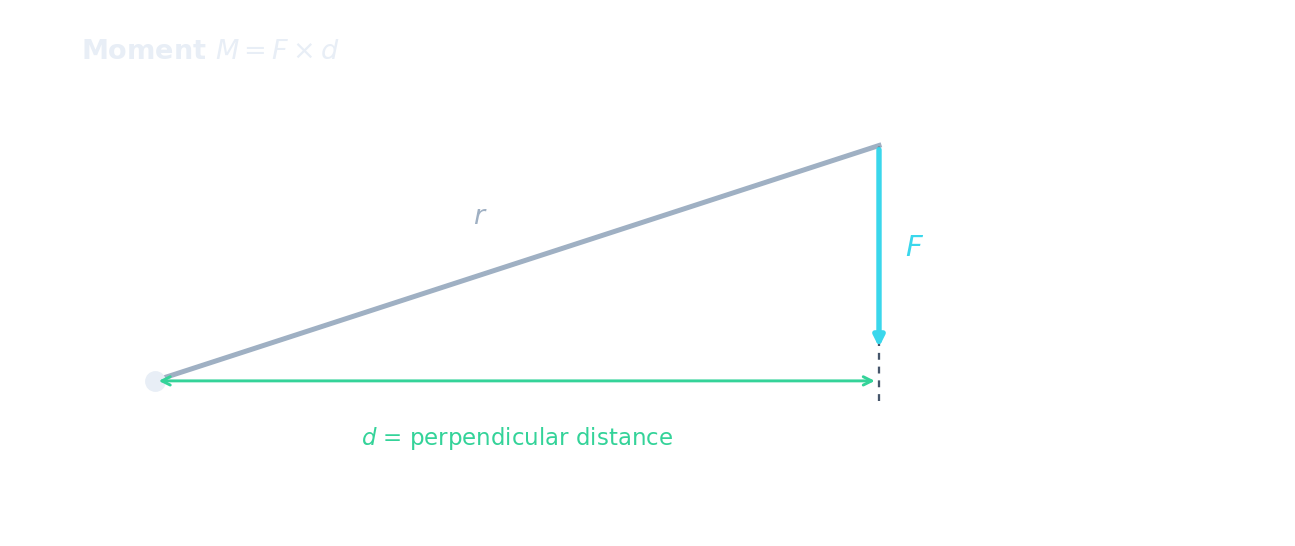
The moment 力矩 depends on the perpendicular distance 垂直距离 $d$ from the pivot to the line of action 作用线 of the force
重心
- 一个物体的全部 重力 可以看作作用在一个点上:它的 重心(centre of gravity)。
- 对于均匀、规则的形状,它位于正中间。

力矩取决于从转轴到力的作用线的垂直距离 $d$
Balance the see-saw · 平衡跷跷板
Put a weight on each side and slide it in or out. A small weight far from the pivot can balance a big weight close in — the beam is level when force × distance matches on both sides. · 在两侧放置重物并向内或向外滑动。远离支点的小重量可以平衡靠近支点的大重量——当两侧的力 × 距离相等时,横梁保持水平。
Moment of a force
- The moment is $M = F \times d$, where $d$ is the perpendicular distance from the pivot to the force's line of action.
- Unit: $\text{N}\cdot\text{m}$. A moment is clockwise or anticlockwise.
力矩
- 力矩(moment) 是 $M = F \times d$,其中 $d$ 是从转轴到力的作用线的 垂直距离。
- 单位:$\text{N}\cdot\text{m}$。力矩有顺时针或逆时针之分。
A force of $20\ \text{N}$ acts at a perpendicular distance of $0.50\ \text{m}$ from a pivot. What is the moment? · 一个 $20\ \text{N}$ 的力作用在离转轴垂直距离 $0.50\ \text{m}$ 处。力矩是多少?
$M = F \times d = 20 \times 0.50 = 10\ \text{N}\cdot\text{m}$. · $M = F \times d = 20 \times 0.50 = 10\ \text{N}\cdot\text{m}$。
Why is a door handle placed far from the hinges? · 为什么门把手放在远离铰链的地方?
Moment $= F \times d$. A bigger $d$ means a bigger turning effect for the same force, so the door opens more easily. · 力矩 $= F \times d$。更大的 $d$ 意味着同样的力有更大的转动效果,所以门更容易打开。
Angle matters
- Only the part of the force perpendicular to the arm turns it.
- For a force at angle $\theta$ to an arm of length $r$: $M = Fr\sin\theta$.
Weights on a rule balanced at a pivot — used to test the principle of moments
角度很重要
- 只有力中 垂直于 力臂的部分才使它转动。
- 对于与长度为 $r$ 的力臂成角 $\theta$ 的力:$M = Fr\sin\theta$。

一根尺在转轴处用砝码平衡——用来检验力矩原理
Only the part of a force perpendicular to the arm contributes to the turning. · 只有力中垂直于力臂的部分对转动有贡献。
Yes — that is why $M = Fr\sin\theta$: $\sin\theta$ picks out the perpendicular part of the force. · 是的——这就是为什么 $M = Fr\sin\theta$,其中 $\sin\theta$ 选出力中垂直的部分。
Match each term to the definition the examiner marks. · 把每个术语与评分认可的定义配对。
Two of these hinge on the phrase line of action, which is what makes the distance perpendicular rather than measured along the rod. · 其中两条都落在「作用线」这个说法上,正是它使那个距离成为垂直距离,而不是沿杆量出的距离。
A couple 力偶
- A couple is two forces: equal in size, opposite in direction, a distance apart.
- It makes the body turn only — the resultant force is zero, so no straight-line push.
力偶
- 力偶(couple) 是两个力:大小相等、方向相反、相隔一段距离。
- 它使物体 只转动——合力为零,所以没有直线方向的推动。
Select all · 所有 the features of a couple. · 选出所有力偶的特征。
A couple is equal, opposite forces a distance apart, giving zero resultant force but a pure turning effect. Same-direction forces are not a couple. · 力偶是相隔一段距离、大小相等、方向相反的力,合力为零但有纯转动效果。同方向的力不是力偶。
Torque 力偶矩 of a couple
- The torque is $\tau = F \times d$, where $d$ is the distance between the two lines of action.
- It is the same about any point — a special property of couples.
力偶的力矩
- 力偶矩(torque) 是 $\tau = F \times d$,其中 $d$ 是两条作用线之间的距离。
- 它对 任何 点都相同——这是力偶的一个特殊性质。
A couple has forces of $5.0\ \text{N}$ with their lines $0.40\ \text{m}$ apart. What is the torque? · 一个力偶的力为 $5.0\ \text{N}$,作用线相隔 $0.40\ \text{m}$。力偶矩是多少?
$\tau = F \times d = 5.0 \times 0.40 = 2.0\ \text{N}\cdot\text{m}$. · $\tau = F \times d = 5.0 \times 0.40 = 2.0\ \text{N}\cdot\text{m}$。
Two equal forces in the same direction are not a couple — they have a resultant force and push the body along.
两个 同 方向的相等的力 不是 力偶——它们有合力,会把物体推着走。
Two equal forces pointing in the same direction form a couple. · 两个方向相同的相等的力构成一个力偶。
No — a couple needs equal and opposite forces. Same-direction forces have a resultant and push the body along. · 不——力偶需要大小相等 且方向相反 的力。同方向的力有合力,会把物体推着走。
Worked example: a beam that is not weightless
- A uniform beam of length $4.0\ \text{m}$ and weight $120\ \text{N}$ rests on a pivot $1.5\ \text{m}$ from its left end. A $200\ \text{N}$ load hangs from the left end. What force at the right end holds it in equilibrium?
- The beam is uniform, so its own weight acts at its centre, $2.0\ \text{m}$ from the left, which is $0.5\ \text{m}$ to the right of the pivot.
- Take moments about the pivot. Anticlockwise: $200 \times 1.5 = 300\ \text{N m}$.
- Clockwise: the beam's weight $120 \times 0.5 = 60\ \text{N m}$, plus the unknown $F$ at $2.5\ \text{m}$.
- $300 = 60 + 2.5F$, so $F = 96\ \text{N}$.
- Leaving out the beam's own weight is the standard lost mark, and it only vanishes when the pivot is at the centre.
例题:一根不是没有重量的梁
- 一根长 $4.0\ \text{m}$、重 $120\ \text{N}$ 的均匀梁搁在距左端 $1.5\ \text{m}$ 的支点上。左端挂着 $200\ \text{N}$ 的负载。右端需要多大的力才能保持平衡?
- 梁是均匀的,所以它自身的重力作用在中点,即距左端 $2.0\ \text{m}$,也就是支点右侧 $0.5\ \text{m}$ 处。
- 对支点取矩。逆时针:$200 \times 1.5 = 300\ \text{N m}$。
- 顺时针:梁自身的重力 $120 \times 0.5 = 60\ \text{N m}$,加上 $2.5\ \text{m}$ 处的未知力 $F$。
- $300 = 60 + 2.5F$,所以 $F = 96\ \text{N}$。
- 漏掉梁自身的重力是标准的丢分点,而它只有在支点恰好在中点时才消失。
Marks that slip away
- A moment uses the perpendicular distance from the point to the line of action of the force, not the distance along the rod.
- The weight of a uniform beam acts at its centre and has a moment about any pivot that is not there. Do not leave it out.
- The torque of a couple uses the distance between the two lines of action, so a symmetric couple gives $2Fd$, not $Fd$ measured from the middle.
- Check whether the geometry needs $\sin\theta$ or $\cos\theta$ by drawing the triangle. Do not guess.
- Equilibrium means the resultant force and the resultant torque are both zero. Two conditions, and a question can test either.
容易丢掉的分
- 力矩用的是从该点到力的作用线的垂直距离,不是沿杆量出的距离。
- 均匀梁的重力作用在它的中点,对任何不在中点的支点都有力矩。不要漏掉它。
- 力偶的力矩用的是两条作用线之间的距离,所以对称的力偶给出 $2Fd$,而不是从中间量起的 $Fd$。
- 画出三角形来确定几何关系需要 $\sin\theta$ 还是 $\cos\theta$。不要猜。
- 平衡意味着合力和合力矩都为零。两个条件,题目可能考其中任何一个。
A uniform 4.0 m beam of weight 120 N is pivoted 1.5 m from its left end, with a 200 N load at that end. What upward force at the right end gives equilibrium, in N? · 一根长 4.0 m、重 120 N 的均匀梁支在距左端 1.5 m 处,左端挂 200 N 的负载。右端需多大的向上的力才能平衡(N)?
Moments about the pivot: 200 x 1.5 = 120 x 0.5 + 2.5F, so F = 96 N. Forgetting the beam's own 120 N at its centre gives 120 N, the classic wrong answer. · 对支点取矩:200 x 1.5 = 120 x 0.5 + 2.5F,所以 F = 96 N。忘了梁自身作用在中点的 120 N 会得到 120 N,那是经典的错误答案。
Put the method for a principle-of-moments problem in order. · 把用力矩原理解题的方法按顺序排列。
Taking moments about a point an unknown passes through removes it from the equation, which is why the choice of point is worth a moment's thought. · 对某个未知力经过的点取矩,可以把它从方程里消掉,所以取矩点的选择值得想一想。
A body is in equilibrium. Which must be true? Select all · 所有 that apply. · 一个物体处于平衡。下列哪些必定成立?选出所有适用的。
Equilibrium permits constant velocity as well as rest. Both conditions are needed, and a question can test either one alone. · 平衡既允许静止也允许匀速运动。两个条件都要满足,而题目可能只考其中一个。
You've got it
- moment $M = F \times d$ — use the perpendicular distance to the line of action
- a couple is equal, opposite forces a distance apart: pure turning, torque $\tau = Fd$
- weight acts at the centre of gravity
你掌握了
- 力矩 $M = F \times d$——用到作用线的 垂直距离
- 力偶 是相隔一段距离、大小相等、方向相反的力:纯转动,力偶矩 $\tau = Fd$
- 重力作用在 重心 上