Permutations and combinations · 排列与组合
| English | 中文 | Pinyin · 拼音 |
|---|---|---|
| permutation/ˌpɜːmjuːˈteɪʃn/ | 排列 | pái liè |
| combination/ˌkɒmbɪˈneɪʃn/ | 组合 | zǔ hé |
| factorial/fækˈtɔːrɪəl/ | 阶乘 | jiē chéng |
| multiplication principle/ˌmʌltɪplɪˈkeɪʃn ˈprɪnsɪpl/ | 乘法原理 | chéng fǎ yuán lǐ |
How many ways to arrange a bookshelf?
- You have 10 books and want to choose 3 to display. How many ways? If order matters, it's a permutation 排列. If you just want any 3, it's a combination 组合.
- Counting techniques are the foundation of probability — and they appear everywhere, from lottery odds to password security.
排一个书架有多少种方式?
- 你有 10 本书,想选 3 本展示。多少种方式?如果顺序重要,这是一个排列(permutation)。如果你只要任意 3 本,这是一个组合(combination)。
- 计数技巧是概率的基础——而且它们到处出现,从彩票赔率到密码安全。
Permutation or combination lab · 排列或组合实验
Choose whether order matters in a counting problem. · 在计数问题中选择顺序是否重要。
Permutations (order matters)
- A permutation is an arrangement where order matters: ${}^nP_r = \dfrac{n!}{(n-r)!}$.
- Example: arranging 3 books from 10: ${}^{10}P_3 = \dfrac{10!}{7!} = 10 \times 9 \times 8 = 720$.
Worked example. How many 3-letter codes can be made from 26 letters (no repeats)? ${}^{26}P_3 = 26 \times 25 \times 24 = 15\,600$.
Permutations: 3 books arrange in 3 × 2 × 1 = 6 different orders
排列(顺序重要)
- 一个排列是一个顺序重要的安排:${}^nP_r = \dfrac{n!}{(n-r)!}$。
- 例子:从 10 本书中排 3 本:${}^{10}P_3 = \dfrac{10!}{7!} = 10 \times 9 \times 8 = 720$。
算例。 用 26 个字母能做多少个 3 字母代码(不重复)?${}^{26}P_3 = 26 \times 25 \times 24 = 15\,600$。
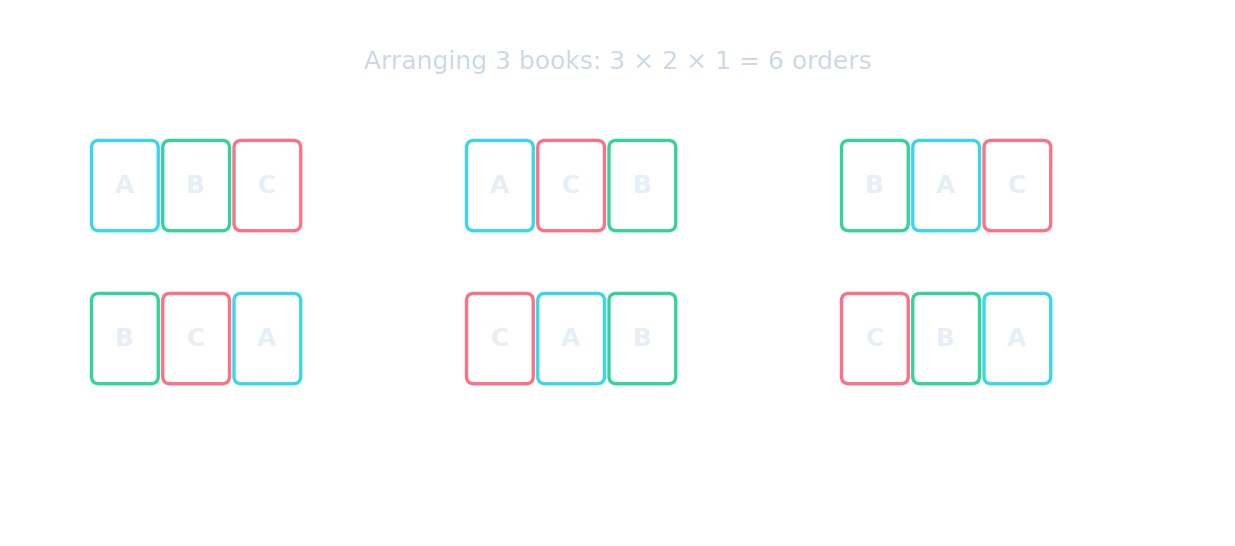
排列:3 本书有 3 × 2 × 1 = 6 种不同的顺序
In a combination, the order of the chosen items: · 在组合中,所选项目的顺序:
Combinations ignore order; permutations count order. · 组合忽略顺序;排列计算顺序。
How many ways to arrange 3 books from 10 on a shelf (¹⁰P₃)? · 从 3 本书中选取 10 本在书架上排列,共有多少种排法?(¹⁰P₃)?
¹⁰P₃ = 10!/(10-3)! = 10!/7! = 10 × 9 × 8 = 720.
Combinations (order doesn't matter)
- A combination is a selection where order doesn't matter: ${}^nC_r = \dbinom{n}{r} = \dfrac{n!}{r!\,(n-r)!}$.
- Example: choosing 3 books from 10: ${}^{10}C_3 = \dfrac{10!}{3!\,7!} = \dfrac{720}{6} = 120$.
Permutation vs combination. Choosing a committee of 3 from 10 people is a combination (order doesn't matter). Choosing a president, vice-president, and secretary from 10 is a permutation (order matters — the roles are different).
Order matters for a permutation, but not for a combination
组合(顺序不重要)
- 一个组合是一个顺序不重要的选择:${}^nC_r = \dbinom{n}{r} = \dfrac{n!}{r!\,(n-r)!}$。
- 例子:从 10 本书中选 3 本:${}^{10}C_3 = \dfrac{10!}{3!\,7!} = \dfrac{720}{6} = 120$。
排列对组合。 从 10 个人中选一个 3 人委员会是一个组合(顺序不重要)。从 10 个人中选一个主席、副主席和秘书是一个排列(顺序重要——角色不同)。
How many ways are there to choose 2 from 5 (⁵C₂)? · 有多少种选择方法 2 来自 5 (⁵C₂)?
⁵C₂ = 5!/(2!3!) = 120/(2×6) = 10.
⁵P₃ is greater than ⁵C₃. · ⁵P₃ 大于 ⁵C₃。
⁵P₃ = 60 (order matters), ⁵C₃ = 10 (order doesn't). Permutations always ≥ combinations. · ⁵P₃ = 60(顺序重要),⁵C₃ = 10(顺序不重要)。排列数总是 ≥ 组合数。
Arrangements with repeats
- To arrange a word with repeated letters, divide by the factorial 阶乘 of each repeat count.
- Example: NEEDLESS has 8 letters with 3 E's and 2 S's: arrangements $= \dfrac{8!}{3!\,2!} = \dfrac{40320}{12} = 3360$.
有重复的排列
- 要排列一个有重复字母的词,除以每个重复计数的阶乘。
- 例子:NEEDLESS 有 8 个字母,3 个 E 和 2 个 S:排列数 $= \dfrac{8!}{3!\,2!} = \dfrac{40320}{12} = 3360$。
How many arrangements of the letters of NEEDLESS? (8 letters: E×3, S×2 → 8!/(3!2!)) · NEEDLESS 字母的排列有多少种?(8 个字母:E×3, S×2 → 8!/(3!2!))
8!/(3!2!) = 40320/(6×2) = 40320/12 = 3360.
The multiplication principle 乘法原理
- If one choice can be made in $m$ ways and another in $n$ ways, both together can be made in $m \times n$ ways.
- Example: 3 shirts and 4 trousers → $3 \times 4 = 12$ outfits.
乘法原理
- 如果一个选择能以 $m$ 种方式做、另一个能以 $n$ 种方式做,两个一起能以 $m \times n$ 种方式做。
- 例子:3 件衬衫和 4 条裤子 → $3 \times 4 = 12$ 套衣服。
You have 3 shirts and 4 trousers. How many outfits can you make? · 你有 3 件衬衫和 4 条裤子。可以搭配出多少套服装?
3 × 4 = 12 outfits (multiplication principle). · 3 × 4 = 12 套(乘法原理)。
You've got it
- permutation (order matters): ${}^nP_r = \dfrac{n!}{(n-r)!}$
- combination (order doesn't): ${}^nC_r = \dfrac{n!}{r!(n-r)!}$
- repeated letters: divide $n!$ by each repeat's factorial (NEEDLESS → $\dfrac{8!}{3!\,2!}$)
你掌握了
- 排列(顺序重要):${}^nP_r = \dfrac{n!}{(n-r)!}$
- 组合(顺序不重要):${}^nC_r = \dfrac{n!}{r!(n-r)!}$
- 重复的字母:把 $n!$ 除以每个重复的阶乘(NEEDLESS → $\dfrac{8!}{3!\,2!}$)