Vectors · 向量
| English | 中文 | Pinyin · 拼音 |
|---|---|---|
| vector/ˈvektə/ | 向量 | xiàng liàng |
| magnitude/ˈmæɡnɪtjuːd/ | 模长 | mó zhǎng |
| unit vector/ˈjuːnɪt ˈvektə/ | 单位向量 | dān wèi xiàng liàng |
| parallel/ˈpærəlel/ | 平行 | píng xíng |
| intersect/ˌɪntəˈsekt/ | 相交 | xiāng jiāo |
| skew/skjuː/ | 异面 | yì miàn |
| perpendicular/ˌpɜːpənˈdɪkjʊlə/ | 垂直 | chuí zhí |
| scalar product/ˈskeɪlə ˈprɒdʌkt/ | 数量积 | shù liàng jī |
Navigating in 3D
- GPS satellites track your position in three dimensions. Aircraft navigate using heading, pitch, and roll.
- Vectors 向量 are the mathematics of direction and magnitude 模长 in space — essential for physics, engineering, and computer graphics.
在 3D 中导航
- GPS 卫星在三个维度上跟踪你的位置。飞机用航向、俯仰和滚转导航。
- 向量(vectors)是空间中方向和大小的数学——对物理、工程和计算机图形必不可少。
Vectors in 3D
- A vector has size and direction: $\mathbf{v} = x\mathbf{i} + y\mathbf{j} + z\mathbf{k}$.
- Magnitude $|\mathbf{v}| = \sqrt{x^2 + y^2 + z^2}$; a unit vector 单位向量 has magnitude 1.
Worked example. $\mathbf{v} = 3\mathbf{i} + 4\mathbf{j}$. Magnitude $= \sqrt{9 + 16} = 5$. Unit vector $= \dfrac{1}{5}(3\mathbf{i} + 4\mathbf{j})$.
Forces like wind and water are vectors, with size and direction
3D 中的向量
- 一个向量有大小和方向:$\mathbf{v} = x\mathbf{i} + y\mathbf{j} + z\mathbf{k}$。
- 模(magnitude)$|\mathbf{v}| = \sqrt{x^2 + y^2 + z^2}$;一个单位向量(unit vector)的模是 1。
算例。 $\mathbf{v} = 3\mathbf{i} + 4\mathbf{j}$。模 $= \sqrt{9 + 16} = 5$。单位向量 $= \dfrac{1}{5}(3\mathbf{i} + 4\mathbf{j})$。

像风和水这样的力是向量,有大小和方向
What is the magnitude of the vector i + 2j + 2k? · 向量 i + 2j + 2k 的模是多少?
|v| = √(1² + 2² + 2²) = √(1+4+4) = √9 = 3. · |v| = √(1² + 2² + 2²) = √(1+4+4) = √9 = 3。
Vector equations of lines
- A line through point $\mathbf{a}$ in direction $\mathbf{b}$: $\mathbf{r} = \mathbf{a} + t\mathbf{b}$.
- Lines may be parallel 平行 (same direction), intersect 相交 (share a point), or be skew 异面 (neither).
Skew lines don't intersect and aren't parallel. In 3D, two lines can miss each other entirely — they're not in the same plane. This is impossible in 2D.
直线的向量方程
- 过点 $\mathbf{a}$、方向 $\mathbf{b}$ 的一条线:$\mathbf{r} = \mathbf{a} + t\mathbf{b}$。
- 线可能平行(同方向)、相交(共享一个点),或异面(skew,两者都不)。
异面线不相交也不平行。 在 3D 中,两条线能完全错过彼此——它们不在同一个平面里。这在 2D 中不可能。
The scalar product · 数量积
a · b = |a||b|cos θ
The dot product measures how much two vectors point the same way — it's zero · 零 when they're perpendicular. · 点积测量两个向量指向同一方向的程度——当它们垂直时它是零。
The vector equation of a line through point a in direction b is: · 过点 a、方向 b 的一条线的向量方程是:
r = a + tb, where t is a scalar parameter. · r = a + tb,其中 t 是一个标量参数。
In 3D, two lines that don't intersect must be parallel. · 在 3D 中,两条不相交的线必定平行。
In 3D, lines can be skew — neither parallel nor intersecting. This is impossible in 2D. · 在 3D 中,线能是异面的——既不平行也不相交。这在 2D 中不可能。
The scalar (dot) product
- So $\mathbf{a}\cdot\mathbf{b} = 0$ means the vectors are perpendicular 垂直.
- Use it to find the angle between two vectors: $\cos\theta = \dfrac{\mathbf{a}\cdot\mathbf{b}}{|\mathbf{a}||\mathbf{b}|}$.
The scalar product 数量积 gives the angle: a·b = |a||b|cos θ, so cos θ = (a·b)/(|a||b|).
数量(点)积
- 所以 $\mathbf{a}\cdot\mathbf{b} = 0$ 意味着向量垂直。
- 用它找两个向量之间的角:$\cos\theta = \dfrac{\mathbf{a}\cdot\mathbf{b}}{|\mathbf{a}||\mathbf{b}|}$。
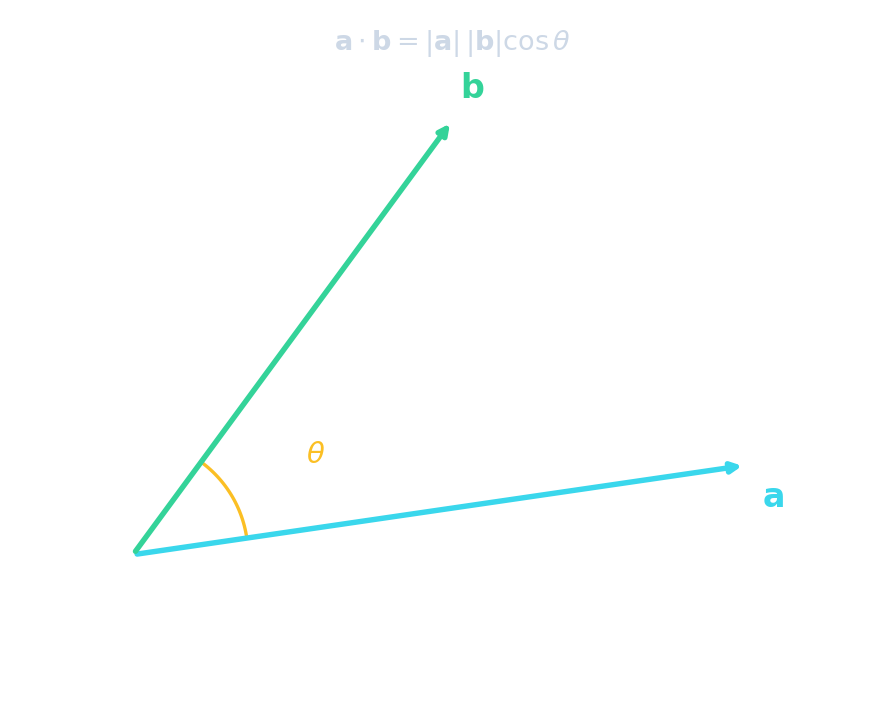
数量积给出角:a·b = |a||b|cos θ,所以 cos θ = (a·b)/(|a||b|)。
Find the scalar product (i + 2j + 2k)·(2i + 2j + k). · 求数量积 (i + 2j + 2k)·(2i + 2j + k)。
(1)(2) + (2)(2) + (2)(1) = 2 + 4 + 2 = 8. · (1)(2) + (2)(2) + (2)(1) = 2 + 4 + 2 = 8。
If a·b = 0, the two vectors are perpendicular. · 如果 a·b = 0,这两个向量垂直。
cos θ = 0 gives θ = 90°, so a zero dot product means the vectors are perpendicular. · cos θ = 0 给出 θ = 90°,所以一个零的点积意味着向量垂直。
If a·b = 6, |a| = 3, |b| = 4, what is cos θ? · 如果 a·b = 6,|a| = 3,|b| = 4,cos θ 是多少?
cos θ = (a·b)/(|a||b|) = 6/(3×4) = 6/12 = 0.5. · cos θ = (a·b)/(|a||b|) = 6/(3×4) = 6/12 = 0.5。
Worked example — angle between vectors
- $\mathbf{a} = \mathbf{i} + 2\mathbf{j} + 2\mathbf{k}$, $\mathbf{b} = 2\mathbf{i} + \mathbf{j} - 2\mathbf{k}$.
- $\mathbf{a}\cdot\mathbf{b} = 2 + 2 - 4 = 0$. So $\mathbf{a}$ and $\mathbf{b}$ are perpendicular ($\theta = 90^{\circ}$).
allow_no_figure: Vectors are inherently 3D and difficult to represent clearly in a 2D static diagram — the algebraic notation and worked examples convey the concepts effectively.
- Use position vectors and displacement vectors, and unit vectors; the ratio theorem divides a line in a given ratio.
算例——向量之间的角
- $\mathbf{a} = \mathbf{i} + 2\mathbf{j} + 2\mathbf{k}$, $\mathbf{b} = 2\mathbf{i} + \mathbf{j} - 2\mathbf{k}$.
- $\mathbf{a}\cdot\mathbf{b} = 2 + 2 - 4 = 0$。所以 $\mathbf{a}$ 和 $\mathbf{b}$ 垂直($\theta = 90^{\circ}$)。
allow_no_figure: 向量本质上是3维的,难以在2维静态图中清晰表示——代数符号和例题能有效地传达这些概念。
- 使用位置向量(position vectors)、位移向量(displacement vectors)和单位向量(unit vectors);比例定理(ratio theorem)按给定比例分线段。
You've got it
- magnitude $|\mathbf{v}| = \sqrt{x^2+y^2+z^2}$; line: $\mathbf{r} = \mathbf{a} + t\mathbf{b}$
- scalar product $\mathbf{a}\cdot\mathbf{b} = a_1b_1 + a_2b_2 + a_3b_3 = |\mathbf a||\mathbf b|\cos\theta$
- $\mathbf{a}\cdot\mathbf{b} = 0$ → perpendicular
你掌握了
- 模 $|\mathbf{v}| = \sqrt{x^2+y^2+z^2}$;直线:$\mathbf{r} = \mathbf{a} + t\mathbf{b}$
- 数量积 $\mathbf{a}\cdot\mathbf{b} = a_1b_1 + a_2b_2 + a_3b_3 = |\mathbf a||\mathbf b|\cos\theta$
- $\mathbf{a}\cdot\mathbf{b} = 0$ → 垂直