Numerical solution of equations · 方程的数值解
| English | 中文 | Pinyin · 拼音 |
|---|---|---|
| root/ruːt/ | 根 | gēn |
| numerical method/njuːˈmerɪkl ˈmeθəd/ | 数值方法 | shù zhí fāng fǎ |
| accuracy/ˈækjʊrəsi/ | 精度 | jīng dù |
| sign change/saɪn tʃeɪndʒ/ | 变号 | biàn hào |
| iteration/ˌɪtəˈreɪʃn/ | 迭代 | dié dài |
| converge/kənˈvɜːdʒ/ | 收敛 | shōu liǎn |
| iterative formula/ˈɪtərətɪv ˈfɔːmjʊlə/ | 迭代公式 | dié dài gōng shì |
| rearrangement/ˌriːəˈreɪndʒmənt/ | 重新排列 | chóng xīn pái liè |
| diverge/daɪˈvɜːdʒ/ | 发散 | fā sàn |
The root 根 you can't see
- Some equations have no neat algebraic solution. $x^3 + x - 1 = 0$ can't be factorised.
- But you know a root exists between $0$ and $1$ because the function changes sign. Numerical methods 数值方法 let you find it to any accuracy 精度.
你看不见的根
- 一些方程没有简洁的代数解。$x^3 + x - 1 = 0$ 不能被因式分解。
- 但你知道在 $0$ 和 $1$ 之间存在一个根,因为函数改变符号。数值方法让你把它找到任何精度。
Locating a root
- Many equations can't be solved exactly. A root is a solution.
- Sign change 变号: if $f(a)$ and $f(b)$ have opposite signs (and no break between them), a root lies between $a$ and $b$.
Worked example. $f(x) = x^3 + x - 1$. $f(0) = -1$ (negative), $f(1) = 1$ (positive). Sign change → root between $0$ and $1$.
Sign change doesn't guarantee exactly one root. There could be 3 roots (or any odd number) between $a$ and $b$. The sign change only tells you there's at least one.
Iteration 迭代: step up to the curve and across to y = x; the steps converge 收敛 to a root
定位一个根
- 许多方程不能被精确求解。一个根(root)是一个解。
- 符号改变(sign change):如果 $f(a)$ 和 $f(b)$ 有相反的符号(且它们之间没有断裂),一个根位于 $a$ 和 $b$ 之间。
算例。 $f(x) = x^3 + x - 1$。$f(0) = -1$(负),$f(1) = 1$(正)。符号改变 → 根在 $0$ 和 $1$ 之间。
符号改变不保证恰好一个根。 在 $a$ 和 $b$ 之间可能有 3 个根(或任何奇数个)。符号改变只告诉你至少有一个。
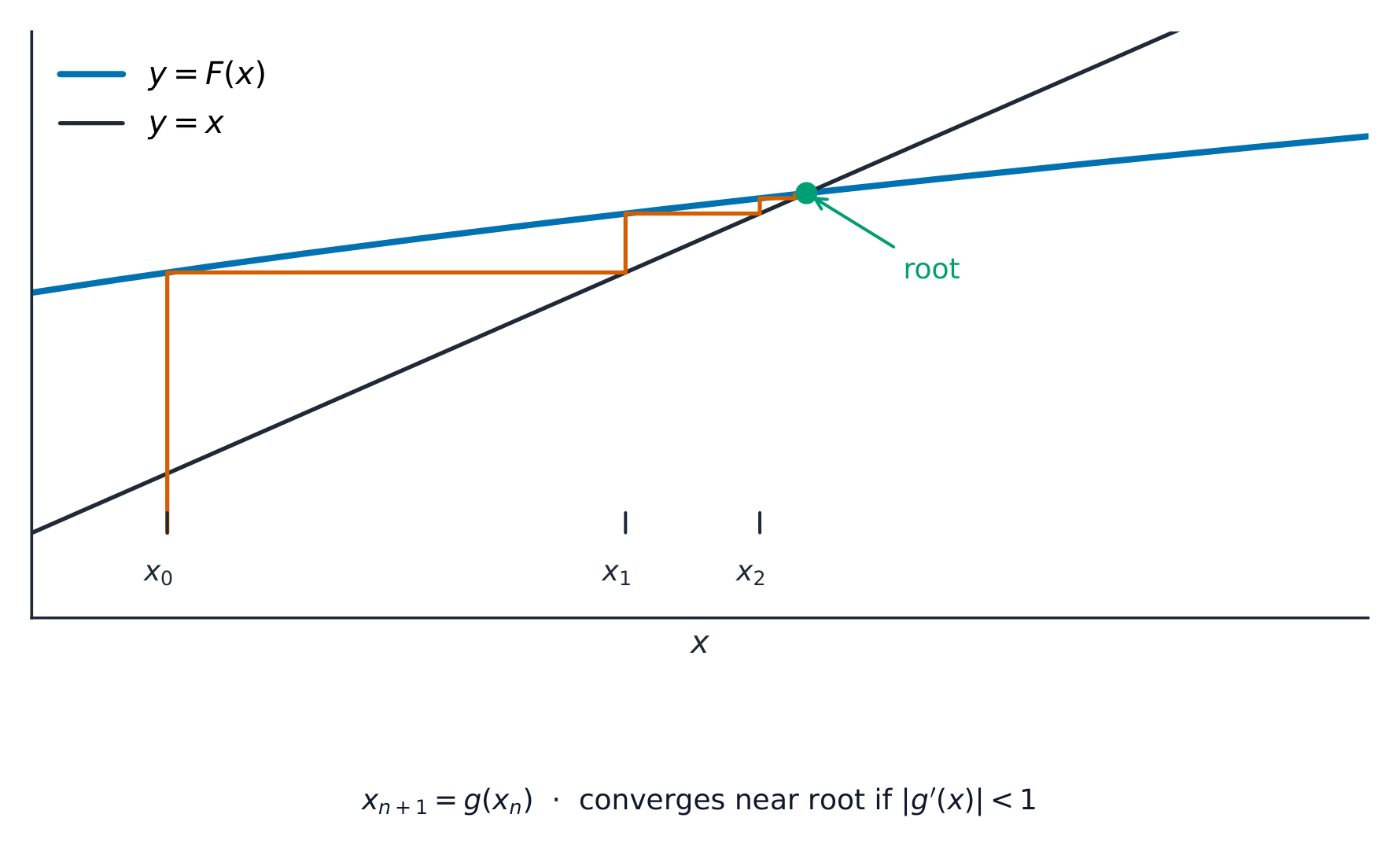
迭代:向上走到曲线,再横向走到 y = x;这些步收敛到一个根
Where is the root? · 根在哪里?
y = ax³ + bx² + cx + d
A root is where the curve crosses zero. A sign change in f(x) traps a root between two x-values. · 一个根是曲线穿过零的地方。f(x) 的一个符号改变把一个根困在两个 x 值之间。
If f(a) and f(b) have opposite signs (and f is continuous between them), then between a and b there is: · 如果 f(a) 和 f(b) 有相反的符号(且 f 在它们之间连续),那么在 a 和 b 之间有:
A sign change of a continuous function guarantees a root between a and b. · 一个连续函数的符号改变保证在 a 和 b 之间有一个根。
f(x) = x³ + x − 1. f(0) = −1 and f(1) = 1. Between which two integers is the root? · f(x) = x³ + x − 1。f(0) = −1 而 f(1) = 1。根在哪两个整数之间?
Sign change between 0 and 1 (f(0) < 0, f(1) > 0), so root is between 0 and 1. · 在 0 和 1 之间符号改变(f(0) < 0, f(1) > 0),因此根位于 0 和 1 之间。
Iteration
- Rearrange the equation into the form $x = F(x)$.
- Use the iterative formula 迭代公式 $x_{n+1} = F(x_n)$ from a first guess $x_0$.
- If the values settle, they converge to a root. Keep going until steady to the asked accuracy.
Iteration: starting from $x_0$, each step applies $F$ and reflects in $y = x$. The cobweb spirals into the fixed point — the root.
迭代
- 把方程重排成 $x = F(x)$ 的形式。
- 从一个初始猜测 $x_0$ 用迭代公式(iterative formula)$x_{n+1} = F(x_n)$。
- 如果这些值稳定下来,它们收敛(converge)到一个根。继续直到达到要求的精度。
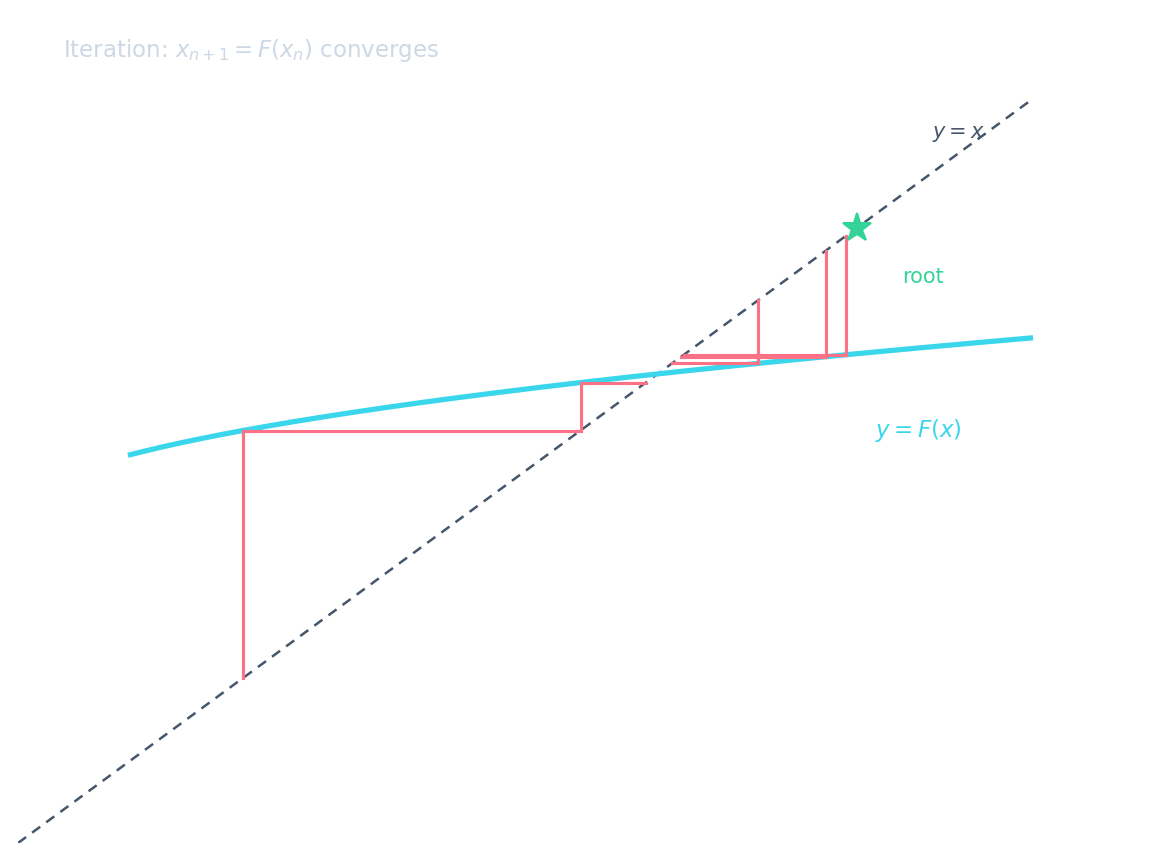
迭代:从 $x_0$ 开始,每一步应用 $F$ 并在 $y = x$ 中反射。蛛网螺旋进入不动点——根。
An iterative formula has the form: · 一个迭代公式有这个形式:
Iteration repeatedly applies x_{n+1} = F(x_n) from a first guess. · 迭代从一个初始猜测反复应用 x_{n+1} = F(x_n)。
If the iteration values settle down to a steady number, they have converged to a root. · 如果迭代的值稳定到一个固定的数,它们已经收敛到一个根。
Convergence means the sequence approaches a fixed value — a root of the equation. · 收敛意味着序列接近一个固定的值——方程的一个根。
Using x_{n+1} = ∛(1 − x_n) with x₀ = 0, what is x₁ (2 dp)? · 用 x_{n+1} = ∛(1 − x_n),x₀ = 0,x₁ 是多少(2 位小数)?
x₁ = ∛(1 − 0) = ∛1 = 1.
Worked example — iteration
- Solve $x^3 + x - 1 = 0$ using $x_{n+1} = \sqrt[3]{1 - x_n}$, starting from $x_0 = 0.5$.
- $x_1 = \sqrt[3]{0.5} = 0.794$, $x_2 = \sqrt[3]{0.206} = 0.591$, $x_3 = \sqrt[3]{0.409} = 0.742$, ...
- The values converge to $x \approx 0.682$.
算例——迭代
- 用 $x_{n+1} = \sqrt[3]{1 - x_n}$ 解 $x^3 + x - 1 = 0$,从 $x_0 = 0.5$ 开始。
- $x_1 = \sqrt[3]{0.5} = 0.794$,$x_2 = \sqrt[3]{0.206} = 0.591$,$x_3 = \sqrt[3]{0.409} = 0.742$,……
- 这些值收敛到 $x \approx 0.682$。
An iteration x_{n+1} = F(x_n) always converges regardless of the starting value. · 一个迭代 x_{n+1} = F(x_n) 无论起始值如何总是收敛。
Convergence requires |F′(x)| < 1 near the root. Poor rearrangements or starting values can diverge. · 收敛要求在根附近 |F′(x)| < 1。差的重排或起始值可能发散。
Choosing a rearrangement 重新排列
- Not all rearrangements converge. The iteration $x_{n+1} = F(x_n)$ converges when $|F'(x)| < 1$ near the root.
- If it diverges 发散 (values move away), try a different rearrangement.
选择一种重排
- 不是所有的重排都收敛。迭代 $x_{n+1} = F(x_n)$ 在根附近 $|F'(x)| < 1$ 时收敛。
- 如果它发散(值移开),试一种不同的重排。
You've got it
- a sign change of $f$ between $a$ and $b$ traps a root in between
- iteration: $x_{n+1} = F(x_n)$ from a starting guess
- if the values converge (settle), they approach a root
- convergence requires $|F'(x)| < 1$ near the root
你掌握了
- $f$ 在 $a$ 和 $b$ 之间的一个符号改变把一个根困在中间
- 迭代:从一个起始猜测 $x_{n+1} = F(x_n)$
- 如果这些值收敛(稳定),它们接近一个根
- 收敛要求在根附近 $|F'(x)| < 1$