| English | 释义 | 拼音 |
|---|---|---|
| R-formula/ɑː ˈfɔːmjʊlə/ | 辅助角公式 | fǔ zhù jiǎo gōng shì |
| reciprocal functions/rɪˈsɪprəkl ˈfʌŋkʃnz/ | 倒数函数 | dào shǔ hán shù |
| double angle/ˈdʌbl ˈæŋɡl/ | 二倍角 | èr bèi jiǎo |
Combining waves
- Two sound waves, or two alternating currents, add to give a single new wave. In maths, $3\sin\theta+4\cos\theta$ is really one sine wave, $5\sin(\theta+53.1^\circ)$.
- Pure 2 trigonometry gives you the tools to see this: the reciprocal functions, two new identities, the compound-angle and double-angle formulae, and the R-formula 辅助角公式.
- The exam's favourite question is "express in the form $R\cos(\theta+\alpha)$, hence solve…". It is worked in full below.
Reciprocal functions 倒数函数
- $\sec\theta=\dfrac1{\cos\theta}$, $\ \operatorname{cosec}\theta=\dfrac1{\sin\theta}$, $\ \cot\theta=\dfrac1{\tan\theta}=\dfrac{\cos\theta}{\sin\theta}$.
- Each one is undefined where its denominator is zero, so its graph has vertical asymptotes there. For example, $\sec\theta$ has asymptotes at $\theta=90^\circ, 270^\circ, \dots$
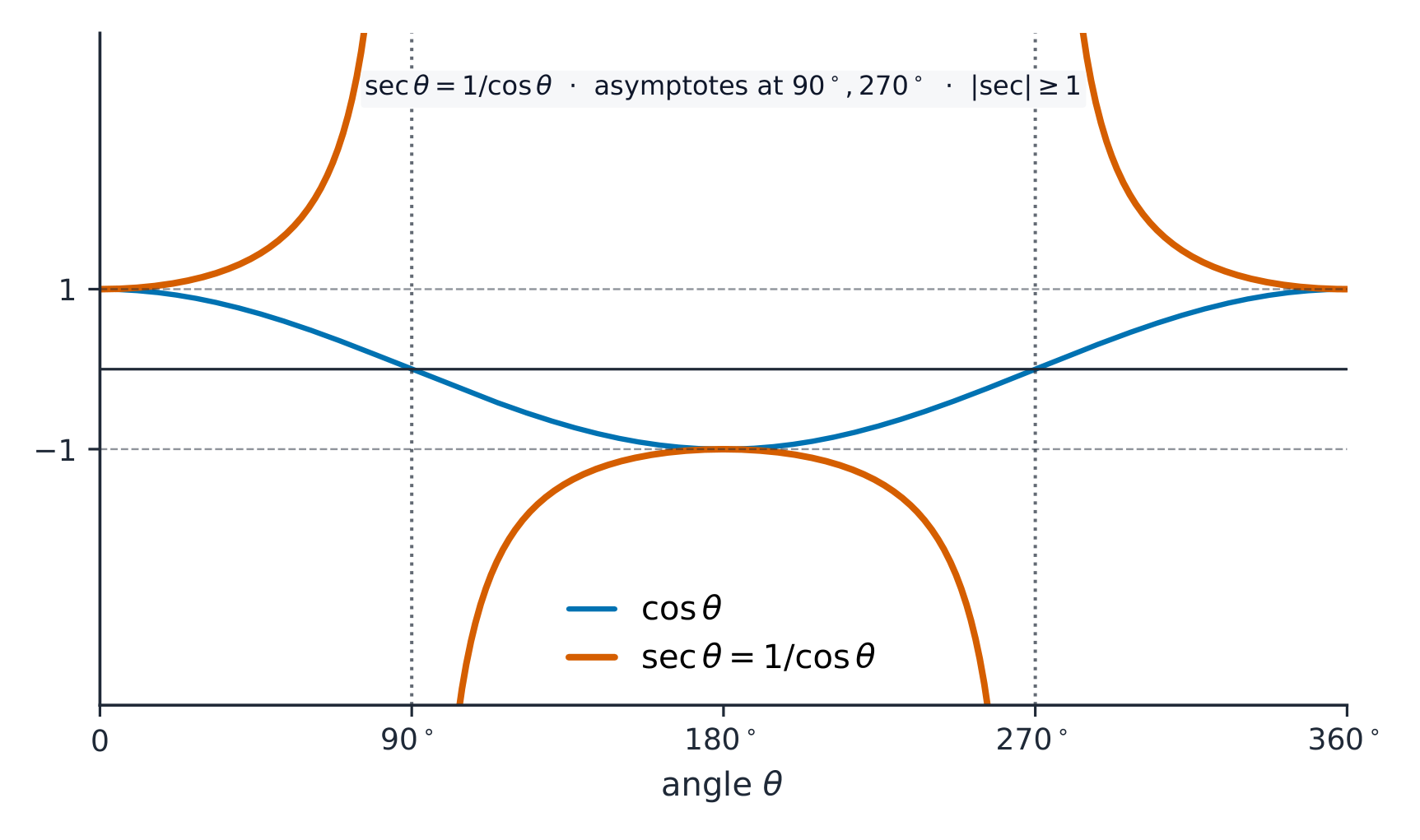
$\theta$ is acute and $\cos\theta=\dfrac35$. A 3-4-5 triangle gives $\sin\theta=\dfrac45$ and $\tan\theta=\dfrac43$. So $\sec\theta=\dfrac53$, $\operatorname{cosec}\theta=\dfrac54$ and $\cot\theta=\dfrac34$.
单位圆
(cos θ, sin θ)
Every trig 身份认同 comes from this circle — watch how sin θ and cos θ relate as θ turns.
The secant function sec θ is equal to:
难度 1/5 · 今日首次完成可获 100 金币及少量额外奖励
sec θ = 1/cos θ; csc θ = 1/sin θ; cot θ = 1/tan θ.
θ is acute and cos θ = 5/13. Find sec θ, cosec θ and cot θ.
1 divided by 5/13 is 13/5.
Two new identities
- Divide $\sin^2\theta+\cos^2\theta\equiv1$ by $\cos^2\theta$, and then by $\sin^2\theta$:
- Use: they turn an equation with two functions into a quadratic in one function.
Solve $2\sec^2\theta-3\tan\theta=3$ for $0^\circ\le\theta\le180^\circ$.
- Replace $\sec^2\theta$: $2(1+\tan^2\theta)-3\tan\theta-3=0$, so $2\tan^2\theta-3\tan\theta-1=0$.
- Quadratic formula: $\tan\theta=\dfrac{3\pm\sqrt{17}}{4}$, so $\tan\theta=1.781$ or $-0.2808$.
- $\theta=60.7^\circ$, or $\theta=180^\circ-15.7^\circ=164.3^\circ$.
The identity sec²θ ≡ 1 + tan²θ. If tan θ = 2, what is sec²θ?
难度 2/5 · 今日首次完成可获 140 金币及少量额外奖励
sec²θ = 1 + tan²θ = 1 + 2² = 1 + 4 = 5.
sec²θ ≡ 1 − tan²θ.
难度 1/5 · 今日首次完成可获 100 金币及少量额外奖励
The correct identity is sec²θ ≡ 1 + tan²θ (plus, not minus).
Compound-angle formulae
- Watch the signs in cos: $\cos(A+B)$ has a minus in the middle.
- Use: exact values, for example $\sin75^\circ=\sin(45^\circ+30^\circ)$:
Which is the correct expansion of cos(A + B)?
难度 1/5 · 今日首次完成可获 100 金币及少量额外奖励
cos(A + B) has a minus in the middle; cos(A − B) has a plus.
Double-angle formulae 二倍角
- Put $B=A$ in the compound-angle formulae:
- Choose the form of $\cos2A$ that matches the rest of the equation, so you get one function only.
Solve $\cos2\theta=\sin\theta$ for $0^\circ\le\theta<360^\circ$.
- Use $\cos2\theta=1-2\sin^2\theta$: $2\sin^2\theta+\sin\theta-1=0$, so $(2\sin\theta-1)(\sin\theta+1)=0$.
- $\sin\theta=\tfrac12$ gives $\theta=30^\circ,150^\circ$; $\sin\theta=-1$ gives $\theta=270^\circ$.
Using the double angle formula, sin 60° = 2 sin 30° cos 30°. Evaluate (2 dp).
难度 2/5 · 今日首次完成可获 140 金币及少量额外奖励
2 × 0.5 × (√3/2) = √3/2 ≈ 0.87.
Solve cos 2θ = cos θ for 0° ≤ θ < 360°. Select all solutions.
难度 2/5 · 今日首次完成可获 140 金币及少量额外奖励
2cos²θ − 1 = cos θ gives (2cos θ + 1)(cos θ − 1) = 0, so cos θ = 1 (θ = 0°) or cos θ = −1/2 (θ = 120°, 240°).
The R-formula
- $a\sin\theta+b\cos\theta$ can be written as $R\sin(\theta+\alpha)$, and $a\cos\theta+b\sin\theta$ as $R\cos(\theta-\alpha)$, with $R=\sqrt{a^2+b^2}$.
- Method: expand the target form with the compound-angle formula, then compare coefficients of $\sin\theta$ and $\cos\theta$.
Express $3\sin\theta+4\cos\theta$ in the form $R\sin(\theta+\alpha)$.
- $R\sin(\theta+\alpha)=R\sin\theta\cos\alpha+R\cos\theta\sin\alpha$, so $R\cos\alpha=3$ and $R\sin\alpha=4$.
- Square and add: $R^2=9+16$, so $R=5$. Divide: $\tan\alpha=\dfrac43$, so $\alpha=53.13^\circ$.
- Result: $5\sin(\theta+53.13^\circ)$. Its maximum is 5, when $\theta+53.13^\circ=90^\circ$, at $\theta=36.87^\circ$.
For 3 sin θ + 4 cos θ = R sin(θ + α), what is R?
难度 2/5 · 今日首次完成可获 140 金币及少量额外奖励
R = √(a² + b²) = √(3² + 4²) = √25 = 5.
The maximum value of 5 sin θ + 12 cos θ is:
难度 2/5 · 今日首次完成可获 140 金币及少量额外奖励
R = √(5² + 12²) = √(25 + 144) = √169 = 13. Maximum value = R.
7 sin θ + 24 cos θ = R sin(θ + α). Find R.
难度 2/5 · 今日首次完成可获 140 金币及少量额外奖励
R = √(7² + 24²) = √625 = 25.
Worked exam question: express, hence solve
Question (6 marks). (a) Express $5\cos\theta-12\sin\theta$ in the form $R\cos(\theta+\alpha)$, where $R>0$ and $0^\circ<\alpha<90^\circ$. (b) Hence solve $5\cos\theta-12\sin\theta=6$ for $0^\circ<\theta<360^\circ$.
- (a) $R\cos(\theta+\alpha)=R\cos\theta\cos\alpha-R\sin\theta\sin\alpha$, so $R\cos\alpha=5$ and $R\sin\alpha=12$. Then $R=13$ (B1), and $\tan\alpha=\dfrac{12}{5}$ gives $\alpha=67.38^\circ$ (M1 A1).
- (b) $13\cos(\theta+67.38^\circ)=6$, so $\cos(\theta+67.38^\circ)=\dfrac{6}{13}$ and the basic angle is $62.51^\circ$ (M1).
- Shift the range: $\theta+67.38^\circ$ lies between $67.38^\circ$ and $427.38^\circ$. In that range, $\cos x=\dfrac6{13}$ at $x=297.49^\circ$ and $x=422.51^\circ$.
- Answers: $\theta=230.1^\circ$ and $\theta=355.1^\circ$ (A1 A1).
Why answers lose marks: using $62.51^\circ$ itself (it is outside the shifted range), or giving $\alpha$ from $\tan\alpha=\dfrac5{12}$ (coefficients swapped).
(a) Express 3 cos θ + 4 sin θ in the form R cos(θ − α), 0° < α < 90°. (b) Hence solve 3 cos θ + 4 sin θ = 2 for 0° < θ < 360°.
Same method as the worked question: expand, compare, then shift the range.
You've got it
- $\sec=\dfrac1{\cos}$, $\operatorname{cosec}=\dfrac1{\sin}$, $\cot=\dfrac1{\tan}$; asymptotes where the denominator is 0
- $\sec^2\theta\equiv1+\tan^2\theta$, $\operatorname{cosec}^2\theta\equiv1+\cot^2\theta$: turn equations into quadratics
- $\sin(A\pm B)$, $\cos(A\pm B)$ (sign swaps), $\tan(A\pm B)$; double angles from $B=A$; pick the right form of $\cos2A$
- R-formula: expand, compare coefficients, $R=\sqrt{a^2+b^2}$, $\tan\alpha=\dfrac{R\sin\alpha}{R\cos\alpha}$ from your two equations
- "hence solve": shift the range by $\alpha$ before finding all angles
θ is acute and cos θ = 5/13. What is sec θ?
难度 1/5 · 今日首次完成可获 100 金币及少量额外奖励
The reciprocal of 5/13 is 13/5. Other options — 5/3 (the lesson secant for cosine 3/5); 5/13 (the cosine left unchanged).