Differentiation · 微分
| English | 中文 | Pinyin · 拼音 |
|---|---|---|
| differentiation/ˌdɪfəˌrenʃɪˈeɪʃn/ | 微分 | wēi fēn |
| power rule/ˈpaʊə ruːl/ | 幂法则 | mì fǎ zé |
| chain rule/tʃeɪn ruːl/ | 链式法则 | liàn shì fǎ zé |
| derivative/dɪˈrɪvətɪv/ | 导数 | dǎo shù |
| stationary point/ˈsteɪʃənəri pɔɪnt/ | 驻点 | zhù diǎn |
| second derivative/ˈsekənd dɪˈrɪvətɪv/ | 二阶导数 | èr jiē dǎo shù |
| optimisation/ˌɒptɪmaɪˈzeɪʃn/ | 最优化 | zuì yōu huà |
The speed of change
- How fast is a rocket accelerating at the exact moment its fuel runs out? How steep is a roller coaster at its highest point?
- Differentiation 微分 answers these questions — it finds the instantaneous rate of change at any point on a curve.
变化的速度
- 一枚火箭在它的燃料用完的确切时刻加速有多快?一个过山车在它的最高点有多陡?
- 微分(differentiation)回答这些问题——它找到一条曲线上任何点的瞬时变化率。
The power rule 幂法则 and chain rule 链式法则
- Differentiation finds the gradient of a curve at each point — the derivative 导数 $f'(x)$ or $\dfrac{dy}{dx}$.
- The power rule: $\dfrac{d}{dx}(x^n) = n x^{n-1}$ (any rational $n$).
- Chain rule for a function inside a function: $\dfrac{d}{dx}f(g(x)) = f'(g(x))\cdot g'(x)$.
The derivative $\dfrac{dy}{dx} = 2x$ gives the gradient at any point: at $x = 2$, the gradient is $4$.
Worked example. $y = (3x+1)^4$. Let $u = 3x+1$, so $y = u^4$. Chain rule: $\dfrac{dy}{dx} = 4u^3 \cdot 3 = 12(3x+1)^3$.
幂法则与链式法则
- 微分找到一条曲线在每个点的斜率——导数(derivative)$f'(x)$ 或 $\dfrac{dy}{dx}$。
- 幂法则(power rule):$\dfrac{d}{dx}(x^n) = n x^{n-1}$(任何有理数 $n$)。
- 链式法则(chain rule)用于函数内的函数:$\dfrac{d}{dx}f(g(x)) = f'(g(x))\cdot g'(x)$。
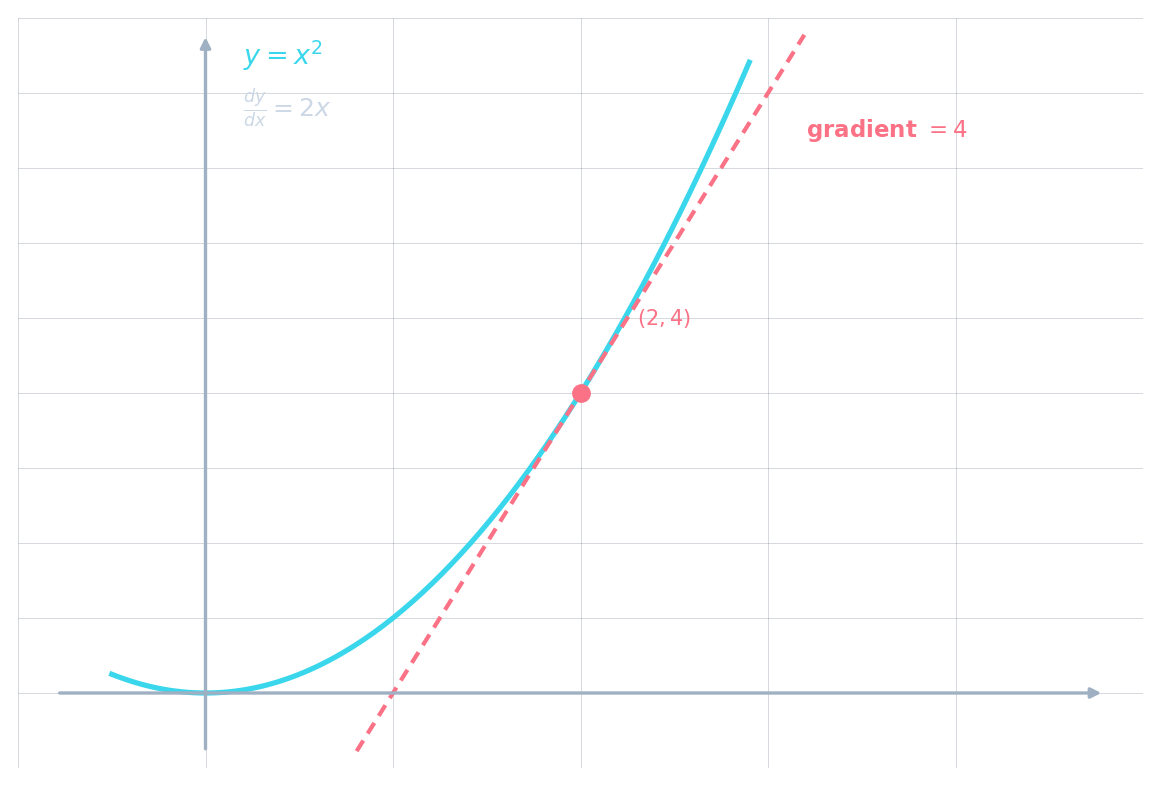
导数 $\dfrac{dy}{dx} = 2x$ 给出任何点的斜率:在 $x = 2$,斜率是 $4$。
算例。 $y = (3x+1)^4$。设 $u = 3x+1$,所以 $y = u^4$。链式法则:$\dfrac{dy}{dx} = 4u^3 \cdot 3 = 12(3x+1)^3$。
The gradient at a point · 一个点处的斜率
gradient = dy/dx = f ′(x)
Slide the point along the curve — the tangent · 相切's slope IS the gradient f ′(x) there. · 沿曲线滑动这个点——切线的斜率就是那里的斜率 f ′(x)。
If y = x³, then dy/dx = 3x². What is the gradient at x = 2? · 如果 y = x³,那么 dy/dx = 3x²。在 x = 2 处的斜率是多少?
dy/dx = 3x² = 3 × 2² = 3 × 4 = 12. · dy/dx = 3x² = 3 × 2² = 3 × 4 = 12。
If y = (2x + 1)³, then dy/dx = 6(2x + 1)². What is dy/dx at x = 1? · 如果 y = (2x + 1)³,那么 dy/dx = 6(2x + 1)²。在 x = 1 处 dy/dx 是多少?
At x = 1: dy/dx = 6(2(1) + 1)² = 6(3)² = 6 × 9 = 54. · 在 x = 1:dy/dx = 6(2(1) + 1)² = 6(3)² = 6 × 9 = 54。
Stationary points 驻点
- A stationary point is where $\dfrac{dy}{dx} = 0$ (the tangent is flat).
- Test with the second derivative 二阶导数:
- $f''(x) > 0$ → minimum,
- $f''(x) < 0$ → maximum.
- Also: $\dfrac{dy}{dx} > 0$ → increasing; $< 0$ → decreasing.
Don't forget the chain rule. When differentiating $(ax+b)^n$, you must multiply by the derivative of the inside: $\dfrac{d}{dx}(ax+b)^n = an(ax+b)^{n-1}$, not just $n(ax+b)^{n-1}$.
At a maximum or minimum the gradient dy/dx is zero
驻点
- 一个驻点(stationary point)是 $\dfrac{dy}{dx} = 0$ 的地方(切线是平的)。
- 用二阶导数测试:
- $f''(x) > 0$ → 最小值,
- $f''(x) < 0$ → 最大值。
- 还有:$\dfrac{dy}{dx} > 0$ → 增加;$< 0$ → 减少。
不要忘记链式法则。 当微分 $(ax+b)^n$ 时,你必须乘以里面的导数:$\dfrac{d}{dx}(ax+b)^n = an(ax+b)^{n-1}$,不只是 $n(ax+b)^{n-1}$。
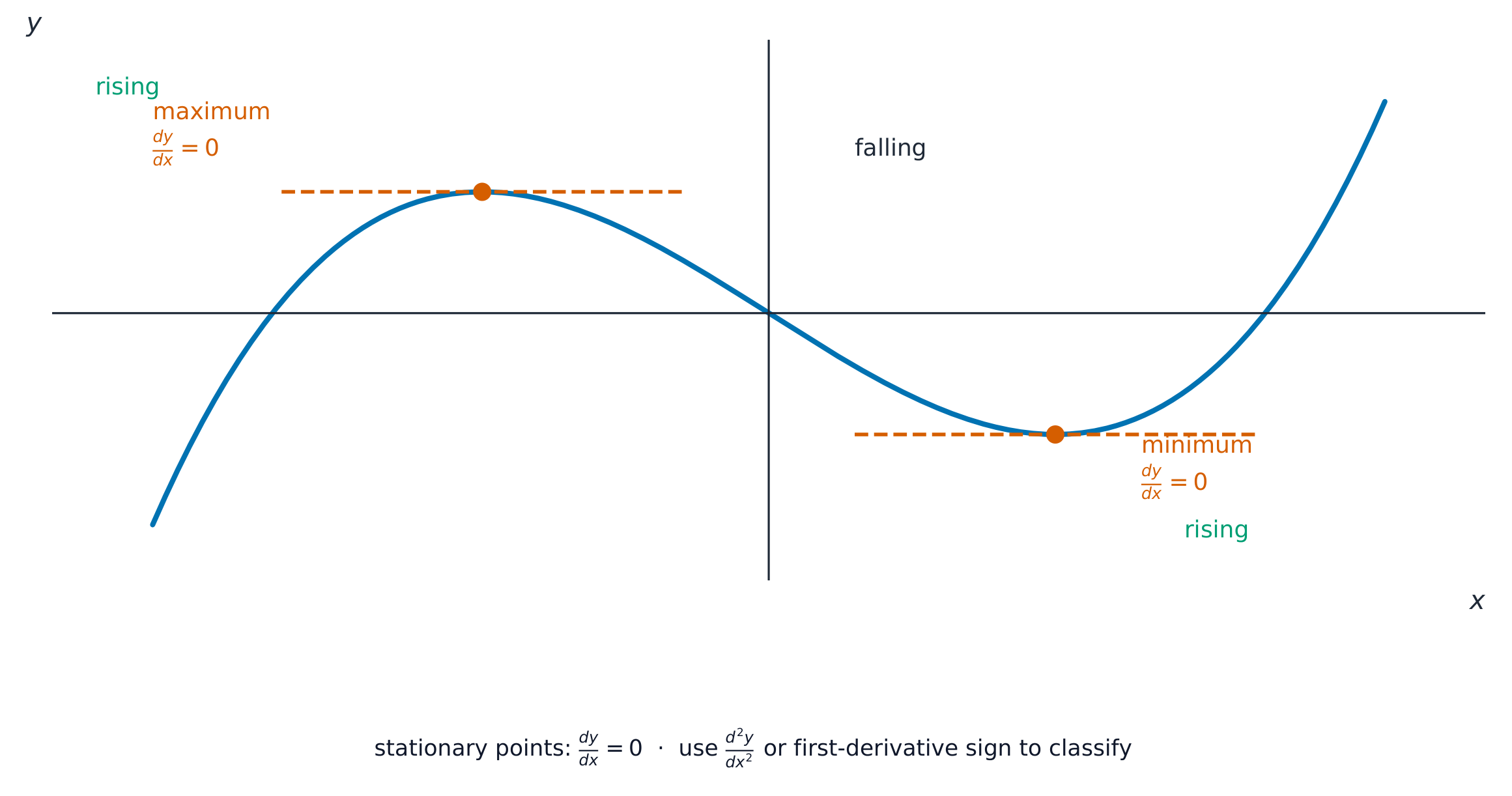
在一个最大值或最小值处,斜率 dy/dx 是零
The curve y = x² − 6x + 5 has a stationary point. At what x value? · 曲线 y = x² − 6x + 5 有一个驻点。在哪个 x 值?
dy/dx = 2x − 6 = 0 gives x = 3. · dy/dx = 2x − 6 = 0 给出 x = 3。
At a stationary point, if the second derivative f″(x) > 0, the point is a: · 在一个驻点处,如果二阶导数 f″(x) > 0,这个点是一个:
f″ > 0 means the curve bends upward — a minimum; f″ < 0 gives a maximum. · f″ > 0 意味着曲线向上弯——一个最小值;f″ < 0 给出一个最大值。
If dy/dx > 0 for all x in an interval, the function is increasing on that interval. · 如果在一个区间内对所有 x 都有 dy/dx > 0,函数在那个区间上是增加的。
A positive derivative means the function is rising — it is increasing. · 一个正的导数意味着函数在上升——它是增加的。
For y = x³ − 6x² + 9x + 2, the second derivative at x = 3 is: · 对于 y = x³ − 6x² + 9x + 2,在 x = 3 处的二阶导数是:
d²y/dx² = 6x − 12. At x = 3: 6(3) − 12 = 18 − 12 = 6 > 0, so it's a minimum. · d²y/dx² = 6x − 12。在 x = 3:6(3) − 12 = 18 − 12 = 6 > 0,所以它是一个最小值。
Worked example — finding stationary points
- $y = x^3 - 6x^2 + 9x + 2$.
- $\dfrac{dy}{dx} = 3x^2 - 12x + 9 = 3(x-1)(x-3)$.
- Stationary points at $x = 1$ and $x = 3$.
- $\dfrac{d^2y}{dx^2} = 6x - 12$: at $x=1$, $f'' = -6 < 0$ (maximum); at $x=3$, $f'' = 6 > 0$ (minimum).
算例——找驻点
- $y = x^3 - 6x^2 + 9x + 2$。
- $\dfrac{dy}{dx} = 3x^2 - 12x + 9 = 3(x-1)(x-3)$。
- 驻点在 $x = 1$ 和 $x = 3$。
- $\dfrac{d^2y}{dx^2} = 6x - 12$:在 $x=1$,$f'' = -6 < 0$(最大值);在 $x=3$,$f'' = 6 > 0$(最小值)。
Applications of differentiation
- Optimisation 最优化: find the maximum profit or minimum cost by setting $\dfrac{dy}{dx} = 0$.
- Rates of change: velocity is the derivative of displacement; acceleration is the derivative of velocity.
- Curve sketching: stationary points and the sign of $\dfrac{dy}{dx}$ reveal the shape.
- The derivative also gives the gradient of normals (perpendicular to the tangent).
微分的应用
- 优化(optimisation):通过设 $\dfrac{dy}{dx} = 0$ 找到最大利润或最小成本。
- 变化率:速度是位移的导数;加速度是速度的导数。
- 曲线作图:驻点和 $\dfrac{dy}{dx}$ 的符号揭示形状。
- 导数也给出法线(normals,与切线垂直)的斜率。
You've got it
- power rule: $\dfrac{d}{dx}(x^n) = n x^{n-1}$; chain rule for nested functions
- stationary point: $\dfrac{dy}{dx} = 0$
- second-derivative test: $f'' > 0$ minimum, $f'' < 0$ maximum
- increasing when $\dfrac{dy}{dx} > 0$; decreasing when $\dfrac{dy}{dx} < 0$
你掌握了
- 幂法则:$\dfrac{d}{dx}(x^n) = n x^{n-1}$;链式法则用于嵌套的函数
- 驻点:$\dfrac{dy}{dx} = 0$
- 二阶导数测试:$f'' > 0$ 最小值,$f'' < 0$ 最大值
- 当 $\dfrac{dy}{dx} > 0$ 时增加;当 $\dfrac{dy}{dx} < 0$ 时减少