Functions · 函数
| English | 中文 | Pinyin · 拼音 |
|---|---|---|
| function/ˈfʌŋkʃn/ | 函数 | hán shù |
| domain/dəˈmeɪn/ | 定义域 | dìng yì yù |
| range/reɪndʒ/ | 值域 | zhí yù |
| composition/ˌkɒmpəˈzɪʃn/ | 复合 | fù hé |
| inverse/ɪnˈvɜːs/ | 反函数 | fǎn hán shù |
| one-one/wʌn wʌn/ | 一一对应 | yī yī duì yìng |
The vending machine test
- A vending machine takes one code and gives exactly one snack. If code A7 sometimes gives crisps and sometimes chocolate, it's broken.
- A function 函数 works the same way: each input maps to exactly one output. This simple rule underpins all of calculus.
自动售货机测试
- 一台自动售货机接受一个代码并给出恰好一个零食。如果代码 A7 有时给薯片、有时给巧克力,它就坏了。
- 一个函数(function)以同样的方式工作:每个输入映射到恰好一个输出。这个简单的规则支撑着所有的微积分。
Functions, domain 定义域 and range 值域
- A function $f(x)$ sends each input to exactly one output.
- The domain = allowed inputs; the range = the outputs produced.
- Example: $f(x) = \sqrt{x}$ has domain $x \geq 0$ and range $f(x) \geq 0$.
Domain restrictions. $g(x) = \dfrac{1}{x-3}$ has domain $x \neq 3$ (division by zero is undefined). The range is all real numbers except $0$.
函数、定义域和值域
- 一个函数 $f(x)$ 把每个输入送到恰好一个输出。
- 定义域(domain)= 允许的输入;值域(range)= 产生的输出。
- 例子:$f(x) = \sqrt{x}$ 有定义域 $x \geq 0$ 和值域 $f(x) \geq 0$。
定义域限制。 $g(x) = \dfrac{1}{x-3}$ 有定义域 $x \neq 3$(除以零是未定义的)。值域是除了 $0$ 之外的所有实数。
Explore a function · 探索一个函数
y = ax³ + bx² + cx + d
A function turns each input · 输入 into exactly one output · 输出 — drag the coefficients and watch where the curve rises and falls. · 一个函数把每个输入变成恰好一个输出——拖动系数,观察曲线在哪里上升和下降。
The domain of f(x) = √(x − 4) is: · f(x) = √(x − 4) 的定义域是:
The expression under the square root must be non-negative: x − 4 ≥ 0, so x ≥ 4. · 平方根下面的表达式必须是非负的:x − 4 ≥ 0,所以 x ≥ 4。
Composition 复合 and inverses 反函数
- A function is one-one 一一对应 if different inputs always give different outputs — only then does it have an inverse $f^{-1}$.
- Composition $fg(x) = f(g(x))$ — do $g$ first, then $f$.
复合与反函数
- 一个函数是一一的(one-one),如果不同的输入总是给出不同的输出——只有那时它才有一个反函数(inverse)$f^{-1}$。
- 复合(composition)$fg(x) = f(g(x))$——先做 $g$,然后 $f$。
If f(x) = x² and g(x) = x + 1, what is fg(2) = f(g(2))? · 如果 f(x) = x² 而 g(x) = x + 1,fg(2) = f(g(2)) 是多少?
g(2) = 3, then f(3) = 3² = 9. · g(2) = 3,然后 f(3) = 3² = 9。
Only a one-one function has an inverse function. · 只有一个一一函数有一个反函数。
If two inputs gave the same output, the reverse rule would be ambiguous — so only one-one functions are invertible. · 如果两个输入给出同样的输出,反向的规则就会有歧义——所以只有一一函数是可逆的。
Finding an inverse
- To find $f^{-1}$: write $y = f(x)$, make $x$ the subject, then swap letters.
- Example: $f(x) = 2x + 6$ → $x = \dfrac{y-6}{2}$ → $f^{-1}(x) = \dfrac{x-6}{2}$.
- The graph of $y = f^{-1}(x)$ is the reflection of $y = f(x)$ in the line $y = x$.
Inverse functions are reflections in $y = x$: the point $(a, b)$ on $f$ becomes $(b, a)$ on $f^{-1}$.
Not all functions have inverses. $f(x) = x^2$ is not one-one (both $2$ and $-2$ give $4$), so it has no inverse unless you restrict the domain to $x \geq 0$.
求一个反函数
- 要求 $f^{-1}$:写 $y = f(x)$,让 $x$ 成为主语,然后交换字母。
- 例子:$f(x) = 2x + 6$ → $x = \dfrac{y-6}{2}$ → $f^{-1}(x) = \dfrac{x-6}{2}$。
- $y = f^{-1}(x)$ 的图是 $y = f(x)$ 在直线 $y = x$ 中的反射(reflection)。
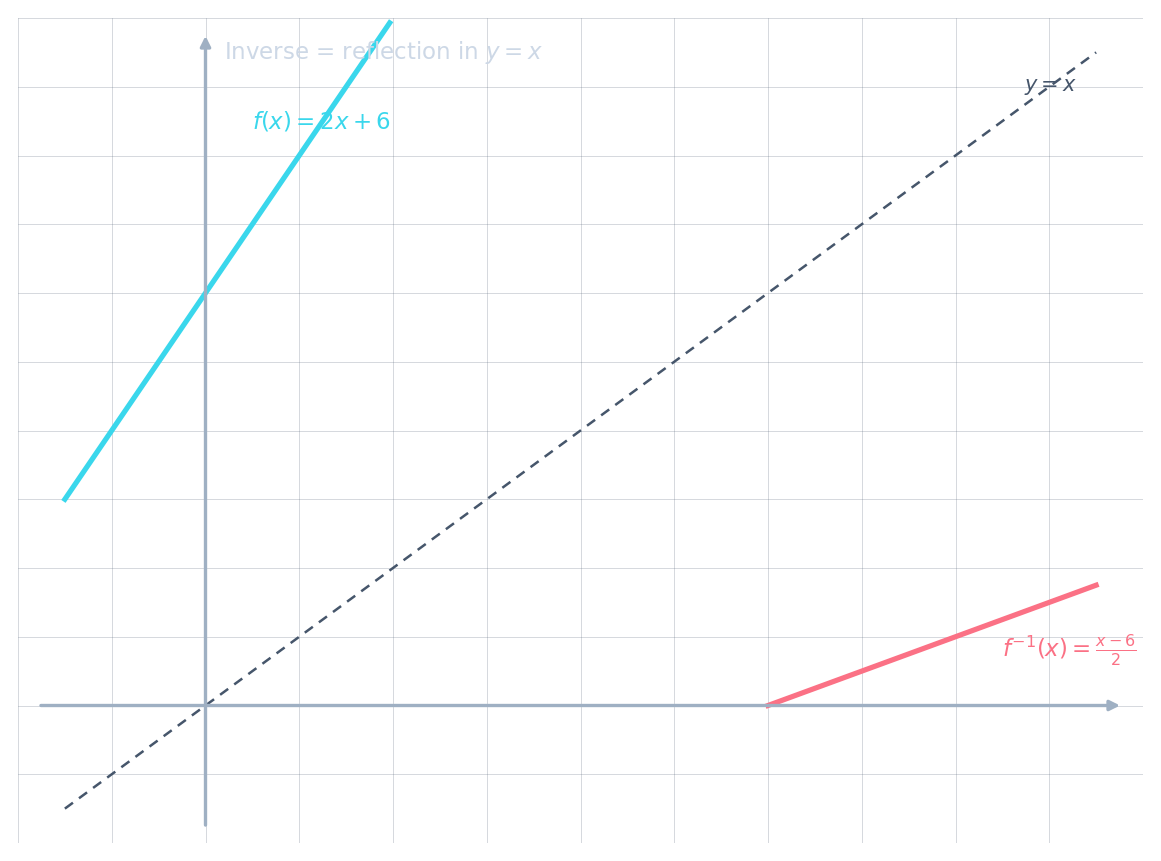
反函数是在 $y = x$ 中的反射:$f$ 上的点 $(a, b)$ 在 $f^{-1}$ 上变成 $(b, a)$。
不是所有函数都有反函数。 $f(x) = x^2$ 不是一一的($2$ 和 $-2$ 都给出 $4$),所以它没有反函数,除非你把定义域限制到 $x \geq 0$。
For f(x) = 2x + 6, the inverse is f⁻¹(x) = (x − 6)/2. What is f⁻¹(10)? · 对于 f(x) = 2x + 6,反函数是 f⁻¹(x) = (x − 6)/2。f⁻¹(10) 是多少?
f⁻¹(10) = (10 − 6)/2 = 4/2 = 2.
The graph of y = f⁻¹(x) is the reflection of y = f(x) in the line: · y = f⁻¹(x) 的图是 y = f(x) 在哪条直线中的反射:
An inverse reflects the original graph in the line y = x; a point (a, b) becomes (b, a). · 一个反函数把原图在直线 y = x 中反射;一个点 (a, b) 变成 (b, a)。
Properties of inverses
- $f(f^{-1}(x)) = x$ and $f^{-1}(f(x)) = x$ — they undo each other.
- The domain of $f^{-1}$ is the range of $f$, and vice versa.
- Graphically: swap the axes.
- Know the composition of functions $fg(x)$ and graph transformations — a translation, a stretch, and reflections.
Adding to the output or input slides the curve; a multiplier stretches it
反函数的性质
- $f(f^{-1}(x)) = x$ 而 $f^{-1}(f(x)) = x$——它们互相抵消。
- $f^{-1}$ 的定义域是 $f$ 的值域,反之亦然。
- 图形上:交换坐标轴。
- 掌握复合函数(composition of functions)$fg(x)$ 和图象变换(transformations)——平移(translation)、拉伸(stretch)和反射。

加到输出或输入上会平移曲线;一个乘数会拉伸它
For any function f with an inverse, f(f⁻¹(x)) = x. · 对任何有反函数的函数 f,f(f⁻¹(x)) = x。
Applying a function and then its inverse returns the original input — they undo each other. · 应用一个函数然后它的反函数返回原始的输入——它们互相抵消。
You've got it
- function: each input → exactly one output; domain = inputs, range = outputs
- one-one functions have inverses; find $f^{-1}$ by swapping and solving
- composition $fg(x) = f(g(x))$ — do $g$ first, then $f$
- the graph of $f^{-1}$ is the reflection of $f$ in $y = x$
你掌握了
- 函数:每个输入 → 恰好一个输出;定义域 = 输入,值域 = 输出
- 一一函数有反函数;通过交换和求解找到 $f^{-1}$
- 复合 $fg(x) = f(g(x))$——先做 $g$,然后 $f$
- $f^{-1}$ 的图是 $f$ 在 $y = x$ 中的反射