Non-parametric tests · 非参数检验
| English | 中文 | Pinyin · 拼音 |
|---|---|---|
| non-parametric/nɒn ˌpærəˈmetrɪk/ | 非参数 | fēi cān shù |
| rank/ræŋk/ | 秩 | zhì |
| sign test/saɪn test/ | 符号检验 | fú hào jiǎn yàn |
| median/ˈmiːdiːən/ | 中位数 | zhōng wèi shù |
| binomial/baɪˈnəʊmɪəl/ | 二项 | èr xiàng |
| outlier/ˈaʊtlaɪə/ | 离群值 | lí qún zhí |
| Wilcoxon signed-rank test/ˈwɪlkɒksn saɪnd ræŋk test/ | 威尔科克森符号秩检验 | wēi ěr kē kè sēn fú hào zhì jiǎn yàn |
| rank-sum test/ræŋk sʌm test/ | 秩和检验 | zhì hé jiǎn yàn |
When the data isn't normal
- Most tests assume the data follows a normal distribution. But reaction times, rankings, and skewed data often don't.
- Non-parametric 非参数 tests make no assumption about the underlying distribution — they work from order and rank 秩 instead of exact values.
当数据不是正态时
- 大多数检验假设数据遵循一个正态分布。但反应时间、排名和偏斜的数据常常不遵循。
- 非参数检验(non-parametric tests)对底层分布不作假设——它们从顺序和秩而不是精确值工作。
Non-parametric test chooser · 非参数检验选择器
Choose the rank-based test that matches the data situation. · 选择与数据情况匹配的基于秩的检验。
The key advantage of a non-parametric test is that it makes no assumption that the data is: · 非参数检验的主要优势在于它不对数据是以下哪种情况进行假设:
Non-parametric tests work without assuming an underlying normal distribution. · 非参数检验在不假设底层正态分布的情况下工作。
The sign test 符号检验
- To test a proposed median 中位数, count how many values fall above versus below it.
- Under the null hypothesis the counts follow a binomial 二项 model with $p = \tfrac12$ — so a lopsided split is evidence against the median.
Why it's robust. The sign test uses only direction (above/below), so a single wild outlier 离群值 can't distort it — unlike the mean.
The sign test counts how many values lie above (+) or below (−) the median
符号检验
- 为了检验一个提出的中位数(median),数有多少值落在它上面对比下面。
- 在零假设下,计数遵循一个 $p = \tfrac12$ 的二项(binomial)模型——所以一个不对称的分割是反对该中位数的证据。
为什么它稳健。 符号检验只使用方向(上面/下面),所以一个单一的极端离群值不能扭曲它——不像均值。
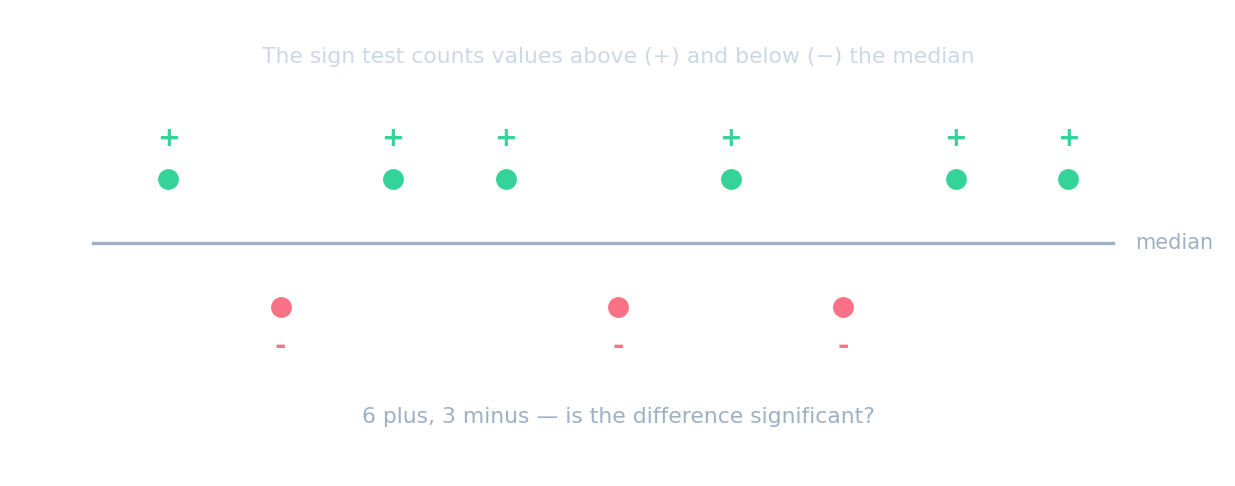
符号检验数有多少个值在中位数之上(+)或之下(−)
Under the null hypothesis, the sign test uses which distribution for the counts above/below the median? · 在原假设下,符号检验使用哪个分布来计算高于/低于中位数的计数?
Each value is equally likely above or below the median, so the count is binomial with p = ½. · 每个值高于或低于中位数的可能性相等,因此计数服从 p = ½ 的二项分布。
Because it uses only direction, the sign test is barely affected by an ______ (an extreme value). · 因为它只使用方向,符号检验几乎不受 ______(极端值)的影响。
Using only above/below makes the sign test robust to outliers. · 仅使用高于/低于使得符号检验对异常值具有稳健性。
The Wilcoxon signed-rank test 威尔科克森符号秩检验
- The sign test throws away how far each value is from the median. The Wilcoxon signed-rank test keeps that information.
- Rank the differences by size, attach their signs, and sum the positive (or negative) ranks as the test statistic.
威尔科克森符号秩检验
- 符号检验扔掉了每个值离中位数多远。威尔科克森符号秩检验(Wilcoxon signed-rank test)保留那个信息。
- 按大小给差排秩(rank),附上它们的符号,把正(或负)秩相加作为检验统计量。
The Wilcoxon signed-rank test uses the sizes of the differences, not just their signs. · 威尔科克森符号秩检验使用差值的大小,而不仅仅是符号。
It ranks the magnitudes of the differences, keeping information the sign test discards. · 它对差值的量级进行排序,保留了符号检验所丢弃的信息。
The Wilcoxon rank-sum test 秩和检验
- To compare two independent samples, pool and rank all the values together, then sum the ranks of one sample.
- If the two groups really differ, one will collect noticeably higher ranks.
Match the test to the design. Sign and signed-rank tests are for one sample (or paired data); the rank-sum test is for two independent samples. Using the wrong one invalidates the result.
- Non-parametric tests include the Wilcoxon matched-pairs signed-rank test for paired data.
威尔科克森秩和检验
- 为了比较两个独立样本,把所有值汇集并一起排秩,然后把一个样本的秩相加。
- 如果两个组真的不同,一个会收集明显更高的秩。
把检验匹配到设计。 符号和符号秩检验用于一个样本(或配对数据);秩和检验用于两个独立样本。用错的使结果无效。
- 非参数检验包括用于配对数据的威尔科克森配对符号秩检验(Wilcoxon matched-pairs signed-rank test)。
Match each test to its design. · 将每个检验与其设计匹配。
Sign and signed-rank are one-sample (or paired); rank-sum compares two independent samples. · 符号检验和符号秩检验是单样本(或配对)检验;秩和检验比较两个独立样本。
You've got it
- non-parametric tests need no normality assumption — they use order and rank
- sign test: counts above/below a median (binomial, very robust)
- Wilcoxon signed-rank (one sample, uses the sizes of differences) and rank-sum (two independent samples)
你掌握了
- 非参数检验不需要正态性假设——它们使用顺序和秩
- 符号检验:数中位数上/下的个数(二项,非常稳健)
- 威尔科克森符号秩(一个样本,使用差的大小)和秩和(两个独立样本)