Momentum (Further Mechanics) · 动量(Further Mechanics)
| English | 中文 | Pinyin · 拼音 |
|---|---|---|
| momentum/məʊˈmentəm/ | 动量 | dòng liàng |
| collision/kəˈlɪʒn/ | 碰撞 | pèng zhuàng |
| conservation of momentum/ˌkɒnsəˈveɪʃn ɒv məʊˈmentəm/ | 动量守恒 | dòng liàng shǒu héng |
| coefficient of restitution/ˌkəʊɪˈfɪʃənt ɒv rɪstɪˈtjuːʃn/ | 恢复系数 | huī fù xì shù |
| perfectly elastic/ˈpɜːfektlɪ ɪˈlæstɪk/ | 完全弹性 | wán quán tán xìng |
| kinetic energy/kɪˈnetɪk ˈenədʒi/ | 动能 | dòng néng |
| perfectly inelastic/ˈpɜːfektlɪ ɪnɪˈlæstɪk/ | 完全非弹性 | wán quán fēi tán xìng |
Newton's cradle and the perfect bounce
- Drop one ball of a Newton's cradle and exactly one flies off the far end. Why one, not two?
- The answer is two conservation ideas working together: momentum 动量, and how much bounce a collision 碰撞 has.
牛顿摆和完美的弹跳
- 放下牛顿摆的一个球,恰好一个从远端飞出去。为什么是一个,不是两个?
- 答案是两个守恒思想一起工作:动量(momentum),以及一次碰撞有多少弹跳。
Conservation of momentum 动量守恒
- In any collision (or explosion), with no external force, total momentum is conserved:
Momentum before equals momentum after — the single most useful equation in collisions.
动量守恒
- 在任何碰撞(或爆炸)中,没有外力时,总动量守恒:
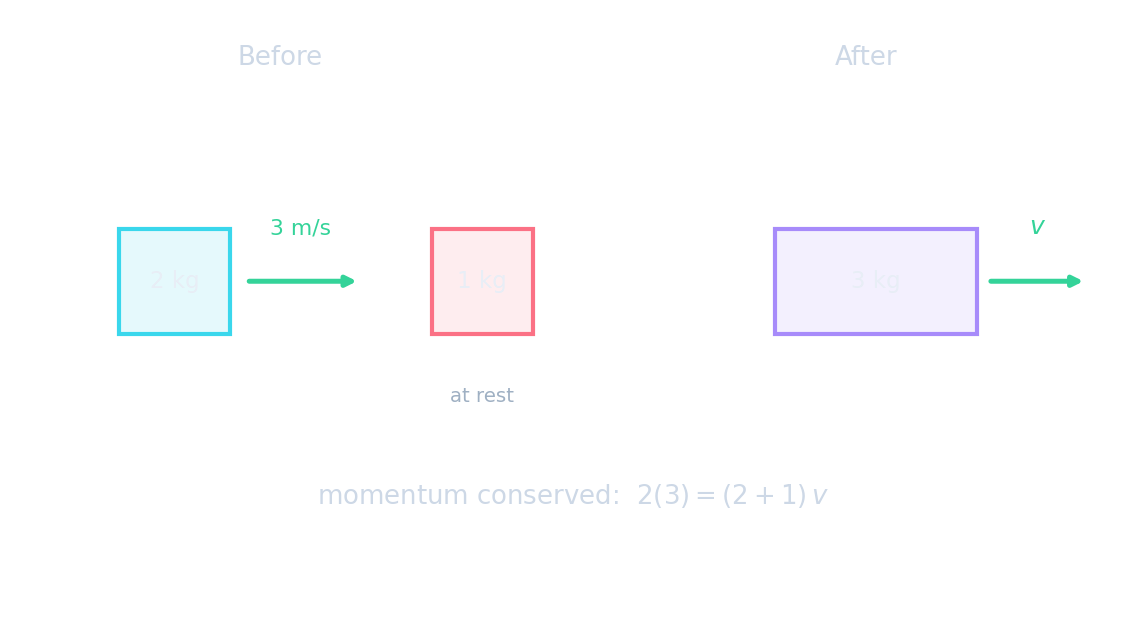
碰撞前的动量等于碰撞后的动量——碰撞中最有用的单一方程。
Conservation of momentum · 动量守恒
m₁u₁ + m₂u₂ = (m₁+m₂)v
Two bodies collide — the total momentum before equals the total after. · 两个物体碰撞——之前的总动量等于之后的总动量。
A 2 kg body at 3 m/s hits a stationary 1 kg body and they stick together. By momentum conservation 2(3) = (2+1)v, find v (m/s). · 一个以 3 m/s 运动的 2 kg 物体撞上一个静止的 1 kg 物体,它们粘在一起。根据动量守恒 2(3) = (2+1)v,求 v(m/s)。
6 = 3v, so v = 2 m/s. · 6 = 3v,所以 v = 2 m/s。
The coefficient of restitution 恢复系数
- How bouncy is the collision? The coefficient of restitution $e$ compares the speeds:
- $e = 1$: perfectly elastic 完全弹性 (no kinetic energy 动能 lost). $e = 0$: perfectly inelastic 完全非弹性 (bodies stick together).
The coefficient of restitution $e$ compares how fast the bodies separate with how fast they approached
A Newton's cradle demonstrates conservation of momentum in collisions
恢复系数
- 碰撞有多弹?恢复系数(coefficient of restitution)$e$ 比较速度:
- $e = 1$:完全弹性(perfectly elastic,没有动能损失)。$e = 0$:完全非弹性(perfectly inelastic,物体粘在一起)。

恢复系数 $e$ 比较物体分开的速度和它们接近的速度

一个牛顿摆演示碰撞中的动量守恒
The coefficient of restitution e always lies in which range? · 恢复系数 e 总是位于哪个范围?
e runs from 0 (perfectly inelastic) to 1 (perfectly elastic). · e 从 0(完全非弹性)到 1(完全弹性)。
The coefficient of restitution e = speed of separation ÷ speed of ______. · 恢复系数 e = 分离速度 ÷ ______速度。
e = separation speed / approach speed. · e = 分离速度 / 接近速度。
If two bodies coalesce (stick together) on impact, the coefficient of restitution is: · 如果两个物体在撞击时合并(粘在一起),恢复系数是:
They move off together (zero separation speed), so e = 0 — perfectly inelastic. · 它们一起移开(零分离速度),所以 e = 0——完全非弹性。
Using both equations
- Two unknowns (the final speeds) need two equations: momentum conservation and Newton's restitution law ($\text{separation} = e \times \text{approach}$).
- Solve them together to find both final velocities.
Kinetic energy is only conserved when $e = 1$. For any $e < 1$ some kinetic energy is lost (to heat and sound) — so never assume energy is conserved in a collision unless told it is perfectly elastic.
- In a direct or oblique impact, total linear momentum is conserved (conservation of linear momentum) and Newton's experimental law gives the coefficient of restitution.
使用两个方程
- 两个未知量(最终速度)需要两个方程:动量守恒和牛顿恢复定律($\text{separation} = e \times \text{approach}$)。
- 一起求解它们以求两个最终速度。
动能只在 $e = 1$ 时守恒。 对任何 $e < 1$,一些动能损失(变成热和声音)——所以除非被告知是完全弹性的,否则永远不要假设碰撞中能量守恒。
- 在对心(direct)或斜碰撞(oblique impact)中,总线动量(linear momentum)守恒(线动量守恒 conservation of linear momentum),牛顿实验定律(Newton's experimental law)给出恢复系数。
Kinetic energy is conserved only when the coefficient of restitution e = 1. · 动能只在恢复系数 e = 1 时守恒。
Only a perfectly elastic collision (e = 1) conserves kinetic energy; otherwise some is lost. · 只有完全弹性碰撞(e = 1)守恒动能;否则一些会损失。
You've got it
- total momentum is conserved: $m_1u_1 + m_2u_2 = m_1v_1 + m_2v_2$
- $e = \dfrac{\text{separation speed}}{\text{approach speed}}$, with $0 \leq e \leq 1$
- combine momentum + restitution to find both final speeds; KE conserved only if $e = 1$
你掌握了
- 总动量守恒:$m_1u_1 + m_2u_2 = m_1v_1 + m_2v_2$
- $e = \dfrac{\text{separation speed}}{\text{approach speed}}$,其中 $0 \leq e \leq 1$
- 结合动量 + 恢复以求两个最终速度;动能只在 $e = 1$ 时守恒