Circular motion · 圆周运动
| English | 中文 | Pinyin · 拼音 |
|---|---|---|
| centripetal acceleration/senˈtrɪpɪtl əkˌseləˈreɪʃn/ | 向心加速度 | xiàng xīn jiā sù dù |
| angular speed/ˈæŋɡjʊlə spiːd/ | 角速度 | jiǎo sù dù |
| linear speed/ˈlɪnɪə spiːd/ | 线速度 | xiàn sù dù |
| radian/ˈreɪdɪən/ | 弧度 | hú dù |
| tangent/ˈtændʒənt/ | 切线 | qiè xiàn |
| centripetal force/senˈtrɪpɪtl fɔːs/ | 向心力 | xiàng xīn lì |
| conical pendulum/ˈkɒnɪkl ˈpendjʊləm/ | 圆锥摆 | yuán zhuī bǎi |
| energy conservation/ˈenədʒi ˌkɒnsəˈveɪʃn/ | 能量守恒 | néng liàng shǒu héng |
| centrifugal/ˌsentrɪˈfjuːɡl/ | 离心 | lí xīn |
| inertia/ɪˈnɜːʃə/ | 惯性 | guàn xìng |
Why you feel pushed out on a roundabout
- Whirl a ball on a string and it pulls outward — yet the force on the ball points inward.
- Anything moving in a circle is constantly accelerating toward the centre, even at steady speed, because its direction keeps changing.
为什么你在旋转木马上感觉被推出去
- 在一根弦上甩一个球,它向外拉——然而球上的力指向内。
- 任何在圆周上运动的东西都不断地朝中心加速,即使在稳定的速度,因为它的方向不停地改变。
Angular speed 角速度 and linear speed 线速度
- Angular speed $\omega$ (radians 弧度 per second) links to linear speed by:
- A point further from the centre (bigger $r$) moves faster for the same $\omega$.
In circular motion velocity is tangent 切线 and acceleration points to the centre
角速度和线速度
- 角速度(angular speed)$\omega$(弧度每秒)通过以下与线速度联系:
- 离中心更远的点(更大的 $r$)在相同的 $\omega$ 下移动得更快。

在圆周运动中速度是切线,加速度指向中心
Angle in radians · 以弧度表示的角
Circular motion is measured in radians: drag the angle θ and radius r to see the arc swept — angular speed ω turns this into v = rω. · 圆周运动以弧度度量:拖动角 θ 和半径 r,看扫过的弧——角速度 ω 把它变成 v = rω。
A particle moves in a circle of radius 2 m with angular speed 3 rad/s. What is its speed v = rω (m/s)? · 一个质点在半径 2 m 的圆上以角速度 3 rad/s 运动。它的速度 v = rω(m/s)是多少?
v = rω = 2 × 3 = 6 m/s. · v = rω = 2 × 3 = 6 m/s。
Linear speed and angular speed are related by v = r ______. · 线速度和角速度由 v = r ______ 联系。
v = rω. · v = rω。
Centripetal acceleration 向心加速度
- The acceleration points to the centre — centripetal acceleration:
- It is caused by a centripetal force 向心力 $F = ma$ (tension, friction, gravity, or a normal reaction).
Velocity is tangent to the circle; the acceleration (and net force) point to the centre.
向心加速度
- 加速度指向中心——向心加速度(centripetal acceleration):
- 它由一个向心力(centripetal force)$F = ma$ 引起(张力、摩擦、重力或一个法向反作用力)。
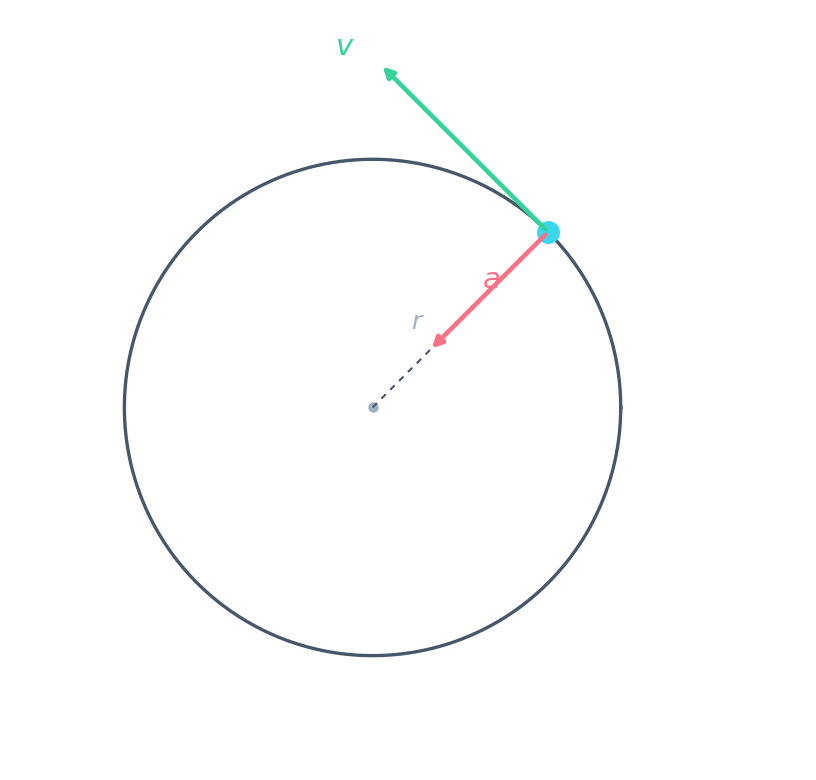
速度是圆的切线;加速度(和净力)指向中心。
For the same particle (r = 2, ω = 3), what is the centripetal acceleration a = rω² (m/s²)? · 对同一个质点(r = 2,ω = 3),向心加速度 a = rω²(m/s²)是多少?
a = rω² = 2 × 9 = 18 m/s². · a = rω² = 2 × 9 = 18 m/s²。
The centripetal acceleration of a particle in circular motion points: · 一个圆周运动中质点的向心加速度指向:
It points to the centre — that is what continually changes the direction of motion. · 它指向中心——那就是不断改变运动方向的东西。
The velocity of a particle in circular motion is directed along the tangent to the circle. · 一个圆周运动中质点的速度沿圆的切线方向。
Velocity is always tangent; the acceleration is perpendicular to it, toward the centre. · 速度总是切线;加速度与它垂直,朝向中心。
Worked example
- A particle moves in a circle of radius $2$ m at angular speed $3\ \tfrac{\text{rad}}{\text{s}}$.
- Speed $v = r\omega = 2 \times 3 = 6\ \tfrac{\text{m}}{\text{s}}$.
- Centripetal acceleration $a = r\omega^2 = 2 \times 3^2 = 18\ \tfrac{\text{m}}{\text{s}^2}$.
例题
- 一个质点在半径 $2$ m 的圆上以角速度 $3\ \tfrac{\text{rad}}{\text{s}}$ 运动。
- 速度 $v = r\omega = 2 \times 3 = 6\ \tfrac{\text{m}}{\text{s}}$。
- 向心加速度 $a = r\omega^2 = 2 \times 3^2 = 18\ \tfrac{\text{m}}{\text{s}^2}$。
Horizontal vs vertical circles
- Horizontal circle (e.g. a conical pendulum 圆锥摆): speed is constant.
- Vertical circle: speed changes with height, so combine circular motion with energy conservation 能量守恒.
There is no outward "centrifugal 离心 force" on the particle. The real force is the inward (centripetal) one; the outward feeling is your body's inertia 惯性 resisting the change in direction.
- In circular motion the normal contact force or tension provides the centripetal force.
水平圆对比竖直圆
- 水平圆(例如一个圆锥摆):速度恒定。
- 竖直圆:速度随高度改变,所以把圆周运动与能量守恒结合。
质点上没有向外的"离心力"。 真实的力是向内的(向心)力;向外的感觉是你身体的惯性抵抗方向的改变。
- 在圆周运动中,法向接触力(normal contact force)或张力提供向心力。
For motion in a vertical circle, the speed is not constant, so you also use: · 对在一个竖直圆中的运动,速度不恒定,所以你还使用:
Height changes, so gravitational PE ↔ KE: use energy conservation alongside the circular-motion equations. · 高度改变,所以重力势能 ↔ 动能:在圆周运动方程之外使用能量守恒。
You've got it
- $v = r\omega$; centripetal acceleration $a = r\omega^2 = \dfrac{v^2}{r}$, directed to the centre
- a real inward centripetal force causes it ($F = ma$)
- horizontal circle → constant speed; vertical circle → use energy conservation
你掌握了
- $v = r\omega$;向心加速度 $a = r\omega^2 = \dfrac{v^2}{r}$,指向中心
- 一个真实的向内向心力引起它($F = ma$)
- 水平圆 → 恒定速度;竖直圆 → 使用能量守恒