Current account of the balance of payments · 国际收支经常账户
| English | 中文 | Pinyin · 拼音 |
|---|---|---|
| balance of payments/ˈbæləns ɒv ˈpeɪmənts/ | 国际收支 | guó jì shōu zhī |
| current account/ˈkʌrənt əˈkaʊnt/ | 经常账户 | jīng cháng zhàng hù |
| deficit/ˈdefɪsɪt/ | 赤字 | chì zì |
| trade in goods/treɪd ɪn ɡʊdz/ | 货物贸易 | huò wù mào yì |
| trade in services/treɪd ɪn ˈsɜːvɪsɪz/ | 服务贸易 | fú wù mào yì |
| remittances/rɪˈmɪtənsɪz/ | 侨汇 | qiáo huì |
| surplus/ˈsɜːpləs/ | 盈余 | yíng yú |
A country's financial scorecard
- Just as a household tracks money in and out, a country records every transaction with the rest of the world in its balance of payments 国际收支.
- The most-watched part is the current account 经常账户 — and a persistent deficit 赤字 makes headlines.
一个国家的财务成绩单
- 正如一个家庭追踪进出的钱,一个国家在它的国际收支(balance of payments)中记录与世界其余部分的每一笔交易。
- 被关注最多的部分是经常账户(current account)——一个持续的赤字成为头条。
Current account flow · 经常账户流量
Track exports, imports and income flows into the current account. · 跟踪进入经常账户的出口、进口和收入流量。
What the current account records
- The current account records trade and income flows with the rest of the world:
- trade in goods 货物贸易 (visible) and trade in services 服务贸易 (invisible),
- primary income (wages, interest, profit from abroad),
- secondary income (transfers like aid and remittances 侨汇).
The current account has four parts: trade in goods, trade in services, primary income and secondary income
A floating exchange rate set by currency demand and supply
经常账户记录什么
- 经常账户记录与世界其余部分的贸易和收入流:
- 货物贸易(可见的)和服务贸易(不可见的),
- 初次收入(primary income,来自国外的工资、利息、利润),
- 二次收入(secondary income,像援助和汇款这样的转移)。

经常账户有四个部分:货物贸易、服务贸易、初次收入和二次收入
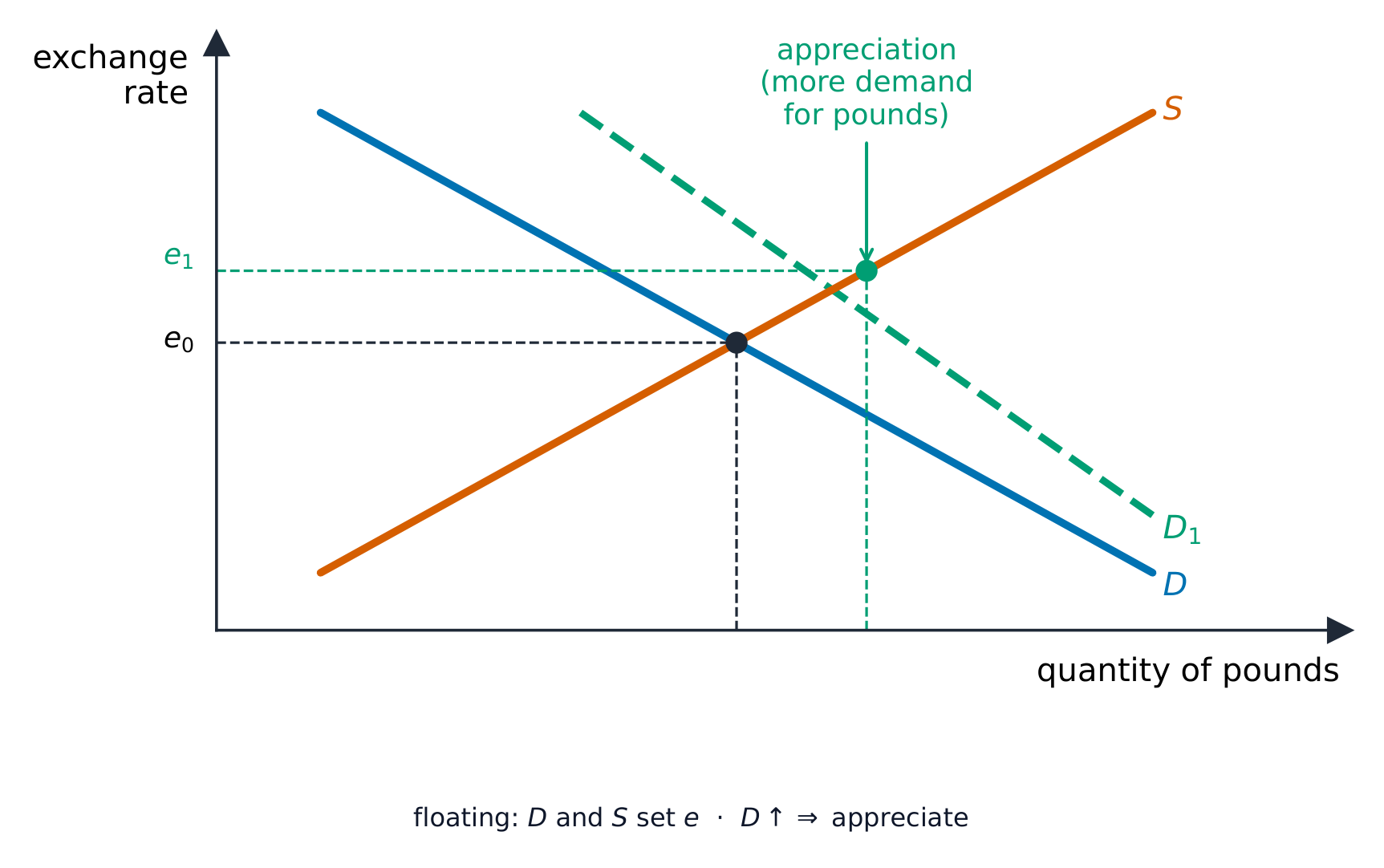
由货币需求和供给决定的浮动汇率
Which is part of the current account? · 哪一项属于经常账户?
The current account records trade in goods/services, primary and secondary income. · 经常账户记录货物/服务贸易、初次收入和二次收入。
Match each current-account component to an example. · 将每个经常账户组成部分与示例相匹配。
Goods + services + primary income + secondary income make up the current account. · 货物+服务+初次收入+二次收入构成了经常账户。
Surplus 盈余 and deficit
- A deficit: more money flows out (imports/payments) than in → the value of imports exceeds exports.
- A surplus: more flows in than out.
Worked example. If exports total 500 and imports total 600, the trade balance is 500 − 600 = −100 (a deficit of 100).
盈余与赤字
- 一个赤字(deficit):流出的钱(进口/付款)比流入的多 → 进口的价值超过出口。
- 一个盈余(surplus):流入的比流出的多。
例题。 如果出口共 500 而进口共 600,贸易平衡是 500 − 600 = −100(一个 100 的赤字)。
Exports total 500 and imports total 600. What is the trade balance (exports − imports)? · 出口总额为500,进口总额为600。贸易差额(出口−进口)是多少?
500 − 600 = −100, a trade deficit of 100. · 500 − 600 = −100,即贸易逆差100。
A current account deficit means the value of imports (and other outflows) exceeds exports (and inflows). · 经常账户逆差意味着进口(及其他流出)的价值超过出口(及流入)。
More money flows out than in → a deficit, financed by borrowing or selling assets. · 流出的资金多于流入的资金 → 形成逆差,通过借贷或出售资产融资。
When inflows exceed outflows, the current account is in ______. · 当流入大于流出时,经常账户处于______状态。
Inflows > outflows → surplus; outflows > inflows → deficit. · 流入 > 流出 → 顺差;流出 > 流入 → 逆差。
Why a deficit matters (or not)
- A large persistent deficit may mean uncompetitiveness or living beyond means, and must be financed by borrowing or selling assets.
- But a deficit can be sustainable if it funds productive investment, or if the financial account offsets it.
为什么一个赤字重要(或不重要)
- 一个大的持续赤字可能意味着缺乏竞争力或入不敷出,且必须靠借款或出售资产来融资。
- 但如果一个赤字为生产性投资提供资金,或如果金融账户抵消它,它能是可持续的。
You've got it
- the current account = trade in goods + services + primary income + secondary income
- deficit = outflows exceed inflows (imports > exports); surplus = the reverse
- a deficit must be financed; it matters most if large, persistent and unproductive
你掌握了
- 经常账户 = 货物贸易 + 服务 + 初次收入 + 二次收入
- 赤字 = 流出超过流入(进口 > 出口);盈余 = 反过来
- 一个赤字必须被融资;如果它大、持续且非生产性,它最重要