Original teaching practice. Read one pattern, cover its model and try the questions before checking the separate answer section. Examples adapted from Chinese Grammar Wiki (AllSet Learning, CC BY-NC-SA) retain the course-reference provenance.
how? (emphatic question)岂no不是 (wouldn't that be …?)
An unused gym card
- Your friend bought a gym membership but never goes.
- you你not不to go去if (coming after a…的话,how? (emphatic question)岂no不是白花钱(completed / change)了? — "If you don't go, wouldn't that be money wasted?"
how? (emphatic question)岂no不是 + conclusion? = wouldn't that be …?
- how? (emphatic question)岂no不是 asks a rhetorical question: the conclusion is obvious, so it means "that would be …, wouldn't it?".
- It usually follows a condition: if如果…,how? (emphatic question)岂no不是…?
this way这样wouldn't it be岂不是even more更troublesome麻烦?

Pointing out a consequence
- now现在to go去if (coming after a…的话,how? (emphatic question)岂no不是want / will / need要to arrive late迟到? — "If we go now, won't we be late?"
- you你so much这么variant of 说说,how? (emphatic question)岂no不是to admit承认oneself自己mistake错(completed / change)了? — "Saying that, aren't you admitting you were wrong?"
you你like this这么say说,aren't you岂不是admitting承认yourself自己wrong错了?
Rhetorical only
- how? (emphatic question)岂no不是 does not ask for information; the speaker is sure of the answer.
- It is a bit literary; in casual speech, that那not不then / just就…(completed / change)了(yes/no ?)吗? is common: that那not不then / just就白花钱(completed / change)了(yes/no ?)吗?
how? (emphatic question)岂no不是 versus don't tell me ...难道
- don't tell me ...难道…(yes/no ?)吗? challenges a belief: don't tell me ...难道you你not不to know知道(yes/no ?)吗?
- how? (emphatic question)岂no不是 draws out a consequence: that那how? (emphatic question)岂no不是to go on an errand for…白跑一趟? — "Wouldn't that be a wasted trip?"
then那not不just就in vain白spent money花钱了吗?
Recap
- (Condition,) how? (emphatic question)岂no不是 + consequence? = wouldn't that be …? (rhetorical).
- Spoken that那not不then / just就…(completed / change)了(yes/no ?)吗; don't tell me ...难道 challenges a belief.
Practise this pattern step by step.
to not be非(want / will / need要) … cannot不可 (simply must / insist on)
He simply must go
- Your little brother wants to go to the amusement park in the rain and won't take no for an answer.
- down下so much这么see 大夫大(modifier / structural particle)的(literary) to rain雨,he / him他to want absolutely非要to go去cannot不可。 — "It's pouring, and he simply insists on going."
to not be非 (want / will / need要) + verb + cannot不可 = must, insist on
- to not be非…cannot不可 is a double negative: "not doing it is not allowed" → must, absolutely have to.
- With want / will / need要, it often shows insistence: he / him他to want absolutely非要to go去cannot不可.
this matter这件事(must)非he他go去(must)不可。

Necessity and stubbornness
- Necessity: this这个question问题to not be非to solve解决cannot不可。 — "This problem absolutely must be solved."
- Stubbornness: I / me我variant of 说说need not不用,she / her她to want absolutely非要to give a dinner party请客cannot不可。 — "I said there was no need, but she insisted on paying."
this这个problem问题(must)非be solved解决(must)不可。
Keep both parts
- In careful style, keep cannot不可 (or won't do不行 / won't do不成) at the end: 非去不可. In speech cannot不可 is sometimes dropped: he / him他to want absolutely非要to go去.
- to not be非 + verb, then cannot不可: not to not be非cannot不可to go去.
to not be非…cannot不可 versus to have to必须 and definitely一定want / will / need要
- to have to必须 / definitely一定want / will / need要 = must (plain).
- to not be非…cannot不可 is more emphatic, often with a sense of insistence or "no other way".
you你must必须on time按时finish完成。
Recap
- to not be非 (want / will / need要) + verb + cannot不可 = absolutely must / insist on (emphatic double negative).
- Plainer: to have to必须 / definitely一定want / will / need要.
Practise this pattern step by step.
double兼 (doubling as / concurrently)
Two jobs in one
- In a small start-up, one person often has several roles.
- he / him他to be / is是we / us我们company公司(modifier / structural particle)的manager经理double兼technician技术员。 — "He's our company's manager and also its technician."
A double兼 B = A and concurrently B
- double兼 joins two roles or functions held by the same person or thing at the same time: teacher老师double兼to translate翻译, drawing room (room for…客厅double兼dining hall餐厅.
- It is formal and compact.
this这(measure word)间room屋子is是a living room客厅and also兼a study书房。

As a verb: hold concurrently
- he / him他double兼(completed / change)了两份to work工作。 — "He holds two jobs at the same time."
- to hold concurrent posts兼职 = part-time job: she / her她at / in在café咖啡馆to make做to hold concurrent posts兼职.
she她at在a café咖啡馆does做a part-time job兼职。
Same person, same time
- double兼 is for roles held at the same time by one person or thing; two different people take and / with和.
- It joins nouns of roles or functions: manager经理double兼technician技术员, not degree / adjective linker很good好double兼degree / adjective linker很cheap便宜 (use again又…again又…).
double兼 versus again又…again又… and already既…again又…
- again又cheap便宜again又good好 / already既…again又… join qualities.
- double兼 joins roles: chauffeur司机double兼tour guide导游 — "driver and guide in one".
driver司机and also兼tour guide导游。
Recap
- A double兼 B = A and concurrently B (two roles of one person or thing); to hold concurrent posts兼职 = part-time job.
- Qualities take again又…again又… / already既…again又…; different people take and / with和.
Practise this pattern step by step.
can it be possible that莫非 (could it be that …?)
A dark office at nine
- The office is dark at nine in the morning and nobody is answering the phone.
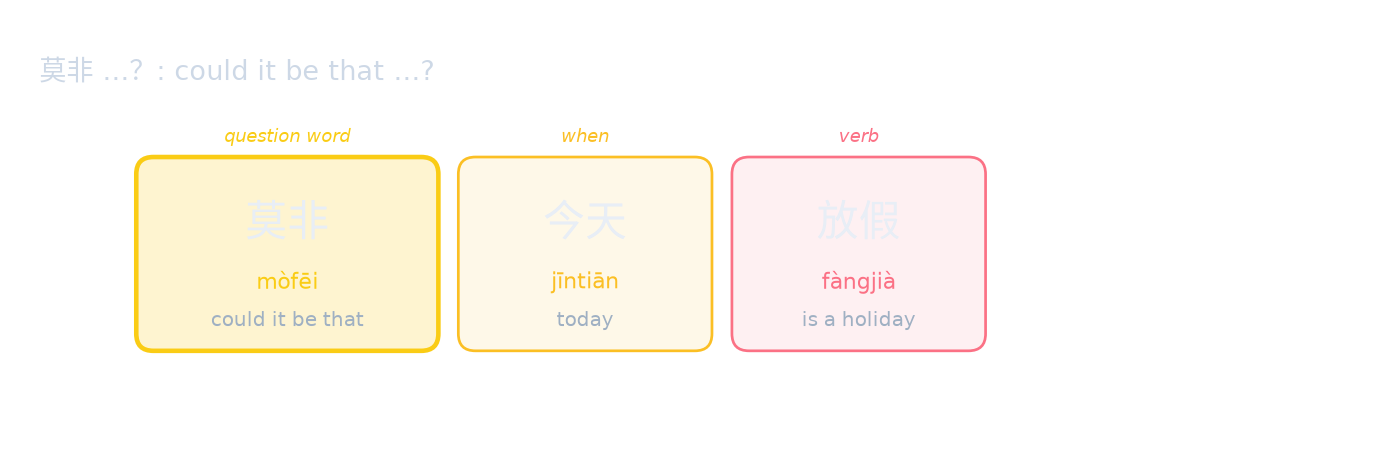
- can it be possible that莫非today今天to have a holiday or…放假? — "Could it be that today is a holiday?"
can it be possible that莫非 + guess? = could it be that …?
- can it be possible that莫非 introduces a surprised guess, often as a question: "Can it be that …?"
- It is literary; the speaker suspects but isn't sure.
could it be莫非he他is ill生病了?
Surprise and suspicion
- he / him他all along一直not不接电话,can it be possible that莫非variant of 出 (classifier…出(completed / change)了what什么matter事? — "He hasn't answered all day — could something have happened?"
- Often with won't do不成 at the end: can it be possible that莫非you你to forget忘(completed / change)了won't do不成? — "Don't tell me you've forgotten?"
he他all along一直not不answer接the phone电话,could it be莫非happened出了something什么matter事?
A guess, not a statement
- can it be possible that莫非 marks an uncertain guess; it does not state a fact.
- It is literary; in speech, don't tell me ...难道 or is or isn't是不是 is more common: is or isn't是不是today今天to have a holiday or…放假?
can it be possible that莫非 versus don't tell me ...难道
- don't tell me ...难道 often challenges (the speaker thinks the answer is "no"): don't tell me ...难道you你not不to know知道(yes/no ?)吗?
- can it be possible that莫非 is closer to a suspicious guess (the speaker thinks it might be "yes").
could it be是不是today今天is a holiday放假?
Recap
- can it be possible that莫非 + guess (won't do不成)? = could it be that …? (literary suspicion).
- Spoken is or isn't是不是…?; don't tell me ...难道 challenges.
Practise this pattern step by step.
hereby由此 (from this / hence)
What the data shows
- A researcher presents a survey on how much students sleep.
- (great) majority大多数student学生every day每天睡不到七个hour小时,from this, it can be seen…由此可见,to learn学习pressure压力很大。 — "Most students sleep less than seven hours a day; from this we can see that study pressure is high."
hereby由此 + verb = from this, hence
- hereby由此 = "from this": it draws a conclusion or consequence from what was just said.
- Common fixed forms: from this, it can be seen…由此可见 (it can be seen from this), thereby由此看来 (judging from this), hereby由此to arise产生 (arise from this).
from this由此it can be seen可见,he他very很hard-working努力。

Consequences that follow
- factory工厂to close关闭(completed / change)了,hereby由此to arise产生(completed / change)了很多失业问题。 — "The factory closed, and many unemployment problems arose from this."
- It links a fact to its result in argument or analysis.
from this由此arose产生了many很多problems问题。
After the evidence
- hereby由此 needs the evidence or event first; it cannot start a text.
- It is written and analytical; in speech, so / therefore所以 / apparently看来 do the job.
hereby由此 versus therefore因此
- therefore因此 = therefore (a logical result): 他病(completed / change)了,therefore因此not / haven't没to come来.
- hereby由此 often precedes a verb of seeing or arising: from this, it can be seen…由此可见, hereby由此to arise产生.
he他was ill病了,therefore因此didn't没come来。
Recap
- hereby由此 + verb = from this (from this, it can be seen…由此可见, thereby由此看来, hereby由此to arise产生).
- After the evidence; written style; therefore因此 = therefore.
Practise this pattern step by step.
nothing can surpass莫过于 (nothing is more … than)
Nothing better
- Asked about the happiest moment of the week, your grandmother smiles.
- most最to feel happy开心(modifier / structural particle)的nothing can surpass莫过于weekend周末whole family全家in the same place一起to have a meal吃饭。 — "Nothing makes me happier than the whole family eating together at the weekend."
… nothing can surpass莫过于 + X = nothing is more … than X
- (most最) Adj (modifier / structural particle)的nothing can surpass莫过于 X = the most Adj thing is X; nothing beats X.
- It singles out the top example in a formal, emphatic way.
most最important重要(thing)的nothing beats莫过于health健康。

Superlatives in essays
- life (one's time on earth)人生最大(modifier / structural particle)的happiness幸福nothing can surpass莫过于to make做oneself自己to like喜欢(modifier / structural particle)的matter事。 — "The greatest happiness in life is doing what you love."
- to learn学习language语言best最好(modifier / structural particle)的method方法nothing can surpass莫过于many多variant of 说说多练。 — "The best way to learn a language is to speak and practise a lot."
the best最好的method方法nothing beats莫过于plenty of多practice练习。
The top example follows
- X after nothing can surpass莫过于 is the single best example; do not put a list there.
- It is formal; in speech say most最…(modifier / structural particle)的to be / is是….
nothing can surpass莫过于 versus most最…(modifier / structural particle)的to be / is是
- most最important重要(modifier / structural particle)的to be / is是health健康 — plain statement.
- most最important重要(modifier / structural particle)的nothing can surpass莫过于health健康 — stronger: nothing is more important.
most最important重要(thing)的is是health健康。
Recap
- (most最) Adj (modifier / structural particle)的nothing can surpass莫过于 X = nothing is more … than X (formal, emphatic).
- Spoken: most最…(modifier / structural particle)的to be / is是….
Practise this pattern step by step.
rather than...与其 A,preferably宁可 / would rather ... (than ...)宁愿 B (rather than … would rather)
Better to walk
- The traffic is completely stuck, and your office is only two kilometres away.
- rather than...与其at / in在车里to wait for等,I / me我preferably宁可to walk走路to go去。 — "Rather than wait in the car, I'd rather walk."
rather than...与其 A,preferably宁可 / would rather ... (than ...)宁愿 B
- rather than...与其 A,preferably宁可 B = rather than A, (I) would rather B: the speaker rejects A and chooses B firmly.
- rather than...与其 introduces the rejected option; preferably宁可 / would rather ... (than ...)宁愿 the chosen one.
rather than与其at home在家wait等,I我would rather宁愿go out出去look找。

Two versions
- rather than...与其…not equal to不如… = rather than A, better B (recommending): rather than...与其to complain抱怨,not equal to不如want / think / miss想means办法.
- rather than...与其…preferably宁可… = rather than A, I'd rather B (personal choice, often with sacrifice).
rather than与其complaining抱怨,better to不如think of想a solution办法。
Which option is chosen?
- The option after rather than...与其 is the one rejected; the one after preferably宁可 / not equal to不如 is chosen.
- variant of 宁宁 in preferably宁可 / would rather ... (than ...)宁愿 is read nìng.
Versus preferably宁可…also也not不…
- preferably宁可 A,also也not不 B = I'd rather A than B (the rejected option second).
- rather than...与其 B,preferably宁可 A = the same choice with the rejected option first.
I我would rather宁可walk走路,(and)也not不take坐this这bus车。
Recap
- rather than...与其 A,preferably宁可 / would rather ... (than ...)宁愿 B = rather than A, I'd rather B; rather than...与其 A,not equal to不如 B = better B.
- The rather than...与其 option is rejected; preferably宁可…also也not不… puts it second.
Practise this pattern step by step.
with / and跟 … seems as if似的 (just like / as if)
Cold as ice
- You come in from a winter walk and your hands are freezing.
- I / me我(modifier / structural particle)的hand手冷得with / and跟variant of 冰冰seems as if似的。 — "My hands are as cold as ice."
with / and跟 / to resemble像 + X + seems as if似的 = like X, as if
- with / and跟 X seems as if似的 (shì de) compares something to X vividly: with / and跟child孩子seems as if似的, with / and跟variant of 冰冰seems as if似的.
- It can describe a noun, a verb or an adjective: he / him他happy高兴(degree marker)得with / and跟child孩子seems as if似的.
he他happy高兴得like跟a child孩子(as if)似的。

As if: imagined situations
- he / him他to speak说话(modifier / structural particle)的appearance样子,as if好像what什么all / both都to know知道seems as if似的。 — "The way he talks, it's as if he knows everything."
- outside (also pr. for this…外面with / and跟down下(completed / change)了一场Daxue or Great Snow, 21st…大雪seems as if似的,everywhere到处all / both都to be / is是white白(modifier / structural particle)的。 — "Outside it's as if there'd been a heavy snowfall — everything is white."
he他as if好像everything什么all都knows知道(as if)似的。
Read it shì de
- seems as if似的 is read shì de, not sì de.
- It is spoken and vivid; in writing, to resemble像…same一样 or to seem仿佛 are common.
with / and跟…seems as if似的 versus to resemble像…same一样
- to resemble像 X same一样 = like X (neutral, also written): to resemble像variant of 冰冰same一样cold冷.
- with / and跟 X seems as if似的 = like X (spoken, lively): 冷得with / and跟variant of 冰冰seems as if似的.
she她like像her mum妈妈(the same)一样gentle温柔。
Recap
- with / and跟 / to resemble像 / as if好像 + X + seems as if似的 (shì de) = like X, as if (spoken, vivid).
- Neutral / written: to resemble像…same一样.
Practise this pattern step by step.
to be worthy of不愧to be / is是 (truly worthy of)
Living up to the name
- The national champion wins again, easily, in front of a huge crowd.
- to be worthy of不愧to be / is是champion冠军,he / him他to run跑(degree marker)得太快(completed / change)了! — "He really lives up to being the champion — he's so fast!"
to be worthy of不愧 (to be / is是) + identity = truly worthy of
- to be worthy of不愧to be / is是 X praises someone for living up to their name, role or reputation.
- It often starts the sentence or follows the subject: he / him他to be worthy of不愧to be / is是teacher老师.
you你truly不愧are是a master chef大厨,this这dish菜so太delicious好吃了。

Praise with evidence
- this这本书to be worthy of不愧to be / is是best-seller畅销书,I / me我一个evening晚上then / just就to see看to finish完(completed / change)了。 — "This book really deserves to be a bestseller; I finished it in one night."
- The evidence usually follows or comes before.
this book这本书truly不愧is是a bestseller畅销书。
Praise only
- to be worthy of不愧 is positive; for "doesn't deserve", say 配不上 or the name does not reflect…名不副实.
- Give the reason: to be worthy of不愧to be / is是champion冠军 alone sounds unfinished without the achievement.
to be worthy of不愧 versus really果然
- really果然 = as expected: he / him他really果然to beat赢(completed / change)了.
- to be worthy of不愧to be / is是 = truly worthy of a title: he / him他to be worthy of不愧to be / is是champion冠军. The two often appear together.
he他as expected果然won赢了,truly不愧is是the champion冠军。
Recap
- to be worthy of不愧 (to be / is是) + identity = truly worthy of, lives up to (praise with evidence).
- Positive only; really果然 = as expected.
Practise this pattern step by step.
to follow由 … see 作主做主 (for … to decide)
Who gets to decide?
- Your parents ask what you want to study at university.
- this这to be / is是you你(modifier / structural particle)的life (one's time on earth)人生,to follow由you你oneself自己see 作主做主。 — "It's your life — it's up to you to decide."
to follow由 + person + see 作主做主 = for … to decide
- to follow由 X see 作主做主 = X has the right to decide: to follow由you你see 作主做主, to follow由father and mother父母see 作主做主.
- see 作主做主 = make the decision, be in charge.
this matter这件事by由you你decide做主。

Who's in charge
- home家里(modifier / structural particle)的major event大事all / both都to follow由(coll.) father's father爷爷see 作主做主。 — "All the big family decisions are made by Grandpa."
- Asking: 这件matter事who谁see 作主做主? — "Who decides about this?"
family家里的big matters大事all都by由Grandpa爷爷decided做主。
to follow由 marks the decider
- to follow由 + person comes before see 作主做主; the matter decided is the topic in front: 这件main content事由you你see 作主做主.
- Do not use (passive: by)被: (passive: by)被you你see 作主做主 is wrong.
see 作主做主 versus to decide (to do something)决定
- to decide (to do something)决定 = to decide (any decision): I / me我to decide (to do something)决定tomorrow明天to walk走.
- see 作主做主 = to have the authority to decide: I / me我做不了owner主 — "It's not my decision to make."
this matter这件事I我can't make做不了the decision主。
Recap
- (Matter) + to follow由 + person + see 作主做主 = it's up to that person to decide.
- see 作主做主 = have the authority; 做不了owner主 = not my call; to decide (to do something)决定 = decide.
Practise this pattern step by step.
(followed by a verb phrase…非得 … cannot不可 (absolutely must)
You have to see a doctor
- Your friend has had a fever for three days but refuses to see a doctor.
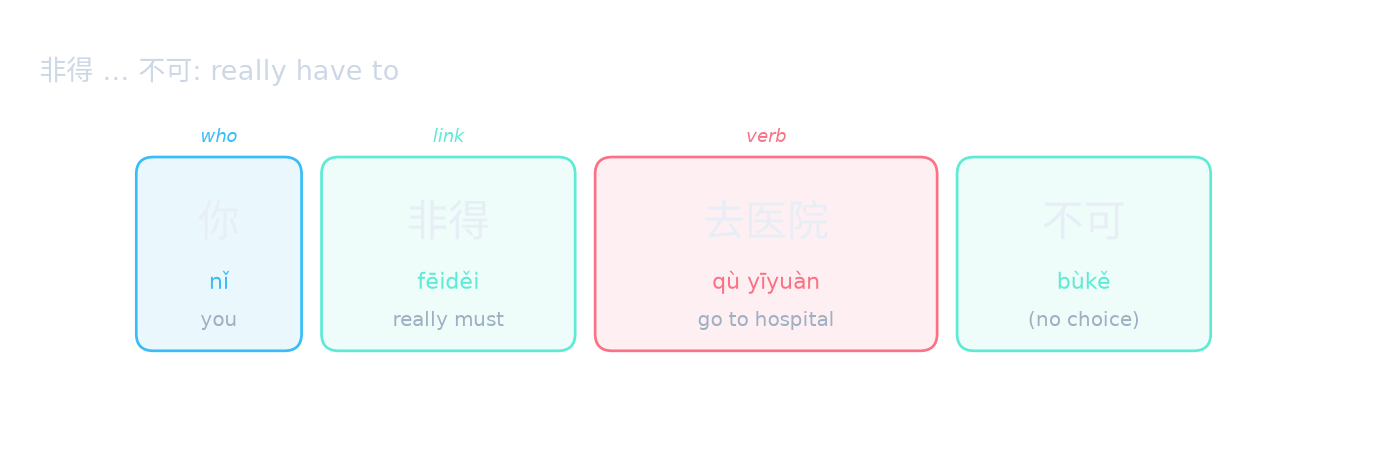
- you你to burn烧(degree marker)得so much这么(used to describe sb or sth…厉害,(followed by a verb phrase…非得to go去hospital医院cannot不可。 — "With a fever this bad, you absolutely have to go to hospital."
(followed by a verb phrase…非得 + verb (+ cannot不可) = must, have to
- (followed by a verb phrase…非得 (fēi děi) = must, absolutely have to; cannot不可 / won't do不行 can close the sentence for extra force.
- In speech, (followed by a verb phrase…非得 alone often works: you你(followed by a verb phrase…非得today今天to go去(yes/no ?)吗?
you你must非得today今天go去吗?
Necessity and insistence
- Necessity: 这份to inform报告(followed by a verb phrase…非得today今天to hand over交cannot不可。 — "This report absolutely must be handed in today."
- Insistence: he / him他(followed by a verb phrase…非得oneself自己to make做,who谁to help帮忙all / both都don't不要。 — "He insists on doing it himself and won't take help from anyone."
this这份report报告must非得today今天be handed in交(absolutely)不可。
Read it fēi děi
- (degree marker)得 here is děi ("must"), not de.
- (followed by a verb phrase…非得 is spoken; in writing, to have to必须 is the neutral choice.
(followed by a verb phrase…非得 versus to not be非…cannot不可
- to not be非…cannot不可 puts the verb in the middle: 非去不可.
- (followed by a verb phrase…非得…(cannot不可) is the spoken variant with (degree marker)得: (followed by a verb phrase…非得to go去 / (followed by a verb phrase…非得to go去cannot不可. Both are emphatic.
I我(must)非go去(must)不可。
Recap
- (followed by a verb phrase…非得 (fēi děi) + verb (+ cannot不可 / won't do不行) = absolutely must / insist on.
- Spoken; to not be非…cannot不可 is the classic form; to have to必须 is neutral.
Practise this pattern step by step.
firstly, ...一来 … ,secondly, ...二来 … (firstly …, secondly …)
Two good reasons
- A friend asks why you chose to live near your office.
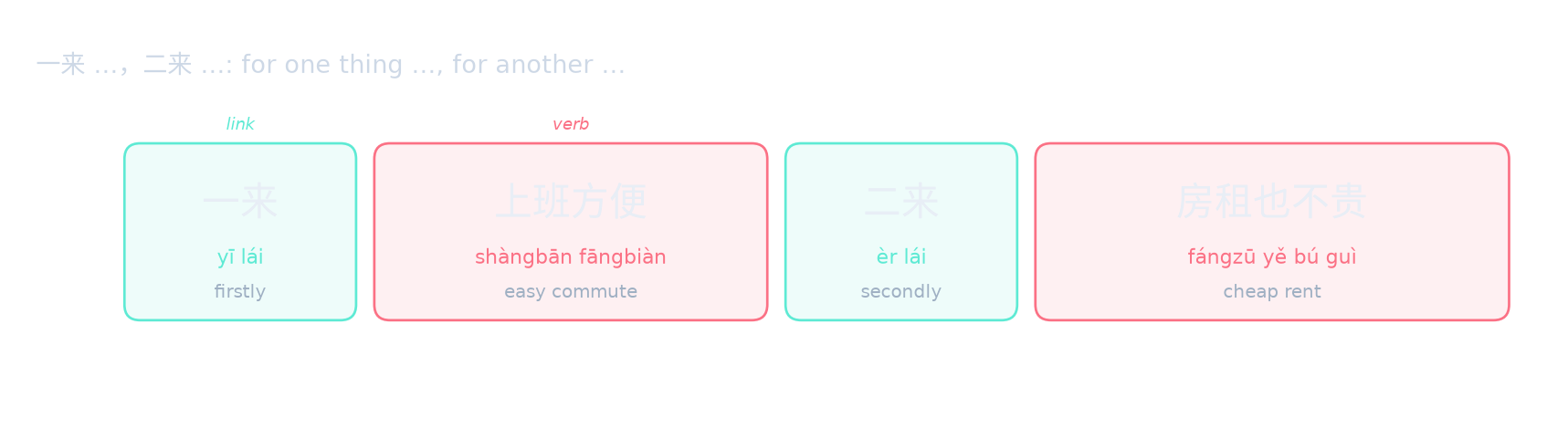
- firstly, ...一来to go to work上班convenient方便,secondly, ...二来rent for a room or house房租also也not不expensive贵。 — "Firstly, it's convenient for work; secondly, the rent isn't high."
firstly, ...一来 A,secondly, ...二来 B = firstly …, secondly …
- firstly, ...一来…,secondly, ...二来… lists two reasons for a choice, usually in speech.
- Each reason is a short clause; a third can follow with 三来.
firstly一来it's cheap便宜,secondly二来from离home家close近。
Explaining a decision
- I / me我坐地铁,firstly, ...一来rapid快,secondly, ...二来不堵车。 — "I take the subway: firstly it's fast, secondly there are no traffic jams."
- 他学Chinese language中文,firstly, ...一来to be / is是in order to为了to work工作,secondly, ...二来to be / is是to like喜欢China中国culture文化。 — "He's learning Chinese partly for work and partly because he likes Chinese culture."
firstly一来is是for为了work工作,secondly二来is是liking喜欢culture文化。
Reasons, not steps
- firstly, ...一来…secondly, ...二来… gives reasons; for steps in a sequence, use first (of all)首先…then / after然后… or first第一…second第二….
- Keep the two reasons parallel and short.
Versus on the one hand一方面…on the other hand另一方面…
- on the one hand一方面…on the other hand另一方面… weighs two aspects, sometimes in contrast.
- firstly, ...一来…secondly, ...二来… simply lists supporting reasons for one decision.
first首先wash洗the vegetables菜,then然后cut them切。
Recap
- firstly, ...一来 A,secondly, ...二来 B (三来 C) = firstly …, secondly … (reasons for a choice).
- Steps take first (of all)首先…then / after然后…; contrasting aspects take on the one hand一方面….
Practise this pattern step by step.
Practice without the models
how? (emphatic question)岂no不是 (wouldn't that be …?)
0701.1 Complete: “Wouldn't that be even more trouble?” this way / so这样…………more更trouble麻烦?
0701.2 Which is the casual spoken equivalent of how? (emphatic question)岂no不是白花钱(completed / change)了?
- A. 白花钱is or isn't是不是?
- B. how? (emphatic question)岂白花钱?
- C. that那not不then / just就白花钱(completed / change)了(yes/no ?)吗?
- D. to spend money花钱white白(completed / change)了(yes/no ?)吗?
0701.3 Build: “If we go now, won't we be late?”
Arrange all chunks: now现在to go去if (coming after a…的话 / how? (emphatic question)岂no不是 / , / want / will / need要to arrive late迟到?
0701.4 how? (emphatic question)岂no不是 asks for information the speaker doesn't have.
True or false? Explain or repair the statement.
0701.5 Your friend bought a gym membership but never goes. Close the examples. Say a Mandarin response, then write it in Chinese. Explain briefly in English what the lesson’s pattern adds. Compare with the model, then change one detail and try again.
Write or say your own response before reading the key.
to not be非(want / will / need要) … cannot不可 (simply must / insist on)
0702.1 Complete: “This problem absolutely must be solved.” this这个question问题to not be非to solve解决…………。
0702.2 Which order is correct?
- A. he / him他to want absolutely非要to go去cannot不可。
- B. he / him他cannot不可to want absolutely非要to go去。
- C. he / him他want / will / need要to go去to not be非cannot不可。
- D. he / him他to not be非cannot不可want / will / need要to go去。
0702.3 Build: “She insisted on paying.”
Arrange all chunks: to give a dinner party请客 / to not be非want / will / need要 / she / her她 / cannot不可。
0702.4 to not be非…cannot不可 is more emphatic than to have to必须.
True or false? Explain or repair the statement.
0702.5 Your little brother wants to go to the amusement park in the rain and won't take no for an answer. Close the examples. Say a Mandarin response, then write it in Chinese. Explain briefly in English what the lesson’s pattern adds. Compare with the model, then change one detail and try again.
Write or say your own response before reading the key.
double兼 (doubling as / concurrently)
0703.1 Complete: “He is the driver and also the guide.” he / him他to be / is是chauffeur司机…………tour guide导游。
0703.2 Which is wrong?
- A. this这gap间house屋子to be / is是drawing room (room for…客厅double兼study (room)书房。
- B. she / her她to make做to hold concurrent posts兼职。
- C. he / him他to be / is是teacher老师double兼to translate翻译。
- D. 这件clothes衣服cheap便宜double兼good-looking好看。
0703.3 Build: “She does a part-time job at a café.”
Arrange all chunks: she / her她 / to hold concurrent posts兼职。 / at / in在café咖啡馆 / to make做
0703.4 double兼 joins roles held at the same time.
True or false? Explain or repair the statement.
0703.5 In a small start-up, one person often has several roles. Close the examples. Say a Mandarin response, then write it in Chinese. Explain briefly in English what the lesson’s pattern adds. Compare with the model, then change one detail and try again.
Write or say your own response before reading the key.
can it be possible that莫非 (could it be that …?)
0704.1 Complete: “Could it be that he's ill?” …………he / him他to fall ill生病(completed / change)了?
0704.2 Which is the everyday spoken equivalent of can it be possible that莫非today今天to have a holiday or…放假?
- A. today今天to have a holiday or…放假(yes/no ?)吗won't do不成?
- B. is or isn't是不是today今天to have a holiday or…放假?
- C. to have a holiday or…放假today今天can it be possible that莫非?
- D. today今天can it be possible that莫非to have a holiday or…放假(completed / change)了。
0704.3 Build: “Could something have happened?”
Arrange all chunks: can it be possible that莫非 / what什么matter事? / variant of 出 (classifier…出(completed / change)了
0704.4 can it be possible that莫非 states a fact.
True or false? Explain or repair the statement.
0704.5 The office is dark at nine in the morning and nobody is answering the phone. Close the examples. Say a Mandarin response, then write it in Chinese. Explain briefly in English what the lesson’s pattern adds. Compare with the model, then change one detail and try again.
Write or say your own response before reading the key.
hereby由此 (from this / hence)
0705.1 Complete: “From this we can see that…” …………it can clearly be seen…可见……
0705.2 Where must hereby由此 come?
- A. Only in questions
- B. At the very start of a text
- C. After the evidence it refers to
- D. After (yes/no ?)吗
0705.3 Build: “Many problems arose from this.”
Arrange all chunks: hereby由此 / 很多 / question问题。 / to arise产生(completed / change)了
0705.4 hereby由此 is more written than so / therefore所以.
True or false? Explain or repair the statement.
0705.5 A researcher presents a survey on how much students sleep. Close the examples. Say a Mandarin response, then write it in Chinese. Explain briefly in English what the lesson’s pattern adds. Compare with the model, then change one detail and try again.
Write or say your own response before reading the key.
nothing can surpass莫过于 (nothing is more … than)
0706.1 Complete: “Nothing is more important than health.” most最important重要(modifier / structural particle)的…………health健康。
0706.2 Which is the plainer spoken equivalent?
- A. most最important重要(modifier / structural particle)的to be / is是health健康。
- B. health健康nothing can surpass莫过于important重要。
- C. important重要nothing can surpass莫过于most最health健康。
- D. most最health健康nothing can surpass莫过于。
0706.3 Build: “The best method is plenty of practice.”
Arrange all chunks: nothing can surpass莫过于 / many多to practice练习。 / best最好(modifier / structural particle)的method方法
0706.4 nothing can surpass莫过于 is followed by a single top example.
True or false? Explain or repair the statement.
0706.5 Asked about the happiest moment of the week, your grandmother smiles. Close the examples. Say a Mandarin response, then write it in Chinese. Explain briefly in English what the lesson’s pattern adds. Compare with the model, then change one detail and try again.
Write or say your own response before reading the key.
rather than...与其 A,preferably宁可 / would rather ... (than ...)宁愿 B (rather than … would rather)
0707.1 Complete: “Rather than complain, better find a solution.” rather than...与其to complain抱怨,…………want / think / miss想means办法。
0707.2 In rather than...与其to be at home在家to wait for等,I / me我would rather ... (than ...)宁愿to go out出去to try to find找, which option does the speaker reject?
- A. both
- B. neither
- C. waiting at home
- D. going out to look
0707.3 Build: “Rather than wait in the car, I'd rather walk.”
Arrange all chunks: I / me我preferably宁可 / to walk走路to go去。 / rather than...与其at / in在车里to wait for等 / ,
0707.4 In preferably宁可 A,also也not不 B, B is the rejected option.
True or false? Explain or repair the statement.
0707.5 The traffic is completely stuck, and your office is only two kilometres away. Close the examples. Say a Mandarin response, then write it in Chinese. Explain briefly in English what the lesson’s pattern adds. Compare with the model, then change one detail and try again.
Write or say your own response before reading the key.
with / and跟 … seems as if似的 (just like / as if)
0708.1 Complete: “He was as happy as a child.” he / him他happy高兴(degree marker)得with / and跟child孩子…………。
0708.2 How is old variant of 似似 read in seems as if似的?
- A. shí
- B. sī
- C. sì
- D. shì
0708.3 Build: “It's as if he knows everything.”
Arrange all chunks: what什么all / both都to know知道 / seems as if似的。 / he / him他as if好像
0708.4 to resemble像…same一样 is more neutral than with / and跟…seems as if似的.
True or false? Explain or repair the statement.
0708.5 You come in from a winter walk and your hands are freezing. Close the examples. Say a Mandarin response, then write it in Chinese. Explain briefly in English what the lesson’s pattern adds. Compare with the model, then change one detail and try again.
Write or say your own response before reading the key.
to be worthy of不愧to be / is是 (truly worthy of)
0709.1 Praise: “You really are a master chef!” you你…………to be / is是大厨!
0709.2 Is to be worthy of不愧 used for criticism?
- A. No, it is praise
- B. Only in questions
- C. Yes, often
- D. Only about places
0709.3 Build: “As expected he won; he truly is the champion.”
Arrange all chunks: , / champion冠军。 / to be worthy of不愧to be / is是 / he / him他really果然to beat赢(completed / change)了
0709.4 to be worthy of不愧to be / is是best-seller畅销书 means the book deserves to be a bestseller.
True or false? Explain or repair the statement.
0709.5 The national champion wins again, easily, in front of a huge crowd. Close the examples. Say a Mandarin response, then write it in Chinese. Explain briefly in English what the lesson’s pattern adds. Compare with the model, then change one detail and try again.
Write or say your own response before reading the key.
to follow由 … see 作主做主 (for … to decide)
0710.1 Complete: “It's up to you.” to follow由you你oneself自己…………。
0710.2 What does I / me我做不了owner主 mean?
- A. I decided not to.
- B. I can't decide quickly.
- C. It's not my decision to make.
- D. I am the boss.
0710.3 Build: “Big family decisions are made by Grandpa.”
Arrange all chunks: home家里(modifier / structural particle)的major event大事 / (coll.) father's father爷爷 / all / both都to follow由 / see 作主做主。
0710.4 (passive: by)被you你see 作主做主 is correct.
True or false? Explain or repair the statement.
0710.5 Your parents ask what you want to study at university. Close the examples. Say a Mandarin response, then write it in Chinese. Explain briefly in English what the lesson’s pattern adds. Compare with the model, then change one detail and try again.
Write or say your own response before reading the key.
(followed by a verb phrase…非得 … cannot不可 (absolutely must)
0711.1 Complete: “Do you really have to go today?” you你…………today今天to go去(yes/no ?)吗?
0711.2 How is (degree marker)得 read in (followed by a verb phrase…非得?
- A. dé
- B. dì
- C. děi
- D. de
0711.3 Build: “This report must be handed in today.”
Arrange all chunks: today今天to hand over交 / cannot不可。 / (followed by a verb phrase…非得 / 这份to inform报告
0711.4 非去不可 and (followed by a verb phrase…非得to go去 are both emphatic.
True or false? Explain or repair the statement.
0711.5 Your friend has had a fever for three days but refuses to see a doctor. Close the examples. Say a Mandarin response, then write it in Chinese. Explain briefly in English what the lesson’s pattern adds. Compare with the model, then change one detail and try again.
Write or say your own response before reading the key.
firstly, ...一来 … ,secondly, ...二来 … (firstly …, secondly …)
0712.1 Complete: “Firstly it's cheap, secondly it's close to home.” firstly, ...一来cheap便宜,…………离家近。
0712.2 For steps in a recipe, which is better?
- A. first (of all)首先洗菜,then / after然后切菜。
- B. on the one hand一方面洗菜,on the one hand一方面切菜。
- C. firstly, ...一来洗菜,secondly, ...二来切菜。
- D. secondly, ...二来洗菜,firstly, ...一来切菜。
0712.3 Build: “I take the subway: firstly it's fast, secondly there are no jams.”
Arrange all chunks: ,firstly, ...一来rapid快 / 不堵车。 / I / me我坐地铁 / ,secondly, ...二来
0712.4 firstly, ...一来…secondly, ...二来… lists reasons for one decision.
True or false? Explain or repair the statement.
0712.5 A friend asks why you chose to live near your office. Close the examples. Say a Mandarin response, then write it in Chinese. Explain briefly in English what the lesson’s pattern adds. Compare with the model, then change one detail and try again.
Write or say your own response before reading the key.
Answers and explanations
how? (emphatic question)岂no不是 (wouldn't that be …?)
0701.1 how? (emphatic question)岂no不是
how? (emphatic question)岂no不是 + consequence.
0701.2 C. that那not不then / just就白花钱(completed / change)了(yes/no ?)吗?
that那not不then / just就…(completed / change)了(yes/no ?)吗? is the spoken form.
0701.3 now现在to go去if (coming after a…的话,how? (emphatic question)岂no不是want / will / need要to arrive late迟到?
Condition, how? (emphatic question)岂no不是 + consequence.
0701.4 False.
False. how? (emphatic question)岂no不是 is rhetorical: it asks “wouldn't that be …?” to make a point the speaker already believes, as in this way / so这样how? (emphatic question)岂no不是更好?
0701.5 One possible response: you你not不to go去if (coming after a…的话,how? (emphatic question)岂no不是白花钱(completed / change)了?
Check meaning and form:
- My response conveys a message that fits the opening situation.
- I can explain the meaning of the pattern, rather than only naming it.
- how? (emphatic question)岂no不是 does not ask for information; the speaker is sure of the answer.
- It is a bit literary; in casual speech, that那not不then / just就…(completed / change)了(yes/no ?)吗? is common: that那not不then / just就白花钱(completed / change)了(yes/no ?)吗?
- I tried a second response with a name, time, place, or description changed.
This is supported productive practice. Compare meaning and structure; your answer need not copy the model. A partner or teacher must hear the spoken response to comment on pronunciation.
to not be非(want / will / need要) … cannot不可 (simply must / insist on)
0702.1 cannot不可
to not be非…cannot不可.
0702.2 A. he / him他to want absolutely非要to go去cannot不可。
The frame is to not be非 + (want / will / need要) + verb + cannot不可, meaning “must, insist on”: he / him他to want absolutely非要to go去cannot不可. to not be非 comes before the verb phrase and cannot不可 closes the sentence.
0702.3 she / her她to want absolutely非要to give a dinner party请客cannot不可。
to not be非want / will / need要 + verb + cannot不可.
0702.4 True.
It stresses there is no other way.
0702.5 One possible response: down下so much这么see 大夫大(modifier / structural particle)的(literary) to rain雨,he / him他to want absolutely非要to go去cannot不可。
Check meaning and form:
- My response conveys a message that fits the opening situation.
- I can explain the meaning of the pattern, rather than only naming it.
- In careful style, keep cannot不可 (or won't do不行 / won't do不成) at the end: 非去不可. In speech cannot不可 is sometimes dropped: he / him他to want absolutely非要to go去.
- to not be非 + verb, then cannot不可: not to not be非cannot不可to go去.
- I tried a second response with a name, time, place, or description changed.
This is supported productive practice. Compare meaning and structure; your answer need not copy the model. A partner or teacher must hear the spoken response to comment on pronunciation.
double兼 (doubling as / concurrently)
0703.1 double兼
A double兼 B for two roles of one person.
0703.2 D. 这件clothes衣服cheap便宜double兼good-looking好看。
Qualities take again又…again又…, not double兼.
0703.3 she / her她at / in在café咖啡馆to make做to hold concurrent posts兼职。
to hold concurrent posts兼职 = part-time job.
0703.4 True.
True. double兼 links two roles or functions held at the same time: manager经理double兼technician技术员 “manager and also technician”, both held by one person.
0703.5 One possible response: he / him他to be / is是we / us我们company公司(modifier / structural particle)的manager经理double兼technician技术员。
Check meaning and form:
- My response conveys a message that fits the opening situation.
- I can explain the meaning of the pattern, rather than only naming it.
- double兼 is for roles held at the same time by one person or thing; two different people take and / with和.
- It joins nouns of roles or functions: manager经理double兼technician技术员, not degree / adjective linker很good好double兼degree / adjective linker很cheap便宜 (use again又…again又…).
- I tried a second response with a name, time, place, or description changed.
This is supported productive practice. Compare meaning and structure; your answer need not copy the model. A partner or teacher must hear the spoken response to comment on pronunciation.
can it be possible that莫非 (could it be that …?)
0704.1 can it be possible that莫非
can it be possible that莫非 + guess.
0704.2 B. is or isn't是不是today今天to have a holiday or…放假?
is or isn't是不是…? is the spoken form.
0704.3 can it be possible that莫非variant of 出 (classifier…出(completed / change)了what什么matter事?
can it be possible that莫非 + guess.
0704.4 False.
It introduces an uncertain guess.
0704.5 One possible response: can it be possible that莫非today今天to have a holiday or…放假?
Check meaning and form:
- My response conveys a message that fits the opening situation.
- I can explain the meaning of the pattern, rather than only naming it.
- can it be possible that莫非 marks an uncertain guess; it does not state a fact.
- It is literary; in speech, don't tell me ...难道 or is or isn't是不是 is more common: is or isn't是不是today今天to have a holiday or…放假?
- I tried a second response with a name, time, place, or description changed.
This is supported productive practice. Compare meaning and structure; your answer need not copy the model. A partner or teacher must hear the spoken response to comment on pronunciation.
hereby由此 (from this / hence)
0705.1 hereby由此
from this, it can be seen…由此可见 = it can be seen from this.
0705.2 C. After the evidence it refers to
hereby由此 refers back to what was just said.
0705.3 hereby由此to arise产生(completed / change)了很多question问题。
hereby由此 + verb + result.
0705.4 True.
True. hereby由此 (“from this, hence”) belongs to analytical and written style: from this, it can be seen…由此可见 “from this we can see”. In speech so / therefore所以 is normal.
0705.5 One possible response: (great) majority大多数student学生every day每天睡不到七个hour小时,from this, it can be seen…由此可见,to learn学习pressure压力很大。
Check meaning and form:
- My response conveys a message that fits the opening situation.
- I can explain the meaning of the pattern, rather than only naming it.
- hereby由此 needs the evidence or event first; it cannot start a text.
- It is written and analytical; in speech, so / therefore所以 / apparently看来 do the job.
- I tried a second response with a name, time, place, or description changed.
This is supported productive practice. Compare meaning and structure; your answer need not copy the model. A partner or teacher must hear the spoken response to comment on pronunciation.
nothing can surpass莫过于 (nothing is more … than)
0706.1 nothing can surpass莫过于
most最…(modifier / structural particle)的nothing can surpass莫过于 X.
0706.2 A. most最important重要(modifier / structural particle)的to be / is是health健康。
most最…(modifier / structural particle)的to be / is是… (“the most … is …”) is the plain spoken form: most最important重要(modifier / structural particle)的to be / is是health健康. nothing can surpass莫过于 is a written way to say “nothing is more … than”, as in most最important重要(modifier / structural particle)的nothing can surpass莫过于health健康.
0706.3 best最好(modifier / structural particle)的method方法nothing can surpass莫过于many多to practice练习。
most最…(modifier / structural particle)的 + nothing can surpass莫过于 + X.
0706.4 True.
True. nothing can surpass莫过于 means “nothing exceeds” and is followed by the single top example: 最大(modifier / structural particle)的happy快乐nothing can surpass莫过于助人.
0706.5 One possible response: most最to feel happy开心(modifier / structural particle)的nothing can surpass莫过于weekend周末whole family全家in the same place一起to have a meal吃饭。
Check meaning and form:
- My response conveys a message that fits the opening situation.
- I can explain the meaning of the pattern, rather than only naming it.
- X after nothing can surpass莫过于 is the single best example; do not put a list there.
- It is formal; in speech say most最…(modifier / structural particle)的to be / is是….
- I tried a second response with a name, time, place, or description changed.
This is supported productive practice. Compare meaning and structure; your answer need not copy the model. A partner or teacher must hear the spoken response to comment on pronunciation.
rather than...与其 A,preferably宁可 / would rather ... (than ...)宁愿 B (rather than … would rather)
0707.1 not equal to不如
rather than...与其 A,not equal to不如 B.
0707.2 C. waiting at home
The rather than...与其 option is rejected.
0707.3 rather than...与其at / in在车里to wait for等,I / me我preferably宁可to walk走路to go去。
rather than...与其 A,preferably宁可 B.
0707.4 True.
The order is reversed compared with rather than...与其.
0707.5 One possible response: rather than...与其at / in在车里to wait for等,I / me我preferably宁可to walk走路to go去。
Check meaning and form:
- My response conveys a message that fits the opening situation.
- I can explain the meaning of the pattern, rather than only naming it.
- The option after rather than...与其 is the one rejected; the one after preferably宁可 / not equal to不如 is chosen.
- variant of 宁宁 in preferably宁可 / would rather ... (than ...)宁愿 is read nìng.
- I tried a second response with a name, time, place, or description changed.
This is supported productive practice. Compare meaning and structure; your answer need not copy the model. A partner or teacher must hear the spoken response to comment on pronunciation.
with / and跟 … seems as if似的 (just like / as if)
0708.1 seems as if似的
with / and跟 X seems as if似的 = like X.
0708.2 D. shì
In seems as if似的 (“as if, like”), old variant of 似似 is read shì: to resemble像…seems as if似的 xiàng … shìde. In other words such as it seems似乎 and similar相似 it is read sì.
0708.3 he / him他as if好像what什么all / both都to know知道seems as if似的。
as if好像 + clause + seems as if似的.
0708.4 True.
with / and跟…seems as if似的 is spoken and vivid.
0708.5 One possible response: I / me我(modifier / structural particle)的hand手冷得with / and跟variant of 冰冰seems as if似的。
Check meaning and form:
- My response conveys a message that fits the opening situation.
- I can explain the meaning of the pattern, rather than only naming it.
- seems as if似的 is read shì de, not sì de.
- It is spoken and vivid; in writing, to resemble像…same一样 or to seem仿佛 are common.
- I tried a second response with a name, time, place, or description changed.
This is supported productive practice. Compare meaning and structure; your answer need not copy the model. A partner or teacher must hear the spoken response to comment on pronunciation.
to be worthy of不愧to be / is是 (truly worthy of)
0709.1 to be worthy of不愧
to be worthy of不愧to be / is是 + identity.
0709.2 A. No, it is praise
to be worthy of不愧 praises someone for living up to a name.
0709.3 he / him他really果然to beat赢(completed / change)了,to be worthy of不愧to be / is是champion冠军。
really果然 + result, to be worthy of不愧to be / is是 + title.
0709.4 True.
It lives up to the title.
0709.5 One possible response: to be worthy of不愧to be / is是champion冠军,he / him他to run跑(degree marker)得太快(completed / change)了!
Check meaning and form:
- My response conveys a message that fits the opening situation.
- I can explain the meaning of the pattern, rather than only naming it.
- to be worthy of不愧 is positive; for "doesn't deserve", say 配不上 or the name does not reflect…名不副实.
- Give the reason: to be worthy of不愧to be / is是champion冠军 alone sounds unfinished without the achievement.
- I tried a second response with a name, time, place, or description changed.
This is supported productive practice. Compare meaning and structure; your answer need not copy the model. A partner or teacher must hear the spoken response to comment on pronunciation.
to follow由 … see 作主做主 (for … to decide)
0710.1 see 作主做主
to follow由 + person + see 作主做主.
0710.2 C. It's not my decision to make.
做不了owner主 = lack the authority.
0710.3 home家里(modifier / structural particle)的major event大事all / both都to follow由(coll.) father's father爷爷see 作主做主。
Matter + to follow由 + person + see 作主做主.
0710.4 False.
False. to follow由 marks who is responsible for a decision: to follow由you你see 作主做主 “It's up to you.” (passive: by)被 marks the passive and does not fit here.
0710.5 One possible response: this这to be / is是you你(modifier / structural particle)的life (one's time on earth)人生,to follow由you你oneself自己see 作主做主。
Check meaning and form:
- My response conveys a message that fits the opening situation.
- I can explain the meaning of the pattern, rather than only naming it.
- to follow由 + person comes before see 作主做主; the matter decided is the topic in front: 这件main content事由you你see 作主做主.
- Do not use (passive: by)被: (passive: by)被you你see 作主做主 is wrong.
- I tried a second response with a name, time, place, or description changed.
This is supported productive practice. Compare meaning and structure; your answer need not copy the model. A partner or teacher must hear the spoken response to comment on pronunciation.
(followed by a verb phrase…非得 … cannot不可 (absolutely must)
0711.1 (followed by a verb phrase…非得
(followed by a verb phrase…非得 = must (spoken).
0711.2 C. děi
In (followed by a verb phrase…非得 (“must, have to”), (degree marker)得 is read děi, as in you你(degree marker)得to go去. It is not the structural particle de or dé “obtain”.
0711.3 这份to inform报告(followed by a verb phrase…非得today今天to hand over交cannot不可。
(followed by a verb phrase…非得 + verb + cannot不可.
0711.4 True.
Both mean “absolutely must go”.
0711.5 One possible response: you你to burn烧(degree marker)得so much这么(used to describe sb or sth…厉害,(followed by a verb phrase…非得to go去hospital医院cannot不可。
Check meaning and form:
- My response conveys a message that fits the opening situation.
- I can explain the meaning of the pattern, rather than only naming it.
- (degree marker)得 here is děi ("must"), not de.
- (followed by a verb phrase…非得 is spoken; in writing, to have to必须 is the neutral choice.
- I tried a second response with a name, time, place, or description changed.
This is supported productive practice. Compare meaning and structure; your answer need not copy the model. A partner or teacher must hear the spoken response to comment on pronunciation.
firstly, ...一来 … ,secondly, ...二来 … (firstly …, secondly …)
0712.1 secondly, ...二来
firstly, ...一来…,secondly, ...二来….
0712.2 A. first (of all)首先洗菜,then / after然后切菜。
Steps take first (of all)首先…then / after然后…; firstly, ...一来…secondly, ...二来… gives reasons.
0712.3 I / me我坐地铁,firstly, ...一来rapid快,secondly, ...二来不堵车。
Decision, then firstly, ...一来…secondly, ...二来….
0712.4 True.
True. firstly, ...一来…secondly, ...二来… lists two reasons for one decision or situation: firstly, ...一来day天太晚,secondly, ...二来I / me我degree / adjective linker很rope累,so / therefore所以不去(completed / change)了.
0712.5 One possible response: firstly, ...一来to go to work上班convenient方便,secondly, ...二来rent for a room or house房租also也not不expensive贵。
Check meaning and form:
- My response conveys a message that fits the opening situation.
- I can explain the meaning of the pattern, rather than only naming it.
- firstly, ...一来…secondly, ...二来… gives reasons; for steps in a sequence, use first (of all)首先…then / after然后… or first第一…second第二….
- Keep the two reasons parallel and short.
- I tried a second response with a name, time, place, or description changed.
This is supported productive practice. Compare meaning and structure; your answer need not copy the model. A partner or teacher must hear the spoken response to comment on pronunciation.