Original teaching practice. Read one pattern, cover its model and try the questions before checking the separate answer section. Examples adapted from Chinese Grammar Wiki (AllSet Learning, CC BY-NC-SA) retain the course-reference provenance.
to link连 … all / both都 … not不 / not / haven't没 (not even)
A day with no break
- You were so busy at work that you didn't have a single break.
- I / me我today今天busy忙(degree marker)得to link连readily一口water水all / both都not / haven't没to shout喝。 — "I was so busy today I didn't even have a sip of water."
to link连 + X + all / both都 / also也 + not不 / not / haven't没 + Verb
- to link连 X all / both都/also也 + negative = "not even X": X is the smallest or easiest thing, and still it didn't happen.
- X moves before the verb: to link连he / him他(modifier / structural particle)的name (of a person or thing)名字all / both都not不to know知道.
I我even连his他的name名字(even)都don't不know知道。

The minimum didn't happen
- he / him他to link连一个letter字all / both都not / haven't没to write写。 — "He didn't write a single character."
- so much这么simple简单(modifier / structural particle)的topic题,he / him他to link连to see看all / both都not / haven't没to see看then / just就to hand over交(completed / change)了。 — "Such an easy question, and he handed it in without even looking at it."
he他even连one一个character字(even)都didn't没write写。
X before the verb
- The to link连 phrase comes before the verb: 连饭all / both都not / haven't没variant of 吃吃, not not / haven't没variant of 吃吃连饭.
- Keep all / both都 / also也: 连水not / haven't没to shout喝 is incomplete; say 连水all / both都not / haven't没to shout喝.
to link连 + Verb + all / both都 + not / haven't没 + Verb
- The same verb can repeat: he / him他to link连want / think / miss想all / both都not / haven't没want / think / miss想then / just就to answer答应(completed / change)了。 — "He agreed without even thinking."
- This shows how little effort or care was taken.
he他even连think想(even)都didn't没think想then就agreed答应了。
Recap
- to link连 X all / both都 / also也 + not不 / not / haven't没 + Verb = not even X.
- X goes before the verb; keep all / both都 / also也. 连想all / both都not / haven't没want / think / miss想 = without even thinking.
Practise this pattern step by step.
for为 … and / but而 … (for the sake of)
Working for a dream
- Your cousin works two jobs to save for university.
- he / him他in order to为了(bound form) up上university大学and / but而to make an effort努力to work工作。 — "He works hard in order to go to university."
for为((completed / change)了) + goal + and / but而 + action
- for为((completed / change)了) A and / but而 B = "do B for the sake of A": a formal way to link a purpose with an action.
- and / but而 links the purpose to the verb that follows: for为an ideal理想and / but而to strive奋斗 — "strive for an ideal".
we我们for为our ideals理想(and)而strive奋斗。

Feelings caused by something
- for为 + cause + and / but而 + feeling: everyone大家all / both都for为he / him他(modifier / structural particle)的success成功and / but而happy高兴。 — "Everyone was happy about his success."
- don't不要for为trifle小事and / but而to get angry生气。 — "Don't get angry over small things."
everyone大家all都about为his他的success成功(and)而happy高兴。
Formal, and for为 is wèi
- In this pattern for为 is read wèi ("for"); it is written or formal speech. In chat, in order to为了…, I / me我… is enough.
- and / but而 does not mean "but" here; it links the purpose or cause to the action.
for为…and / but而… versus in order to为了
- in order to为了 + goal, clause: in order to为了(bound form) up上university大学,he / him他to make an effort努力to work工作 — the everyday form.
- for为…and / but而… puts the goal and action in one tight phrase, common in speeches and slogans.
in order to为了go to上university大学,he他hard努力works工作。
Recap
- for为((completed / change)了) A and / but而 B = do B for the sake of A; for为 + cause + and / but而 + feeling = feel … about.
- Formal; for为 = wèi; and / but而 links, it is not "but".
Practise this pattern step by step.
any任何 + Noun + all / both都 / also也 (any)
Any questions?
- At the end of the lesson your teacher wants to be sure everyone understood.
- to have / there is有any任何question问题,all / both都can / may可以to ask问I / me我。 — "If you have any questions at all, you can ask me."
any任何 + Noun + all / both都 / also也
- any任何 + noun = "any (at all)"; all / both都 or also也 usually follows: 任何人all / both都can / may可以to participate参加.
- In the negative: 任何人all / both都not不to know知道 / he / him他not have / haven't没有any任何question问题 — "nobody / no … at all".
any任何person人(all)都can可以take part参加。

Total statements
- I / me我improbable不会to tell告诉任何人。 — "I won't tell anyone."
- any任何time时候you你all / both都can / may可以to / for / give给I / me我to make a telephone call打电话。 — "You can call me any time."
I我won't不(will)会tell告诉any任何person人。
Add all / both都 as a subject
- As a subject, any任何 + noun needs all / both都 / also也: 任何人all / both都to know知道, not 任何人to know知道.
- any任何 goes before a noun only; it does not stand alone: 任何人, not just any任何.
any任何 versus question word + all / both都
- Spoken: who谁all / both都can / may可以to come来 — "Anyone can come."
- 任何人all / both都can / may可以to come来 says the same in a more formal way.
anyone谁(all)都can可以come来。
Recap
- any任何 + noun + all / both都 / also也 = any … at all; negative = no … at all.
- Needs a noun and, as a subject, all / both都 / also也. who谁all / both都 is the spoken equivalent.
Practise this pattern step by step.
already既 … also也 / again又 … (both … and …)
Good-looking and practical
- You are recommending a backpack to a friend.
- this这个to cover包already既good-looking好看again又practical实用。 — "This bag is both good-looking and practical."
already既 A again又 / also也 B = both A and B
- already既 A again又 B joins two qualities or actions of the same subject; again又 / also也 introduces the second.
- It sounds a little more formal and balanced than again又…again又….
she她both既clever聪明and又hard-working努力。

Two roles or two actions
- he / him他already既to be / is是teacher老师,also也to be / is是author作家。 — "He is both a teacher and a writer."
- we / us我们already既want / will / need要to learn学习,also也want / will / need要rest休息。 — "We need both to study and to rest."
we我们both既need to要study学习,also也need to要rest休息。
Same subject, same direction
- Both parts belong to one subject: he / him他already既…again又…, not he / him他already既…,she / her她again又….
- The two qualities should fit together (both good, both bad); for a contrast use but但是.
already既…again又… versus not only (... but also ...)不但…moreover而且…
- already既…again又… gives two qualities equal weight.
- not only (... but also ...)不但…moreover而且… builds up: the second point is stronger: not only (... but also ...)不但cheap便宜,moreover而且quality质量degree / adjective linker很good好.
not only不但cheap便宜,but also而且quality质量very很good好。
Recap
- already既 A again又 / also也 B = both A and B (same subject, equal weight).
- not only (... but also ...)不但…moreover而且… builds up to a stronger second point.
Practise this pattern step by step.
at / in在 + Place + (bound form) up上 / down下 / li, ancient measure of…里 / side旁边 (location)
Where did I put it?
- You can't find your keys and your roommate helps you look.
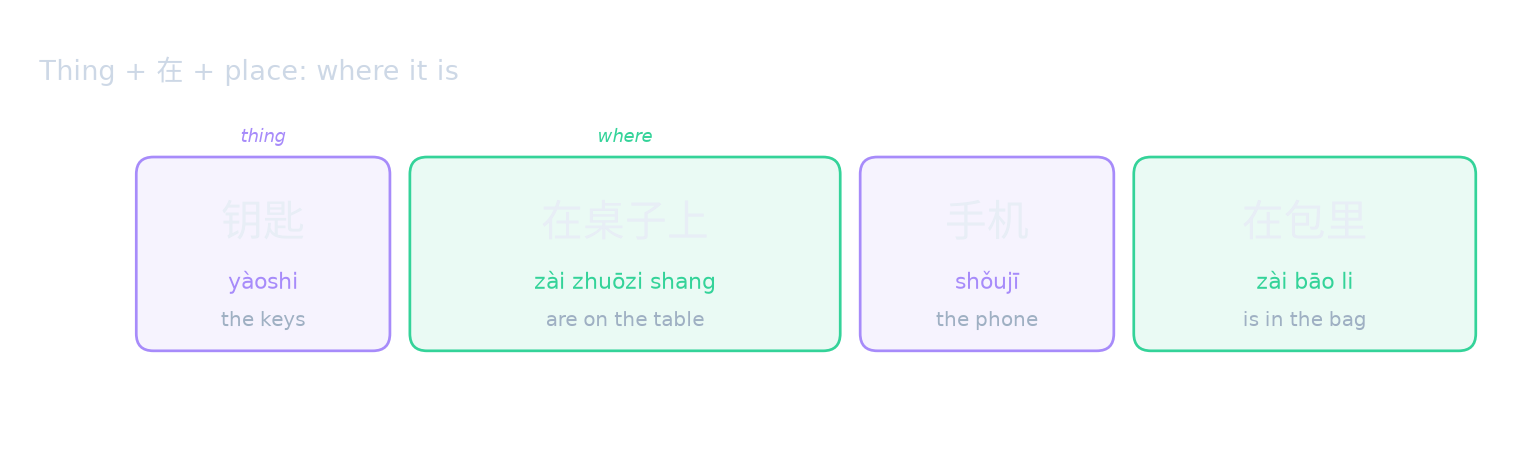
- key钥匙at / in在table桌子(bound form) up上,cell phone手机at / in在to cover包li, ancient measure of…里。 — "The keys are on the table, and the phone is in the bag."
at / in在 + place + (bound form) up上 / down下 / li, ancient measure of…里 / side旁边
- at / in在 + noun + location word = on / under / in / beside: at / in在table桌子(bound form) up上, at / in在variant of 床床down下, at / in在to cover包li, ancient measure of…里, at / in在gate门side旁边.
- Most ordinary nouns need the location word: at / in在table桌子(bound form) up上, not at / in在table桌子.
the cat猫is在the bed床under下。
Doing something somewhere
- Before a verb: he / him他at / in在library图书馆li, ancient measure of…里to read看书。 — "He's reading in the library."
- After a verb: (把: marks the object)把book书放在table桌子(bound form) up上。 — "Put the book on the table."
把the book书put放on在the table桌子(on)上。
When to drop the location word
- Ordinary objects need it: at / in在schoolbag书包li, ancient measure of…里, not at / in在schoolbag书包.
- Place names and places that are already locations do not: at / in在Beijing, capital of the…北京, at / in在school学校, not at / in在Beijing, capital of the…北京li, ancient measure of…里.
(bound form) up上 / li, ancient measure of…里 / to hit (the mark)中 for abstract places
- at / in在television电视(bound form) up上 / at / in在online网上 = on TV / online; at / in在newspaper报纸(bound form) up上 = in the newspaper.
- at / in在chest心里 = in one's heart; 在生活中 = in life. Fixed phrases are worth learning as chunks.
I我on在the internet网上bought买的。
Recap
- at / in在 + noun + (bound form) up上/down下/li, ancient measure of…里/side旁边 = on/under/in/beside; ordinary nouns need the location word.
- Place names do not (at / in在Beijing, capital of the…北京). Fixed phrases: at / in在online网上, at / in在newspaper报纸(bound form) up上, 在生活中.
Practise this pattern step by step.
Practice without the models
to link连 … all / both都 … not不 / not / haven't没 (not even)
2301.1 Complete: “He doesn't even know my name.” he / him他…………I / me我(modifier / structural particle)的name (of a person or thing)名字all / both都not不to know知道。
2301.2 Which sentence is correct?
- A. he / him他not / haven't没variant of 吃吃to link连breakfast早饭。
- B. he / him他to link连breakfast早饭not / haven't没variant of 吃吃。
- C. to link连he / him他all / both都breakfast早饭not / haven't没variant of 吃吃。
- D. he / him他to link连breakfast早饭all / both都not / haven't没variant of 吃吃。
2301.3 Build: “He agreed without even thinking.”
Arrange all chunks: then / just就 / all / both都not / haven't没want / think / miss想 / he / him他to link连want / think / miss想 / to answer答应(completed / change)了。
2301.4 he / him他to link连一个letter字all / both都not / haven't没to write写 means he wrote a lot.
True or false? Explain or repair the statement.
2301.5 You were so busy at work that you didn't have a single break. Close the examples. Say a Mandarin response, then write it in Chinese. Explain briefly in English what the lesson’s pattern adds. Compare with the model, then change one detail and try again.
Write or say your own response before reading the key.
for为 … and / but而 … (for the sake of)
2302.1 Complete (formal): “Strive for your dreams.” for为(fig.) to dream of梦想…………to strive奋斗。
2302.2 In don't不要for为trifle小事and / but而to get angry生气, what does and / but而 do?
- A. means “but”
- B. links the cause to the feeling
- C. asks a question
- D. means “and then later”
2302.3 Build: “Everyone was happy about his success.”
Arrange all chunks: everyone大家all / both都 / happy高兴。 / and / but而 / for为he / him他(modifier / structural particle)的success成功
2302.4 in order to为了…,… is the more everyday form.
True or false? Explain or repair the statement.
2302.5 Your cousin works two jobs to save for university. Close the examples. Say a Mandarin response, then write it in Chinese. Explain briefly in English what the lesson’s pattern adds. Compare with the model, then change one detail and try again.
Write or say your own response before reading the key.
any任何 + Noun + all / both都 / also也 (any)
2303.1 Complete: “Anyone can take part.” …………person人all / both都can / may可以to participate参加。
2303.2 Which sentence is correct?
- A. person人any任何all / both都to know知道这件matter事。
- B. 任何人all / both都to know知道这件matter事。
- C. any任何all / both都person人to know知道这件matter事。
- D. 任何人to know知道这件matter事。
2303.3 Build: “I won't tell anyone.”
Arrange all chunks: improbable不会to tell告诉 / I / me我 / person人。 / any任何
2303.4 who谁all / both都can / may可以to come来 is a spoken way to say 任何人all / both都can / may可以to come来.
True or false? Explain or repair the statement.
2303.5 At the end of the lesson your teacher wants to be sure everyone understood. Close the examples. Say a Mandarin response, then write it in Chinese. Explain briefly in English what the lesson’s pattern adds. Compare with the model, then change one detail and try again.
Write or say your own response before reading the key.
already既 … also也 / again又 … (both … and …)
2304.1 Complete: “This dish is both cheap and tasty.” this这个vegetable菜already既cheap便宜…………to be fond of eating好吃。
2304.2 Which sentence is correct?
- A. he / him他already既high高again又thin瘦。
- B. he / him他high高already既again又thin瘦。
- C. already既he / him他high高again又thin瘦。
- D. he / him他already既high高,she / her她again又thin瘦。
2304.3 Build: “He is both a teacher and a writer.”
Arrange all chunks: he / him他already既to be / is是teacher老师 / also也to be / is是 / , / author作家。
2304.4 not only (... but also ...)不但…moreover而且… usually makes the second point stronger.
True or false? Explain or repair the statement.
2304.5 You are recommending a backpack to a friend. Close the examples. Say a Mandarin response, then write it in Chinese. Explain briefly in English what the lesson’s pattern adds. Compare with the model, then change one detail and try again.
Write or say your own response before reading the key.
at / in在 + Place + (bound form) up上 / down下 / li, ancient measure of…里 / side旁边 (location)
2305.1 Complete: “The phone is in the bag.” cell phone手机at / in在to cover包…………。
2305.2 Which is correct?
- A. he / him他Beijing, capital of the…北京at / in在to work工作。
- B. he / him他at / in在table桌子to work工作。
- C. he / him他at / in在Beijing, capital of the…北京li, ancient measure of…里to work工作。
- D. he / him他at / in在Beijing, capital of the…北京to work工作。
2305.3 Build: “Put the book on the table.”
Arrange all chunks: (bound form) up上。 / table桌子 / (把: marks the object)把book书 / 放在
2305.4 at / in在online网上 means “online”.
True or false? Explain or repair the statement.
2305.5 You can't find your keys and your roommate helps you look. Close the examples. Say a Mandarin response, then write it in Chinese. Explain briefly in English what the lesson’s pattern adds. Compare with the model, then change one detail and try again.
Write or say your own response before reading the key.
Answers and explanations
to link连 … all / both都 … not不 / not / haven't没 (not even)
2301.1 to link连
to link连 X all / both都 + negative = not even X.
2301.2 D. he / him他to link连breakfast早饭all / both都not / haven't没variant of 吃吃。
he / him他to link连breakfast早饭all / both都not / haven't没variant of 吃吃 is right: to link连 + X + all / both都/also也 + not / haven't没 + verb. Without all / both都 the sentence is incomplete, and to link连 must come right before the item it stresses.
2301.3 he / him他to link连want / think / miss想all / both都not / haven't没want / think / miss想then / just就to answer答应(completed / change)了。
to link连 + V + all / both都not / haven't没 + V + then / just就….
2301.4 False.
He didn't write a single character.
2301.5 One possible response: I / me我today今天busy忙(degree marker)得to link连readily一口water水all / both都not / haven't没to shout喝。
Check meaning and form:
- My response conveys a message that fits the opening situation.
- I can explain the meaning of the pattern, rather than only naming it.
- The to link连 phrase comes before the verb: 连饭all / both都not / haven't没variant of 吃吃, not not / haven't没variant of 吃吃连饭.
- Keep all / both都 / also也: 连水not / haven't没to shout喝 is incomplete; say 连水all / both都not / haven't没to shout喝.
- I tried a second response with a name, time, place, or description changed.
This is supported productive practice. Compare meaning and structure; your answer need not copy the model. A partner or teacher must hear the spoken response to comment on pronunciation.
for为 … and / but而 … (for the sake of)
2302.1 and / but而
for为 A and / but而 B links the purpose and the action.
2302.2 B. links the cause to the feeling
In for为 + cause + and / but而 + verb, and / but而 links the cause to the reaction: don't不要for为trifle小事and / but而to get angry生气 “Don't get angry over small things.” It does not mean “but” here.
2302.3 everyone大家all / both都for为he / him他(modifier / structural particle)的success成功and / but而happy高兴。
for为 + cause + and / but而 + feeling.
2302.4 True.
True. in order to为了…,… is the everyday way to state a purpose. for为…and / but而… is more formal and written.
2302.5 One possible response: he / him他in order to为了(bound form) up上university大学and / but而to make an effort努力to work工作。
Check meaning and form:
- My response conveys a message that fits the opening situation.
- I can explain the meaning of the pattern, rather than only naming it.
- In this pattern for为 is read wèi ("for"); it is written or formal speech. In chat, in order to为了…, I / me我… is enough.
- and / but而 does not mean "but" here; it links the purpose or cause to the action.
- I tried a second response with a name, time, place, or description changed.
This is supported productive practice. Compare meaning and structure; your answer need not copy the model. A partner or teacher must hear the spoken response to comment on pronunciation.
any任何 + Noun + all / both都 / also也 (any)
2303.1 any任何
any任何 + noun + all / both都.
2303.2 B. 任何人all / both都to know知道这件matter事。
任何人all / both都to know知道这件matter事 is right: any任何 + noun as the subject needs all / both都 before the verb, and any任何 always comes before its noun.
2303.3 I / me我improbable不会to tell告诉任何人。
Negative verb + any任何 + noun.
2303.4 True.
QW + all / both都 is the spoken equivalent.
2303.5 One possible response: to have / there is有any任何question问题,all / both都can / may可以to ask问I / me我。
Check meaning and form:
- My response conveys a message that fits the opening situation.
- I can explain the meaning of the pattern, rather than only naming it.
- As a subject, any任何 + noun needs all / both都 / also也: 任何人all / both都to know知道, not 任何人to know知道.
- any任何 goes before a noun only; it does not stand alone: 任何人, not just any任何.
- I tried a second response with a name, time, place, or description changed.
This is supported productive practice. Compare meaning and structure; your answer need not copy the model. A partner or teacher must hear the spoken response to comment on pronunciation.
already既 … also也 / again又 … (both … and …)
2304.1 again又
already既 A again又 B.
2304.2 A. he / him他already既high高again又thin瘦。
he / him他already既high高again又thin瘦 is right: already既 A again又 B describes one subject, with both words after it. A second subject (she / her她) breaks the pattern.
2304.3 he / him他already既to be / is是teacher老师,also也to be / is是author作家。
already既to be / is是…,also也to be / is是….
2304.4 True.
It builds up; already既…again又… gives equal weight.
2304.5 One possible response: this这个to cover包already既good-looking好看again又practical实用。
Check meaning and form:
- My response conveys a message that fits the opening situation.
- I can explain the meaning of the pattern, rather than only naming it.
- Both parts belong to one subject: he / him他already既…again又…, not he / him他already既…,she / her她again又….
- The two qualities should fit together (both good, both bad); for a contrast use but但是.
- I tried a second response with a name, time, place, or description changed.
This is supported productive practice. Compare meaning and structure; your answer need not copy the model. A partner or teacher must hear the spoken response to comment on pronunciation.
at / in在 + Place + (bound form) up上 / down下 / li, ancient measure of…里 / side旁边 (location)
2305.1 li, ancient measure of…里
at / in在 + noun + li, ancient measure of…里 = in.
2305.2 D. he / him他at / in在Beijing, capital of the…北京to work工作。
Place names take no location word.
2305.3 (把: marks the object)把book书放在table桌子(bound form) up上。
Verb + at / in在 + noun + (bound form) up上.
2305.4 True.
It is a fixed abstract location.
2305.5 One possible response: key钥匙at / in在table桌子(bound form) up上,cell phone手机at / in在to cover包li, ancient measure of…里。
Check meaning and form:
- My response conveys a message that fits the opening situation.
- I can explain the meaning of the pattern, rather than only naming it.
- Ordinary objects need it: at / in在schoolbag书包li, ancient measure of…里, not at / in在schoolbag书包.
- Place names and places that are already locations do not: at / in在Beijing, capital of the…北京, at / in在school学校, not at / in在Beijing, capital of the…北京li, ancient measure of…里.
- I tried a second response with a name, time, place, or description changed.
This is supported productive practice. Compare meaning and structure; your answer need not copy the model. A partner or teacher must hear the spoken response to comment on pronunciation.