Original teaching practice. Read one pattern, cover its model and try the questions before checking the separate answer section. Examples adapted from Chinese Grammar Wiki (AllSet Learning, CC BY-NC-SA) retain the course-reference provenance.
one / a一 … also也 / all / both都 … not不 / not / haven't没 (not even one)
Not a single yuan
- At the end of the month your wallet is completely empty.
- I / me我一块钱also也not have / haven't没有(completed / change)了。 — "I don't have a single yuan left."
one / a一 + MW + Noun + also也 / all / both都 + not不 / not / haven't没
- one / a一 + measure word + noun + also也/all / both都 + not / haven't没/not不 + verb = "not even one", a strong negative.
- The object moves before the verb, after the subject: I / me我一个person人also也not不to know认识 — "I don't know a single person."
I我one一(measure word)个person人even也not不know认识。

not / haven't没 for the past, not不 for habits and wishes
- he / him他today今天readily一口cooked rice饭all / both都not / haven't没variant of 吃吃。 — "He hasn't eaten a single mouthful today."
- this这个weekend周末I / me我erhua variant of 一点一点儿also也unexpectedly不想to go out出去。 — "I don't want to go out at all this weekend." erhua variant of 一点一点儿also也not不 = not at all.
he他today今天one mouthful一口food饭even都not没eat吃。
The object comes first
- Move the "one" phrase before the verb: I / me我one / a一本书also也not / haven't没to buy买, not I / me我not / haven't没to buy买one / a一本书also也.
- Choose not / haven't没 for something that did not happen, not不 for a habit, wish or refusal: readily一口also也unexpectedly不想variant of 吃吃.
erhua variant of 一点一点儿also也not不 + Adjective
- With adjectives: today今天erhua variant of 一点一点儿also也not不cold冷。 — "It isn't cold at all today."
- also也 and all / both都 are interchangeable here; also也 is slightly more common in speech.
today今天a bit一点儿even也not不cold冷。
Recap
- one / a一 + MW + Noun + also也/all / both都 + not / haven't没/not不 + Verb = not a single …; the phrase goes before the verb.
- erhua variant of 一点一点儿also也not不 + Adj = not at all. not / haven't没 for what didn't happen, not不 for habits and wishes.
Practise this pattern step by step.
to exceed越 … to exceed越 … (the more …, the more …)
The longer it rains
- You are waiting for the rain to stop, but it only gets heavier.
- 雨越down下to exceed越see 大夫大。 — "The rain is getting heavier and heavier (the longer it falls)."
to exceed越 A to exceed越 B
- to exceed越 A to exceed越 B = "the more A, the more B": B grows as A increases. Each to exceed越 goes before a verb or adjective.
- One subject: he / him他to exceed越variant of 说说to exceed越rapid快. Two subjects: you你to exceed越explanation解释,I / me我to exceed越not不clear明白.
he他the more越talk说the more越fast快。

Two subjects, two clauses
- you你to exceed越to practice练习,variant of 说说(degree marker)得to exceed越good好。 — "The more you practise, the better you speak."
- 天越cold冷,人越young少。 — "The colder it gets, the fewer people there are."
you你the more越practise练习,speak说得the more越well好。
to exceed越 replaces degree / adjective linker很
- No degree / adjective linker很 after to exceed越: more and more越来越good好 and to exceed越variant of 说说to exceed越rapid快, not to exceed越variant of 说说to exceed越很快.
- Each to exceed越 sits after its own subject: 天越cold冷,人越young少, not 越天cold冷,越人少.
to exceed越 A to exceed越 B versus more and more越来越
- more and more越来越 + Adj = more and more over time: weather天气more and more越来越cold冷.
- to exceed越 A to exceed越 B ties the growth to something else: 越想to exceed越to get angry生气 — "the more I think about it, the angrier I get."
I我the more越think想the more越angry生气。
Recap
- to exceed越 A to exceed越 B = the more A, the more B; each to exceed越 before its verb or adjective.
- With two subjects: 天越cold冷,人越young少. No degree / adjective linker很. more and more越来越 = growth over time alone.
Practise this pattern step by step.
(把: marks the object)把 sentences (do something to the object)
Close the door, please
- It is cold, and your little brother has left the door wide open again.
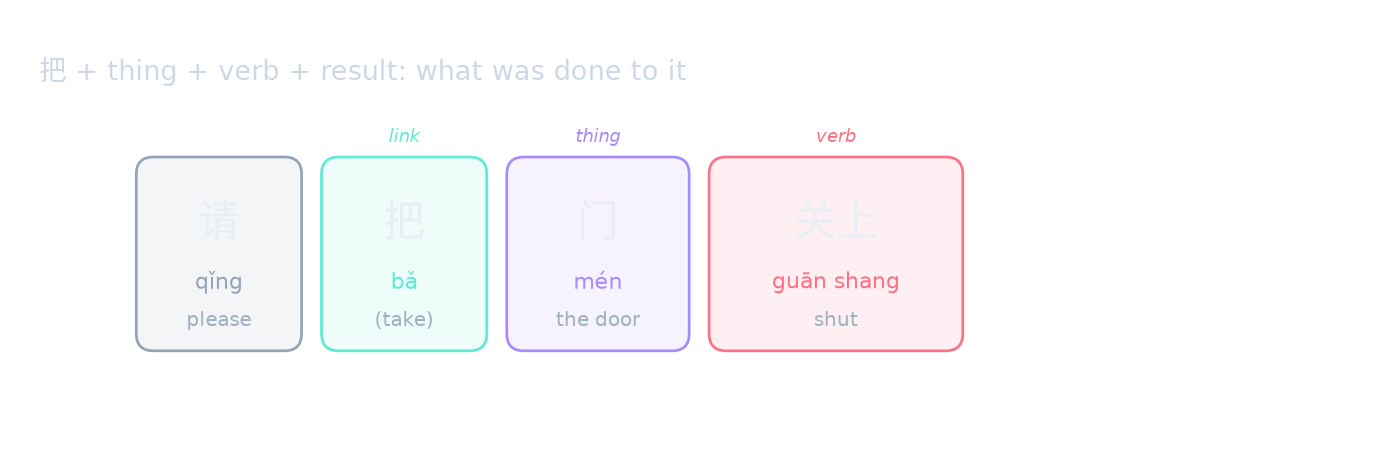
- to ask请to stand as a goalkeeper把门to close (a door)关上。 — "Please shut the door." (把: marks the object)把 brings the object forward and says what happens to it.
Subject + (把: marks the object)把 + Object + Verb + result
- (把: marks the object)把 + object comes before the verb; the verb must have something after it: a result, a direction, (completed / change)了, or a place.
- I / me我(把: marks the object)把school assignment作业to make做to finish完(completed / change)了 — "I've finished the homework." he / him他(把: marks the object)把book书放在table桌子(bound form) up上 — "He put the book on the table."
he他把the book书put放on在the table桌子(on)上。
Moving, changing, finishing
- Moving something: to ask请(把: marks the object)把trash垃圾to take out拿出to go去。 — "Please take the rubbish out."
- Changing something: I / me我(把: marks the object)把this这个sentence句子翻译成English (language)英文(completed / change)了。 — "I translated this sentence into English."
please请把the rubbish垃圾take拿out出去。
The verb cannot stand alone
- I / me我(把: marks the object)把cooked rice饭variant of 吃吃 is incomplete. Add a result or (completed / change)了: I / me我(把: marks the object)把cooked rice饭variant of 吃吃to finish完(completed / change)了.
- The affected object is normally identifiable in the situation. These examples use a known book or door; indefinite objects can also occur with an appropriate context.
Negatives and don't别
- not / haven't没 / not不 / don't别 go before (把: marks the object)把: I / me我not / haven't没(把: marks the object)把key钥匙to bring带来。 — "I didn't bring the keys." don't别(把: marks the object)把cell phone手机to forget忘at / in在home家里! — "Don't leave your phone at home!"
- Feeling and knowing verbs (to like喜欢, to know知道) do not take (把: marks the object)把.
don't别把your phone手机forget忘at在home家里!
Recap
- Subject + (把: marks the object)把 + specific object + Verb + something (result, direction, place, (completed / change)了).
- Negative words go before (把: marks the object)把. Not with feeling or knowing verbs.
Practise this pattern step by step.
(passive: by)被 sentences (the passive)
Where's my bike?
- You come out of the library and your bike is gone.
- I / me我(modifier / structural particle)的bicycle自行车(passive: by)被person人to steal偷(completed / change)了! — "My bike has been stolen!"
Receiver + (passive: by)被 (+ doer) + Verb + result
- (passive: by)被 marks the passive: the subject receives the action. The doer can follow (passive: by)被 or be left out.
- As with (把: marks the object)把, the verb needs something after it: (completed / change)了, a result or a place.
my我的bike自行车(was)被stolen偷了。

Often bad news
- (passive: by)被 sentences often report something unwelcome: he / him他(passive: by)被teacher老师to criticize批评(completed / change)了。 — "He was told off by the teacher."
- cake蛋糕(passive: by)被younger brother弟弟variant of 吃吃to finish完(completed / change)了。 — "The cake was eaten up by my little brother."
the cake蛋糕by被my younger brother弟弟eat吃up完了。
Complete verb, negative first
- The verb cannot stand alone: bicycle自行车(passive: by)被to steal偷(completed / change)了, not bicycle自行车(passive: by)被to steal偷.
- Put not / haven't没 before (passive: by)被: I / me我(modifier / structural particle)的cell phone手机not / haven't没(passive: by)被to steal偷, not I / me我(modifier / structural particle)的cell phone手机(passive: by)被not / haven't没to steal偷.
(passive: by)被 versus (把: marks the object)把
- (把: marks the object)把 starts with the doer: younger brother弟弟(把: marks the object)把cake蛋糕variant of 吃吃to finish完(completed / change)了。
- (passive: by)被 starts with the receiver: cake蛋糕(passive: by)被younger brother弟弟variant of 吃吃to finish完(completed / change)了。 Same event, different starting point.
my younger brother弟弟把the cake蛋糕eat吃up完了。
Recap
- Receiver + (passive: by)被 (+ doer) + Verb + result/(completed / change)了 = was done (by …); often unwelcome news.
- not / haven't没 goes before (passive: by)被. (把: marks the object)把 starts from the doer, (passive: by)被 from the receiver.
Practise this pattern step by step.
Practice without the models
one / a一 … also也 / all / both都 … not不 / not / haven't没 (not even one)
0601.1 Complete: “I didn't buy a single book.” I / me我one / a一本书…………没买。
0601.2 Which sentence is correct?
- A. I / me我一杯water水also也not / haven't没to shout喝。
- B. I / me我not / haven't没喝一杯water水also也。
- C. 一杯water水I / me我to shout喝also也not / haven't没。
- D. I / me我一杯water水not / haven't没also也to shout喝。
0601.3 Build: “It isn't cold at all today.”
Arrange all chunks: erhua variant of 一点一点儿 / also也not不 / cold冷。 / today今天
0601.4 I / me我readily一口also也unexpectedly不想variant of 吃吃 means “I don't want to eat a single bite.”
True or false? Explain or repair the statement.
0601.5 At the end of the month your wallet is completely empty. Close the examples. Say a Mandarin response, then write it in Chinese. Explain briefly in English what the lesson’s pattern adds. Compare with the model, then change one detail and try again.
Write or say your own response before reading the key.
to exceed越 … to exceed越 … (the more …, the more …)
0602.1 Complete: “The more he eats, the fatter he gets.” he / him他to exceed越variant of 吃吃…………fat胖。
0602.2 Which sentence is correct?
- A. 越天to warm up热,越人many多。
- B. 天热越,人多越。
- C. 天越to warm up热,人越many多。
- D. 天越to warm up热,人越很多。
0602.3 Build: “The more you practise, the better you speak.”
Arrange all chunks: variant of 说说(degree marker)得 / , / you你to exceed越to practice练习 / to exceed越good好。
0602.4 越想to exceed越to get angry生气 means “the more I think about it, the angrier I get.”
True or false? Explain or repair the statement.
0602.5 You are waiting for the rain to stop, but it only gets heavier. Close the examples. Say a Mandarin response, then write it in Chinese. Explain briefly in English what the lesson’s pattern adds. Compare with the model, then change one detail and try again.
Write or say your own response before reading the key.
(把: marks the object)把 sentences (do something to the object)
0603.1 Complete: “I've finished the homework.” I / me我…………school assignment作业to make做to finish完(completed / change)了。
0603.2 Which sentence is complete and correct?
- A. I / me我(把: marks the object)把to have a meal吃饭to finish完(completed / change)了。
- B. I / me我(把: marks the object)把cooked rice饭variant of 吃吃to finish完(completed / change)了。
- C. I / me我(把: marks the object)把cooked rice饭variant of 吃吃。
- D. I / me我variant of 吃吃(把: marks the object)把cooked rice饭to finish完(completed / change)了。
0603.3 Build: “Please take the rubbish out.”
Arrange all chunks: to ask请 / to hold拿 / to go out出去。 / (把: marks the object)把trash垃圾
0603.4 I / me我(把: marks the object)把key钥匙not / haven't没to bring带来 is the correct word order.
True or false? Explain or repair the statement.
0603.5 It is cold, and your little brother has left the door wide open again. Close the examples. Say a Mandarin response, then write it in Chinese. Explain briefly in English what the lesson’s pattern adds. Compare with the model, then change one detail and try again.
Write or say your own response before reading the key.
(passive: by)被 sentences (the passive)
0604.1 Complete: “My wallet was stolen.” I / me我(modifier / structural particle)的purse钱包…………to steal偷(completed / change)了。
0604.2 Which says “My phone wasn't taken”?
- A. I / me我(modifier / structural particle)的cell phone手机(passive: by)被to take away拿走not / haven't没。
- B. I / me我(modifier / structural particle)的cell phone手机(passive: by)被not / haven't没to take away拿走。
- C. not / haven't没I / me我(modifier / structural particle)的cell phone手机(passive: by)被to take away拿走。
- D. I / me我(modifier / structural particle)的cell phone手机not / haven't没(passive: by)被to take away拿走。
0604.3 Build: “The cake was eaten up by my little brother.”
Arrange all chunks: variant of 吃吃to finish完 / (completed / change)了。 / (passive: by)被younger brother弟弟 / cake蛋糕
0604.4 younger brother弟弟(把: marks the object)把cake蛋糕variant of 吃吃to finish完(completed / change)了 and cake蛋糕(passive: by)被younger brother弟弟variant of 吃吃to finish完(completed / change)了 describe the same event.
True or false? Explain or repair the statement.
0604.5 You come out of the library and your bike is gone. Close the examples. Say a Mandarin response, then write it in Chinese. Explain briefly in English what the lesson’s pattern adds. Compare with the model, then change one detail and try again.
Write or say your own response before reading the key.
Answers and explanations
one / a一 … also也 / all / both都 … not不 / not / haven't没 (not even one)
0601.1 also也
one / a一 + MW + noun + also也/all / both都 + not / haven't没 + verb.
0601.2 A. I / me我一杯water水also也not / haven't没to shout喝。
The “one” phrase goes before also也 + not / haven't没 + verb.
0601.3 today今天erhua variant of 一点一点儿also也not不cold冷。
erhua variant of 一点一点儿also也not不 + adjective.
0601.4 True.
unexpectedly不想 = don't want; the one / a一 phrase makes it total.
0601.5 One possible response: I / me我一块钱also也not have / haven't没有(completed / change)了。
Check meaning and form:
- My response conveys a message that fits the opening situation.
- I can explain the meaning of the pattern, rather than only naming it.
- Move the "one" phrase before the verb: I / me我one / a一本书also也not / haven't没to buy买, not I / me我not / haven't没to buy买one / a一本书also也.
- Choose not / haven't没 for something that did not happen, not不 for a habit, wish or refusal: readily一口also也unexpectedly不想variant of 吃吃.
- I tried a second response with a name, time, place, or description changed.
This is supported productive practice. Compare meaning and structure; your answer need not copy the model. A partner or teacher must hear the spoken response to comment on pronunciation.
to exceed越 … to exceed越 … (the more …, the more …)
0602.1 to exceed越
to exceed越 A to exceed越 B.
0602.2 C. 天越to warm up热,人越many多。
天越to warm up热,人越many多 is right: each to exceed越 comes after its own subject (day天, person人) and before a bare adjective. Do not put to exceed越 before the subject, or add degree / adjective linker很.
0602.3 you你to exceed越to practice练习,variant of 说说(degree marker)得to exceed越good好。
Subject + to exceed越 + verb, then to exceed越 + result.
0602.4 True.
to exceed越 A to exceed越 B links growth in B to A.
0602.5 One possible response: 雨越down下to exceed越see 大夫大。
Check meaning and form:
- My response conveys a message that fits the opening situation.
- I can explain the meaning of the pattern, rather than only naming it.
- No degree / adjective linker很 after to exceed越: more and more越来越good好 and to exceed越variant of 说说to exceed越rapid快, not to exceed越variant of 说说to exceed越很快.
- Each to exceed越 sits after its own subject: 天越cold冷,人越young少, not 越天cold冷,越人少.
- I tried a second response with a name, time, place, or description changed.
This is supported productive practice. Compare meaning and structure; your answer need not copy the model. A partner or teacher must hear the spoken response to comment on pronunciation.
(把: marks the object)把 sentences (do something to the object)
0603.1 (把: marks the object)把
(把: marks the object)把 + object + verb + result.
0603.2 B. I / me我(把: marks the object)把cooked rice饭variant of 吃吃to finish完(completed / change)了。
The verb after (把: marks the object)把 needs a result or (completed / change)了.
0603.3 to ask请(把: marks the object)把trash垃圾to take out拿出to go去。
(把: marks the object)把 + object + verb + direction.
0603.4 False.
not / haven't没 goes before (把: marks the object)把: I / me我not / haven't没(把: marks the object)把key钥匙to bring带来.
0603.5 One possible response: to ask请to stand as a goalkeeper把门to close (a door)关上。
Check meaning and form:
- My response conveys a message that fits the opening situation.
- I can explain the meaning of the pattern, rather than only naming it.
- I / me我(把: marks the object)把cooked rice饭variant of 吃吃 is incomplete. Add a result or (completed / change)了: I / me我(把: marks the object)把cooked rice饭variant of 吃吃to finish完(completed / change)了.
- The affected object is normally identifiable in the situation. These examples use a known book or door; indefinite objects can also occur with an appropriate context.
- I tried a second response with a name, time, place, or description changed.
This is supported productive practice. Compare meaning and structure; your answer need not copy the model. A partner or teacher must hear the spoken response to comment on pronunciation.
(passive: by)被 sentences (the passive)
0604.1 (passive: by)被
Receiver + (passive: by)被 + verb + (completed / change)了.
0604.2 D. I / me我(modifier / structural particle)的cell phone手机not / haven't没(passive: by)被to take away拿走。
not / haven't没 goes before (passive: by)被.
0604.3 cake蛋糕(passive: by)被younger brother弟弟variant of 吃吃to finish完(completed / change)了。
Receiver + (passive: by)被 + doer + verb + result + (completed / change)了.
0604.4 True.
Both say the brother ate the cake; they start from different points.
0604.5 One possible response: I / me我(modifier / structural particle)的bicycle自行车(passive: by)被person人to steal偷(completed / change)了!
Check meaning and form:
- My response conveys a message that fits the opening situation.
- I can explain the meaning of the pattern, rather than only naming it.
- The verb cannot stand alone: bicycle自行车(passive: by)被to steal偷(completed / change)了, not bicycle自行车(passive: by)被to steal偷.
- Put not / haven't没 before (passive: by)被: I / me我(modifier / structural particle)的cell phone手机not / haven't没(passive: by)被to steal偷, not I / me我(modifier / structural particle)的cell phone手机(passive: by)被not / haven't没to steal偷.
- I tried a second response with a name, time, place, or description changed.
This is supported productive practice. Compare meaning and structure; your answer need not copy the model. A partner or teacher must hear the spoken response to comment on pronunciation.