This handout teaches C.3 Motivation for the course first assessed in 2026: what motivation is, how rewards affect it, self-determination theory, achievement motivation and achievement goals, how athletes explain success and failure, self-efficacy, and why people start and stop exercising. The common core covers achievement motivation, basic self-determination and motivational climate. Attribution, confidence and exercise-change examples are labelled extensions connecting this unit to other learning.
Prerequisites: unit C.1 (individual differences). Unit C.5 teaches goal setting and other skills used to build motivation.
9.2
什么是动机
English
Paying children to draw
Lepper, Greene and Nisbett's 1973 field experiment compared preschool children who initially showed interest in drawing. One group expected an award, one received an unexpected award and one received no award. Subsequent free-play observations found less interest in the expected-award group than in the comparison groups. This is evidence about a particular reward arrangement and activity, not proof that every certificate harms every child or that drawing and competitive sport are interchangeable. The coaching question is what a reward communicates and how the participant experiences it.
Expected rewards and later interest
Direction and intensity
Motivation 动机 is the direction and intensity of a person's effort: which activities they choose (direction) and how hard and how long they try (intensity). It explains why people start an activity, how much effort they put in and whether they persist when it becomes difficult.
Motivation = direction (which activity) and intensity (how hard, how long)
Type
Meaning
Examples
Intrinsic motivation 内在动机
Taking part for the activity itself: enjoyment, interest, the satisfaction of improving
Loving the feeling of a perfect dive; enjoying the challenge of a hard climb
Extrinsic motivation 外在动机
Taking part for something outside the activity
Medals, money, praise, a place in the team, avoiding criticism
Extrinsic rewards can be tangible (trophies, prize money, scholarships) or intangible (praise, status, applause).
Reasons can differ for the same behaviour
Two students may attend the same session, one because they enjoy learning and the other to avoid criticism. Attendance counts alone cannot identify the reason. People can also have several reasons at once, and personally valuing a health benefit is not the same as enjoying every activity. Ask what the action means to the participant before interpreting a reward or a score.
Same behaviour, different reasons
For a school investigation, use an approved, anonymous, voluntary questionnaire with non-sensitive questions and explain withdrawal arrangements before participation. State the scale, task and measurement time; avoid private disclosures or public labels. Compare different people (between-person variation) separately from repeated reports by one person (within-person variation); following one person requires a protected linking code rather than fully anonymous records. A self-report describes reported experience, not a diagnosis or a universal arousal–performance rule.
Self-determination theory 自我决定理论 (Deci and Ryan) says people are most motivated, and feel best, when three basic psychological needs are met:
Need
Meaning
What a coach can do
Autonomy 自主
Feeling that you choose your own actions
Offer choices, explain reasons, ask for the athlete's ideas
Competence 胜任
Feeling capable and improving
Set achievable challenges, give specific feedback on improvement
Relatedness 归属
Feeling connected to and valued by others
Build team spirit, treat every athlete with respect
Self-determination theory: meet the three needs and motivation becomes more autonomous
Controlled, autonomous and absent motivation
Controlled motivation involves experienced pressure, such as obtaining approval or avoiding guilt. Autonomous motivation involves willingness and personal endorsement. Enjoyment of the activity is intrinsic; an externally separable purpose can also be personally valued. Amotivation 无动机 involves little intention or a perceived lack of connection between action and useful outcome. These distinctions concern the reason for behaviour, not merely whether a coach is present or a trophy exists.
Street football: children play for the enjoyment of the game itself, intrinsic motivation in its plainest form
Intrinsic motives can involve learning something new, accomplishing a challenge or experiencing stimulation. An athlete may enjoy learning a new stroke, mastering a routine or the sensations of a well-timed movement. Enjoyment and persistence are associated in research.
Support autonomy by providing meaningful choices and reasons within clear boundaries; support competence with achievable challenges and usable feedback; support relatedness with respectful inclusion. Autonomy is not abandonment, competence is not superiority over teammates, and relatedness is not compulsory agreement with every instruction.
Achievement motivation 成就动机 (Atkinson) depends on two personality factors:
the need to achieve (NAch): the wish to succeed, to take on challenges and to feel pride;
the need to avoid failure (NAF): the wish to avoid the shame of failing.
High need to achieve
High need to avoid failure
Chooses realistic challenges, a moderate perceived chance of success in the simplified model
Chooses very easy tasks (certain success) or impossible ones (failure is no shame)
Enjoys being evaluated; welcomes feedback
Avoids situations where they will be judged
Persists after failure
Gives up quickly
Attributes failure to effort or strategy
Attributes failure to lack of ability
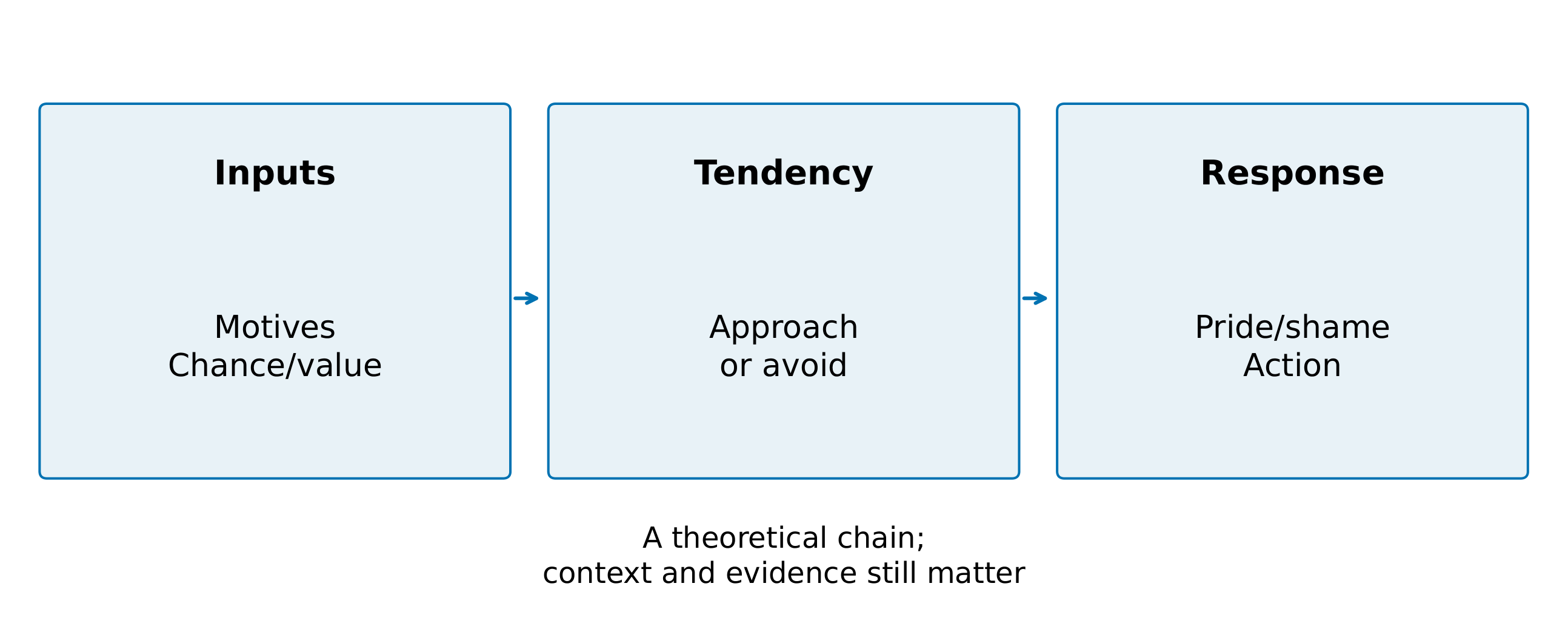
The model links person factors (approach and avoidance motives) with situation factors (perceived probability of success and incentive value). Their interaction gives a resultant tendency towards approach or avoidance; anticipated pride or shame helps explain the behaviour. These are theoretical tendencies, not a personality diagnosis from one choice.
For example, a runner may avoid an unfamiliar time trial if public comparison makes failure feel humiliating. A coach can offer a suitable challenge, explain a self-referenced target and give private feedback. That changes situational demands and the meaning of evaluation. A moderate challenge can balance possible success with meaningful accomplishment. The often-used 50% example belongs to a simplified model, not a universal prescription that half of every athlete’s attempts should fail.
Explain the links in the specific situation; a model does not diagnose a fixed trait from one task choice
Achievement goal theory
Achievement goal theory 成就目标理论 (Nicholls) says that people judge success in two ways:
Task and ego orientation are two separate scales: an athlete can be high in both
Task orientation 任务取向
Ego orientation 自我取向
Success means
Mastering the skill, improving, trying hard
Beating others, being the best, winning with little effort
Ability judged by
Comparing with your own past performance
Comparing with others
After failure
Tries harder; sees mistakes as part of learning
Norm-referenced success may feel threatened when perceived competence is low
Linked to
Enjoyment, persistence, fair play
Interpretation depends on perceived competence, task orientation and context
The two orientations are separate: an athlete can be high in both. Comparing with others and valuing personal improvement can coexist. A goal orientation concerns how the individual judges success; the climate concerns what the environment recognises and rewards. Neither orientation alone establishes a moral character or inevitable outcome.
The coach helps create a motivational climate 动机氛围 through tasks, instruction, feedback and recognition; parents, peers and organisational conditions can also contribute:
In a mastery climate, effort, improvement and learning are rewarded; mistakes are part of learning; everyone has an important role.
In a performance climate, only winning and the best players are rewarded; mistakes are punished; players are compared with each other.
The same team can feel very different depending on what the coach rewards
A mastery climate is linked to more enjoyment, more effort, more intrinsic motivation and less anxiety, especially for young athletes. Coaches can create one through the TARGET areas: the tasks set (varied, challenging), authority (sharing decisions), recognition (for effort and improvement, given privately), grouping (mixed-ability groups), evaluation (against personal improvement) and time (allowing suitable opportunities to learn). TARGET is a design framework rather than a guarantee. Mixed grouping may support cooperation when thoughtfully organised, but grouping should fit the actual task, access and safety needs.
Worked comparison. A club changes to private improvement feedback and cooperative tasks. Attendance rises from 18/30 to 24/30: 60% to 80%, a rise of 20 percentage points or 33.333…% relative to the starting rate. This is compatible with improved engagement, but does not establish that the climate caused it. Season, timetable, transport, membership changes and extra coaching may differ. A stronger investigation compares suitable baselines and groups, records the planned changes and follows participation and experience over time.
Attributions 归因 are the reasons people give for their success or failure. They matter because they affect future emotion, confidence and motivation.
Attribution statements; classify the perceived explanation and timescale, not an immutable ability label
Weiner classified attributions on three dimensions:
Locus of causality: internal (about the athlete: ability, effort) or external (outside the athlete: task difficulty, luck, the referee).
Stability: stable (expected to persist in that explanation) or unstable (expected to differ). Ability, effort and difficulty are not permanently assigned to one cell regardless of wording or timescale.
Controllability: under the athlete's control (effort, strategy) or not (luck, the opponent's skill).
A constructive explanation remains consistent with evidence. After success, recognising a practised skill can support confidence; after failure, identifying a feasible change in preparation may support a plan. But not every failure is caused by insufficient effort. Injury, access, unfair decisions and other barriers can matter. Internal does not automatically mean controllable, and external does not automatically mean unstable. Do not invent a positive story or blame a person to fit a preferred cell.
The self-serving bias 自利偏差 is the common habit of taking credit for success (internal attributions) and blaming failure on external factors (the referee, the pitch). It protects self-esteem but can stop the athlete from learning from mistakes.
Learned helplessness
Learned helplessness 习得性无助 concerns a perception that actions do not influence outcomes, which can discourage further attempts. It should not be diagnosed from one comment, nor treated as inevitable after every failure. Attribution retraining 归因再训练 can help examine explanations and identify feasible, evidence-based actions while acknowledging real barriers. Unit C.1 provides the syllabus connection.
Breaking the helplessness loop
Worked interpretation. After a 6–2, 6–3 loss, a player says "I have no ability and never will". This is internal and stable as stated; controllability requires a separate judgement. If 40% of second serves went in, that gives one specific performance observation, not proof of the loss’s sole cause. A supervised plan can target a suitable serve action and reassess it, without guaranteeing more wins or denying the opponent’s contribution.
Self-efficacy 自我效能 (Bandura) is a person's belief that they can successfully perform a specific task in a specific situation, for example "I can make this free throw now". It is more specific than general self-confidence. Self-efficacy can influence task choice, effort and persistence, while actual skill, demands and support also affect performance.
Bandura's four sources of self-efficacy
Bandura described four main sources. Relevant mastery experience is often influential, but the value of each source depends on its credibility and context:
Source
Meaning
Example
Performance accomplishments
Past success at the task
Having landed the dive many times in training
Vicarious experience 替代经验
Seeing someone similar succeed
Watching a teammate of similar ability land it
Verbal persuasion 言语说服
Encouragement from others or oneself
The coach saying, "You're ready for this"
Emotional and physiological states
How the athlete interprets their arousal
Seeing a racing heart as readiness, not fear
Imagery of success is also used as a source. Coaches build self-efficacy by offering achievable, safely supervised steps, using models of similar ability, giving honest encouragement and teaching arousal control. Interpret failure in context; no universal ranking of its impact follows from its timing alone.
Physical activity has strong health benefits, yet many people who start an exercise programme stop. Dropout estimates depend on the population, programme, definition and follow-up period; do not apply one universal six-month percentage. Exercise adherence 运动坚持 is keeping to a programme over time.
A parkrun start: free, weekly and social, it removes several common barriers to starting exerciseStarting, stopping and adherence
Reasons for starting
Common barriers
Health and fitness, weight control, appearance, enjoyment, friends, stress relief
Lack of time, cost, poor access to facilities, low enjoyment, injury, low self-efficacy, lack of support
Adherence is helped by enjoyable activities, realistic goals, social support (a training partner or class), convenient times and places, and feedback that shows progress.
Stages of change
The transtheoretical model 跨理论模型 describes stages people move through when changing behaviour:
The transtheoretical model: people climb the stages but can also slip back
Precontemplation: not thinking of exercising in the next 6 months.
Contemplation: thinking about starting within 6 months.
Preparation: planning to start soon, perhaps exercising a little.
Action: exercising regularly for less than 6 months, with duration defined from that person’s behaviour change, not merely the club’s calendar.
Maintenance: maintaining the defined regular behaviour for 6 months or longer in this conventional model.
People can move back as well as forward (relapse). Support should fit the stage: information about benefits for precontemplators, help to plan for those preparing, and strategies to prevent relapse for those in action.
Worked example. A school gym starts a lunchtime club in September with 80 students. In December 56 still attend, and in March 44. Dropout by December = (80 − 56) ÷ 80 × 100 = 30 %; by March = (80 − 44) ÷ 80 × 100 = 45 %. March retention is 44/80×100 = 55%. From December to March, a further 12 of the 56 December participants leave: 12/56×100 = 21.4286…%, a different denominator from cumulative dropout. The calendar and attendance counts do not establish each person’s stage: prior exercise, exact duration and the defined regular behaviour are needed. Ask about barriers and preferences before choosing support; enjoyment, suitable access and constructive feedback can be investigated without promising identical responses.
Define motivation by direction and intensity. Contrast intrinsic enjoyment with an instrumental purpose, and explain why identical attendance can hide different motives.
Explain need-achievement theory as a chain linking person factors, situation, resultant tendency, emotion and behaviour. Suggest a situational change for a learner who fears public failure.
Distinguish task and ego orientation from mastery and ego climate. Apply all six TARGET areas to a club without guaranteeing an outcome.
Explain autonomy, competence and relatedness with an appropriate coaching action and a misconception about each.
Distinguish controlled, autonomous and absent motivation. Give examples involving enjoyment, pressure and a personally valued benefit; explain why autonomous does not always mean intrinsically enjoyable.
In a club, attendance rises from 18/30 to 24/30 after a climate change. Find both rates, the percentage-point rise and relative rise; state why causation remains uncertain.
Describe the three conditions in the 1973 drawing study and its bounded inference. Explain why this does not establish a universal rule about sporting rewards.
As extension applications, classify a stated internal/stable explanation without assuming uncontrollability, and describe four sources of task-specific self-efficacy without promising successful performance.
A class starts with 60 people and 39 remain after three months. Find retention and dropout percentages, identify a denominator risk and suggest evidence needed to choose support.
The 80-person club retains 56 in December and 44 in March. Find cumulative December/March dropout, March retention and the relative loss from December to March. Explain why stage of change cannot be inferred from the month alone.
Answers.
Direction concerns which actions are chosen; intensity concerns effort and persistence. Enjoying the act is intrinsic; pursuing a separable result is instrumental/extrinsic. Two attendees may have different or mixed reasons. Attendance alone identifies neither their motivation nor a diagnosis.
Approach/avoidance motives interact with perceived chance and value of success. The resultant tendency relates to anticipated pride/shame and behaviour. A coach can replace humiliating public comparison with a suitable development target and constructive private feedback. This changes the situation’s meaning and opportunities, without guaranteeing a trait change. Moderate challenge is not a universal 50% failure prescription.
Orientation is the individual’s success criterion; climate is the environment’s demands and recognition. Task orientation values improvement; ego orientation compares others. TARGET: meaningful tasks; appropriate shared authority; accurate improvement/cooperation recognition; purposeful inclusive grouping; self-referenced evaluation; suitable learning time. Match these decisions to participants and task safety; evaluate actual experience and participation rather than assuming a labelled climate caused the result.
Autonomy: willing endorsement, supported by meaningful choices and reasons; clear rules can remain. Competence: effective action, supported by achievable challenge and useful feedback; it does not require beating teammates. Relatedness: valued connection, supported by respect and inclusion; it is not compulsory agreement.
Controlled reasons involve approval or guilt pressure; autonomous reasons involve willingness and personal value; amotivation involves little intention or perceived useful action–outcome connection. Enjoying swimming is intrinsic. Willingly doing an uninteresting drill for a valued benefit can be autonomous but extrinsic. Reasons can coexist and do not guarantee future attendance.
18/30×100 = 60%; 24/30×100 = 80%; rise = 20 percentage points; relative rise = (24−18)/18×100 = 33.333…%. Season, access, membership or other coaching changes may differ. Comparable baselines/groups, independent participants and follow-up strengthen inference. Attendance alone identifies neither the cause nor the participant’s reasons.
Initially interested preschool children experienced expected award, unexpected award or no award. Later free-play interest was lower after expected reward than in comparison conditions. This supports a bounded overjustification inference, not a universal reduction or direct estimate for paying young athletes. Sample, activity, reward contingency and measured outcome limit generalisation.
“I have no ability and never will” is internal/stable as perceived; controllability is separate and ability is not proved immutable. Relevant mastery experience, observing a credible similar model, credible persuasion and interpretation of bodily/emotional states inform self-efficacy. They replace neither actual competence nor safe supervision. A real external barrier should not be denied to force an effort explanation.
Retention = 39/60×100 = 65%; dropout = 21/60×100 = 35%. Cumulative dropout uses the original cohort, not those remaining. Define attendance and eligibility; investigate missing records, reasons, access and prior activity before choosing support. A rate alone establishes neither a change-model stage nor a motive.
December dropout = 24/80 = 30%; March dropout = 36/80 = 45%; March retention = 44/80 = 55%; interval loss = 12/56×100 = 21.428571…% of December attenders. The denominators answer different questions. Stage-of-change classification needs each person’s defined behaviour, intention and duration.
9.10
考试技巧
English
Distinguish motives, orientation, climate and observed behaviour.
State denominators; treat scores as evidence, never diagnoses.