Two runners finish with the same change in body mass. One drank during the activity and the other did not. Did they lose the same amount of sweat? A useful explanation must account for inputs, outputs and stored material before interpreting a performance result.
This handout covers A2: water and electrolyte balance, fuelling for health and performance, and energy systems. The practical comparisons and numerical datasets are original teaching examples, not measurements from real athletes or examination papers.
Prerequisites: percentages, rates, the roles of blood and the nervous/endocrine systems, and the difference between an acute response and a training adaptation. Use supplied data for classroom calculations; these examples are not individual diet, drinking or exercise prescriptions.
2.2
水平衡取决于输入、输出和储存
English
Water balance 水平衡 describes the relationship between water entering the body, leaving it and changing its stored amount. Food and drinks supply water; metabolism produces some water too. Absorption takes place through the digestive tract, importantly in the small intestine, with further water and electrolyte absorption in the large intestine. Do not treat the large intestine as the only entry route. The NIDDK digestive-system explanation distinguishes the two regions.
Body water changes by inputs minus outputs; sweat removes ions as well as water
Water leaves through urine, faeces, the respiratory tract and the skin. Sweat contains water and dissolved ions; evaporation removes water vapour from the skin while salts remain behind. Respiratory water vapour is another loss. The kidneys regulate how much water and solute leave in urine; describing this simply as “everything is excreted by osmosis” misses filtration, solute handling and regulated water reabsorption.
Electrolytes are dissolved substances producing ions, including sodium and potassium ions. Their concentration depends on the amount of solute relative to water, not just the total salt present. These ions contribute to osmotic conditions, nerve signalling and muscle function. A person can lose both water and sodium while the remaining fluid becomes more concentrated if water loss is relatively greater.
For a compartment with 100 arbitrary solute units in 10 water-volume units, concentration is 10. If it loses 10 solute units and two water units, concentration becomes $90/8=11.25$: a 12.5% increase despite less total solute. This accounting model does not reproduce all body compartments, kidney responses or clinical sodium measurements.
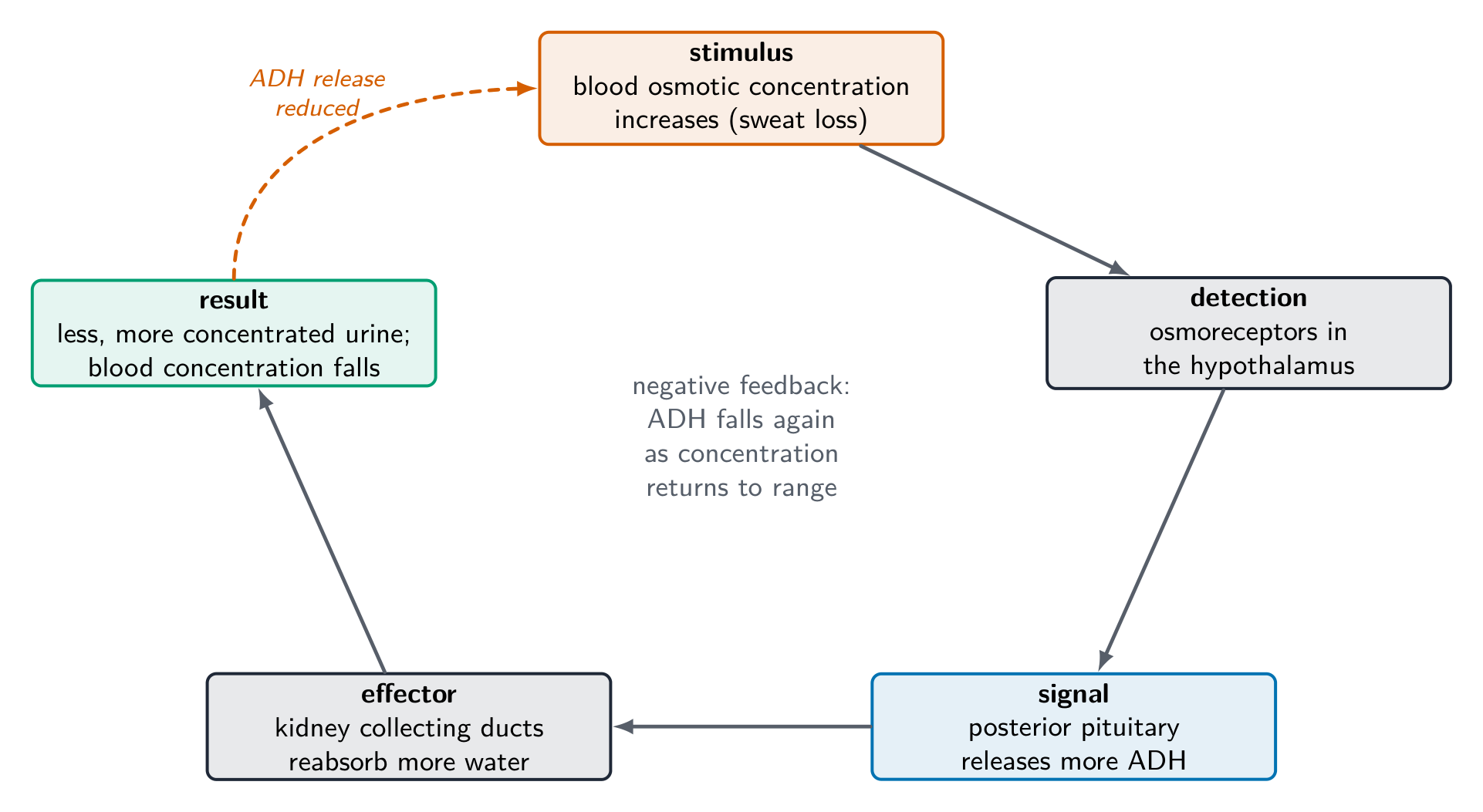
The hypothalamus detects changes in internal osmotic conditions and participates in thirst and hormonal regulation. Antidiuretic hormone, ADH or vasopressin, is made in hypothalamic neurons and released from the posterior pituitary. When conditions favour conserving water, increased ADH action makes the kidneys retain more water; less water then leaves in urine, which can become more concentrated. Falling osmotic concentration reduces that stimulus under ordinary feedback conditions.
This is negative feedback because the response opposes the initiating disturbance. The pituitary does not manufacture all of its released ADH, and the kidneys do not produce new water. Regulation includes blood-volume/pressure signals and other hormones affecting solute handling, so it is not a one-sensor switch controlled only by sweat. Detailed nephron anatomy is not needed for this unit's explanation.
The kidney response tends to oppose increased concentration. Thirst and other regulatory signals also contribute.
Dehydration concerns loss of body water. Hypernatraemia means an abnormally high sodium concentration in blood; hyponatraemia means an abnormally low concentration. They are not interchangeable names for the same amount of sweating. Excessive intake of hypotonic fluid relative to losses and impaired water excretion can contribute to exercise-associated hyponatraemia; a sports drink does not automatically remove that risk. Water and solute must be considered together.
The NATA position statement explains why fluid replacement depends on individual losses, conditions and tolerance. “More drinking is always better” and “never drink until severe thirst” are both poor universal rules. In class, analyse records rather than inducing dehydration or excessive drinking. Illness during activity needs qualified assessment, not a diagnosis from a worksheet or a single sign.
2.4
水分状况指标各有强弱和局限
English
Body mass measured consistently before and after an interval can help estimate net mass change. Use comparable dry clothing, the same suitable balance and recorded food, drink and urine where relevant. Wet clothes, retained food, respiratory exchange and metabolic changes can affect the interpretation. A short-term fall in mass does not demonstrate loss of that mass as body fat.
A urine-colour chart: cheap and quick, but only a rough indicator of hydration statusEach field indicator shows something and is limited by something: compare several
Urine colour offers a simple observation, but food pigments, supplements, medication, timing and lighting can affect it. Urine concentration can lag behind a changing exercise state. Osmolarity describes the number of osmotically active particles per volume of solution; osmolality uses mass of solvent instead. A measured urine value is not automatically identical to blood concentration. State the sample and method rather than writing “osmolarity was high” without a context.
Thirst is an important physiological cue, but perception, access to fluid, exercise conditions and timing influence its use as evidence. No one field indicator perfectly measures every aspect of water and electrolyte status. Compare measures and explain uncertainties; a single dark sample does not establish a precise percentage dehydration or a sodium diagnosis.
Sweat rate 出汗率 is sweat loss per time. A simplified field estimate is:
The signs follow mass balance. Drinking partly replaces lost mass, so it is added back when estimating sweat. Urine explains some of the mass lost separately from sweat, so subtract it. All terms must use compatible units; one kilogram of water is approximately one litre for this estimate, not an identity for every liquid.
Values 60.0 kg before, 59.6 kg after, drink 0.50 kg and urine 0.10 kg give sweat loss $60.0-59.6+0.50-0.10=0.80$ kg. Over 1.5 hours, estimated rate is $0.80/1.5\approx0.53$ kg per hour. The body-mass fall alone is 0.40 kg, or about 0.67% of initial mass; it is neither the whole sweat loss nor a complete fluid-status assessment. The approximation omits other exchanges, and recording uncertainty matters.
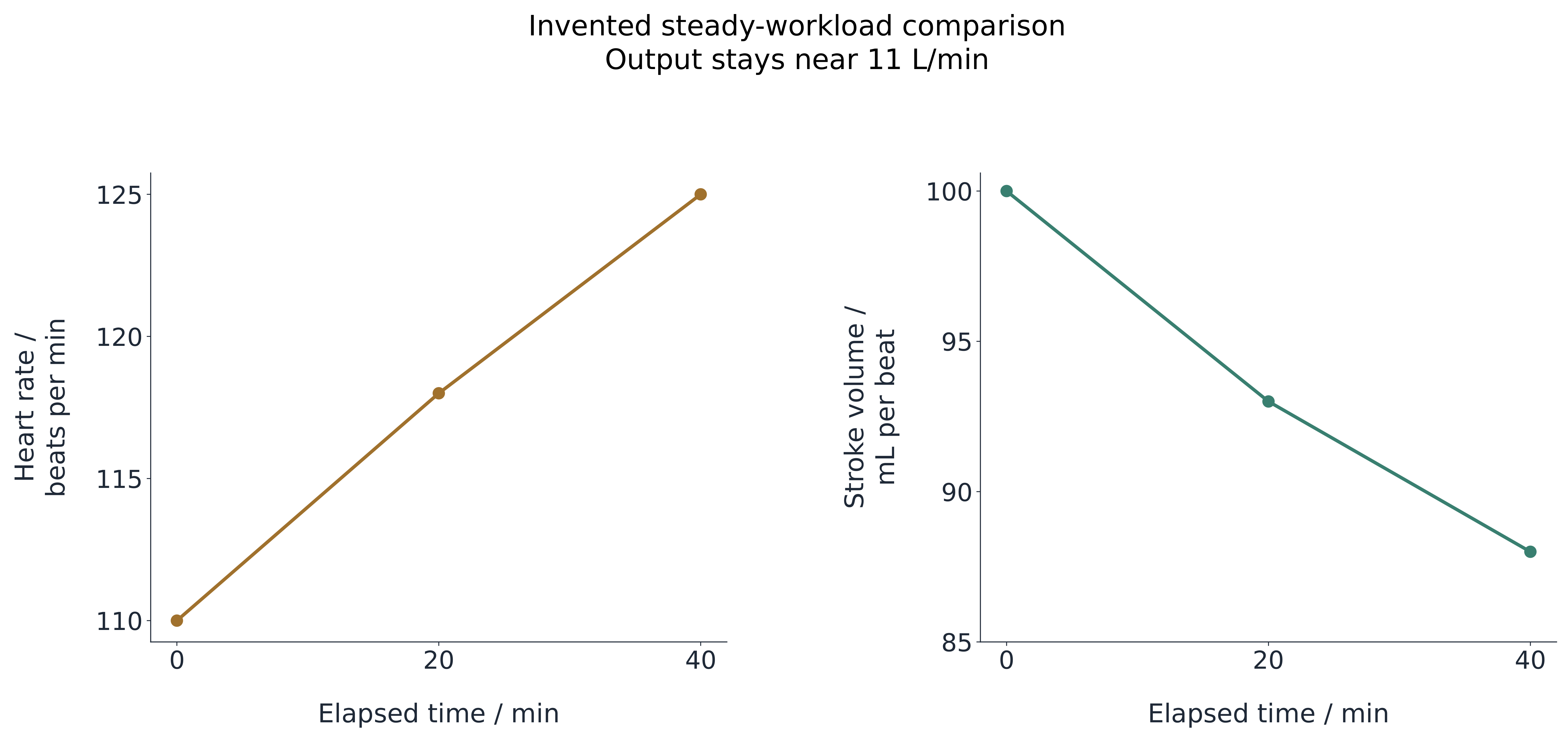
During prolonged exercise at a steady submaximal external workload, heart rate may gradually rise while stroke volume falls: cardiovascular drift. Rising body temperature increases skin circulation demand; loss of fluid can reduce plasma volume, venous return and ventricular filling. Several interacting mechanisms alter how the circulation supports exercise and heat transfer. Drift can occur in thermoneutral as well as hot conditions; heat and water loss can increase the challenge.
Cardiac output is heart rate multiplied by stroke volume. An early value of 110 beats per minute and 100 mL per beat gives 11.0 litres per minute. Later, 125 and 88 give the same 11.0 litres per minute. A higher heart rate therefore need not mean more cardiac output or a higher external workload. Actual output may be maintained or fall depending on the circumstances; the model is not a universal fixed compensation.
Heart rate rises while stroke volume falls; their product remains approximately 11 litres per minute in this model.
Environmental temperature, humidity, airflow, clothing, exercise intensity and acclimatization affect heat exchange and losses. Humidity limits evaporative cooling when the air's capacity to take up more water is reduced. More visible sweat does not necessarily mean more heat successfully removed; sweat that drips away contributes less evaporative cooling. Comparisons need matched workload and conditions, not simply two finish-line heart rates.
2.6
消化与吸收使膳食物质可供利用
English
Digestion 消化 breaks down food molecules mechanically and chemically. Carbohydrate-digesting enzymes form smaller sugars; proteases form peptides and amino acids; lipases help break triglycerides into absorbable products including fatty acids and monoacylglycerols. Bile emulsifies lipid into smaller droplets and supports absorption; it is not itself an enzyme. Pancreatic bicarbonate helps neutralize acidic contents entering the small intestine.
Along the gutDigestive enzymes break large insoluble molecules into small soluble ones
Absorption 吸收 moves digested products across the intestinal surface into the body. Villi and microvilli provide a large exchange area, while a thin epithelium shortens transfer distance. Sugars and amino acids enter blood; much absorbed dietary lipid is packaged and initially transported through lymph before reaching blood. Enzyme breakdown, membrane transport and bulk circulation are different steps. Water and ions can be absorbed without first being digested like a starch molecule.
Food tests detect components under controlled conditions: Benedict reagent with approved heating for reducing sugars, iodine for starch, Biuret reagent for protein and an ethanol emulsion test for lipids. Use suitable positive and negative controls; ethanol must be kept away from flames. A positive test does not measure the whole diet's quality, show how much nutrient is absorbed or prove that a food causes a health outcome. Classroom protocols require teacher approval and appropriate handling/disposal.
Carbohydrates can support relatively rapid ATP supply and are stored as glycogen in liver and muscle. Liver glycogen helps support blood glucose; muscle glycogen mainly supports the muscle using it. Lipids provide substantial stored energy and also contribute to membranes and other functions. Proteins provide amino acids for tissue synthesis, enzymes and repair; they can contribute to energy metabolism, but their role is not limited to fuel.
Bread is rich in carbohydrate, the macronutrient that refuels muscle and liver glycogenEnergy per gram of each macronutrientThe shapes of storage polysaccharides (starch, glycogen) and structural cellulose
Approximate metabolizable energy factors used for calculations are 17 kJ per gram for carbohydrate, 17 for protein and 37 for fat. These are teaching approximations, not ATP yields or a guarantee of complete usable energy from every food. Fibre, digestibility and how a food label is constructed can affect an actual estimate. Fat's higher energy per gram does not make it the fastest ATP-supply route during an explosive action.
A food portion containing 60 g carbohydrate, 20 g protein and 10 g fat has estimated energy $60(17)+20(17)+10(37)=1730$ kJ. Fat contributes $370/1730\times100\approx21.4\%$ of that estimate. Its percentage of nutrient mass, $10/90\times100\approx11.1\%$, answers a different question. Do not mix a mass fraction with an energy fraction.
Nutrient requirements vary with growth, age, body composition, activity, training load and individual circumstances. Sex-related physiological differences and reproductive status can affect needs, but a category alone cannot prescribe an individual's intake. Energy is needed during rest and recovery as well as exercise. A balanced argument considers adequate overall intake, nutrient availability and tolerance rather than declaring one macronutrient universally good or bad.
2.8
补能策略必须匹配需求及胃肠道耐受性
English
Before activity, food choice and timing affect stored carbohydrate, available energy and stomach comfort. Large meals close to exercise, or high fat/fibre amounts that are poorly tolerated in that context, can cause discomfort. During longer or more demanding activity, carbohydrate availability can help sustain ATP supply; during a brief activity, consuming a product does not instantly change the energy system doing the most work. Individual tolerance, event duration/intensity and opportunity to eat or drink matter.
Sports supplements and a shaker: a fuelling plan is judged by the event's demands and the gut's tolerance, not by the labelFuel before, during and after: match the plan to the event and the athlete
Match nutritional planning to the changing demands of a training programme: a heavy training day and a rest day are not identical tasks, yet both require fuel for normal physiology and recovery. Practise approved strategies under supervision rather than treating a new product as automatically beneficial on competition day. An experiment comparing two drinks should control carbohydrate concentration, fluid amount, prior food, workload and environmental conditions, or acknowledge what it cannot separate.
Low energy availability means too little energy remains available for physiological functions after accounting for exercise expenditure. Problematic prolonged and/or severe low availability can contribute to relative energy deficiency in sport, RED-S or REDs, affecting health and performance. Possible consequences include impaired bone health, hormonal/reproductive function, immunity, recovery and adaptation. It can affect male and female athletes and does not require low body mass or a diagnosed eating disorder.
For a daily model, calculate energy availability as intake minus exercise expenditure, divided by fat-free mass. With intake 8000 kJ, exercise expenditure 2000 kJ and fat-free mass 50 kg, the estimate is 120 kJ per kilogram fat-free mass per day. Raising exercise expenditure to 3000 while intake stays fixed gives 100. This is an accounting example, not a diagnostic cut-off or instruction to target these intakes. It is different from whole-day energy balance, which includes other expenditure.
The IOC consensus on REDs treats its assessment as more complex than a single arithmetic value. Food/exercise records have error, duration matters and clinical assessment considers multiple findings. Do not diagnose peers or prescribe restriction from these examples.
2.9
ATP通过重叠的能量系统持续再合成
English
ATP hydrolysis supplies energy for cellular work, including contraction and ion transport. The small immediately available ATP store needs continual resynthesis from ADP and phosphate. The three named systems describe major ATP-supply pathways; they do not take turns as mutually exclusive switches.
A hard sprint relies on anaerobic respiration, building up lactic acid.
The phosphagen system uses phosphocreatine to rapidly transfer phosphate to ADP, resynthesizing ATP. It supports very rapid demand but has limited stored capacity. It does not require oxygen directly in that phosphate-transfer reaction; restoration of phosphocreatine during recovery is strongly supported by oxidative metabolism. “Anaerobic” does not mean all other reactions in the body stop using oxygen.
Glycolysis breaks down carbohydrate in the cytosol and supplies ATP rapidly. Converting pyruvate to lactate helps regenerate $\mathrm{NAD}^{+}$ for continued glycolysis when that route is needed. Lactate can be produced even when oxygen is available; it is not merely a useless poison or proof that all cells lack oxygen. It can be transported and used as a fuel by other tissues.
Oxidative ATP supply uses oxygen-dependent metabolism, principally in mitochondria, from carbohydrate and lipid fuels, with amino acids contributing in some conditions. It can support sustained activity but its maximum ATP-supply rate is lower than rapid anaerobic pathways. Oxygen delivery, mitochondrial capacity and fuel availability limit it. Detailed Krebs-cycle and electron-transport reactions are not needed to compare these systems here.
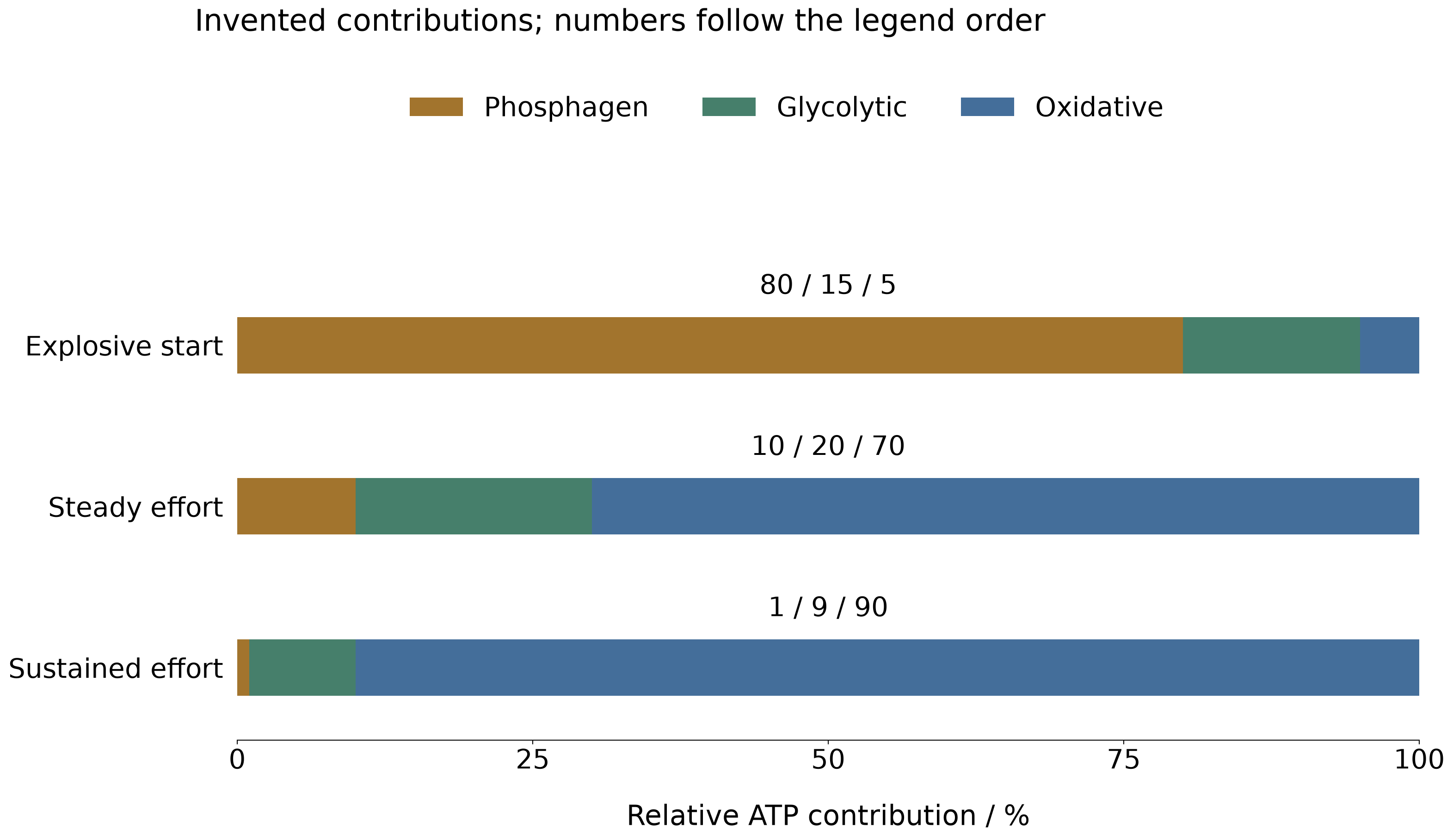
Relative ATP contributions for three activity conditions, showing all three systems in each
An explosive-start model assigns 80%, 15% and 5% to phosphagen, glycolytic and oxidative supply. A sustained-activity model assigns 1%, 9% and 90%. All contributions sum to 100%, but the percentages alone do not state the absolute ATP used. A high-intensity surge can increase anaerobic contribution during an otherwise oxidative event. Relative contributions depend on intensity, duration, training, fuel and preceding activity, not just a stopwatch boundary.
2.10
摄氧量与运动经济性描述不同的限制因素
English
Maximal oxygen consumption, $\dot V O_2\max$, describes the highest oxygen-uptake rate achieved under an appropriate maximal test. Its expression depends on units: absolute uptake in litres per minute differs from body-mass-relative uptake in millilitres per kilogram per minute. A reported peak in a test is not always accompanied by a demonstrated plateau; protocols and effort affect interpretation. In class, analyse supplied records rather than perform unsupervised maximal tests.
Marathon runners work almost entirely aerobically, so economy (oxygen used per kilometre) shapes their paceSame VO2max, different economyRelative VO2max depends on the denominator: 3.6 L/min is 60 at 60 kg but 45 at 80 kg
An absolute value 3.6 litres per minute equals 3600 millilitres per minute. At body mass 60 kg, this is $3600/60=60$ millilitres per kilogram per minute; at 80 kg, the same absolute uptake is 45. Changing the denominator changes the relative number without necessarily changing absolute oxygen-delivery capacity. These comparisons do not justify a weight-loss target.
Age, body composition, physiological sex-related differences, genetics, training and lifestyle can influence values, with substantial individual overlap. Endurance performance also depends on how much oxygen is required at a given speed, sustainable intensity, pacing and conditions. Running economy compares oxygen or energy cost at matched submaximal speeds. A supplied comparison of 2.4 versus 2.1 litres per minute at the same speed gives a 12.5% lower oxygen cost relative to 2.4; it does not by itself establish a higher maximum uptake or guarantee race victory.
2.11
练习
English
Distinguish total solute from concentration. A model starts with 120 solute units in 12 water units and loses 12 solute units and three water units. Calculate final concentration and percentage change; explain the model's limits.
Trace increased osmotic concentration through hypothalamus, pituitary ADH release and kidney action. Explain negative feedback without saying the kidneys create water or the pituitary makes all released ADH.
Compare body mass, urine colour and a concentration measurement as evidence of hydration. Give two confounders and explain why none alone establishes a sodium diagnosis.
Mass falls 55.0 to 54.5 kg; drink is 0.40 kg and urine 0.20 kg over 45 minutes. Estimate sweat loss and rate, and percentage body-mass fall. Explain the signs and one limitation.
At unchanged external workload, heart rate changes from 120 to 135 beats per minute and stroke volume from 90 to 80 mL per beat. Calculate cardiac output at both times; explain possible drift without inferring increased workload.
Separate digestion, absorption and transport for carbohydrate, protein and lipid. Explain bile's role, one food test with controls and a limit of the resulting health inference.
A model portion has 40 g carbohydrate, 15 g protein and 8 g fat. Using 17, 17 and 37 kJ per gram, calculate energy and fat's energy percentage. Explain why mass percentage differs.
Using intake 9000 kJ, exercise expenditure 2400 kJ and fat-free mass 55 kg, calculate the defined energy-availability estimate. Explain LEA/RED-S without treating that single value or body mass as a diagnosis.
Compare fuels, maximum supply rate, capacity and oxygen dependence of the three ATP systems. Explain the contribution figure and why an oxidative event can contain anaerobic surges.
Convert 3.0 litres per minute at 50 kg and at 75 kg to relative oxygen uptake. At matched running speed, uptake falls from 2.0 to 1.8 litres per minute: calculate percentage reduction and distinguish economy from maximum uptake.
Six of 24 participants report an outcome after a dietary exposure. Calculate percentage and design a more informative comparison, accounting for prior diet, workload and other confounders. Explain why the fraction is not causal proof.
2.12
例题答案
English
Initially $120/12=10$; later $108/9=12$, a 20% rise despite loss of solute. The model has fixed accounting units and omits compartments, excretion and feedback; it is not a clinical sodium calculation.
Increased concentration can stimulate hypothalamic signalling and posterior-pituitary ADH release. Kidneys reabsorb more water, tending to reduce the disturbance; urine water loss falls. ADH is synthesized in the hypothalamus. Volume signals, thirst and other regulatory pathways also matter.
Standardized mass gives net change with intake/output corrections; urine colour is affected by pigments/timing; concentration depends on sample and method. Wet clothing, food, medication and recording error can confound. Several measures and qualified assessment are needed for clinical interpretation.
Sweat estimate $55.0-54.5+0.40-0.20=0.70$ kg. Time $45/60=0.75$ hour; rate $0.70/0.75\approx0.93$ kg per hour. Mass fall $0.50/55.0\times100\approx0.91\%$. Add drink to restore replaced mass; subtract urine as another output. Other exchanges and balance/clothing error limit the estimate.
$120(90)=10800$ and $135(80)=10800$ mL per minute, both 10.8 litres per minute. Increased heart rate can partly compensate for reduced filling/stroke volume during thermal/fluid challenge; the values do not prove increased work or uniquely identify hydration state.
Enzymes form absorbable sugars, amino acids and lipid products; epithelial transport brings them into blood/lymph. Bile emulsifies lipid but is not an enzyme. Use a suitable component test with positive/negative controls and approved handling. Detection does not quantify overall diet quality or establish a disease cause.
$40(17)+15(17)+8(37)=1231$ kJ. Fat contributes $296/1231\times100\approx24.0\%$ of energy. Its nutrient-mass share is $8/63\times100\approx12.7\%$, with a different denominator and unequal energy factors.
$(9000-2400)/55=120$ kJ per kilogram fat-free mass per day. Problematic insufficient availability can impair normal functions and contribute to RED-S, in males and females. This estimate lacks the clinical context, duration and reliable full history needed for diagnosis; it is not whole-day net energy balance.
Phosphagen transfers stored phosphate rapidly with limited capacity; glycolysis supplies ATP from carbohydrate rapidly; oxidative metabolism uses oxygen and carbohydrate/lipid fuels for sustained supply with a lower maximum rate. Systems overlap. Relative percentages sum to 100 but do not determine absolute ATP, and a surge can increase anaerobic contribution.
$3000/50=60$ and $3000/75=40$ millilitres per kilogram per minute. Economy comparison: $(2.0-1.8)/2.0\times100=10\%$ lower oxygen cost at matched speed. Relative maximum and submaximal economy are different measures; neither alone fixes endurance performance.
$6/24\times100=25\%$. Compare suitable groups or a controlled, approved design with matched prior diet, workload, environment and measurement timing; record allocation, missing data and variation. Confounding, reverse causation and sampling can explain an association.
2.13
考试技巧
English
Name the compartment, quantity, time interval and denominator. Separate sweat loss from net mass change, energy share from mass share, and relative from absolute oxygen uptake. Trace feedback through the correct hormone source and target. State that ATP pathways overlap and judge a nutrition claim using method and context rather than a product label.