This handout teaches C.4 Standing waves and resonance in full, for the course first assessed in 2025. There is no additional higher level content in C.4, so SL and HL students study the same material.
Prerequisites: superposition, wavelength, frequency and $v = f\lambda$ from C.2 and C.3; natural oscillation, phase and energy in simple harmonic motion from C.1. Use about $340\ \text{m s}^{-1}$ for the speed of sound in air.
14.2
驻波如何形成
English
Why does a guitar string play only certain notes?
A plucked guitar string produces a pitched sound containing several harmonics. Touch its midpoint lightly and pluck again: in the ideal string model this suppresses modes that move the midpoint, leaving the second harmonic as the lowest surviving mode, one octave above the first. Strings and air columns select modes through reflection and boundary conditions. A bottle blown across its neck can instead behave as a Helmholtz resonator; do not apply the uniform-pipe formulas to every cavity.
Two waves travelling in opposite directions
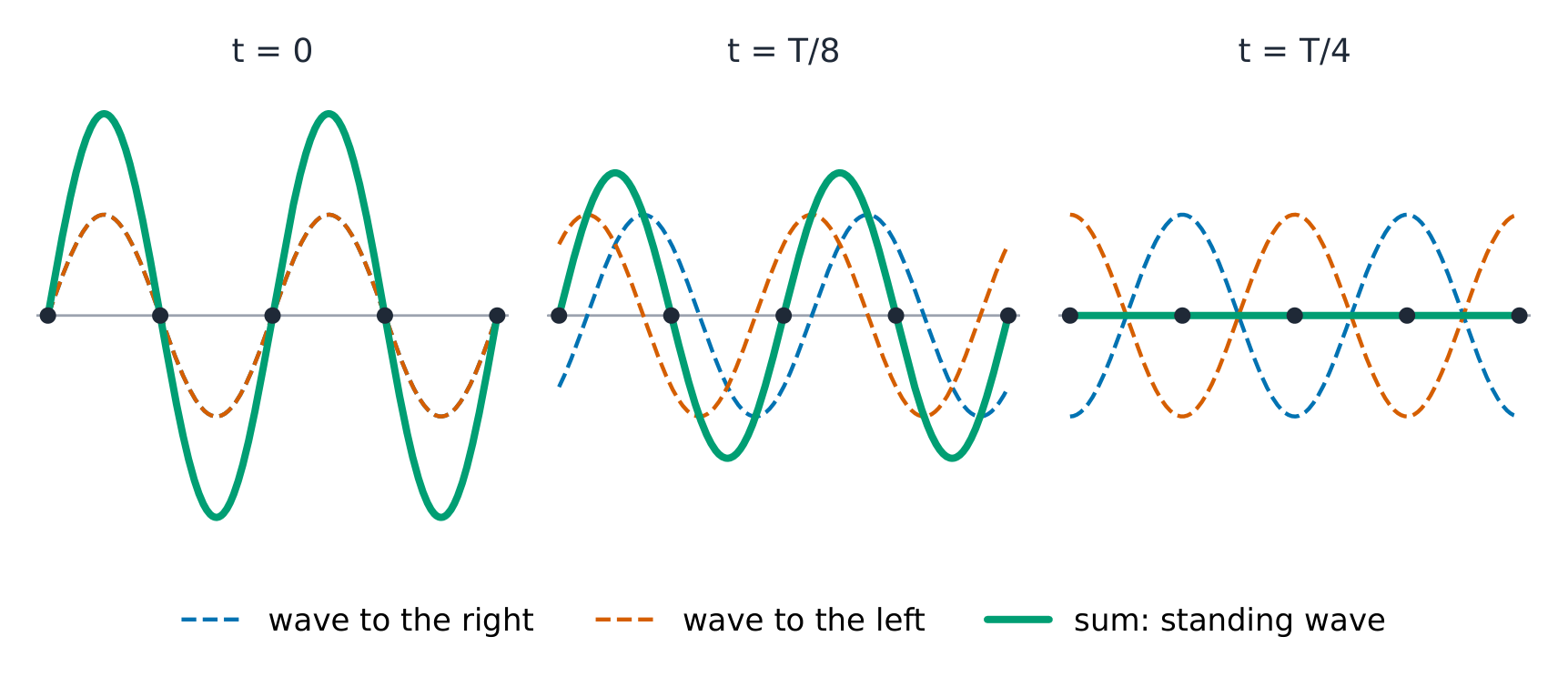
A standing wave 驻波 forms when two waves of the same frequency, wavelength and amplitude travel in opposite directions through the same medium and superpose. Usually one is a wave and the other is its own reflection from the end of a string or pipe.
The sum of two opposite travelling waves: the nodes never move
At some points the two waves always cancel: these points never move. At others the waves reinforce, and the medium oscillates with twice the amplitude of each wave. The pattern does not travel along the medium. At $t = T/4$ in this drawing, the waves cancel everywhere: the string is flat, while its non-node points are moving. The nodes remain at rest.
A node 波节 is a point where the displacement is always zero.
An antinode 波腹 is a point where the amplitude is greatest.
Neighbouring nodes are half a wavelength apart; so are neighbouring antinodes. A node and the nearest antinode are a quarter of a wavelength apart.
Nodes λ/2 apart, node to antinode λ/4; one loop moves in phase, neighbouring loops in antiphase.
Amplitude and phase along a standing wave
Amplitude varies with position: zero at the nodes, greatest at the antinodes.
Phase: all points between two neighbouring nodes move in phase: they reach their maximum displacement at the same moment. Points in neighbouring loops, on opposite sides of a node, move in antiphase (phase difference $\pi$).
Worked example: microwaves reflected from a metal plate form a standing wave. A detector finds nodes 1.5 cm apart, so $\lambda = 3.0\ \text{cm}$ and $f = c/\lambda = 3.00 \times 10^8/0.030 = 1.0 \times 10^{10}\ \text{Hz}$.
Standing and travelling waves compared
Travelling wave
Standing wave
Energy
net transfer in the propagation direction
no net transfer along an ideal standing wave
Amplitude
uniform for an ideal undamped plane wave
zero at nodes, greatest at antinodes
Phase
changes steadily along the wave
the same within a loop; $\pi$ between neighbouring loops
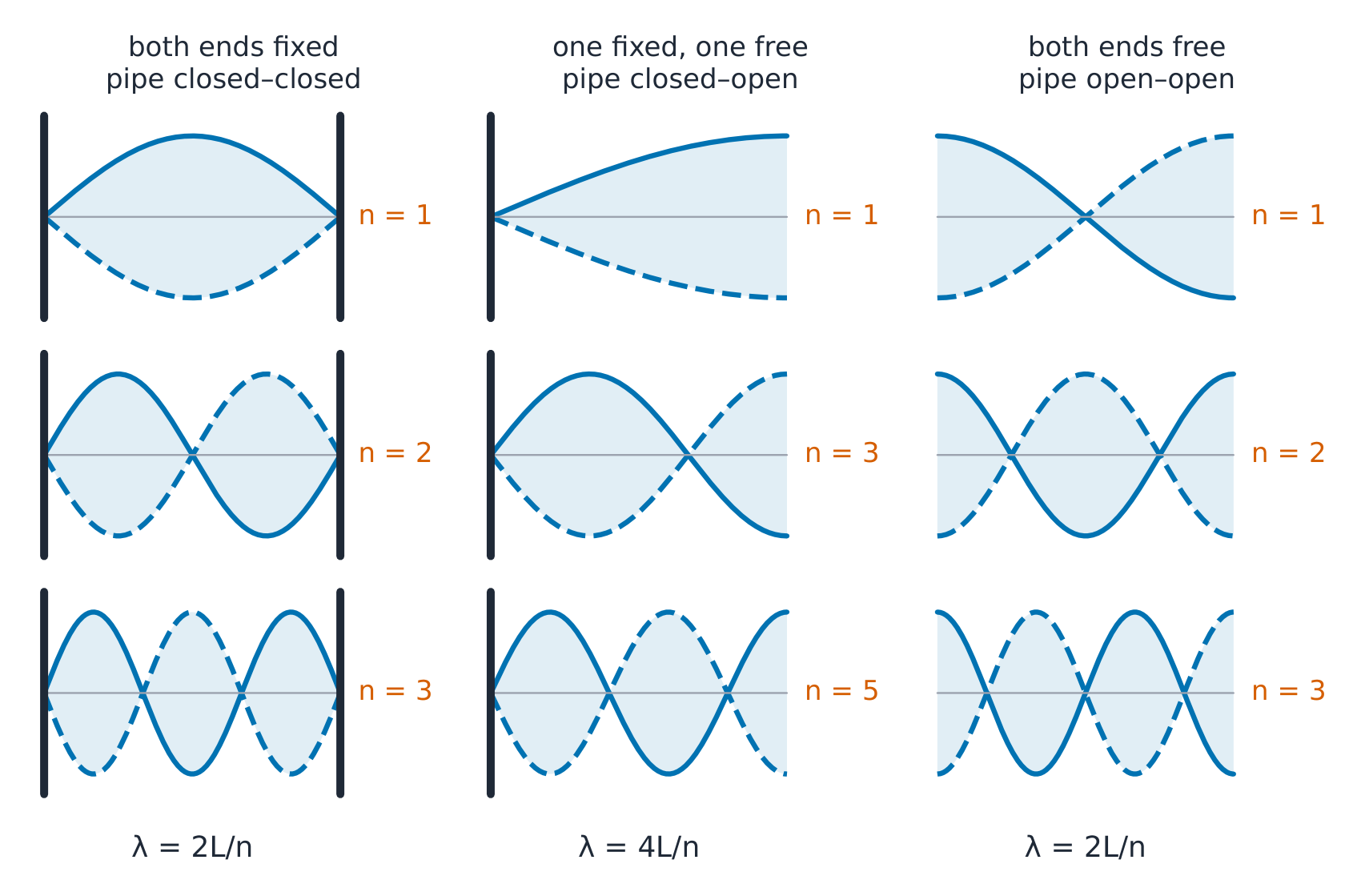
The ends of a string decide which standing waves fit. These are the boundary conditions 边界条件:
A fixed end, such as a string clamped at a guitar's bridge, cannot move, so it must be a node.
A free end, such as a light ring that can slide on a smooth rod, moves the most, so it is an antinode.
Only wavelengths that give a node or antinode at the right places can form. Each allowed pattern is a harmonic 谐波. The lowest frequency is the first harmonic 第一谐波 ($n = 1$).
The ends decide which harmonics fit; the solid and dashed lines show the extremes of the motion
Boundaries
Allowed $n$
Wavelength
Frequency
both fixed, or both free
1, 2, 3, …
$\lambda_n = \dfrac{2L}{n}$
$f_n = \dfrac{nv}{2L}$
one fixed, one free
1, 3, 5, … (odd only)
$\lambda_n = \dfrac{4L}{n}$
$f_n = \dfrac{nv}{4L}$
where $L$ is the length of the string and $v$ is the speed of the wave along it. Every harmonic is a whole-number multiple of the first harmonic frequency.
Worked example: a guitar string of length 0.65 m, fixed at both ends, plays a first harmonic of 110 Hz.
The air in a pipe can hold a standing sound wave. It is described by the displacement of the air molecules:
Organ pipes: each pipe's length sets the wavelength of its standing wave, and so its note
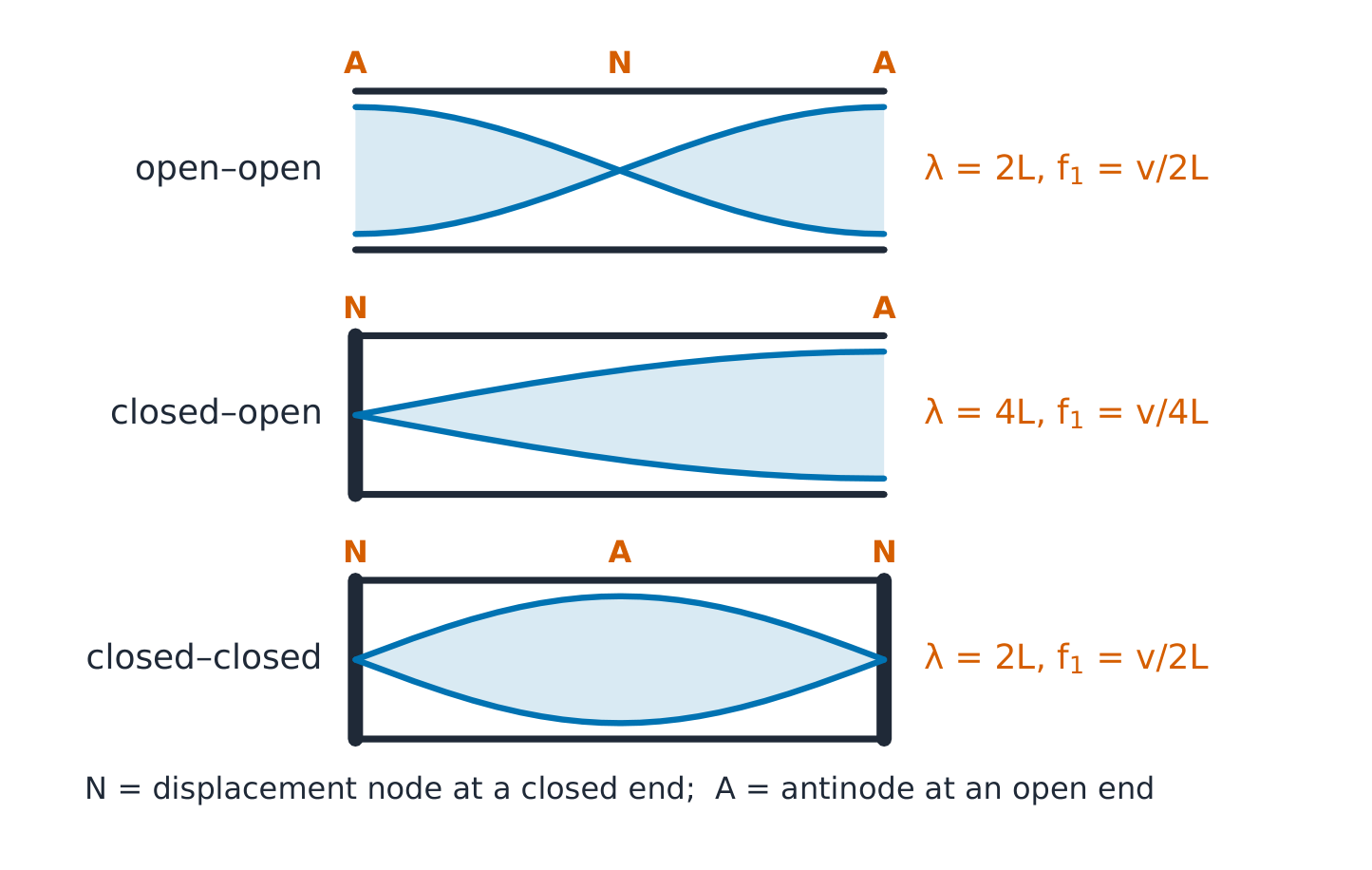
At a closed end the air cannot move, so there is a displacement node.
At an open end the air moves most freely, so there is a displacement antinode.
First harmonics in pipes: closed ends are nodes, open ends are antinodes
These are displacement patterns, not transverse paths of the air. Pressure variations have the opposite node/antinode pattern. Neglecting end corrections and losses, a uniform pipe has the same mode-length relationships as the corresponding string boundaries:
open–open and closed–closed pipes: all harmonics, $f_n = \dfrac{nv}{2L}$;
closed–open pipe (closed at one end): odd harmonics only, $f_n = \dfrac{nv}{4L}$, $n = 1, 3, 5, \dots$
Worked examples, for pipes 0.34 m long with $v = 340\ \text{m s}^{-1}$:
Modes of an air column: a closed end is a node, an open end an antinode
Open at both ends: $f_1 = 340/(2 \times 0.34) = 500\ \text{Hz}$, then 1000 Hz, 1500 Hz, …
Closed at one end: $f_1 = 340/(4 \times 0.34) = 250\ \text{Hz}$, then 750 Hz, 1250 Hz, … Closing one end lowers the first harmonic by an octave and removes the even harmonics.
Worked example with measurements, neglecting end correction: measuring the speed of sound. A tuning fork of 512 Hz is held over a tube whose lower end is closed by water. The first loud resonance is heard when the air column is 0.166 m long. This is a closed–open pipe, so $L = \lambda/4$: $\lambda = 0.664\ \text{m}$ and $v = 512 \times 0.664 = 340\ \text{m s}^{-1}$. The next resonance is at $3\lambda/4 = 0.498\ \text{m}$.
14.6
共振
English
Natural frequency and driving frequency
A natural frequency 固有频率 is a frequency of free oscillation of a mode after displacement and release. A simple oscillator has one relevant mode; a glass or bridge can have many.
The amplitude of a forced oscillation peaks at resonance, when the driving frequency equals the natural frequency
When a periodic force keeps pushing an oscillator, the oscillator is forced to oscillate at the frequency of the push, the driving frequency 驱动频率. The amplitude depends on how close the driving frequency is to the natural frequency.
Resonance 共振 is an enhanced response to periodic driving near a natural frequency. For light damping the displacement-amplitude maximum is very close to the undamped natural frequency. With damping its precise position can be lower; in the linear viscous-damping model, maximum average absorbed power is at the undamped natural frequency. Pushing a swing once per swing, at the right moment, makes it go higher and higher; pushing at any other rhythm sometimes helps and sometimes hinders.
The resonance curve
Light and moderate damping have peaks below the natural frequency; the overdamped case has no resonance peak.
At very low driving frequency the oscillator follows the force almost statically. Its amplitude is finite, about force amplitude divided by stiffness in the spring model.
With light damping, the displacement peak lies close to the natural frequency; increasing damping shifts it lower.
At high driving frequencies the oscillator cannot keep up, and the amplitude falls towards zero.
Damping 阻尼 is the loss of energy from an oscillator, usually by friction or air resistance, which makes the amplitude of free oscillations decrease.
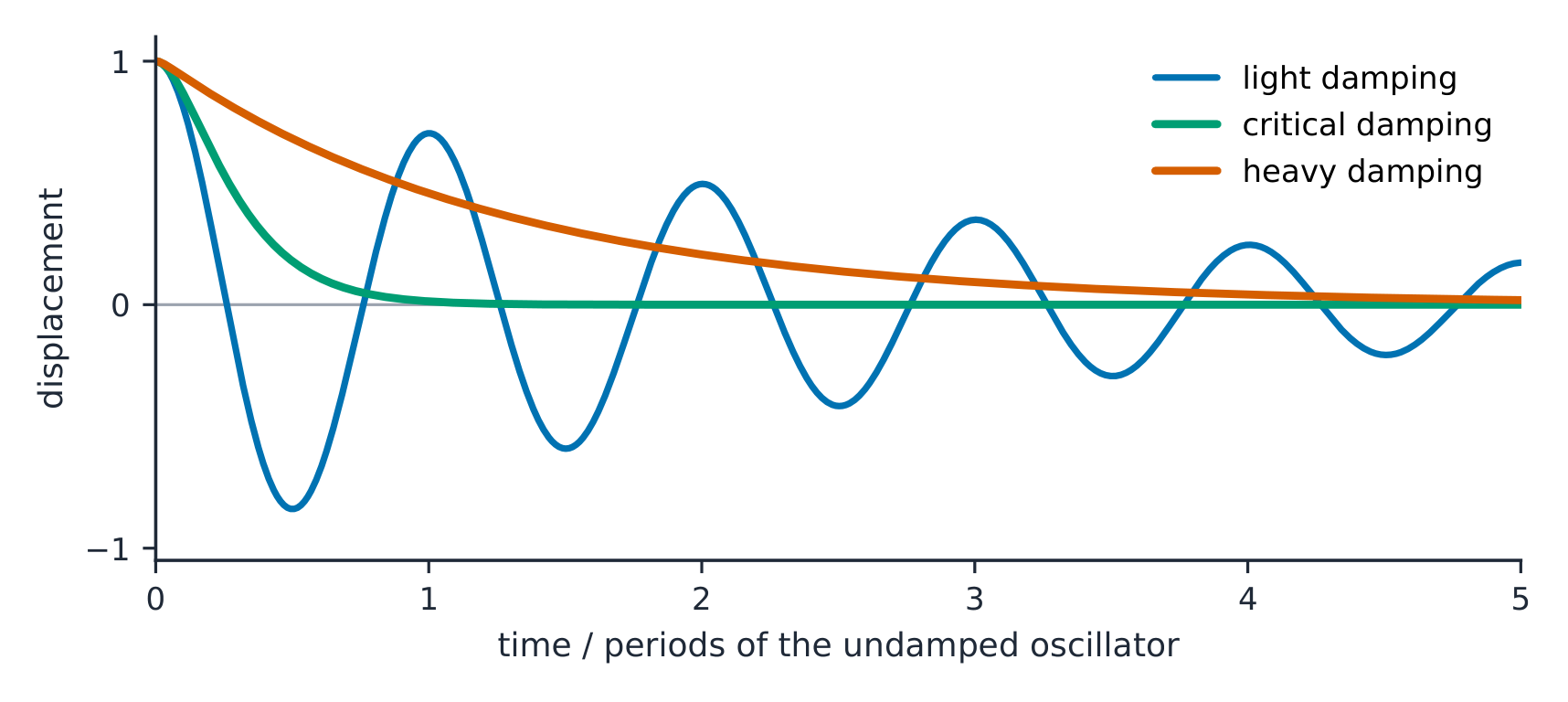
Three degrees of damping after the same release
An oscillator can have light damping 欠阻尼, critical damping 临界阻尼 or heavy damping 过阻尼:
Degree of damping
Behaviour after release
Example
light
oscillates many times; the amplitude decreases gradually
a pendulum in air, a plucked guitar string
critical
fastest non-oscillatory return for the same ideal oscillator released from rest
a model suspension or door closer
heavy
returns to equilibrium slowly, without oscillating
a pendulum in thick oil
Damping and resonance
Increasing the damping of a driven oscillator:
reduces the maximum amplitude at resonance;
makes the resonance peak broader, so the oscillator responds over a wider range of frequencies;
moves the displacement-amplitude peak to a lower frequency; sufficiently strong damping removes a distinct peak altogether.
In the lab: release a pendulum through a small angle, keep its path clear and time several complete oscillations. Count each cycle when the bob returns to the same position moving in the same direction, then divide the total time by the number of cycles. Repeat the timing and record how the amplitude decreases, rather than assuming undamped motion. For ideal local SHM, speed is greatest at equilibrium and acceleration magnitude is greatest at the extremes.
Resonance is useful when we want large oscillations at one particular frequency:
Musical instruments: the body of a guitar or the air in a flute resonates to make the sound loud.
Tuning a radio: the circuit is adjusted until its natural frequency matches one station, so only that station is received strongly.
Clocks: many quartz watches use a 32 768 Hz crystal mode as a stable timing reference; quartz resonators do not all share this frequency.
MRI scanners use radio-frequency excitation near the nuclear-spin resonance frequency in a magnetic field. Microwave-oven heating is not a special resonance of water molecules: its alternating electric field drives molecular dipoles and energy is dissipated. See the IAPWS explanation.
Resonance is dangerous when a structure is driven near its natural frequency:
The Tacoma Narrows Bridge collapsed in 1940 through self-excited torsional flutter: the moving deck changed the aerodynamic forces, feeding energy into its twisting motion. This differs from a prescribed periodic force driving simple resonance. See WSDOT’s engineering account.
Bridges: London's Millennium Bridge developed lateral sway under crowds in 2000. Pedestrian forces interacted with the moving deck and fed its motion; this was more complex than a fixed external driver at one frequency. Engineers added damping. See the Arup engineers' account.
Buildings in earthquakes: ground motion near a building mode can amplify its response, but damage also depends on strength, duration, damping and the shaking spectrum. A tuned mass damper can reduce selected structural vibrations.
Machines and vehicles: an engine running at a certain speed can make a part of a car vibrate loudly, or a washing machine shake across the floor.
To avoid harmful resonance, engineers change the natural frequency (make the structure stiffer or heavier) or add damping.
14.9
练习
English
Explain how a standing wave forms on a string fixed at both ends.
State three differences between a standing wave and a travelling wave.
A string 0.80 m long is fixed at both ends. Waves travel along it at 240 m s⁻¹. Find the wavelength and frequency of the first harmonic, and the frequencies of the next two harmonics.
Neighbouring nodes on a vibrating string are 0.25 m apart. The frequency is 400 Hz. Find the wave speed.
A pipe 0.25 m long is closed at one end. Find the frequencies of the two lowest harmonics.
A pipe open at both ends has a first harmonic of 425 Hz. Find its length.
Two neighbouring resonant frequencies of a pipe are 300 Hz and 500 Hz. Show that the pipe must be closed at one end, and find its first harmonic.
Points X and Y on a standing wave are on opposite sides of one node. Points Y and Z are in the same loop. State the phase difference between X and Y, and between Y and Z.
Define natural frequency and resonance.
Describe how the resonance curve of a driven oscillator changes as the damping increases.
In an ideal suspension model released from rest, explain the advantage of critical damping over light or heavy damping. State one limit of applying this model to a real car.
Give one useful and one harmful example of resonance.
A 512 Hz tuning fork gives its first resonance over a tube closed at the bottom when the air column is 0.166 m long. Find the speed of sound, and the length for the next resonance.
Answers.
Waves travel along the string and reflect at the fixed ends. The incident and reflected waves have the same frequency, wavelength and amplitude and travel in opposite directions; they superpose to give fixed nodes (including at the ends) and antinodes.
An ideal standing wave has zero net energy transfer along the medium, amplitude varying between nodes and antinodes, and in-phase motion within each loop. An ideal undamped plane travelling wave has uniform amplitude and changing phase along its direction of travel.
$\lambda_1 = 2L = 1.6\ \text{m}$; $f_1 = 240/1.6 = 150\ \text{Hz}$; then 300 Hz and 450 Hz.
For an open (or closed–closed) pipe, neighbouring harmonics differ by $f_1$, so $f_1 = 200\ \text{Hz}$, but 300 Hz is not a whole multiple of 200 Hz. For a closed–open pipe, neighbouring harmonics differ by $2f_1$: $f_1 = 100\ \text{Hz}$, and 300 Hz and 500 Hz are the 3rd and 5th harmonics.
X and Y: $\pi$ rad (antiphase). Y and Z: zero (in phase).
The natural frequency is the frequency at which a system oscillates freely after being displaced. Resonance is an enhanced driven response near a natural frequency; damping limits the response and can shift the displacement-amplitude peak.
At fixed driving-force amplitude the displacement peak lowers, broadens and shifts lower; sufficiently strong damping removes a distinct peak.
Critical damping gives the fastest non-oscillatory return for this released ideal model. Light damping permits bouncing; heavy damping returns more slowly. A real suspension has several coupled modes and must also maintain tyre contact, so its optimum is not universally exact critical damping.
Useful: a radio tuned to one station, a musical instrument body, a quartz watch. Harmful: a footbridge swaying under walkers, buildings in an earthquake, a vibrating car part.