This handout teaches HL lens a, Environmental law, for the course first assessed in 2026. It is for HL students only. Environmental law is one of three HL lenses, with environmental and ecological economics (unit 10) and environmental ethics (unit 11), that you apply to the case studies of Topics 1 to 8.
Prerequisites: Topic 1 (sustainability, perspectives and the three levels of pollution management), Topic 3 (conservation and CITES), Topic 4 (the tragedy of the commons and fisheries), Topic 6 (the Paris Agreement and the Montreal Protocol) and Topic 8 (urban air pollution).
9.2
环境法及其目的
English
Ten years without fishing
China's ten-year commercial fishing ban in key Yangtze waters began in 2021, alongside other conservation and livelihood measures. The agriculture ministry's 2022 survey, reported in 2023, estimated 1249 Yangtze finless porpoises compared with 1012 in 2017: a 23.42% increase. This is evidence of recovery across five years, not proof that a policy beginning in 2021 caused the whole change. The Yangtze River Protection Law 长江保护法 entered into force in March 2021. Enforcement, habitat, other pressures and support for former fishers all affect outcomes. The baiji is classified as Critically Endangered (Possibly Extinct), not simply declared extinct; distinguish it from the finless porpoise. This unit asks how laws change behaviour and how to test whether that change protects ecosystems fairly.
Porpoise estimates rose 23.42% from 2017 to 2022; the ban began in 2021
What is environmental law?
Environmental law 环境法 is the set of rules, established and enforced through relevant public or recognized social authorities, that controls how people use and affect the environment. Unlike a voluntary code, a law carries consequences: fines, closure, compensation or prison.
Five sources of environmental law
Environmental law comes from several sources:
Source
Meaning
Example
Statute 成文法
A law passed by a parliament or legislature
China's Environmental Protection Law (revised 2014)
Regulation 法规
Detailed rules made by a government agency under a statute
Emission standards for power stations
Case law 判例法
Decisions by courts that guide later cases
The Urgenda climate case (Netherlands, 2019)
Treaty 条约
A written agreement between states, binding on those that join
The Montreal Protocol (1987)
Customary international law 国际习惯法
General state practice accepted as law; a different source from treaty consent
A state must not cause serious harm to another state's environment
Every law applies within a jurisdiction 管辖范围: the area or group of people a government or court has authority over. Pollution and wildlife do not respect borders, so a problem may cross many jurisdictions.
Hard law and soft law
Hard law 硬法 is legally binding: treaties, statutes and regulations that can be enforced.
Soft law 软法 is not binding but still guides behaviour: declarations, principles, guidelines and targets, such as the Rio Declaration (1992) or the Sustainable Development Goals.
Soft law can allow agreement without a binding treaty obligation and can influence later legislation, standards or treaties. Its political and practical effects may still be substantial; non-binding does not mean unimportant.
Key principles of environmental law
Many environmental laws are built on a small set of principles, most of them stated in the Rio Declaration of 1992:
The principles grouped by the question each answers
Principle
Meaning
Prevention principle 预防原则
It is better to prevent environmental harm than to repair it
Precautionary principle 风险预防原则
Where there is a threat of serious or irreversible damage, lack of full scientific certainty is not a reason to delay action
Polluter pays principle 污染者付费原则
Those who cause pollution should pay the costs of preventing it or cleaning it up
Environmental impact assessment 环境影响评价
Large projects must be assessed for environmental effects before approval (Topic 1)
Public participation 公众参与
People have a right to information, to take part in decisions and to go to court on environmental matters
Intergenerational equity 代际公平
The present generation must not leave the environment worse for future generations
Common but differentiated responsibilities 共同但有区别的责任
All states share the duty to protect the environment, but richer states that caused more of the damage should do more
Precaution supports proportionate preventive action despite scientific uncertainty about serious or irreversible harm. Some legal systems place evidence requirements on project proponents, but the principle does not universally reverse the burden of proof or require proof of zero risk. State the applicable instrument, evidence, seriousness, alternatives and review arrangements.
Types of legal instrument
Laws use different tools to change behaviour:
Five legal tools that change behaviour in different ways; outcomes depend on enforcement
Command and control 命令与控制: standards, permits, quotas and bans set by the government and enforced with penalties. Examples: emission limits, a ban on ivory trade, a fishing ban. They specify permitted conduct or limits, but actual outcomes depend on enforcement; a minimum standard alone may give little incentive to go further.
Market-based instruments 市场手段: taxes, charges, subsidies and tradable permits that put a price on pollution (unit 10). Example: China's Environmental Protection Tax Law (2018) charges polluters per unit of pollutant released.
Liability 责任: polluters must pay compensation for harm they cause, which encourages care.
Protected areas 保护区 and land-use planning: national parks, ecological red lines and zoning (Topics 3 and 8).
Information 信息: rules requiring companies to monitor and publish their emissions, so the public and investors can put pressure on them.
Worked example: concentration and load
A discharge permit may limit the concentration of a pollutant, the total load (mass per unit time), or both.
A concentration limit is not a load limit: the same 1.5 mg/L at double the flow doubles the load
A factory's permit allows a maximum concentration of 2 mg/L of a pollutant. Its discharge is 1.5 mg/L at 400 L per minute.
The factory doubles its output, so the flow rises to 800 L/min at the same 1.5 mg/L.
New load = 1.5 × 800 = 1200 mg per minute.
The factory still obeys the concentration limit, but twice as much pollutant now reaches the river. A permit that limits only concentration can also be met by diluting the waste with clean water. For this reason many permits also cap the total load, and China's water laws set total load controls for key pollutants in many river basins.
Many environmental problems are transboundary 跨界: acid rain, river pollution, migratory species, ozone depletion and climate change. Others concern the global commons 全球公域, a term used for shared spaces or environmental systems whose protection needs international cooperation. The term does not give every example the same legal status. No state may claim sovereignty over the high seas, but activities there are still governed by international law; shared does not mean unregulated.
Seized raw ivory: CITES makes international trade in it illegal, but national agencies must enforce the banTransboundary harm and the global commons need cooperation
Distinguish the atmosphere as a connected environmental system from legal authority over airspace. States have sovereignty over the airspace above their territory, as ICAO explains under Article 1 of the Chicago Convention. That authority does not keep greenhouse gases inside national borders. Antarctica has a different arrangement: Article IV of the Antarctic Treaty preserves parties' positions on existing territorial claims and their recognition, while preventing new or enlarged claims during the treaty's operation. It does not simply erase every claim. Cooperation addresses shared effects while respecting the applicable legal regime; without effective arrangements, free-riding can weaken protection (Topic 4).
The basic rule of customary international law comes from the Trail Smelter case (1941): a smelter in Canada damaged farms and forests in the USA with sulfur dioxide, and a tribunal ruled that no state may allow its territory to be used to cause serious environmental harm to another. This rule appears again as Principle 21 of the Stockholm Declaration (1972) and Principle 2 of the Rio Declaration (1992).
Major agreements
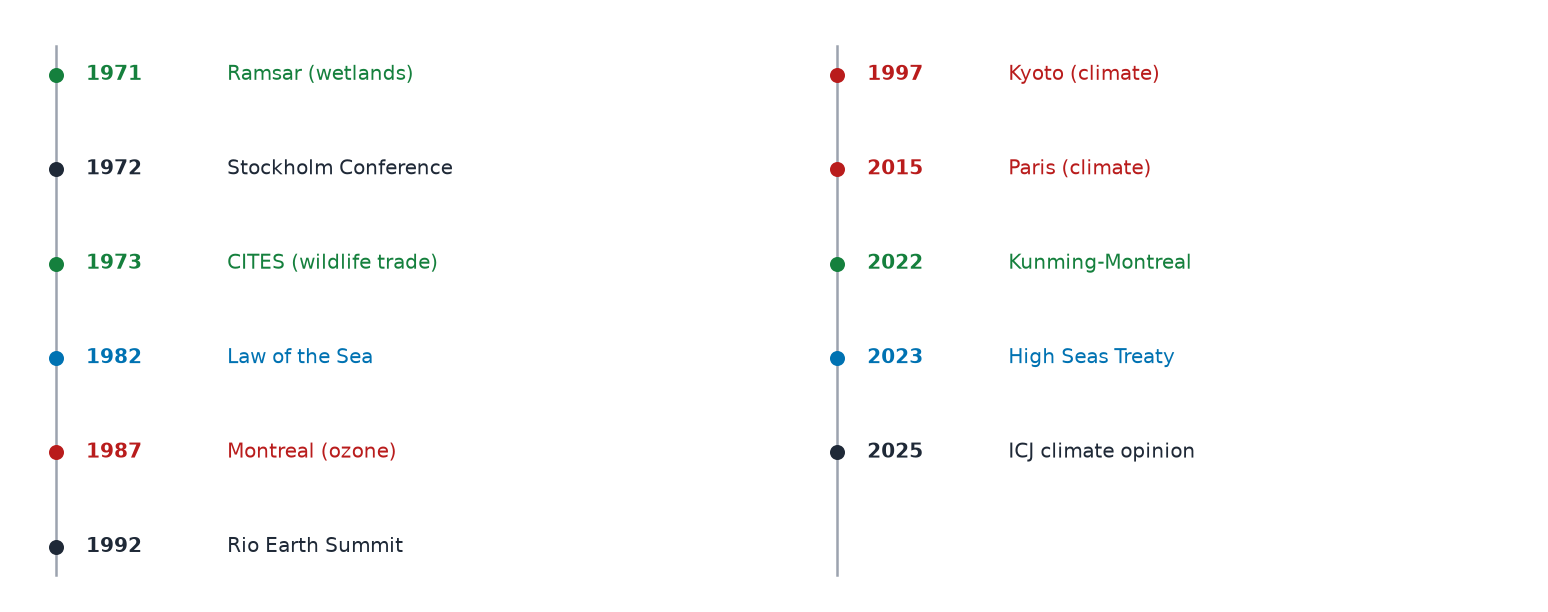
Some milestones in international environmental law (green: biodiversity; red: atmosphere and climate; blue: oceans)
Agreement
Year
What it does
Ramsar Convention 拉姆萨尔公约
1971
Protects wetlands of international importance; over 2500 listed sites
CITES 濒危野生动植物种国际贸易公约
1973
Controls trade in endangered species through permits; international commercial trade in wild Appendix I specimens is generally prohibited, subject to defined exceptions and permit rules
UN Convention on the Law of the Sea 联合国海洋法公约
1982
Sets territorial waters and 200-nautical-mile exclusive economic zones; duty to protect the marine environment
Montreal Protocol
1987
Phases out ozone-depleting substances; ratified by every UN member state
Convention on Biological Diversity 生物多样性公约
1992
Conservation, sustainable use and fair sharing of the benefits of genetic resources
UN Framework Convention on Climate Change 联合国气候变化框架公约
1992
Aims to stop dangerous human interference with the climate; meets every year at a Conference of the Parties (COP)
Kyoto Protocol
1997
Binding emission cuts for developed countries only
Paris Agreement
2015
Parties submit nationally determined contributions; well below 2 °C with efforts towards 1.5 °C; binding procedural duties differ from achieving each target
Kunming-Montreal Global Biodiversity Framework 昆明-蒙特利尔全球生物多样性框架
2022
23 targets for 2030, including protecting 30 % of land and sea ("30 by 30"); agreed under China's presidency of COP 15
High Seas Treaty 公海条约
2023
Allows marine protected areas and impact assessments in waters beyond national jurisdiction; in force from January 2026
Many agreements follow a framework-protocol model: a framework convention sets general aims, and later protocols add binding details. The Vienna Convention (1985) was followed by the Montreal Protocol (1987); the UNFCCC (1992) by the Kyoto Protocol (1997) and the Paris Agreement (2015).
From treaty to change on the ground
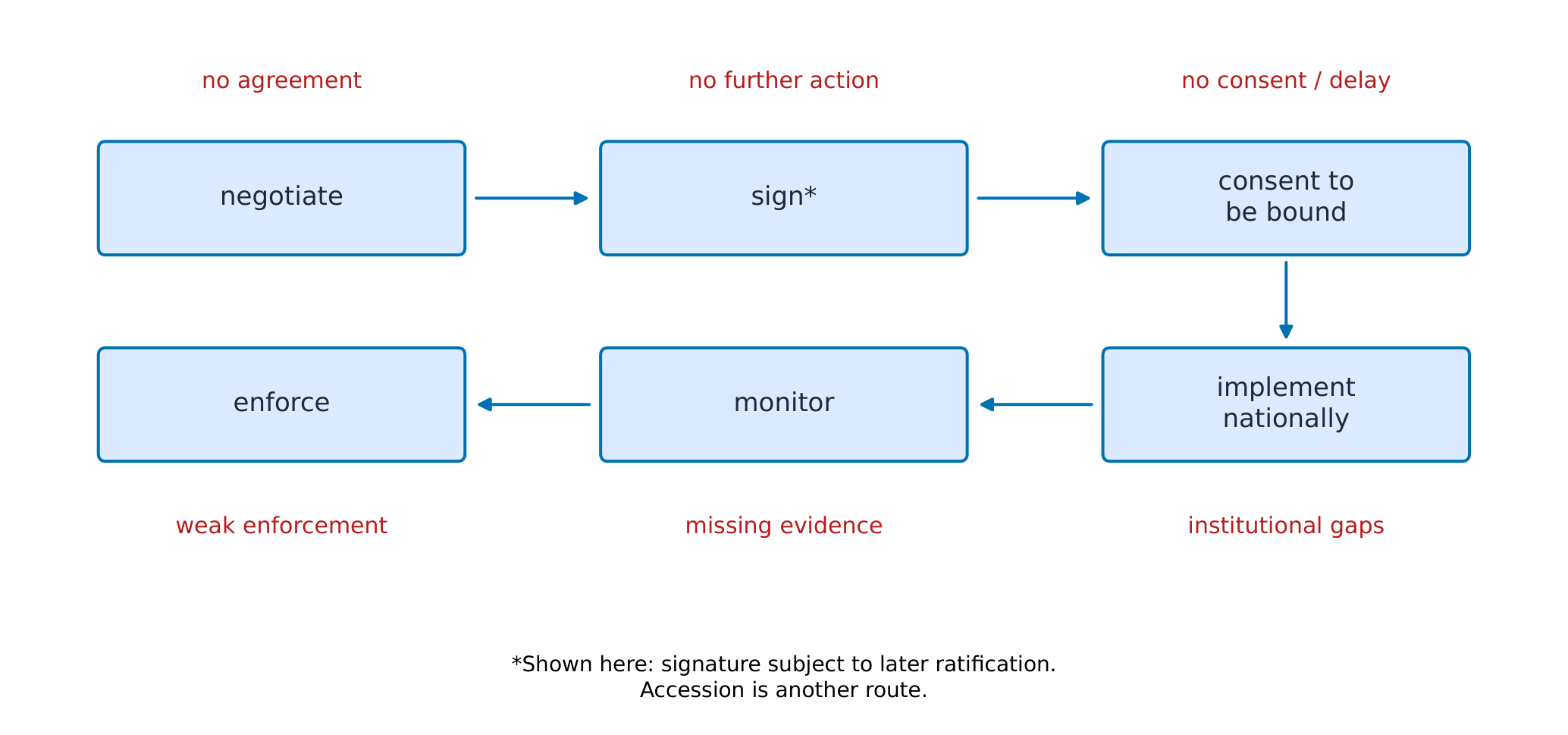
States are sovereign 主权: they exercise state authority, but sovereignty does not remove international duties. A state can ratify 批准 a treaty through the prescribed process or use another form of consent allowed by that treaty. Treaty obligations depend on the agreement's provisions, consent to be bound and entry into force for the state. The UN treaty guidance distinguishes signature, ratification, acceptance, approval and accession. Signature subject to ratification does not itself establish consent to be bound by the whole treaty, but it is not merely meaningless symbolism. Accession can make a state a party without the same prior signature sequence. Withdrawal must follow applicable rules; leaving one treaty does not remove independent customary obligations.
A route, not a compulsory sequence for every treaty or legal system; red labels identify implementation risks.
The USA signed but never ratified Kyoto. Its first Paris withdrawal took effect in 2020, it rejoined in 2021, and the second withdrawal took effect on 27 January 2026. Date participation claims rather than using an announcement as the effective date.
International judgments can bind parties within a court's jurisdiction, although implementation and enforcement may be difficult. Advisory opinions, such as the ICJ's 2025 climate opinion, have a different legal status. Treaty reporting, review, technical assistance, finance and applicable trade measures can support compliance. Neither a signature nor a judgment alone demonstrates an ecological improvement.
Why the Montreal Protocol worked
The Montreal Protocol is often called the most successful environmental treaty. About 99 % of controlled ozone-depleting substances have been phased out, and the ozone layer is expected to recover by about 2066 over Antarctica. Reasons:
Why the Montreal Protocol worked
strong scientific evidence and a clear, frightening signal (the ozone hole);
a more concentrated set of producers and uses than economy-wide greenhouse emissions, with alternatives becoming available (not every substitute is harmless or equally affordable);
a fund paid by rich countries to help developing countries switch;
trade restrictions on non-parties, which made staying outside costly;
regular meetings that tightened controls as the science improved.
The Kigali Amendment 基加利修正案 (2016) added HFCs, which do not harm ozone but are powerful greenhouse gases. Climate agreements also use science, finance and review, but economy-wide emissions, different development needs, investment lifetimes and unequal costs make implementation difficult. Montreal is a comparison, not proof that every climate measure lacks affordable alternatives (Topic 6).
Courts and climate
Courts have become an important part of environmental law:
Three climate rulings, 2019 to 2025
Urgenda Foundation v the Netherlands (2019): the Dutch Supreme Court ordered the government to cut emissions by at least 25 % from 1990 levels by the end of 2020, to protect citizens' rights to life and family life.
KlimaSeniorinnen v Switzerland (2024): the European Court of Human Rights ruled that Switzerland's weak climate action violated the rights of a group of older women.
International Court of Justice advisory opinion (2025): asked by the UN General Assembly after a campaign led by students from Vanuatu, the ICJ said that states have legal duties under international law to protect the climate system, and that failing to act could be a breach of international law. An advisory opinion is not binding, but courts and governments around the world refer to it.
Institutions, influence and compensation
Treaty secretariats organize reporting, meetings and support; they do not replace national inspectors or create an automatic global police force. CITES is a convention with parties and national management/scientific authorities. IUCN is a conservation union providing scientific assessment and expertise; its Red List is not itself a treaty or a legally binding trade ban. A scientific risk classification can inform a legal decision without being the decision.
What each institution is, and is not
Negotiations can be slow because scientific understanding changes, states disagree over finance and historical responsibilities, and domestic stakeholders face different costs. Lobbying can supply information or protect powerful interests; transparent consultation and conflict-of-interest rules help judge whose evidence is heard. A weak agreement can result from these pressures, while an ambitious agreement still needs implementation. For alleged transboundary harm, separate evidence of damage, legal responsibility, causal attribution and valuation. A court cannot infer an appropriate compensation sum merely from a pollution reading: health, livelihoods, restoration, uncertainty and the legal basis for a remedy matter.
China has built one of the world's largest bodies of environmental law since the 1980 s. Key features:
Law or tool
What it does
Environmental Protection Law (revised 2014, in force 2015)
Daily penalties 按日计罚 that continue until a polluter stops; officials can be held responsible; NGOs can bring public interest cases
Environmental Protection Tax Law (2018)
Replaced pollution fees with a tax on each unit of pollutant released
Ecological red lines 生态保护红线
Areas where development is strictly restricted; about 30 % of China's land is inside them
Central environmental inspections 中央生态环境保护督察
Teams from Beijing inspect provinces since 2016; thousands of officials have been disciplined
Yangtze (2021) and Yellow River (2023) Protection Laws
Whole-basin rules for water, pollution, fishing and development
Environmental public interest litigation 环境公益诉讼
NGOs (since 2015) and public prosecutors (since 2017) can sue polluters on behalf of the public
Worked example: daily penalties. A factory saves 50 000 yuan a day by not running its treatment plant. Under an old system it pays a one-off fine of 200 000 yuan.
Over a year of illegal discharge: savings = 50 000 × 365 ≈ 18.3 million yuan.
The one-off fine is about 1 % of the savings, so breaking the law pays.
Under a daily penalty of 100 000 yuan, each day of pollution costs the factory 100 000 − 50 000 = 50 000 yuan more than it saves.
If a penalty is smaller than the money saved by breaking the law, a rational company will pay the fine and keep polluting. Effective penalties must be larger than the gain, and the chance of being caught must be high.
A law deters only when the expected penalty beats the gain: make it larger (left) or make detection likelier (right)
Worked example: detection changes an incentive
A firm saves 30 000 yuan per day through non-compliance. Suppose a detected breach costs a 50 000-yuan fine and the model treats each day separately. At detection probability 0.2, expected daily fine is $0.2\times 50\,000=10\,000$ yuan, below the saving. At probability 0.8 it is 40 000 yuan, above the saving. Break-even probability is $30\,000/50\,000=0.6$ under these simplified assumptions.
Expected fine against detection probability: break-even at 0.6
This is a risk-neutral expected-cost model, not permission to break a law or a prediction of every firm's behaviour. Cleanup liability, closure, reputational effects, repeated offences and ethical commitments can change the decision. Monitoring quality, staffing and funding matter as well as the maximum fine written in legislation. Laws define obligations; economic incentives and support can help achieve them, but a calculated price cannot settle every rights question or irreversible ecological loss.
Local and community rules
Not all environmental rules come from national governments. Cities make their own rules, such as Shanghai's waste-sorting regulation (Topic 7) or Beijing's vehicle limits (Topic 8). Indigenous and local communities often have customary rules 习惯规则 about fishing seasons, sacred forests and grazing, which can manage commons sustainably. Elinor Ostrom, the first woman to win the Nobel Prize in economics (2009), showed that many communities avoid the tragedy of the commons through their own clear rules, monitoring and fair punishments.
Environmental constitutionalism
Environmental constitutionalism places environmental rights and duties in a country's constitution or develops their protection through constitutional interpretation. It can help people challenge public decisions and require authorities to protect health, ecosystems and future generations; access to a court, standing, costs and effective remedies remain important. Do not assume every constitution gives identical rights or every court applies them in the same way.
How a constitutional right can become protection
Named example: Colombia's Atrato River. In decision T-622 of 2016, the Constitutional Court addressed harm associated with illegal mining and protection of affected communities' rights, recognizing the river as a subject of rights with representation involving the state and communities. This connects constitutional protection with rights of nature. The legal recognition is an achieved legal outcome, not evidence that contamination has already ended. Evaluate budgets, safety, restoration and implementation separately.
Rights of nature
A newer legal idea gives nature itself legal rights, so that a river or forest can be represented in court:
Rights of nature in three legal systems
Ecuador's constitution (2008) recognised the rights of nature (Pachamama) to exist and regenerate.
New Zealand made the Whanganui River a legal person 法人 in 2017, with guardians from the Māori iwi and the government, after a 140-year campaign by the Whanganui iwi.
Spain gave legal personhood to the Mar Menor lagoon in 2022, after eutrophication killed tonnes of fish.
Supporters say this matches many indigenous worldviews and gives nature a voice. Critics say rights are hard to enforce without money and clear guardians, and may clash with the rights of people who depend on the resource. Some campaigners also want ecocide 生态灭绝罪, the mass destruction of ecosystems, to become an international crime.
A law on paper does not guarantee a change on the ground. Common problems:
Seven reasons a law on paper may not change things on the ground
Weak monitoring 监测: regulators may lack staff, equipment or data; companies may falsify readings.
Weak penalties: fines smaller than the profit from breaking the law.
Local protectionism 地方保护主义: local governments may protect polluting firms that provide jobs and taxes.
Corruption 腐败 and lack of transparency.
Displacement 转移: pollution or harvesting moves to places with weaker laws (such as illegal fishing moving elsewhere, or polluting industries moving to other provinces or countries).
Unequal access to justice: poor communities may not be able to afford lawyers or obtain information.
Conflict with other goals: jobs, energy security or development.
How to judge whether a law works
To evaluate a law, compare the outcome with the objective:
Judge a law against its objective, with indicators, before-and-after data and a control
State the objective (for example, raise fish numbers in the Yangtze).
Choose indicators and collect data before and after (porpoise counts, fish surveys).
Compare with a control or with trends that were already happening; changes can be caused by rainfall, economic change or other policies at the same time.
Look at compliance: how many breaches are detected and punished?
Consider costs and fairness: who paid (fishers losing their livelihoods), and were they compensated?
Check for displacement and unintended effects.
Environmental justice 环境正义 asks whether environmental benefits and harms are shared fairly. Exposure to pollution and access to legal remedies can be distributed unequally; test a particular claim with local siting, exposure, income and participation evidence rather than assuming every case has the same pattern. The Escazú Agreement (2018, Latin America and the Caribbean) is the first treaty to protect environmental defenders, after hundreds of activists were killed.
(a) Distinguish between hard law and soft law, with one example of each. (b) Outline precaution and explain why it does not universally reverse the burden of proof.
Explain the polluter pays principle and give one example of a law based on it.
(a) A factory discharges 2.4 mg/L of a pollutant at 600 L per minute. Calculate the load per minute and per day. (b) Explain why a permit that limits only concentration may not protect a river.
Compare command-and-control instruments with market-based instruments.
(a) Explain consent to treaty obligations, including ratification and accession. Why does leaving a treaty not remove every international environmental obligation? (b) Explain why calling the atmosphere and Antarctica global commons does not establish that neither has territorial sovereignty issues.
Outline the steps by which a treaty leads to change on the ground, and explain one way each of two steps can fail.
Explain four reasons for the success of the Montreal Protocol.
Explain why climate change has been harder to control through international law than ozone depletion.
Describe the role of courts in climate law, with one named case.
A company saves 30 000 yuan a day by not treating its waste. Compare a one-off fine of 500 000 yuan with a daily penalty of 50 000 yuan over a year. Then use the model of a 30 000-yuan daily saving,50 000-yuan fine and detection probability 0.2: find expected fine and the break-even detection probability.
Outline three features of China's environmental laws since 2014.
Evaluate the ten-year fishing ban on the Yangtze River.
Discuss the strengths and limitations of giving legal rights to rivers. Use Colombia’s Atrato decision to explain environmental constitutionalism and distinguish a legal result from ecological recovery.
Explain why environmental laws often fail in practice.
Answers.
(a) Hard law is legally binding and enforceable, such as a treaty like the Montreal Protocol or a national statute. Soft law is not binding but guides behaviour, such as the Rio Declaration or the Sustainable Development Goals. (b) A threat of serious or irreversible damage can justify proportionate prevention despite incomplete scientific certainty. Evidence duties and burdens depend on the legal instrument; precaution does not universally require proponents to prove zero risk.
Those who cause pollution should pay for preventing it or cleaning it up. Examples: China's Environmental Protection Tax Law, a charge per unit of pollutant; landfill taxes; liability laws requiring polluters to pay for clean-up.
(a) Load = 2.4 × 600 = 1440 mg per minute. Per day: 1440 × 60 × 24 = 2 073 600 mg, about 2.07 kg per day. (b) The company can meet the concentration limit while increasing its pollutant load if discharge flow rises at the same concentration. Dilution with clean water can lower concentration without changing the pollutant load. A load limit is also needed.
Command-and-control instruments specify conduct or limits but need monitoring and enforcement; a minimum limit alone may offer little reward for further improvement. Taxes and tradable permits use incentives. A tax fixes a price while emissions responses vary; a well-enforced cap can constrain covered quantity while allowance prices vary. Neither guarantees complete compliance, fairness or ecological safety.
(a) Treaties bind according to consent, entry into force and their provisions; consent can be expressed through ratification, acceptance, approval or accession, and sometimes definitive signature. Withdrawal follows applicable rules. Customary law and other independent duties can still apply; international law is not limited to whichever treaties a state currently joins. (b) States have sovereignty over airspace above their territory, although atmospheric pollution crosses borders. Antarctica's treaty preserves positions on existing territorial claims and recognition while barring new or enlarged claims during its operation. Shared environmental interests do not erase these different legal arrangements.
A route is negotiation, signature subject to ratification, consent to be bound, national implementation, monitoring and enforcement. Kyoto illustrates US non-ratification; Paris illustrates withdrawal under its rules. Monitoring gaps and weak institutions can frustrate implementation. Accession and different national legal systems mean this is not one compulsory sequence.
Any four with explanation: strong science; a comparatively concentrated set of relevant industries; workable alternatives for many uses; finance and technical support; applicable trade restrictions; periodic review and stronger controls. Substitutes and transition costs differ, and success does not mean zero remaining ozone risk.
Greenhouse gases come from the whole economy, not a few products; there are no cheap substitutes for all fossil fuel uses; costs and benefits are shared unequally between countries and generations; the benefits come slowly; and states fear losing competitiveness, so free-riding is tempting.
Courts can order governments to act and interpret rights to include protection from climate harm. For example, in Urgenda (2019) the Dutch Supreme Court ordered a 25 % emissions cut from 1990 levels by 2020; in 2024 the European Court of Human Rights found Switzerland in breach of rights; the ICJ's 2025 advisory opinion said states have legal climate duties.
Savings over a year = 30 000 × 365 = 10.95 million yuan. A one-off fine of 0.5 million is far smaller, so polluting pays. A daily penalty of 50 000 costs 18.25 million a year, 20 000 yuan a day more than the saving, so it makes compliance the cheaper option. In the separate simplified model, expected daily fine=0.2×50 000=10 000 yuan, below 30 000 saved; break-even detection probability=30 000/50 000=0.6. This omits other liabilities and behavioural factors.
Any three: daily penalties that continue until a polluter stops; an environmental protection tax; ecological red lines; central environmental inspections that hold officials responsible; public interest litigation by NGOs and prosecutors; river-basin laws for the Yangtze and Yellow Rivers.
The 2022 survey estimated 1249 porpoises versus 1012 in 2017, a 23.42% increase, providing evidence of recovery. The commercial fishing ban began in 2021, within that interval, so the whole increase cannot be assigned to it. Evaluate enforcement, fishing pressure, habitat, shipping, pollution and livelihoods/compensation; compare methods and other trends before claiming a causal effect.
Strengths: nature can be represented in court; it reflects indigenous worldviews (Whanganui River); it can protect ecosystems for their own sake. Limitations: rights need guardians, money and enforcement; it may conflict with the needs of people who use the river; courts have sometimes overturned such rulings. It is most useful when combined with other laws and local support. Colombia’s Constitutional Court connected constitutional rights, affected communities and river rights in T-622/2016. Representation and legal recognition can support protection, while ecological outcomes depend on implementation and resources.
Weak monitoring and falsified data; penalties smaller than profits; local protectionism; corruption; pollution displaced to other places; unequal access to justice; conflicts with jobs and development; states withdrawing from treaties.
9.7
考试技巧
English
Name the law or agreement, its date and who it binds, then judge its effect with evidence.
Separate what a law says from whether it has changed the environment.
Use the principles (precautionary, polluter pays, common but differentiated responsibilities) by name.
In calculations, give units and compare a penalty with the gain from breaking the law.
In evaluation, consider monitoring, enforcement, fairness and displacement, then reach a judgement.