This handout teaches Topic 3, Biodiversity and conservation (3.1 Biodiversity and evolution, 3.2 Human impact on biodiversity, 3.3 Conservation and regeneration), for the course first assessed in 2026. Sections marked AHL are for Higher Level only. HL students also apply the three HL lenses (environmental law, environmental and ecological economics, and environmental ethics, units 9 to 11) to these ideas.
Prerequisites: Topic 1 (perspectives, systems and sustainability) and common Topic 2 ideas about populations, habitats and representative sampling.
3.2
生物多样性与进化
English
The goddess of the Yangtze
The baiji (Lipotes vexillifer) is a Yangtze river dolphin listed as Critically Endangered (Possibly Extinct) in the cited IUCN assessment. Failure to find it in a major survey is grave evidence, but 'possibly extinct' and a confirmed extinction category are different claims. Its neighbour, the Yangtze finless porpoise, faces fishing, traffic and habitat pressures too. A 2022 survey reported 1249 porpoises; a dated estimate is not an exact census or proof that recovery is permanent. Conservation starts by naming the organism, evidence and uncertainty accurately.
What biodiversity means
Biodiversity 生物多样性 is the variety of life on Earth. It has three levels:
A coral reef is one of the most biodiverse habitats on Earth: many species of coral, fish and invertebrates share it
Genetic diversity 遗传多样性: inherited variation within a species. Variation can provide different responses to disease or environmental change; more variants do not guarantee survival in every circumstance.
Species diversity 物种多样性: the variety of species in an area. It depends on species richness 物种丰富度 (the number of species) and evenness 均匀度 (how equally the individuals are shared among them).
Habitat diversity 生境多样性: the variety of habitats or ecosystems in an area, such as forest, river, marsh and grassland.
Same richness, different evenness: site B is more even
Worked example. Both sites have 3 species and 10 individuals, so $N(N-1) = 10 \times 9 = 90$. Using Simpson's reciprocal index (Topic 2):
Under this formula, site B is more diverse. The finite-sample expression can exceed the observed richness; do not force it into a 0–1 range or mix it with another Simpson convention.
How many species?
A species catalogue counts described taxa; an estimate of total richness also includes organisms not yet described. Mora and colleagues’ 2011 model estimated about 8.7 million eukaryotic species, including groups beyond animals, plants and fungi. This is a model estimate, not an exact current inventory or a total for bacteria and archaea. Identification effort and taxonomic revision change recorded counts. Local citizens, trained parabiologists, museums and agencies can help document biodiversity when records have locations, dates, identification evidence and suitable permissions.
Evolution by natural selection
Evolution 进化 is change in inherited characteristics across generations; not every evolutionary change creates a new species. Natural selection 自然选择 acts through differences in reproductive success:
Individuals in a population vary, and much of this variation is inherited. New variation comes from mutation and sexual reproduction.
Populations produce more offspring than the environment can support, so there is a struggle to survive.
Individuals differ in survival and reproductive success under the stated conditions. Fitness concerns contribution to later generations, not simply strength or lifespan.
They pass these characteristics to their offspring, so the characteristics become more common over generations.
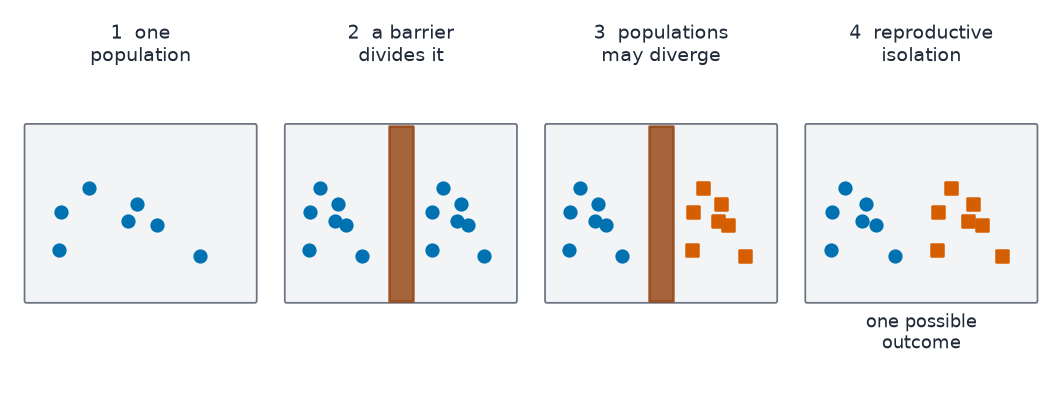
Speciation 物种形成 is the formation of a new species. It often happens when populations are separated by a barrier.
Speciation by geographical isolation
A barrier can reduce gene flow: geographical isolation 地理隔离 allows separated populations to diverge through selection, mutation and drift. Reproductive isolation may eventually develop, but a barrier does not guarantee it. Habitat or mating differences can also restrict interbreeding without a complete physical barrier. Use evidence about inherited differences and reproduction, not appearance alone.
The Intergovernmental Science-Policy Platform on Biodiversity and Ecosystem Services (IPBES) estimated in 2019 that about 1 million species are threatened with extinction.
The 2024 Living Planet Report reported a 73% decline in its index of monitored vertebrate populations between 1970 and 2020. This concerns proportional population trends, not 73% of species becoming extinct or a census showing 73% of all individual animals lost.
The planetary boundary for biosphere integrity (Topic 1) has been crossed.
Clearing forest destroys habitats and reduces biodiversity.
Causes of biodiversity loss
The main causes of loss are often remembered as HIPPO, plus climate change:
The invasive vine kudzu smothering a stand of trees. With no natural predators in its new home, it blankets and kills what it coversDeforestation lowers biodiversity and causes erosion, flooding, and higher CO2Deforestation lowers biodiversity and causes erosion, flooding, and higher CO2
Cause
How it harms biodiversity
Example
Habitat loss 栖息地丧失 and fragmentation 生境破碎化
Clearing land for farms, towns and roads destroys habitats and cuts the rest into small, isolated patches
Rainforest cleared for cattle, soya and oil palm
Invasive species 入侵物种
Some introduced species establish and spread, competing with, consuming or infecting native species
Cane toads in Australia; water hyacinth in Chinese lakes
Pollution 污染
Pesticides, fertiliser runoff, plastics and noise harm organisms
Eutrophication killing fish (Topic 4)
Population growth and consumption
More people using more resources increases every other pressure
Growing demand for food, land and water
Overharvesting 过度捕捞
Hunting, fishing and collecting faster than populations can recover
Overfishing of cod; poaching of rhinos for horn
Climate change 气候变化
Species cannot move or adapt fast enough as conditions change
Coral bleaching; mountain species with nowhere higher to go
The dominant pressures differ among ecosystems. Land/sea-use change and direct exploitation are major drivers; climate, pollution and invasive species interact with them. An introduced species is not automatically invasive, and a native outbreak is not automatically an alien invasion.
Fragmentation makes small patches with a lot of edge. At an edge the conditions change: more light, more wind, drier air, and more predators and invasive species. These edge effects 边缘效应 mean a small patch has little true interior habitat. Small isolated populations face drift and inbreeding; restricted gene flow can increase vulnerability. Edge conditions depend on the boundary and species: an edge can favour some organisms while harming interior specialists.
Shared resources and interacting pressures
An open-access resource can be overused when each user gains privately from an extra harvest but shares the resulting depletion with everyone. This is a tragedy-of-the-commons mechanism, not proof that all shared ownership fails. Communities can set enforceable rules, access rights, seasonal closures and monitoring. Overfishing and plastic inputs to shared seas illustrate different problems: one removes organisms, the other adds persistent material. Prevention needs attention to incentives, enforcement and alternatives, not simply a request that individual users care more.
The tragedy of the commons: private gain, shared cost
For a fishery, annual stock growth is 120 tonnes and combined catches are 150 tonnes; ignoring other flows, the stock falls by 30 tonnes. Warming, fragmented nursery habitat and pollution can lower recovery simultaneously. Compare threatened populations before and after management using suitable controls rather than attributing every improvement to the most visible action.
Why some species are more at risk
A species is more likely to become extinct if it has:
a small population or a small geographical range;
a narrow niche, such as one food source (the giant panda eats almost only bamboo);
a low reproductive rate (K-strategists, such as elephants and great apes);
a large body and a high trophic level, needing a large area;
low genetic diversity;
commercial value, so it is hunted or collected;
a migration route that crosses many countries, so it depends on habitat in all of them.
The IUCN Red List
The International Union for Conservation of Nature (IUCN) publishes the Red List 红色名录, which assesses the risk of extinction of species. It uses criteria such as population size, rate of decline, geographical range, degree of fragmentation, and the number of mature individuals.
IUCN Red List categories
The list raises awareness, guides where conservation money is spent, and supports laws. Its limits are that most species have never been assessed, data are often poor (the category Data Deficient 数据缺乏 is used for these), and listing a species does not by itself protect it.
Three case histories
Extinct: the passenger pigeon. In the 1800s it was probably the most common bird in North America, with flocks of billions. It was hunted on a huge scale and its forests were cleared. Colonial breeding and typically single-egg clutches could constrain recovery; a clutch count must not be turned into an unsupported fixed number per year. The last one, Martha, died in Cincinnati Zoo in 1914.
Critically endangered: the Yangtze finless porpoise. It is threatened by fishing nets, boat strikes, dams, sand dredging and pollution. The 2021 fishing ban, protected reserves along the river and moving some porpoises to safe oxbow lakes have helped. The 2022 count was higher than in 2017.
Recovering: the giant panda. Its habitat was cut into small fragments by farming and roads. China banned logging in its forests and created more than 60 panda reserves linked by corridors. The wild population rose to about 1860 in a national survey published in 2015, and in 2016 the IUCN moved the panda from Endangered to Vulnerable.
Three case histories: the pressures behind each conservation status
Intrinsic value 内在价值: every species has a right to exist, whatever its use to people. This is an ecocentric view.
Instrumental value 工具价值: biodiversity is useful to people. It provides food, timber and medicines; for example, the malaria drug artemisinin comes from sweet wormwood 青蒿, work that won Tu Youyou a Nobel Prize in 2015. It also provides ecosystem services such as pollination, clean water and flood control, and cultural, aesthetic and scientific value.
Functional diversity can support resilience (Topic 1), especially when species respond differently to disturbance.
Who does conservation?
Governmental organisations
Non-governmental organisations
Examples
United Nations Environment Programme (UNEP); national forestry and parks agencies
WWF (World Wide Fund for Nature); Greenpeace; local community groups
Funding
Taxes and governments
Donations and members
Approach
Laws, international agreements, protected areas
Campaigns, media, fieldwork, direct action
Strengths
Some agencies enforce law; resources vary
Campaigns and fieldwork; independence varies
Limits
Mandate and political constraints
No legislative power; funding constraints
In-situ and ex-situ conservation protect species
International agreements include the Convention on International Trade in Endangered Species 濒危野生动植物种国际贸易公约 (CITES, 1973), which bans or controls trade in threatened species, and the Convention on Biological Diversity. In 2022 its members adopted the Kunming-Montreal Global Biodiversity Framework, whose Target 3 aims for at least 30% of terrestrial/inland-water areas and 30% of marine/coastal areas to be effectively conserved by 2030. Representation, connectivity, equitable governance and Indigenous/local rights matter as well as area. CITES regulates international trade in listed species; it does not itself ban every domestic hunt. The CBD also addresses sustainable use and fair sharing of benefits from genetic resources, including through the Nagoya Protocol. Species protection can be in situ (in natural habitat) or ex situ (outside it); a trade agreement is a legal measure, not a place where an animal lives.
Species-based conservation
These approaches protect a particular species:
The Svalbard Global Seed Vault stores seeds of crop varieties deep in Arctic rock: ex situ conservation of genetic diversityConservation is either in-situ (protecting species in their own habitat) or ex-situ (keeping and breeding them away from the wild)
Captive breeding 圈养繁殖 and reintroduction 重新引入: breeding animals in zoos and releasing them into the wild. Przewalski's horse, extinct in the wild by the 1960s, has been bred in zoos and returned to Mongolia and to Xinjiang and Gansu in China.
Seed banks 种子库 and botanical gardens store seeds and plants. The Svalbard Global Seed Vault in Norway holds more than a million seed samples of crops from around the world.
Legal protection: hunting bans, trade bans (CITES) and fishing bans.
Conservation often uses a flagship species 旗舰物种, a large, appealing animal such as the panda or the tiger, to raise money and public support. Protecting its habitat can benefit other species, but a flagship’s needs do not automatically represent every organism.
Species-based conservation can save a species on the edge, but it is expensive, protects few species, and captive animals may lose genetic diversity or wild behaviour. Reintroduction can fail if suitable habitat is absent or the original threat remains unaddressed.
Habitat-based conservation
These approaches protect habitats and ecological processes, benefiting many species without guaranteeing that every population is safe:
Protected areas 保护区: national parks and nature reserves where development, hunting or logging is limited.
Ecological restoration 生态修复: returning damaged land to a healthy ecosystem, such as replanting native forest or blocking drains to rewet peatland.
Rewilding 再野化: restoring natural processes on a large scale and then letting nature manage itself, sometimes by reintroducing missing keystone species, as with the wolves of Yellowstone (Topic 2).
The design of a protected area affects how well it works. The ideas come from studies of islands: larger islands, and islands close to the mainland, hold more species.
Interior habitat under an assigned edge-depth model; no boundary is guaranteed free of every external influence
Size: larger areas support larger populations and species with large ranges. But several smaller reserves spread risk: one disease or fire cannot destroy them all. This is the SLOSS debate ("single large or several small").
Shape: a round shape has less edge for its area than a long thin one, so less edge effect and more core habitat.
Corridors 生态廊道: strips of habitat linking reserves let animals move and populations mix genes. They can also spread disease or fire.
Buffer zones 缓冲区: land around the core where some human use is allowed, which reduces disturbance at the core.
Local people: reserves work better when local communities benefit, through jobs in ecotourism or a share in decisions, than when people are simply excluded.
Comparing the approaches
Habitat-based conservation can protect many interacting organisms and their functions; comparative value depends on the conservation goal, threats, feasibility and costs. Species-based conservation is needed when a species is so rare that its habitat alone cannot save it. Most real projects combine both. The panda programme uses reserves and corridors (habitat) and captive breeding (species).
Turn protection into a monitored project
An invasive-species plan needs identification, introduction pathways, a realistic control method and follow-up. At Zealandia in Wellington, a mammalian predator-exclusion fence is combined with pest removal and continued management. A fence needs inspection and responses to reinvasion; exclusion of selected mammals is not exclusion of every organism or permanent protection without effort.
An invasive-species plan is a monitored cycle, not a one-off fence
Habitat restoration can require active intervention: restore drainage patterns, control damaging introduced herbivores or regenerate native vegetation before reducing intervention. Rewilding seeks functioning ecological processes, not simply an unmanaged vacant site. In a UNESCO biosphere-reserve model, a protected core is supported by a buffer and a transition zone with compatible livelihoods; zoning alone is not evidence of effective enforcement. Wuyishan provides a named subtropical-forest example. Evaluate recreation, roads, surrounding farming, local access and fire or water movement across the boundary.
Monitor survival, breeding, native regeneration, habitat quality and local acceptance, not just money spent or hectares announced. Citizen observations need comparable effort, seasonal coverage, identification checks and protection of sensitive location information. Threatened status, local abundance and global extinction are different quantities: a species may recover locally while remaining at risk elsewhere.
Mutation can create a new allele; meiosis and fertilisation reshuffle existing alleles into new combinations. Mutation is not directed toward what an organism needs. Selection changes the reproductive success of variants already present or arising. Drift can also change allele frequencies, especially in small populations. A trait becoming common is not automatically a new species.
Natural selection: the best-adapted survive, reproduce, and pass on their allelesNatural selection: the best-adapted survive, reproduce and pass on their alleles
Reproductive isolation can develop through geography, habitat use, breeding time or mate recognition. A barrier reduces gene flow, but separation alone does not guarantee speciation. Divergence can be reversed by renewed gene flow. A biological-species test concerns successful reproduction, rather than how different two drawings look; fossils and asexual organisms need other evidence.
Two contemporary research examples show different routes. The 2018 finch study traced a hybrid lineage on Daphne Major after an immigrant Geospiza conirostris bred with a resident G. fortis. Descendants formed a reproductively isolated lineage during the observations; this does not mean all hybrids become lasting species. In apple and hawthorn host races of Rhagoletis pomonella, host-associated odour preferences and timing reduce gene flow without a complete geographical barrier. Isolation is partial: this is evidence of ongoing divergence, not proof that the two host races are already fully separate species.
People can change selection unintentionally. The Gorongosa elephant study published in 2021 linked intense ivory poaching to increased tusklessness among surviving females and their descendants. Poaching selected among heritable variants; elephants did not deliberately stop growing tusks. The inheritance evidence supported a sex-linked model, not a claim that every tuskless elephant everywhere has the same cause.
Artificial selection deliberately chooses breeders. Repeated use of a few parents can reduce genetic diversity and increase shared vulnerability to disease or environmental change. This is a risk of breeding design, not proof that every breeding programme must lose every useful allele. Maintain varied parental lines, wild relatives and suitable gene or seed collections. On isolated islands, limited colonisation and restricted gene flow can foster endemism; small ranges can also magnify vulnerability to a single introduced predator or disturbance.
3.6
AHL:地质历史与灭绝证据
English
Earth is about 4.5 billion years old. The geological hierarchy runs from eons to eras, periods and epochs. Fossils provide evidence of past organisms and changing communities; sedimentary context and dating constrain their ages. Preservation and sampling are uneven, so a fossil's last observed occurrence is not necessarily the exact day its species disappeared. Missing fossils do not establish that an organism never lived there.
Leg bones of the North Island giant moa (Auckland Museum): hunted to extinction within about two centuries of human arrival
Plate tectonics and biodiversity
The lithosphere consists of moving tectonic plates 构造板块. Plate movement can split populations, connect formerly separated faunas, build mountains and change climatic settings. Australian isolation helped shape its distinctive marsupial fauna, but Australia also has native placental mammals, including bats and rodents, and monotremes. Isolation is not a sufficient explanation for every trait or every extinction.
Mass extinctions
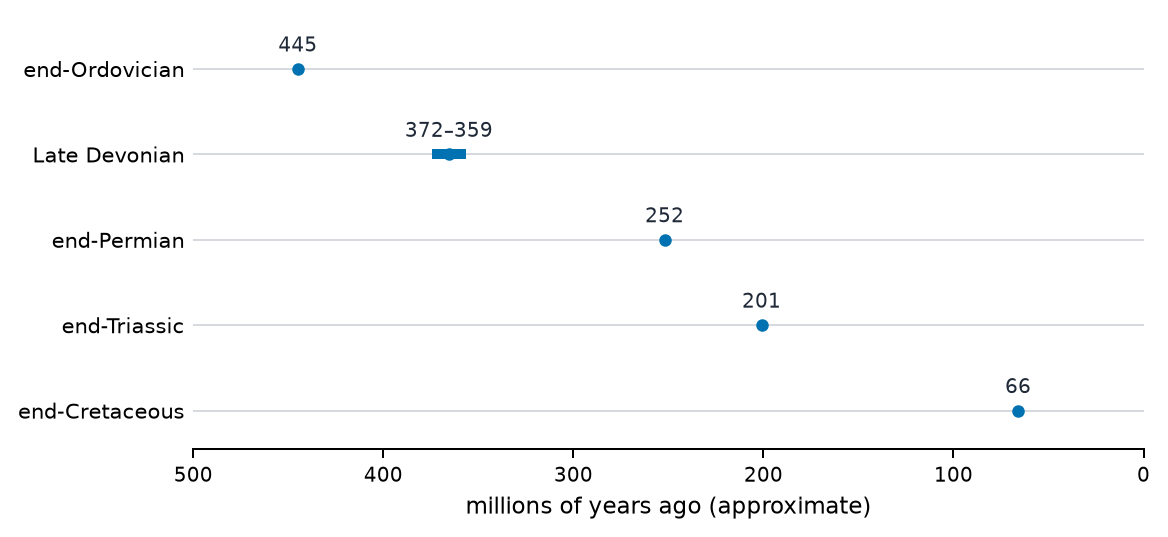
A mass extinction 大灭绝 removes a large share of species in a geologically short interval. The background extinction rate 背景灭绝速率 describes losses outside such exceptional intervals, with estimates depending on the organism group and time scale. The major extinction intervals are separated by long periods of evolutionary change. The end-Permian event was especially severe; the end-Cretaceous event removed non-avian dinosaurs, while birds survived. Volcanism, climate and ocean changes, sea-level changes and impact events contributed in different combinations. Estimates of losses depend on the organisms, time interval, fossil record and method: a list of precise-looking percentages without these definitions can mislead.
Geological intervals, not evenly spaced events or directly comparable species censuses
Survivors can diversify as ecological opportunities change, but recovery can take millions of years and need not restore the same species or functions. Present human-driven losses occur over much shorter management timescales. Calling the situation a sixth mass extinction expresses concern about the scale and trajectory; it does not make every current population decline a confirmed global extinction.
The Anthropocene describes profound human effects, but its status as a formal geological unit is a separate question. IUGS/ICS rejected the proposed formal epoch in 2024; the term remains useful outside the formal time scale. Candidate human signals include artificial radionuclides from nuclear testing, fly ash from combustion, plastics or other novel materials in sediments, and changed sedimentation or fossil assemblages as species are redistributed. A useful boundary marker must be datable, widely correlatable and preservable; scientific evidence of human impacts is not cancelled by disagreement about a formal boundary.
An endemic species 特有物种 occurs naturally only within a specified region. A biodiversity hotspot 生物多样性热点 has a specific terrestrial definition: at least 1500 endemic vascular plant species and loss of at least 70% of original natural vegetation. Conservation International describes 36 designated regions. A hotspot is not simply any species-rich site. Remaining natural vegetation covers much less area than the original region, so distinguish those two areas when quoting percentages.
Biodiversity at three levels: genetic, species, and habitatBiodiversity at three levels: genetic, species, and habitat
Key biodiversity areas identify sites important for the global persistence of biodiversity using evidence about threatened species, ecosystems and other qualifying features. They are a prioritisation tool, not automatically a legal protection order. Two database examples make the site evidence concrete. Kakadu Savanna, Australia, is confirmed in an assessment dated 2018. Its savanna habitat and threatened or restricted-range biodiversity require attention to fire timing, frequency and introduced species. Tanjung Puting, Indonesia, is a confirmed legacy site with an assessment dated 2001. Peat-swamp, heath and other forest habitats support birds and mammals, including orangutans; the historical factsheet identifies logging, conversion and fire pressures. Assess habitat condition and appropriate protection, while treating old records as dated evidence rather than current population counts. KBA recognition, a UNESCO biosphere reserve and legal protection are different designations.
Habitat clearing for oil-palm production can replace diverse tropical forest with a plantation, alter drainage and fragment populations. Income, employment and food demand are real benefits to analyse, while habitat loss, fire, emissions and unequal land access are costs. A plantation is not ecologically equivalent to the forest it replaces. Assess supply chains and displaced clearing elsewhere rather than assuming that banning one crop removes demand for vegetable oil.
At Kakadu, Bininj/Mungguy and Parks Australia describe cultural burning combined with contemporary management. Patchy burning under suitable conditions can reduce fuel continuity and the risk of extensive later fires. Loss of access, disrupted knowledge transfer, invasive grasses and changing climate can challenge such practices. This is a named, place-specific approach; Indigenous communities are diverse and no community should be assumed inherently sustainable or incapable of change.
Conservation also needs environmental justice: who decides, who loses access, who receives tourism income, and whose knowledge counts? UN experts' communications concerning Ngorongoro record allegations of pressure on Maasai people to leave their homelands. Treat the dated allegations and evidence explicitly; biodiversity gains cannot simply be presumed to justify displacement. Participation, land rights, fair benefit sharing, appropriate livelihoods and independent grievance procedures are part of assessing a project, alongside ecological monitoring.
Biosphere integrity concerns genetic diversity and ecosystem functioning. A planetary-boundary assessment signals elevated systemic risk; it is not an exact countdown or proof that one local species loss triggers a known global tipping date. Track abundance, distribution, interactions and functions as well as species counts.
National agencies can fund monitoring and enforce applicable rules; international bodies coordinate agreements and evidence. NGOs fund fieldwork, campaign and pursue legal challenges. UNEP does not enforce every national hunting law, and an NGO can influence legislation without enacting it. Compare named projects by funding, accountability, diplomacy, access, political influence, response time and results. Independence and speed vary; neither organisational label guarantees success.
Restoration can reinforce itself: more trees provide seed and shelter, increasing recruitment and supporting more trees. This is positive feedback because change is amplified, not because it is welcome. Competition and limited water constrain growth.
Restoration as positive feedback: change is amplified, while competition and water set limits
Rewilding restores processes as well as selected species. Reconnecting habitat, restoring water regimes and allowing natural regeneration can be as important as reintroducing a predator. Land released from farming may lose food production or employment; moving production elsewhere can transfer environmental pressure. Assess animal welfare, neighbouring farms, invasive species, fire risk and funding continuity rather than assuming that management can simply stop.
Restoration comparison. A restored site records 40 breeding pairs before and 60 after the intervention; a comparable untreated site records 50 and 55. The restored site's increase is 20 pairs, but the comparison increased by 5, so a simple difference-in-changes is $(60-40)-(55-50)=15$ pairs. This supports an additional increase associated with the intervention only under suitable comparison assumptions. It is not a randomised causal proof, and breeding pairs, occupancy, genetic variation and community acceptance measure different outcomes.
Evaluate success at three levels: was the promised activity completed, did ecological and social outcomes improve, and was this a defensible use of resources compared with alternatives? Planting 1000 trees measures an activity; survival after five years, native regeneration, habitat connectivity and community benefits measure outcomes. Record a baseline, comparable controls where possible, uncertainty and long enough monitoring to include bad years.
Ecotourism can fund rangers, restoration and local employment, while disturbing breeding animals, consuming water, producing waste or distributing profits unequally. Wuyishan's UNESCO account describes attempts to combine conservation with surrounding livelihoods. This is a management approach, not by itself a measured causal estimate of tourism's benefits. In a visitor budget, 8000 visits at 20 currency units generate 160000 gross revenue; operating costs of 110000 leave 50000, before any omitted costs. Specify how much actually funds conservation and local people, rather than calling gross receipts profit or equating visitor growth with ecological recovery.
3.9
考试技巧
English
Define the measure, show index working, and judge conservation against ecological outcomes, feasibility and community rights.
3.10
练习
English
(a) Define biodiversity and outline its three levels. (b) Distinguish between species richness and evenness.
Site X has species with 12, 4 and 4 individuals; site Y has 7, 7 and 6. Calculate Simpson's reciprocal index for each and state which is more diverse.
(a) Outline how natural selection leads to evolution. (b) Explain how geographical isolation can lead to the formation of a new species.
Explain two ways in which plate tectonics has affected biodiversity.
Describe what is meant by a mass extinction, and state two possible causes.
Outline four human causes of biodiversity loss, with an example of each.
Explain how habitat fragmentation reduces biodiversity, including edge effects.
State five characteristics that make a species vulnerable to extinction.
Outline the IUCN Red List categories and evaluate the usefulness of the Red List.
Explain why tropical rainforests are both important for and vulnerable to biodiversity loss.
Distinguish between the intrinsic and instrumental value of biodiversity, with an example.
Compare the roles of governmental and non-governmental organisations in conservation.
Evaluate captive breeding and reintroduction as a conservation strategy.
Explain four principles of protected-area design.
Answers.
(a) Biodiversity is the variety of life on Earth. Genetic diversity is inherited variation within a species; species diversity is the variety of species in an area; habitat diversity is the variety of habitats or ecosystems. (b) Richness is the number of species. Evenness is how equally individuals are shared among those species.
Both $N = 20$, $N(N-1) = 380$. X: $\sum n(n-1) = 132 + 12 + 12 = 156$, $D = 2.4$. Y: $\sum n(n-1) = 42 + 42 + 30 = 114$, $D = 3.3$. Y is more diverse because it is more even.
(a) Some variation is heritable. Overproduction and limited resources create competition; individuals differ in reproductive success. Inherited advantageous variants can become more common across generations under the stated conditions. (b) A barrier can reduce gene flow; selection, mutation and drift may produce inherited differences. Reproductive isolation can develop, but a barrier alone does not guarantee speciation. Assess reproductive compatibility.
Land separation can reduce gene flow and allow divergence; continental connections can introduce competitors. Mountain building adds habitats and barriers; continental movement shifts climates. Australia also has native placentals and monotremes.
Mass extinction is a geologically rapid loss of a large share of species. Two possible causes are major volcanism and asteroid impact; mechanisms differed among events.
Any four, for example: habitat loss (rainforest cleared for oil palm); invasive species (cane toads in Australia); pollution (fertiliser runoff causing eutrophication); overharvesting (overfishing of cod); climate change (coral bleaching).
Fragmentation can increase edge exposure and restrict movement and gene flow. Interior specialists can lose suitable habitat; small populations face drift, inbreeding and shared hazards. Effects depend on species and surroundings.
Any five: small population, small range, narrow niche or specialised diet, low reproductive rate, large body or high trophic level, low genetic diversity, commercial value, migratory.
LC, NT, VU, EN, CR, EW and EX, plus DD and Not Evaluated. VU/EN/CR are threatened categories; DD is insufficient evidence, not low risk. Assessments guide priorities but do not themselves enforce protection.
Tropical forests can contain high richness and endemism. Clearing, fragmentation, fire and climate pressures threaten them; nutrient cycling, soils, seed sources and disturbance history affect recovery. Not every tropical soil is uniformly poor, and cleared forest does not universally fail to regrow.
Intrinsic value is the value of a species in itself, whatever its use (a right to exist). Instrumental value is its usefulness to people, such as medicines (artemisinin from sweet wormwood) or pollination.
National agencies can fund and enforce rules; international bodies coordinate agreements. NGOs fund fieldwork, campaign and pursue legal challenges. Powers, resources, speed and accountability vary; UNEP does not enforce all national wildlife law.
Strengths: can prevent loss and provide reintroduction stock (Przewalski’s horse). Limits: costs, few species supported, and loss of genetic variation or wild behaviour. Success requires suitable habitat and control of original threats; combine with habitat protection.
Match area, shape, connectivity and buffers to species and threats. Compact shapes reduce relative edge; corridors aid movement but can transmit hazards. Several sites spread risk. Include local rights and monitoring; no layout is universally best.