This handout teaches Structure 2.4, From models to materials, for the course first assessed in 2025.
Prerequisites: the ionic, covalent and metallic models from Structures 2.1 to 2.3, and electronegativity values from the data booklet. You will draw structural formulas of simple organic molecules.
9.2
化学键是一个连续体
English
Why is a bicycle frame made of carbon fibre?
A racing bicycle frame must be strong, stiff and light. Steel is strong but heavy. Aluminium alloy is lighter. Carbon-fibre reinforced polymer combines stiff, strong graphitic carbon fibres with a polymer matrix that transfers load and protects the fibres. It can provide high strength per unit mass in specified loading directions. Choosing a material 材料 means comparing bonding, structure, processing, direction of loading and practical constraints, rather than naming one universally best substance.
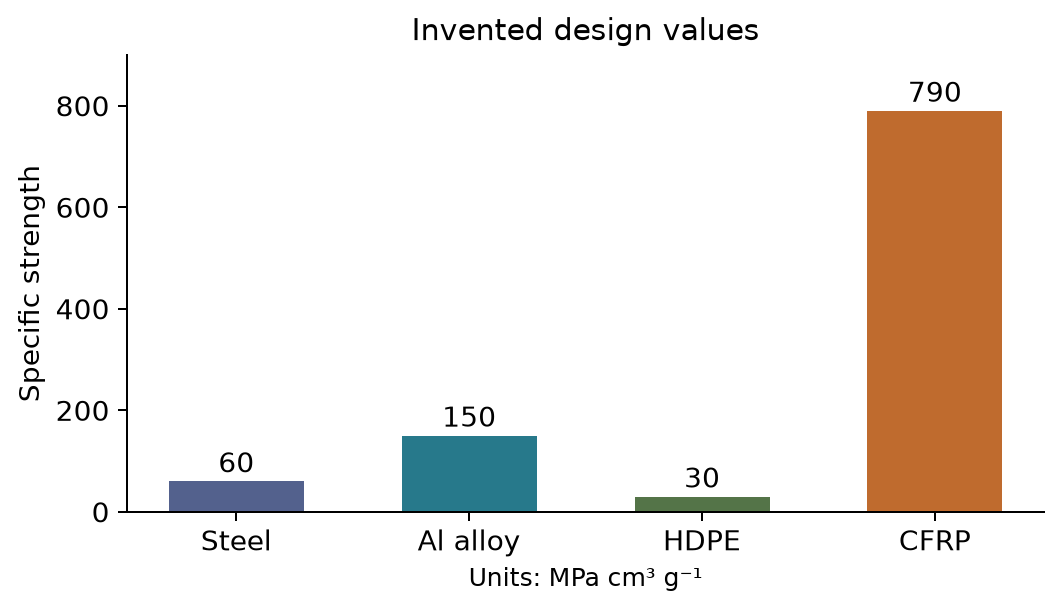
Typical round values, not a specification for any grade: strength/density pairs are steel 480 MPa/8.0 g cm⁻³, aluminium alloy 405/2.7, HDPE 28.5/0.95 and CFRP 1264/1.6. The ratios are 60, 150, 30 and 790 MPa cm³ g⁻¹. Grade, fibre direction, stiffness, toughness, cost and damage tolerance also matter.
Three models, one continuum
Ionic, covalent and metallic bonding are models: ideal cases. Real substances often sit between them.
Ionic character tends to increase with a large electronegativity difference; the ionic bond itself is attraction between oppositely charged ions, not the electron-transfer event.
Covalent character describes shared electron density and is often associated with two relatively electronegative elements.
Metallic character involves delocalized electron density among positive cores and is associated with relatively electropositive elements.
Most bonds have some character of more than one type. In aluminium oxide the bonding is mainly ionic, but the small, highly charged $\text{Al}^{3+}$ ion pulls the electrons of the oxide ion towards it, giving the bond some covalent character.
The bonding triangle
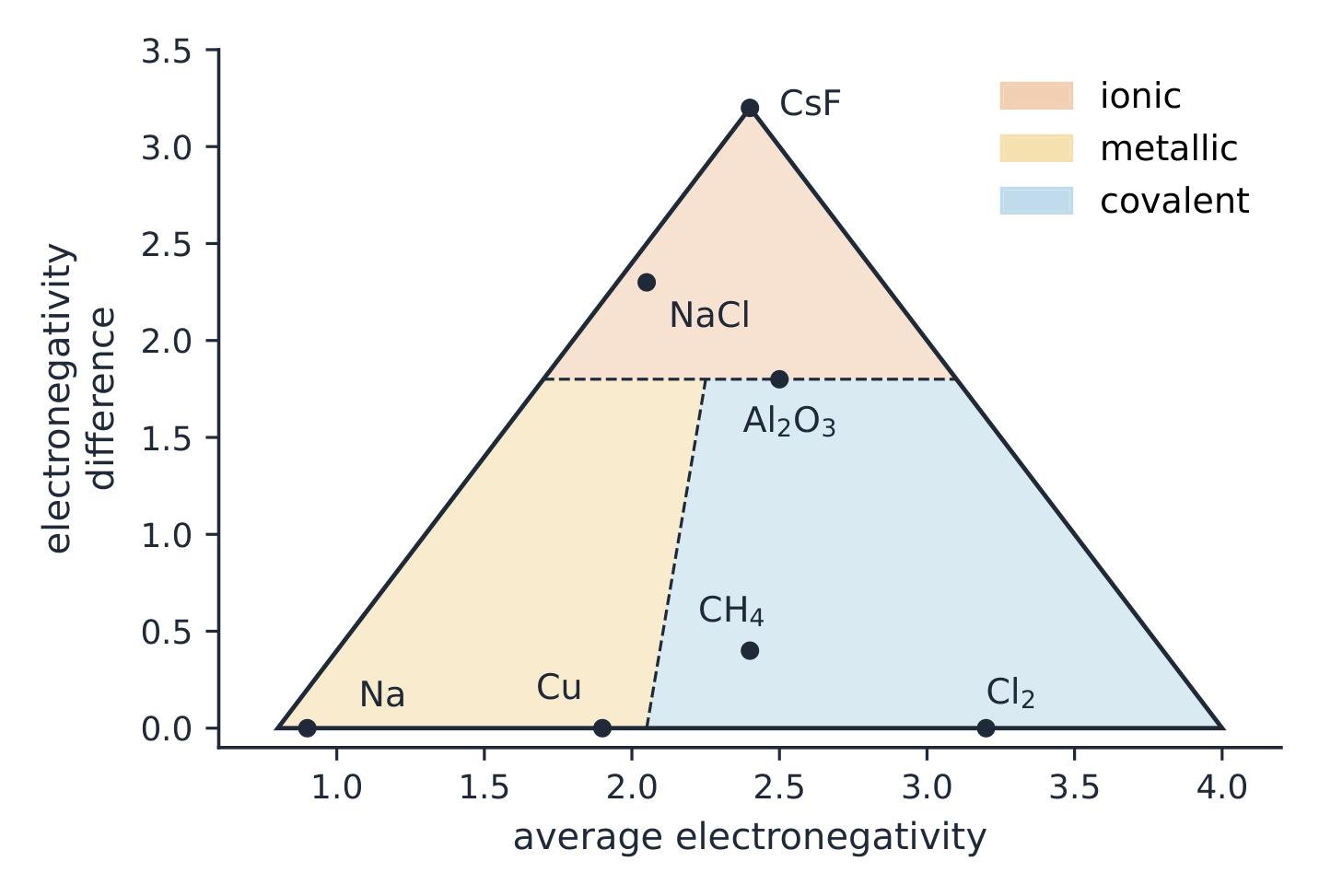
The bonding triangle 键型三角形 (the van Arkel–Ketelaar triangle in the data booklet) places a binary substance by two numbers:
the average electronegativity of the two elements on the $x$-axis;
the electronegativity difference on the $y$-axis.
Approximate regions using consistently rounded electronegativities; the elemental points are model references. Use the supplied booklet diagram for a specified binary compound, without treating a drawn boundary as a universal cutoff.
Worked example: placing a compound
Use the triangle to predict the bonding in magnesium oxide. Electronegativities: Mg 1.3, O 3.4.
Average: $(1.3 + 3.4) / 2 = 2.35$.
Difference: $3.4 - 1.3 = 2.1$.
The point (2.35, 2.1) is in the ionic region, so MgO is predicted to be mainly ionic: generally high melting point and ionic conduction when molten; a solution would conduct if enough ions dissolved. This prediction does not guarantee high water solubility.
For silicon dioxide (Si 1.9, O 3.4): average 2.65, difference 1.5. The point lies in the covalent region, which fits its giant covalent structure.
From position to properties
Region
Typical properties
ionic (top)
high melting point, brittle, conducts only when molten or dissolved, solubility varies
covalent (bottom right)
molecular: often low melting/poor conduction; network: high disruption energy, with conductivity exceptions such as graphite and silicon
metallic (bottom left)
conducts when solid, malleable, shiny, most melt high
The triangle predicts bonding; it does not decide between a molecular and a network covalent structure. Use other evidence, such as the melting point, for that.
Composites combine structures at a larger scale
Composites retain distinct components and transfer load across interfaces. In CFRP, graphitic fibres mainly carry tension along their length; a polymer matrix transfers load and protects fibres. Layer direction changes laminate behaviour; specific strength does not fix stiffness, toughness or damage tolerance.
In reinforced concrete, the cement-based matrix and aggregate support compression, while steel carries tension and limits cracking. Interface bonding transfers forces. The combination has ionic/covalent components and metallic steel, rather than one new bond type.
An alloy 合金 is a mixture of a metal with other metals, or with a non-metal such as carbon. Many alloys are made by combining molten components and cooling, but other processing routes also exist. They still have metallic bonding: cations of different elements in a sea of delocalized electrons.
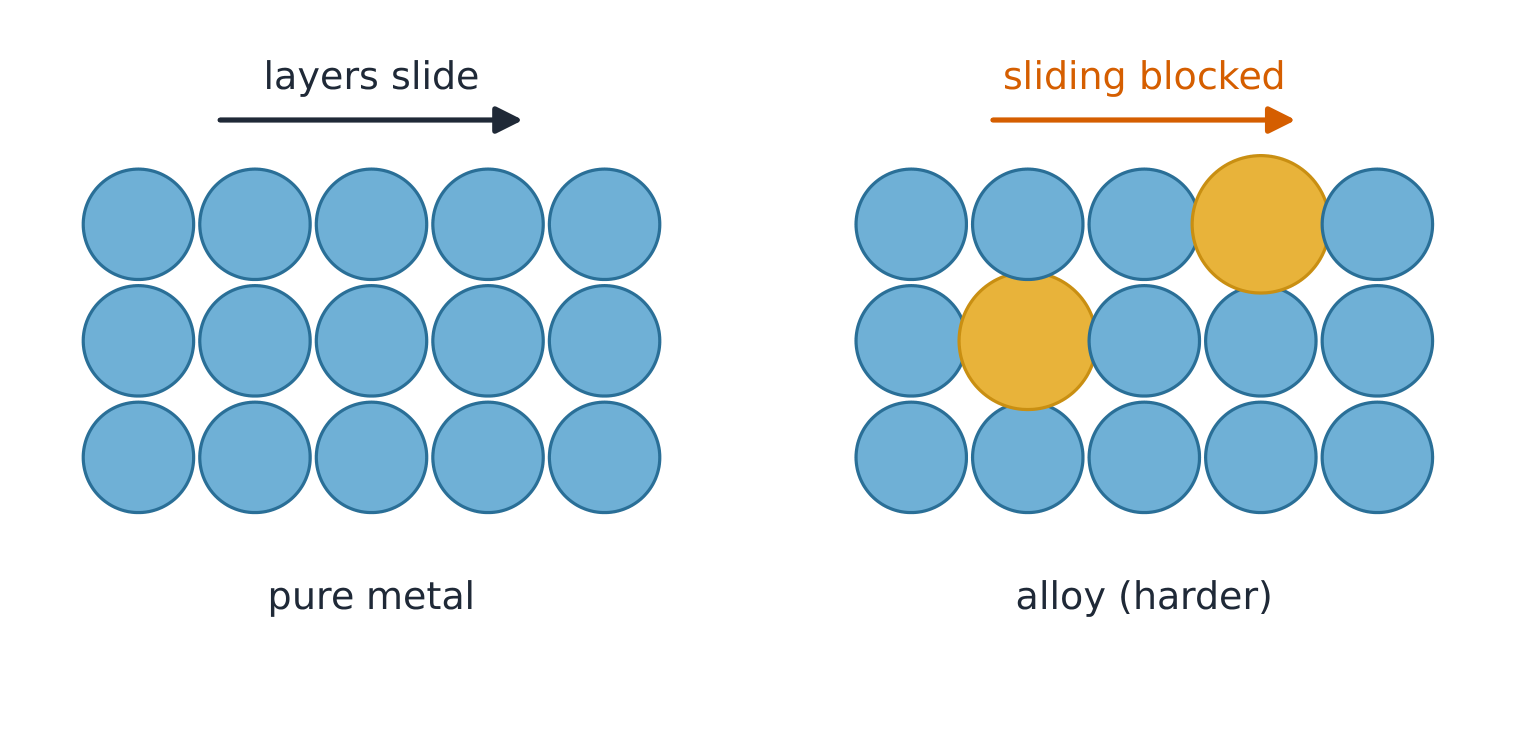
Aircraft bodies are built from aluminium alloys: still light, but much stronger than the pure metalDifferent-sized atoms in an alloy stop the layers sliding, so it is harder
Pure metals are often too soft. In a pure metal all the cations are the same size, so the layers slide easily. In an alloy, atoms of a different size distort the regular layers. Slip can become more difficult, making many alloys harder or stronger than the corresponding pure metal. Properties depend on composition, phases and heat treatment; alloying does not guarantee an improvement in every property.
Substitutional-alloy cartoon: differently sized atoms can hinder slip. Carbon in steel can occupy interstitial sites, and steel properties also depend on phases and processing; this is not a literal oversized-carbon drawing.
Alloy
Composition
Improved property
Use
steel
iron with up to about 2% carbon
harder and stronger than iron
buildings, bridges
stainless steel
iron with sufficient chromium; many grades also contain nickel
resists corrosion
cutlery, medical tools
brass
copper and zinc
harder than copper, resists corrosion
taps, musical instruments
bronze
copper and tin
harder, resists corrosion
statues, bearings
duralumin
aluminium with copper and magnesium
stronger, still light
aircraft bodies
Alloys can also change other properties: some melt at lower temperatures than any of their parts (solder), and some resist corrosion because the added element forms a protective oxide layer (chromium in stainless steel).
A polymer 聚合物 consists of macromolecules with many repeating structural units. They may form linear or branched chains, or cross-linked networks. The small molecules that join are monomers 单体, and the part of the chain that repeats is the repeating unit 重复单元.
Polymers can be natural, such as starch, cellulose, proteins and DNA, or synthetic, such as poly(ethene) and nylon. Most plastics are synthetic polymers.
Properties of plastics
The properties of a plastic come from its long chains:
Most plastics are non-biodegradable, so waste plastic collects on beaches and in the oceans for hundreds of years
For uncross-linked chains, intermolecular interactions, chain entanglement and crystallinity affect properties. Increasing chain length can change strength and softening behaviour, but there is no universal linear relation between chain length and melting temperature.
Relatively little-branched HDPE chains can pack more regularly and have greater crystallinity; more-branched LDPE chains pack less regularly, so LDPE is softer and more flexible.
Many common plastics have low density and useful chemical resistance and are electrical insulators. Additives, structure, processing and specialized conducting polymers prevent these from being universal properties of every plastic.
Many common plastics are not readily biodegradable 可生物降解的 in ordinary disposal environments. Persistence depends on polymer, additives, thickness and conditions; fragmentation is not the same as complete biodegradation. Combustion of carbon-containing plastics can release CO₂; PVC can also release corrosive hydrogen chloride. A resin identification code helps identify a polymer family but does not guarantee local collection or successful recycling.
Thermoplastic and thermoset behaviour
A thermoplastic can soften on heating enough for chains to move and can often be reshaped. A thermoset contains a covalently cross-linked network: it does not simply melt into freely sliding separate chains and commonly degrades on sufficiently strong heating. Distinguish reversible softening from chemical decomposition. Neither behaviour by itself guarantees easy or environmentally favourable recycling.
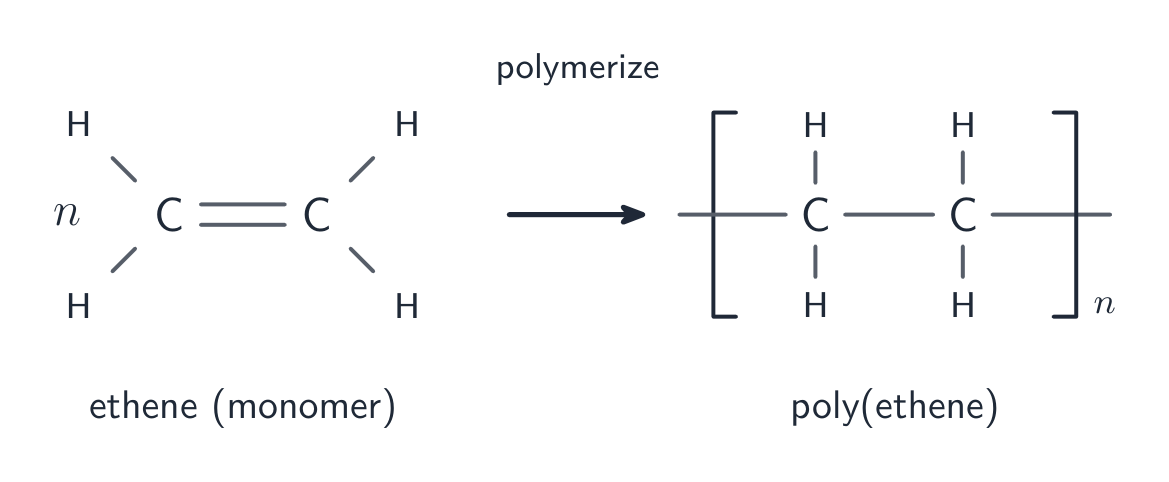
In addition polymerization 加成聚合 monomers with a C=C double bond join together. The pi bond in each double bond breaks, and the electrons form new single bonds to the neighbouring monomers. No other product forms: every atom of the monomers ends up in the polymer.
Poly(ethene), a common addition polymer, is supplied as tiny pellets a few millimetres across; these are later melted and moulded into bottles, bags and other productsThe double bond opens; the repeating unit has the same atoms as the monomer, joined by single bonds
To draw the repeating unit from a monomer:
Draw the two carbons of the C=C with a single bond between them.
Keep every group that was attached to those carbons in the same place.
Add a continuation bond on each side, through square brackets, and write $n$ after the bracket.
Monomer
Formula
Polymer
Repeating unit
ethene
$\text{CH}_2=\text{CH}_2$
poly(ethene)
$-\text{CH}_2-\text{CH}_2-$
propene
$\text{CH}_2=\text{CHCH}_3$
poly(propene)
$-\text{CH}_2-\text{CH(CH}_3)-$
chloroethene
$\text{CH}_2=\text{CHCl}$
poly(chloroethene), PVC
$-\text{CH}_2-\text{CHCl}-$
tetrafluoroethene
$\text{CF}_2=\text{CF}_2$
PTFE (Teflon)
$-\text{CF}_2-\text{CF}_2-$
To go backwards from a polymer to its monomer, find the two-carbon repeating unit and put a double bond between those two carbons.
Note that the side group (such as $\text{CH}_3$ or Cl) hangs off the main chain; it is never part of the chain itself.
Electronegativities: Na 0.9, Cl 3.2, C 2.6, H 2.2, Cu 1.9, Zn 1.6. (a) Plot NaCl and (b) CH$_4$ using both triangle coordinates. (c) Explain why a brass sample’s metallic bonding does not make “CuZn” a fixed molecular formula for every brass composition.
Explain why aluminium oxide is described as ionic with some covalent character.
Explain why steel is harder than pure iron.
Draw the repeating unit of poly(propene), and the monomer of a polymer with repeating unit $-\text{CH}_2-\text{CH(CN)}-$.
State two properties that make poly(ethene) useful for packaging and one environmental problem it causes.
Explain why HDPE is stronger and denser than LDPE.
For the CFRP data, strength is 1264 MPa and density 1.6 g cm⁻³. Calculate specific strength and explain why this is not proof of the best bicycle frame in every loading direction.
Explain how steel reinforcement and a concrete matrix can supply complementary mechanical properties. Is this one new chemical bond type?
Compare the response to heating of an uncross-linked thermoplastic and a heavily cross-linked thermoset. Distinguish softening, melting and decomposition.
Draw an addition repeating unit from CH₂=CCl₂, keeping every substituent and showing continuation bonds. Is any small molecule lost in the ideal propagation model?
A package has a resin identification code and breaks into smaller fragments outdoors. Does either observation prove complete biodegradation or local recyclability? Explain.
Worked answers.
(a) average 2.05, difference 2.3: ionic. (b) average 2.4, difference 0.4: covalent. (c) Brass is a Cu–Zn alloy with variable composition and metallic bonding, not a collection of CuZn molecules. The two elemental electronegativities alone do not specify its composition or phase structure.
The electronegativity difference (Al 1.6, O 3.4: difference 1.8) is on the boundary of the ionic region. The small $\text{Al}^{3+}$ ion with a high charge distorts the electron cloud of $\text{O}^{2-}$, pulling electron density between the ions, so the bond has some covalent character.
Small carbon atoms can occupy interstitial positions in iron-based structures and affect slip; phase composition and heat treatment also matter. Steel is not simply a row of oversized carbon atoms replacing iron. These mechanisms can increase hardness or strength, with trade-offs in ductility depending on the steel.
Poly(propene): $-\text{CH}_2-\text{CH(CH}_3)-$ in square brackets with continuation bonds and $n$. The monomer is $\text{CH}_2=\text{CHCN}$ (propenenitrile).
Any two of: light, cheap, flexible, waterproof, unreactive, easy to shape. Problem: many grades resist biodegradation under ordinary disposal conditions and can persist or fragment; burning carbon-containing plastic can release $\text{CO}_2$. No universal lifetime follows from the polymer name alone.
HDPE typically has less branching than LDPE, so chains can pack more regularly and crystallinity is greater. There is more contact between chains, so the London forces are stronger and more mass fits in the same volume.
Specific strength $=1264/1.6=790\ \mathrm{MPa\,cm^3\,g^{-1}}$. Fibre orientation, grade, stiffness, toughness, damage tolerance, joints and manufacturing also affect frame performance. A high strength/density ratio does not establish all those properties.
The concrete matrix supports compression; steel reinforcement helps carry tension and limit crack opening, with load transferred at the interface. The composite combines existing structures and interactions on a larger scale, rather than creating one universal new bond type.
A thermoplastic can soften as segmental/chain motion becomes easier, and crystalline regions may melt. A heavily cross-linked thermoset retains a connected covalent network rather than becoming a liquid of separate chains; sufficient heating can decompose it. Reversible softening is not the same process as breaking the polymer chemically.
The repeat is $[-\mathrm{CH_2-CCl_2}-]_n$, with the left and right continuation bonds passing through brackets. Both Cl substituents stay on the second backbone carbon. The ideal alkene addition model loses no small molecule; initiator/end-group details are separate from the repeat-unit drawing.
No. A code identifies a resin family but does not promise a local collection/reprocessing route. Smaller fragments may still be polymer; complete biodegradation requires suitable biological conversion under specified conditions. Polymer chemistry, additives and the actual disposal environment matter.
9.7
考试技巧
English
Plot both electronegativity coordinates; boundaries are approximate.
Explain alloy slip using the actual structure. Retain substituents and bracket-crossing continuation bonds in addition repeats.