This handout teaches Structure 3.1, The periodic table: classification of elements, for the course first assessed in 2025.
Prerequisites: electron configurations and ionization energy from Structure 1.3, and ionic and covalent bonding from Structures 2.1 and 2.2. You will use the periodic table, ionic radii and electronegativity values from the data booklet.
10.2
元素周期表的组织
English
One table, many predictions
In 1869 Dmitri Mendeleev arranged the known elements in order of atomic mass and left gaps where the pattern said an element should be. He predicted the properties of "eka-silicon", and germanium, found in 1886, matched them closely. The periodic table 元素周期表 works because the properties of elements repeat in a regular way: periodicity 周期性.
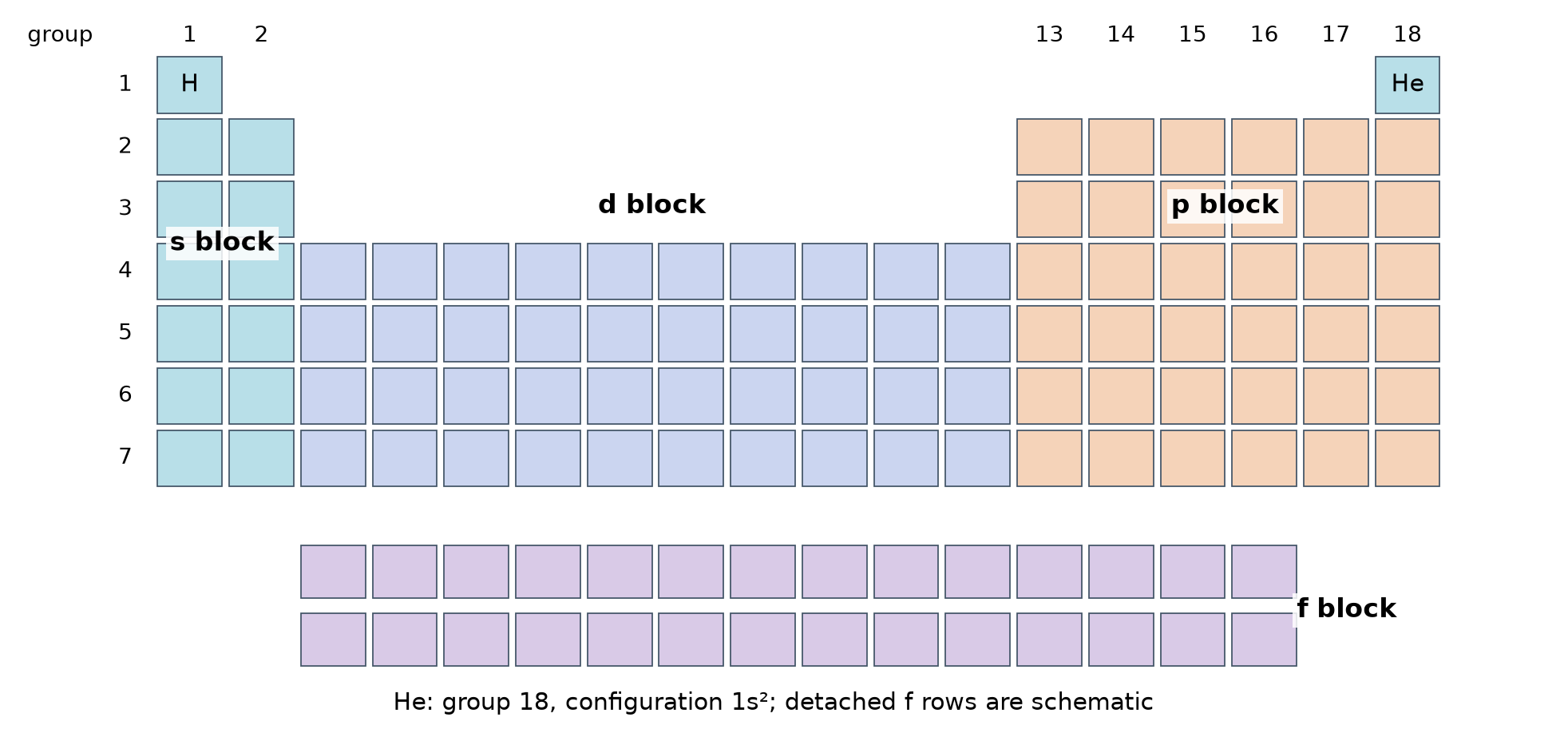
A display periodic table with a sample of each element: patterns repeat across each periodHelium has an s configuration but noble-gas placement. Detached f rows are schematic; no unique group-3 boundary is implied.
Periods, groups and blocks
The modern table orders the elements by atomic number $Z$.
Groups are the columns and periods are the rows; metals lie to the left of the staircase, non-metals to the right
A period 周期 is a horizontal row. The period number is the number of the outer energy level: sodium, $[\text{Ne}]\,3\text{s}^1$, is in period 3.
A group 族 is a vertical column, numbered 1 to 18. Main-group elements in a group usually have related outer configurations and chemical properties. For groups 1 and 2 the usual outer-electron count equals the group number; for groups 13 to 18 it is the group number minus 10, except helium, which has two. Hydrogen is not an alkali metal, and d-block chemistry cannot be predicted by a main-group outer-electron rule alone.
A block 区 is named after the characteristic sublevel being filled: s (groups 1 and 2, plus helium by configuration), p (groups 13 to 18 except helium), d (the central ten columns) and f (the detached inner-transition rows). The printed position of helium does not change its 1s² configuration.
Worked example: chlorine is $1\text{s}^2\,2\text{s}^2\,2\text{p}^6\,3\text{s}^2\,3\text{p}^5$. The outer level is $n = 3$, so period 3; the last electron enters a p sublevel, so p block; seven outer electrons, so group 17.
Recovering configurations from position
Up to krypton, use the preceding noble-gas core and fill the intervening sublevels. Bromine is period 4, group 17: $[\text{Ar}]\,3\text{d}^{10}\,4\text{s}^{2}\,4\text{p}^{5}$, with 18 + 10 + 2 + 5 = 35 electrons. The 3d sublevel fills before 4p. For the first d row, the starting pattern is $[\text{Ar}]\,3\text{d}^{n}\,4\text{s}^{2}$, with Cr ($3\text{d}^{5}4\text{s}^{1}$) and Cu ($3\text{d}^{10}4\text{s}^{1}$) exceptions. Period 4 includes filling 3d; the sublevel’s first number alone does not specify the period.
Metals, metalloids and non-metals
Metals are on the left and in the middle of the table; non-metals are on the right. A diagonal band of metalloids 准金属 (B, Si, Ge, As, Sb, Te) separates them. Metalloids have some properties of both: silicon looks shiny but is brittle, and it is a semiconductor.
Some groups have names: group 1 the alkali metals 碱金属, group 2 the alkaline earth metals, group 17 the halogens 卤素 and group 18 the noble gases.
Explain broad trends using attraction, shielding and distance; use configurations for local exceptions:
nuclear charge 核电荷: more protons pull the electrons more strongly;
shielding 屏蔽: inner electrons repel the outer electrons and reduce the pull they feel.
Across a main-group period, nuclear charge rises while electrons enter the same main level: similar inner shielding gives stronger attraction overall. Down a main group, outer electrons occupy a higher principal level; greater distance and shielding usually outweigh the larger nuclear charge. These are broad patterns, not exact effective-charge calculations.
Atomic radius
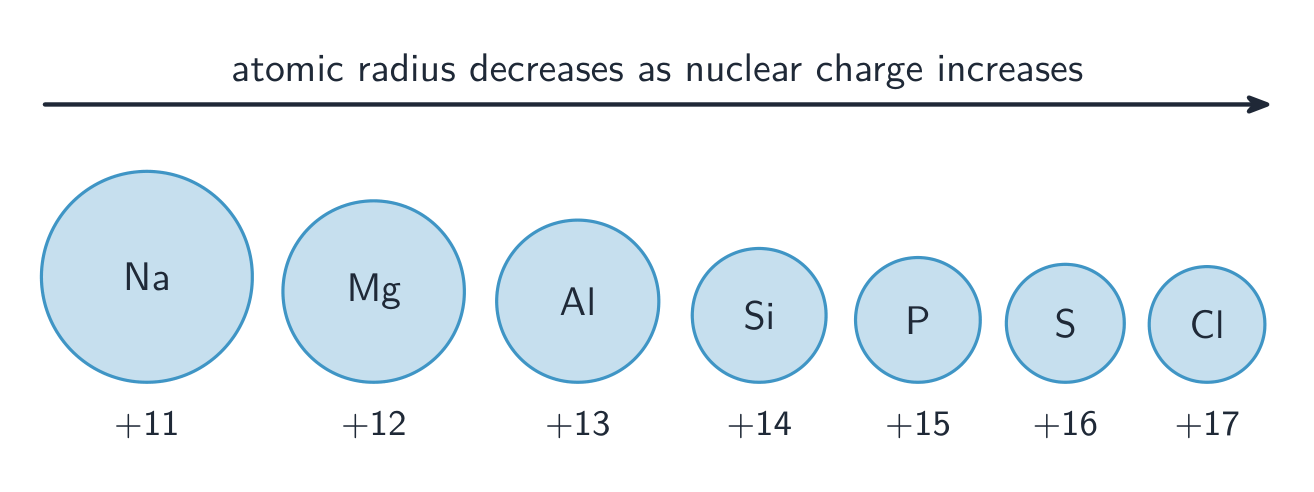
Circles scale the example radii. Compare like measurement conventions: electron clouds have no hard boundary.
Across a period the atomic radius decreases: Na 186 pm to Cl 102 pm.
Down a group the atomic radius increases: one extra occupied energy level each time.
Ionic radius
A cation is smaller than its atom: electron loss reduces repulsion and may remove an outer level, as in Na → Na⁺ (186 → 102 pm). Not every cation loses a complete shell.
An anion is larger: added electrons increase repulsion at the same nuclear charge. Cl → Cl⁻ gives 102 → 181 pm in these example conventions.
For ions with the same electron configuration (isoelectronic ions), the radius falls as the nuclear charge rises: $\text{N}^{3-} > \text{O}^{2-} > \text{F}^{-} > \text{Na}^{+} > \text{Mg}^{2+} > \text{Al}^{3+}$, all with the configuration of neon.
Ionization energy, electron affinity and electronegativity
towards halogens: often more exothermic many exceptions
electronegativity
relative attraction of a bonded atom for shared electron density
across: generally rises down: generally falls
Two processes on isolated gaseous atoms, and one property of an atom in a bond: keep the definitions apart.
The first process removes an electron; the second adds one to an isolated atom; the third describes an atom in a bond. Do not replace one definition with another. Fluorine is the most electronegative element on the usual Pauling scale; noble gases often have no value on a supplied school table.
Check affinity signs: positive energy released is the reverse of the electron-gain enthalpy convention used here, where exothermic gain is negative. Chlorine releases about 349 kJ/mol, fluorine about 328: fluorine’s compact 2p region increases incoming-electron repulsion. Thus group-17 affinity is not steadily more exothermic from iodine to fluorine. Filled or half-filled sublevels also interrupt across-period patterns. Isolated-atom gain energies alone do not determine halogen-molecule reactions in solution. (RSC chlorine data)
Metallic and non-metallic character
In the usual simple-ion reactions, metals undergo oxidation by losing electrons. Metallic character therefore increases as ionization energy decreases: down a group and to the left across a period. Non-metallic character increases up and to the right. This explains the broad group-1 and group-17 patterns. Do not extrapolate one perfectly monotonic numerical trend to francium or infer every reaction rate from ionization energy alone: bonding, phases, products and conditions also matter.
Group 1 metals are soft, have low melting points and react quickly with water to give a hydroxide and hydrogen:
Potassium reacts violently with water, giving off hydrogen that burns with a lilac flame — reactivity increases down Group IChlorine is more reactive, so it displaces bromine from the solution; the released bromine turns the colourless solution orange
Reactivity increases down the group. The outer electron is further from the nucleus and more shielded, so it is lost more easily. In a small-scale teacher demonstration, lithium commonly fizzes and potassium can melt and ignite with a lilac flame; the observed vigour also depends on sample size, surface and conditions. Use observations as evidence for the broad trend, rather than treating ignition as guaranteed.
The halogens
Halogens exist as diatomic molecules: $\text{F}_2$ and $\text{Cl}_2$ are gases, $\text{Br}_2$ a liquid and $\text{I}_2$ a solid at room temperature (London forces increase down the group). In halide-forming redox reactions, a halogen molecule is reduced: $\text{X}_2+2\text{e}^{-}\rightarrow2\text{X}^{-}$. Oxidizing ability generally decreases down group 17. Increasing distance and shielding help explain the broad pattern, but the overall reaction also involves breaking X–X and solvation; it is not identical to the isolated atom’s electron affinity. Fluorine reacts with water, so ordinary aqueous halide-displacement comparisons use chlorine, bromine and iodine.
Bromine is a Group 17 halogen — a dark liquid that gives off an orange vapour.Down Group 17 the halogens change from a pale green gas to a red-brown liquid to a grey-black solid as volatility falls
A more reactive halogen displaces a less reactive one from a solution of its halide ions:
The solution turns orange-yellow as bromine forms. Bromine cannot displace chloride ions, because chlorine is more reactive.
10.5
元素的氧化物
English
From basic to acidic
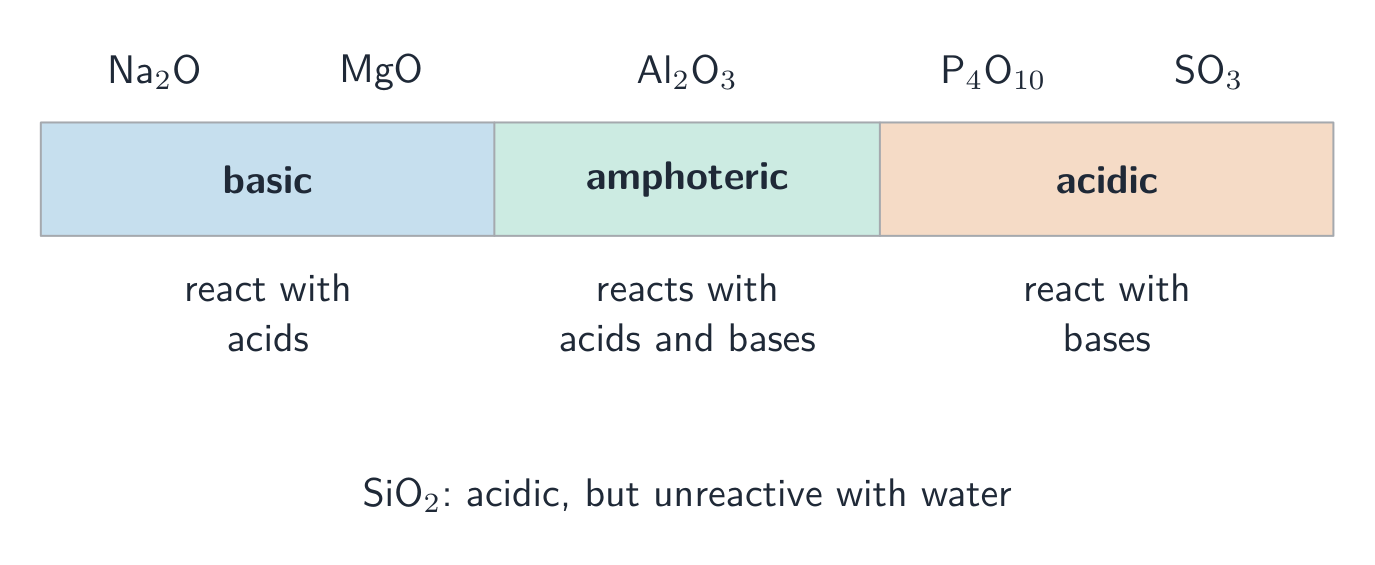
Many common metal oxides are mostly ionic and basic 碱性的: they neutralize acids, and those that react appreciably with water can give alkaline solutions. Many non-metal oxides are covalent and acidic 酸性的, reacting with bases. These are patterns with exceptions: CO is a neutral oxide, and acidic SiO₂ does not form an acidic solution merely by being placed in water.
Oxide character describes reactions. Actual pH also depends on solubility, amount, water volume and conditions.
Oxide
Bonding
Reaction with water
Character
Na₂O
ionic
Na₂O + H₂O → 2NaOH
basic
MgO
ionic
MgO + H₂O → Mg(OH)₂ (sparingly soluble)
basic
Al₂O₃
ionic with covalent character
no appreciable reaction
amphoteric 两性的
SiO₂
giant covalent
no appreciable reaction
acidic: reacts with hot NaOH
P₄O₁₀
molecular covalent
P₄O₁₀ + 6H₂O → 4H₃PO₄
acidic
SO₃
covalent
SO₃ + H₂O → H₂SO₄
acidic
An amphoteric oxide reacts with both acids and bases:
Non-metal oxides in the air make rain more acidic. Burning fuels that contain sulfur forms $\text{SO}_2$, and the high temperature in engines forms nitrogen oxides. Atmospheric oxidation and reactions in water droplets can form sulfuric and nitric acids. For example, these overall equations summarize oxidation and hydration; they are not elementary one-step mechanisms:
Nitrogen and sulfur oxides make acid rain: NO$_2$ forms nitric acid directly and also catalyses the oxidation of SO$_2$ to sulfuric acid
This acid deposition 酸沉降 damages limestone buildings, forests and lakes. Carbon dioxide dissolving in the oceans forms carbonic acid, $\text{CO}_2 + \text{H}_2\text{O} \rightleftharpoons \text{H}_2\text{CO}_3$, which lowers the pH of seawater: ocean acidification 海洋酸化. A useful aqueous model is $\text{CO}_2+\text{H}_2\text{O}\rightleftharpoons\text{H}^{+}+\text{HCO}_3^{-}$. Added H⁺ shifts carbonate towards hydrogencarbonate, reducing carbonate availability for many calcifying organisms. Acidification means a decrease in pH: seawater can become less alkaline while remaining above pH 7. CO is not an acid-forming substitute for CO₂.
For required group-1 and group-2 oxide equations, compare $\text{K}_2\text{O}+\text{H}_2\text{O}\rightarrow2\text{KOH}$ and $\text{CaO}+\text{H}_2\text{O}\rightarrow\text{Ca(OH)}_2$. Both give basic hydroxides under appropriate conditions, but MgO reacts less readily and Mg(OH)₂ is only sparingly soluble. Sulfur dioxide in water forms an acidic equilibrium mixture, often represented as $\text{SO}_2+\text{H}_2\text{O}\rightleftharpoons\text{H}^{+}+\text{HSO}_3^{-}$; do not label that alone the formation of sulfuric acid.
An oxidation state 氧化态 is the charge an atom would have if all its bonds were ionic. It is written with the sign first: $+2$, $-1$.
Assigning an oxidation number: fix the known atoms (K = +1, O = −2 each), then use “they sum to zero” to find the unknown (Mn = +7)
An uncombined element is 0: Fe, $\text{O}_2$, $\text{Cl}_2$.
A simple ion has its charge: $\text{Na}^{+}$ is $+1$, $\text{O}^{2-}$ is $-2$.
In a compound, oxygen is usually $-2$ (except in peroxides, $-1$, and with fluorine), hydrogen is usually $+1$ (except in metal hydrides, $-1$), and fluorine in its compounds is $-1$ (elemental F₂ is 0).
The oxidation states add up to zero in a neutral compound, and to the total charge in a polyatomic ion. Assigning equal shared electrons between identical atoms gives no electron transfer for an uncombined element, so its oxidation state is 0.
Worked example: the oxidation state of Mn in $\text{MnO}_4^{-}$. Four oxygens give $4(-2) = -8$. The total must be $-1$, so $\text{Mn} + (-8) = -1$, and Mn is $+7$.
For NaH, Na is +1 and H is −1. In H₂O₂, hydrogen is +1 and oxygen is −1; in OF₂, fluorine is −1 and oxygen is +2. The sum rule still holds. If a formula contains inequivalent atoms of one element, solving for one symbol can give only an average: thiosulfate has average sulfur +2, not two necessarily equivalent S atoms.
Naming with Roman numerals
When an element can have more than one oxidation state, the name shows it in Roman numerals: iron(II) chloride is $\text{FeCl}_2$, iron(III) chloride is $\text{FeCl}_3$. Oxyanions are named the same way: $\text{SO}_4^{2-}$ is sulfate(VI) and $\text{SO}_3^{2-}$ is sulfate(IV), commonly called sulfite; $\text{NO}_3^{-}$ is nitrate(V).
Without a periodic table, state the period, group and block of the atom with configuration $1\text{s}^2\,2\text{s}^2\,2\text{p}^6\,3\text{s}^2\,3\text{p}^4$.
Explain why the atomic radius generally decreases from sodium to chlorine.
Order these ions by increasing radius and explain: Mg²⁺, Na⁺, F⁻, O²⁻.
Explain why potassium generally reacts more vigorously with water than sodium under comparable conditions.
Write an ionic equation for chlorine added to aqueous iodide; state an observation and whether iodine displaces chloride under the same conditions.
Write equations for Na₂O and SO₃ with water. Can their formulas alone specify pH 14 and 0 respectively?
Deduce oxidation states: (a) Cr in Cr₂O₇²⁻, (b) average S in Na₂S₂O₃, (c) N in NH₄⁺. Explain the word “average” in (b).
Give Br’s configuration and electron count from its period-4/group-17 position. Explain He’s group-18 placement despite 1s².
Write CaO/CO₂ water equations. Explain acidification above pH 7 and acidic SiO₂’s lack of reaction with water.
Deduce H in NaH, O in H₂O₂ and O in OF₂, showing the sum rule.
For F −328 and Cl −349 kJ/mol electron-gain enthalpies, compare exothermicity, explain the exception and convert to positive-release values.
Worked answers.
Period 3 (outer n = 3), group 16 (six outer electrons), p block: sulfur.
Nuclear charge rises from +11 to +17 while electrons enter the same main level. Similar inner shielding gives stronger attraction and contraction; shielding is not exactly constant.
Mg²⁺ < Na⁺ < F⁻ < O²⁻. Each has ten electrons; nuclear charges 12, 11, 9 and 8 give greater attraction and contraction at the higher charge.
Potassium’s outer electron occupies a higher, more shielded level, farther from the nucleus. Easier removal explains the broad trend despite the greater nuclear charge; conditions affect observations.
Cl₂ + 2I⁻ → 2Cl⁻ + I₂: a brown iodine-containing solution forms. Iodine does not ordinarily oxidize chloride in the reverse aqueous displacement; chlorine is the stronger oxidizing agent here.
Na₂O + H₂O → 2NaOH gives an alkaline solution; SO₃ + H₂O → H₂SO₄ gives an acidic solution. Exact pH requires concentration and conditions, not an oxide formula alone.
(a) 2Cr − 14 = −2, so Cr +6. (b) 2 + 2S − 6 = 0 gives average S +2, without proving identical local sulfur states. (c) N + 4 = +1 gives N −3.
Br is [Ar] 3d¹⁰4s²4p⁵: 18 + 10 + 2 + 5 = 35 electrons. He’s filled 1s² level supports noble-gas group-18 placement, with two outer electrons.
CaO + H₂O → Ca(OH)₂; CO₂ + H₂O ⇌ H⁺ + HCO₃⁻. Falling alkaline pH is acidification. SiO₂ reacts with bases, not appreciably with water.
NaH: +1 + H = 0 gives H −1. H₂O₂: 2(+1) + 2O = 0 gives O −1. OF₂: O + 2(−1) = 0 gives O +2. Elemental F₂ remains 0.
Cl releases 349 − 328 = 21 kJ/mol more; compact F 2p increases incoming-electron repulsion. Positive-release values are F +328 and Cl +349 kJ/mol.
10.8
考试技巧
English
Use configuration, nuclear charge, shielding and distance; compare like radius conventions.
Balance equations and oxidation-state sums; check exceptions. Oxide character does not set pH.