This handout teaches Reactivity 2.1, How much? The amount of chemical change, for the course first assessed in 2025. All of it is SL and HL content.
Prerequisites: the mole, molar mass and concentration from Structure 1.4, and the molar volume of a gas from Structure 1.5. Use the relative atomic masses from the data booklet.
15.2
配平方程式
English
A recipe for a reaction
A cake recipe says 2 eggs for every 250 g of flour. With 6 eggs you need 750 g of flour, and if you have only 500 g of flour, the flour runs out first. A balanced equation is a recipe for a reaction, but it counts particles, not eggs.
Conservation of mass
In a chemical reaction atoms are rearranged, never made or destroyed. This is the conservation of mass 质量守恒: in a closed system, the total mass after an ordinary chemical reaction equals the total mass before it. Gas escaping from an open flask can reduce the measured mass of the flask and its contents; it has not destroyed atoms. So a balanced equation has the same number of atoms of each element on both sides.
A balanced equation rearranges atoms: four H and two O on each side
Balancing an equation
Change only the numbers in front of the formulae, the coefficients 系数. Never change a formula itself.
Propane burns in oxygen:
Unbalanced: C₃H₈ + O₂ → CO₂ + H₂O.
Balance C: 3 C on the left, so 3CO₂.
Balance H: 8 H on the left, so 4H₂O.
Balance O last: $3 \times 2 + 4 \times 1 = 10$ O atoms on the right, so 5O₂.
State symbols: (s) solid, (l) liquid, (g) gas, (aq) dissolved in water.
What the coefficients mean
The coefficients give the mole ratio 摩尔比 of the reaction. For propane: 1 mol of C₃H₈ reacts with 5 mol of O₂ to give 3 mol of CO₂ and 4 mol of H₂O. The study of these amounts is stoichiometry 化学计量.
Ratio Fe₂O₃ : Fe = 1 : 2, so $n(\text{Fe}) = 0.200$ mol.
$m(\text{Fe}) = 0.200 \times 55.85 = 11.2$ g.
Charges and units are conserved too
An ionic equation must balance charge as well as atoms: Ca²⁺(aq) + CO₃²⁻(aq) → CaCO₃(s) has zero net charge on each side. Coefficients are dimensionless ratios of numbers of entities or amounts; they are not mass ratios. A subscript belongs to the identity of the compound, so changing H₂O to H₂O₂ describes another substance rather than balancing water formation.
Keep intermediate precision. The calcium-carbonate example uses $(50.0/100.09)\times56.08=28.0148\ldots$ g, reported as 28.0 g. The displayed 0.500 mol is rounded for reading, not a replacement for the unrounded value in the calculator. If the starting solid is impure, first determine the mass of the reacting component. A theoretical calculation also assumes the named reaction occurs completely without competing products.
15.4
反应气体体积
English
Using the molar volume
At STP (273.15 K, 100 kPa) one mole of any ideal gas occupies 22.7 dm³. This is the molar volume 摩尔体积 (data booklet).
A deployed curtain airbag: a fast reaction makes a calculated volume of nitrogen gas to fill it in millisecondsEqual volumes of gases at the same temperature and pressure hold equal numbers of molecules, whatever the gas
$$n = \frac{V}{22.7} \quad (V \text{ in dm}^3 \text{ at STP})$$
Worked example: gas from a reaction
What volume of carbon dioxide, at STP, forms when 2.50 g of calcium carbonate reacts with excess hydrochloric acid?
For two gases at the same temperature and pressure you do not need the molar volume: the volume ratio is the mole ratio (Avogadro's law, Structure 1.4).
Compare gas volumes only under matching conditions
For an original idealized case, mix 40.0 cm³ H₂ with 30.0 cm³ O₂ and allow complete reaction at a common 400 K and 100 kPa. The equation 2H₂(g) + O₂(g) → 2H₂O(g) uses 20.0 cm³ oxygen for the 40.0 cm³ hydrogen. Thus hydrogen limits; 10.0 cm³ oxygen remains and 40.0 cm³ steam forms. If the final gases are compared at the original temperature and pressure, their total volume is 50.0 cm³, assuming water remains gaseous and ideal behaviour.
Gas volumes before and after: hydrogen limits
Cooling and condensing the water changes the gas count, and changing temperature changes the volume even for the remaining oxygen. For non-STP data use $pV=nRT$ with matching pressure, volume and R units. A gas collected over water may contain water vapour; use the dry-gas partial pressure when it is supplied, rather than assigning the entire pressure to the reaction gas. Specify whether a quoted volume is wet, dry or an ideal prediction.
The titre is the final burette reading minus the initial reading
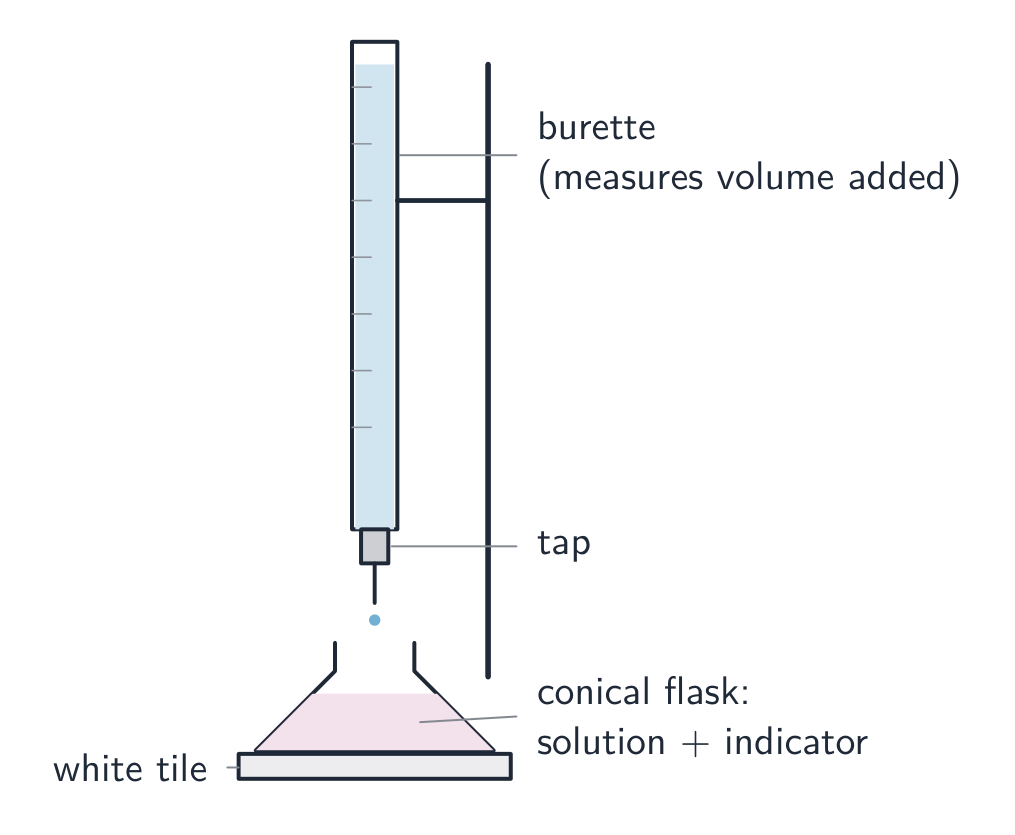
A titration 滴定 finds the concentration of a solution by reacting it with a standard solution 标准溶液 of known concentration.
A calibrated pipette 移液管 delivers a specified volume with a finite uncertainty, often 25.00 cm³, of one solution into a conical flask.
Add a few drops of indicator 指示剂.
Add the other solution from a burette 滴定管 until the indicator just changes colour: the end point 终点.
The volume added from the burette is the titre 滴定体积.
The end point is an observed indicator change; the equivalence point is the stoichiometric condition where the added amount matches the equation ratio. Choose an indicator whose transition occurs near that condition. A repeatable colour change is not by itself proof that the concentration is accurate: an unsuitable indicator or miscalibrated apparatus can produce concordant but biased results.
Good technique
Wear appropriate eye protection throughout the titration.
Read the meniscus bottom at eye level, and clear the tip of air before the first reading
Rinse the burette with the solution it will hold, and the pipette with the solution it will deliver. Rinse the flask with distilled water only; extra water does not change the amount in it.
Stand the flask on a white tile so the colour change is easy to see.
Do a rough titration first. Then add the solution drop by drop near the end point, swirling the flask.
For a clear aqueous solution in a suitable burette, read the bottom of the meniscus at eye level. A common 0.1 cm³ scale is estimated to 0.05 cm³; use the instrument scale and stated uncertainty rather than assuming every burette has this resolution.
Repeat until titres are concordant 一致的 under the stated method. Here use a school criterion of a range no greater than 0.10 cm³; this is a specified protocol, not a universal definition for every instrument. Average the accepted careful runs, not the rough trial.
Close the tap while filling, remove the filling funnel before reading, and check that the burette tip is full with no air bubble. A bubble that fills during delivery makes part of the apparent titre fill the tip instead of reaching the flask. For a known titrant used to infer analyte amount, this can overestimate that amount. Read a delivered volume as final minus initial; a burette need not start at zero.
If each reading has a stated maximum uncertainty of 0.05 cm³, the maximum uncertainty in their difference is 0.10 cm³. For a 21.50 cm³ titre this contributes $0.10/21.50\times100\approx0.47\%$. This maximum estimate is not the same as a statistical uncertainty from repeated trials, and neither automatically accounts for a biased endpoint. Use the specified method when combining uncertainties.
Worked example: a titration calculation
25.00 cm³ of sodium hydroxide solution is titrated with 0.100 mol dm⁻³ sulfuric acid.
Titration apparatus: a burette delivers a known solution into a conical flask
Titration
rough
1
2
3
Final reading / cm³
22.10
43.65
21.45
42.95
Initial reading / cm³
0.00
22.10
0.00
21.45
Titre / cm³
22.10
21.55
21.45
21.50
The concordant titres are 21.55, 21.45 and 21.50 cm³; the mean is 21.50 cm³. The rough titre is left out.
A titration measures the amount in the aliquot transferred by the pipette. Suppose an original sample is dissolved and made up to 250.0 cm³; a 25.00 cm³ aliquot requires 0.00200 mol titrant in a 1:1 reaction. The aliquot contains 0.00200 mol analyte, so the full prepared solution contains ten times that amount, 0.0200 mol. The flask volume divided by aliquot volume supplies the factor; do not multiply the final concentration by ten a second time when it already refers to the diluted solution.
Scale the aliquot amount to the whole flask once
A calculated concentration can require a correction for an earlier dilution. For a tenfold dilution, the original stock concentration is ten times the concentration in the diluted solution. Keep amount scaling and concentration scaling distinct, and label every vessel and volume in the calculation.
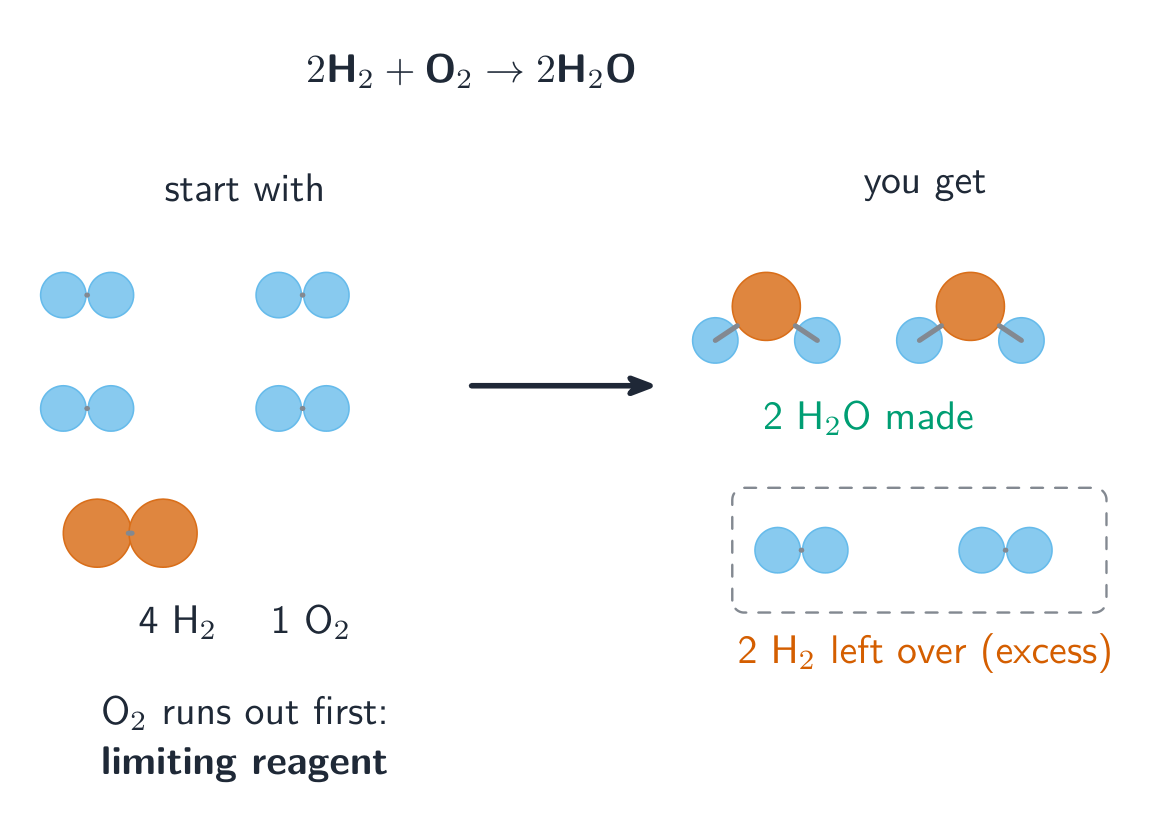
The reactant that runs out first decides how much product forms
The limiting reactant 限量反应物 is used up first and stops the reaction. The other reactant is in excess 过量: some of it is left over.
To find the limiting reactant, work out the amount of each reactant in moles and divide by its coefficient in the equation. The smaller result is the limiting reactant.
Worked example: aluminium and chlorine
5.40 g of aluminium is heated with 14.2 g of chlorine.
0.0667 is smaller, so chlorine is the limiting reactant and aluminium is in excess.
Retain the unrounded chlorine amount: $n(\text{AlCl}_3)=(14.2/70.90)\times2/3=0.133521\ldots$ mol. Then $m=(14.2/70.90)\times(2/3)\times133.33=17.8$ g to three significant figures.
Equal amounts in moles do not mean neither is limiting. Always use the coefficients.
Percentage yield
The theoretical yield 理论产量 is the mass of product calculated from the limiting reactant. The mass you actually collect is the actual yield.
If 14.2 g of AlCl₃ is collected in the example above: $14.2 / 17.8 \times 100 = 79.8\%$.
A pure, dry product often gives less than 100% of the theoretical yield because:
the reaction may be reversible and reach equilibrium;
side reactions make other products;
product is lost when it is filtered, transferred or purified.
Check excess amount and apparent yields above 100 percent
In the aluminium example, use unrounded amounts: chlorine consumes $2/3\times(14.2/70.90)=0.133521\ldots$ mol Al. Initially $5.40/26.98=0.200148\ldots$ mol Al was present, leaving about 0.0666 mol, or 1.80 g. The excess is the initial amount minus the amount consumed in the balanced ratio, not the difference between the two starting masses.
A measured “yield” above 100% can indicate retained solvent, an incompletely dried solid, impurities or a mistaken limiting-reactant calculation. It does not show that atoms have been created. Compare the actual mass of the desired pure product against a theoretical mass for that same product and reaction; mixtures and wet solids do not satisfy that comparison.
Worked solution precipitation case
Mix 25.0 cm³ of 0.120 mol/dm³ CaCl₂ with 40.0 cm³ of 0.0500 mol/dm³ Na₂CO₃. Assume quantitative precipitation, additive solution volumes and negligible dissolved CaCO₃. The net equation is Ca²⁺ + CO₃²⁻ → CaCO₃(s).
Calcium amount is $0.120\times0.0250=0.00300$ mol; carbonate is $0.0500\times0.0400=0.00200$ mol. Carbonate limits, giving $0.00200\times100.09=0.20018$ g precipitate, reported as 0.200 g. Remaining calcium amount is 0.00100 mol. Its concentration in 0.0650 dm³ is $0.00100/0.0650=0.0154\ \text{mol dm}^{-3}$. The spectator ions remain dissolved; the volume used for the final concentration includes both mixed solutions.
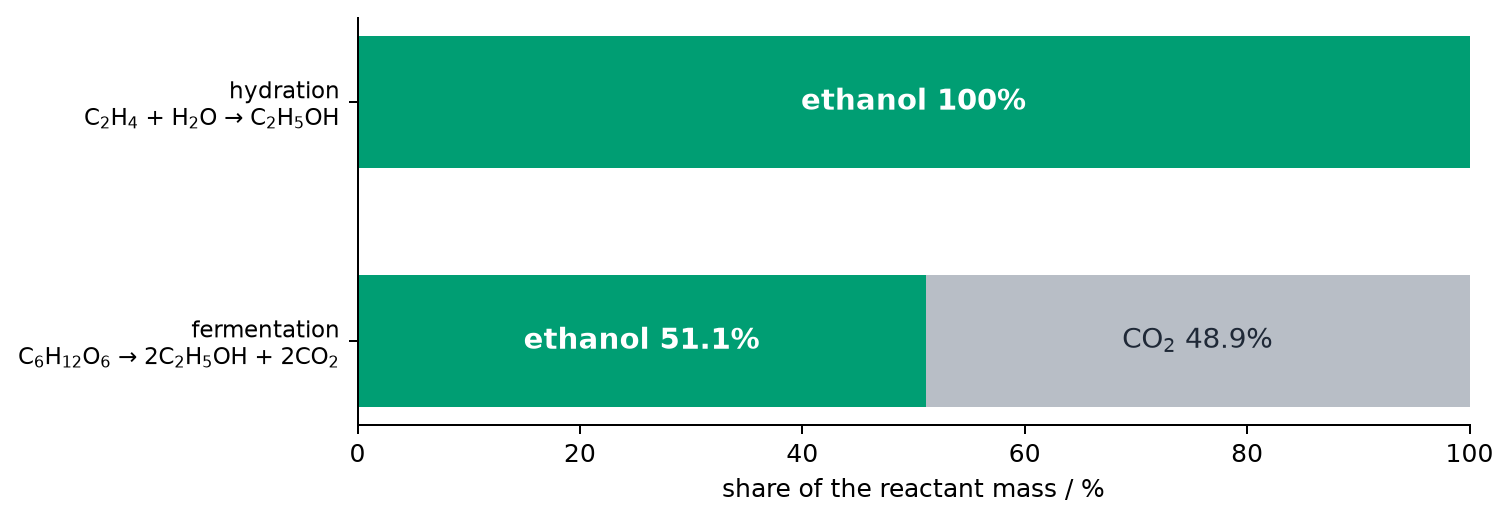
A high atom economy means a larger fraction of the stoichiometric reactant mass is allocated to the desired product. It does not measure solvent use, energy demand, toxicity, actual conversion, product isolation or overall cost; compare those separately. It is not the same as percentage yield: a reaction can have a 100% atom economy but a poor yield.
Balance: Al + O₂ → Al₂O₃. Also balance the charge and atoms for calcium carbonate precipitation from Ca²⁺(aq) and CO₃²⁻(aq).
Balance: C₂H₆ + O₂ → CO₂ + H₂O.
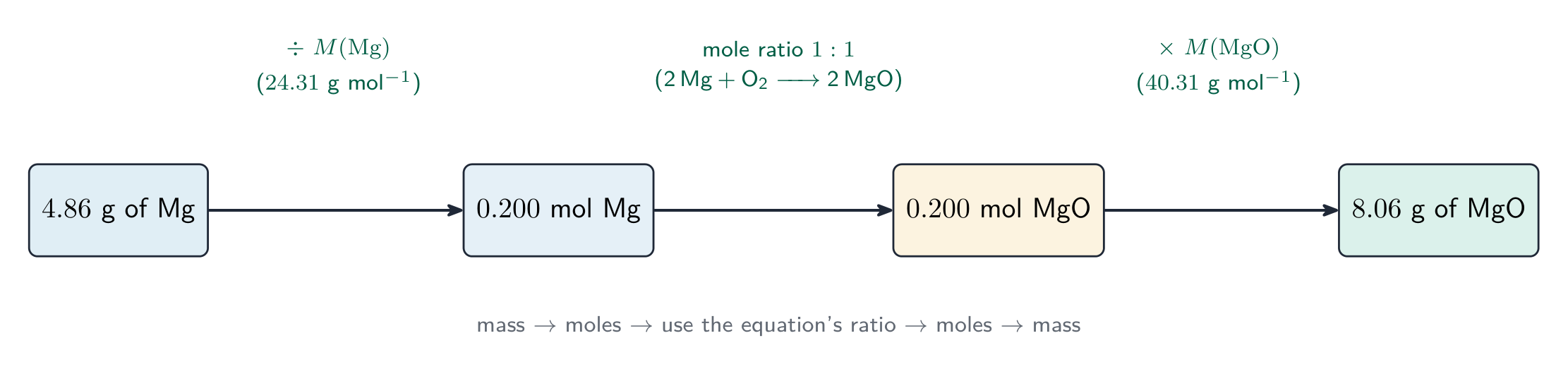
Calculate the mass of magnesium oxide made by burning 6.08 g of magnesium: 2Mg + O₂ → 2MgO.
Calculate the mass of oxygen needed to burn 11.0 g of propane completely (equation in the handout).
Calculate the volume of hydrogen at STP made when 0.654 g of zinc reacts with excess acid: Zn + 2HCl → ZnCl₂ + H₂.
25.00 cm³ of hydrochloric acid needs 18.40 cm³ of 0.150 mol dm⁻³ sodium hydroxide for neutralization. Calculate the concentration of the acid.
Titres of 24.30, 23.80, 23.70 and 23.75 cm³ were recorded; the first was the rough titration. Calculate the mean titre to use.
Explain why the conical flask is rinsed with distilled water but the burette is rinsed with the solution it holds.
4.00 g of hydrogen reacts with 16.0 g of oxygen: 2H₂ + O₂ → 2H₂O. Find the limiting reactant and the mass of water made.
10.0 g of CaCO₃ is heated and 4.80 g of CaO is collected. Calculate the percentage yield.
Calculate the atom economy for making hydrogen from methane: CH₄ + H₂O → CO + 3H₂.
Give two reasons why the actual yield of a reaction is often less than the theoretical yield.
In the precipitation case above, find the limiting reactant, dry CaCO₃ mass and remaining Ca²⁺ concentration. Explain why the original 25.0 cm³ is not the volume for that final concentration. Then find the total gas volume for the 40.0 cm³ H₂/30.0 cm³ O₂ case at the stated 400 K, 100 kPa after complete reaction.
An 1.25 g impure limestone sample produces 0.227 dm³ dry CO₂ at STP with excess acid. Assume only CaCO₃ produces gas and reaction/collection are complete. Calculate CaCO₃ percentage purity. Explain how loss of CO₂ would bias this inferred purity, and why collecting the gas wet would require considering its water-vapour contribution.
Any two: the reaction is reversible; side reactions; product lost in transfer, filtering or purification; the reaction does not go to completion.
Carbonate limits at 0.00200 mol. Dry precipitate: $0.00200\times100.09=0.200$ g to three significant figures. Excess calcium: $0.00300-0.00200=0.00100$ mol; divide by the combined $0.0250+0.0400=0.0650$ dm³ to obtain 0.0154 mol/dm³. In the separate hot-gas case, 40.0 cm³ H₂ consumes 20.0 cm³ O₂, forming 40.0 cm³ steam with 10.0 cm³ O₂ remaining: total 50.0 cm³ at the same conditions.
Dry CO₂ amount $0.227/22.7=0.0100$ mol equals CaCO₃ amount. Reacting CaCO₃ mass is $0.0100\times100.09=1.0009$ g; purity $1.0009/1.25\times100=80.1\%$. CO₂ loss gives too small an inferred amount and purity. For wet gas, the total pressure includes water vapour, so the CO₂ partial pressure is smaller than the total.
15.9
考试技巧
English
Balance the equation before any calculation, and change only the coefficients.
Show the mole ratio as a separate line so that the stoichiometric step can be checked.
Divide cm³ by 1000 before using $c = n/V$, and use 22.7 dm³ only at STP.
Average only concordant titres, and leave out the rough titration.
For the limiting reactant, divide moles by the coefficient; never compare masses.
Percentage yield compares masses of product; atom economy compares molar masses in the equation.