This handout teaches Reactivity 1.2, Energy cycles in reactions, for the course first assessed in 2025. Sections marked AHL are for Higher Level only.
Prerequisites: enthalpy change, exothermic and endothermic reactions, and calorimetry from Reactivity 1.1; covalent bonds from Structure 2.2. You will use bond enthalpies and enthalpy data from the data booklet.
13.2
键焓
English
Where does the energy of a reaction come from?
Burning one mole of methane in a gas cooker releases about $800\ \text{kJ}$. No atoms are created or destroyed, so the energy must come from the bonds: forming the product bonds releases more energy in total than breaking the reactant bonds requires. Individual bond strengths alone are not enough: count how many bonds of each type occur. This unit shows how to calculate enthalpy changes from bond data and from energy cycles 能量循环 when they cannot be measured directly.
Breaking and making bonds
Breaking a bond needs energy: bond breaking is endothermic.
Making a bond releases energy: bond making is exothermic.
The bond enthalpy 键焓 is the energy needed to break one mole of a covalent bond, with the substances in the gaseous state. It is always positive. For example, $\text{H}_2(\text{g}) \rightarrow 2\text{H}(\text{g})$, $\Delta H = +436\ \text{kJ mol}^{-1}$.
The value for a bond such as C–H differs a little from one molecule to another, so the data booklet gives an average bond enthalpy 平均键焓: the mean over many compounds.
Calculating $\Delta H$ from bond enthalpies
$$\Delta H = \sum(\text{bonds broken}) - \sum(\text{bonds formed})$$
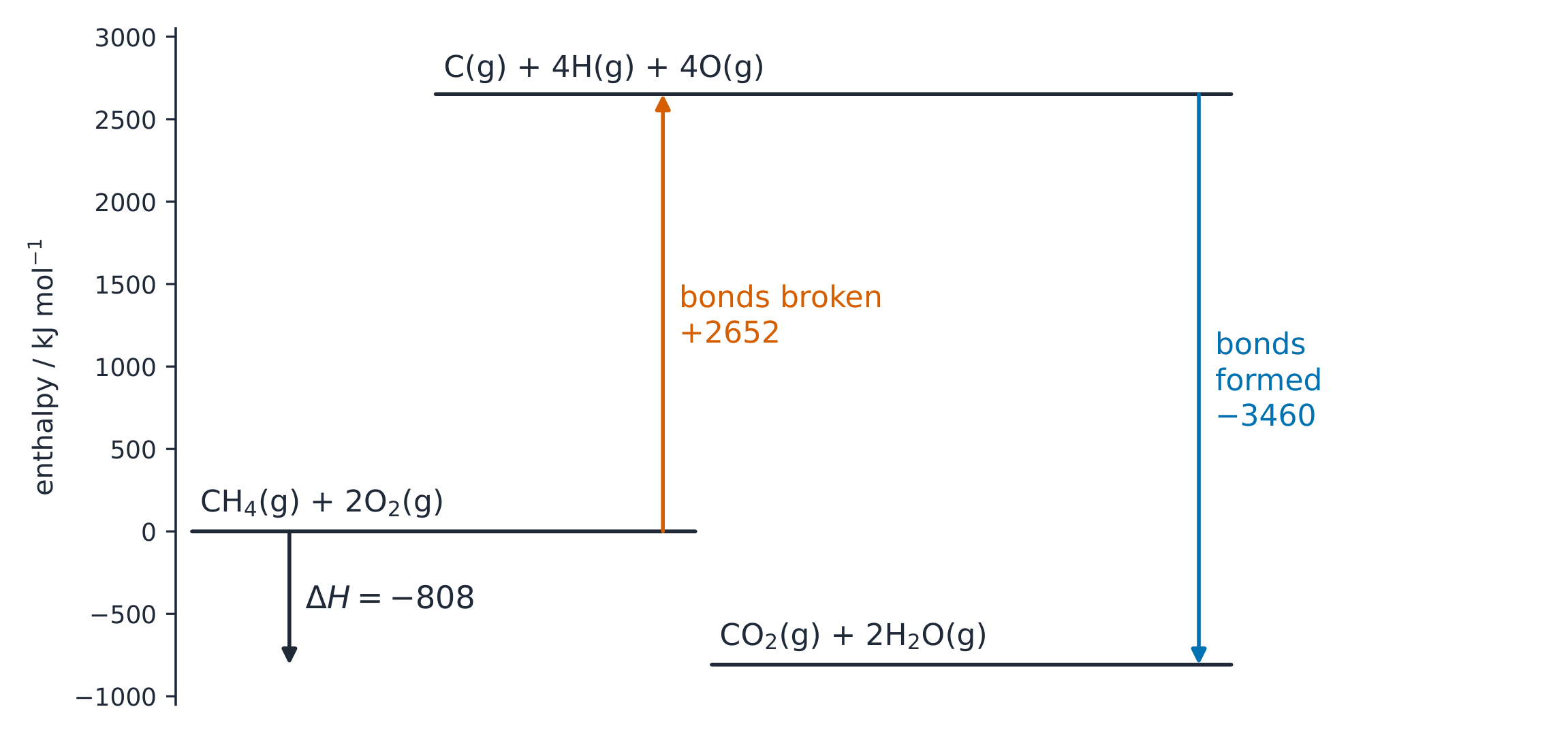
Worked example: $\text{CH}_4(\text{g}) + 2\text{O}_2(\text{g}) \rightarrow \text{CO}_2(\text{g}) + 2\text{H}_2\text{O}(\text{g})$.
Bonds broken
Energy / kJ
Bonds formed
Energy / kJ
4 C–H: $4 \times 414$
1656
2 C=O: $2 \times 804$
1608
2 O=O: $2 \times 498$
996
4 O–H: $4 \times 463$
1852
total
2652
total
3460
$\Delta H = 2652 - 3460 = -808\ \text{kJ mol}^{-1}$. More energy is released by forming bonds than is needed to break them, so the reaction is exothermic.
Every bond is broken to gaseous atoms, then the new bonds form; $\Delta H$ is the difference
Why the answer is only approximate
The measured value for this reaction is $-802\ \text{kJ mol}^{-1}$ (with water as a gas). The bond enthalpy answer differs because:
average bond enthalpies are used, not the values for these exact molecules;
bond enthalpies apply only to gases. If a substance is a liquid or solid, the energy to change its state is missing. With liquid water as a product the true value is $-890\ \text{kJ mol}^{-1}$.
Count a complete inventory before cancelling
For ethene hydrogenation, draw CH₂=CH₂ + H–H → CH₃–CH₃. A complete inventory breaks one C=C, four C–H and one H–H, then forms one C–C and six C–H. Using 614, 414, 436 and 346 kJ per mole respectively gives $(614+4\times414+436)-(346+6\times414)=-124\ \text{kJ mol}^{-1}$. Cancelling four identical average C–H contributions gives the same shortcut. This bookkeeping route through isolated atoms does not assert that a real reaction simultaneously breaks every bond, or that an average C–H value is identical in every molecule.
A complete bond inventory for ethene hydrogenation: −124 kJ mol⁻¹
A stronger comparable bond generally has a larger dissociation enthalpy and a shorter length, but bond type and environment matter. Neither bond polarity alone nor a bond count without bond energies determines the overall heat change. A negative reaction enthalpy also does not imply a fast reaction: activation barriers concern the pathway, not just its endpoints.
Put a phase correction on the correct side
Suppose supplied rounded data give a gas-phase reaction change of −808 kJ per mole of methane and water condensation releases 44 kJ per mole. Two moles of product water condense, so the estimate for liquid products is $-808+2(-44)=-896\ \text{kJ mol}^{-1}$. This remains an estimate from the supplied bond data, rather than the measured −890 value. Condensation releases energy; vaporizing a liquid reactant would require energy before its gaseous bonds could be broken. Write the extra state-change equation instead of guessing its sign.
Hess's law 盖斯定律: the enthalpy change of a reaction is the same whatever route is taken, as long as the initial and final conditions are the same. Enthalpy is a state function: it depends only on where you start and where you finish, like the difference in height between the bottom and the top of a mountain, whichever path you climb.
This lets you calculate enthalpy changes that cannot be measured directly. Build an energy cycle with the target reaction on one route and reactions with known $\Delta H$ on the other.
Both routes start with C(s) + O₂(g) and finish with CO₂(g): x − 283 = −394, so x = −111 kJ for the equation shown.
Working with equations
You can also combine equations directly, like algebra:
Reverse, multiply, add, cancel
If you reverse an equation, change the sign of $\Delta H$.
If you multiply an equation by a number, multiply $\Delta H$ by the same number.
Add the equations and their $\Delta H$ values; species that appear on both sides cancel.
Worked example: find $\Delta H$ for $\text{C}(\text{s}) + \tfrac{1}{2}\text{O}_2(\text{g}) \rightarrow \text{CO}(\text{g})$, which is difficult to isolate by direct combustion calorimetry because oxidation can also produce $\text{CO}_2$.
Keep (1) and reverse (2): $\text{CO}_2 \rightarrow \text{CO} + \tfrac{1}{2}\text{O}_2$, $\Delta H = +283$. Adding them, $\text{CO}_2$ cancels and $\tfrac{1}{2}\text{O}_2$ is left on the left:
$$\Delta H = -394 + 283 = -111\ \text{kJ mol}^{-1}$$
Worked example: three equations
Find $\Delta H$ for $2\text{C}(\text{s}) + \text{H}_2(\text{g}) \rightarrow \text{C}_2\text{H}_2(\text{g})$, given:
(1) $\text{C}(\text{s}) + \text{O}_2(\text{g}) \rightarrow \text{CO}_2(\text{g})$, $\Delta H = -394$
(2) $\text{H}_2(\text{g}) + \tfrac{1}{2}\text{O}_2(\text{g}) \rightarrow \text{H}_2\text{O}(\text{l})$, $\Delta H = -286$
Check that the oxygen, $\text{CO}_2$ and water cancel: $\tfrac{5}{2}\text{O}_2$ on each side, $2\text{CO}_2$ on each side, one $\text{H}_2\text{O}$ on each side.
Link a measured heat change to a cycle
A cycle can use an enthalpy change obtained by calorimetry. Use an insulated cup and lid, stir, start the solutions at the same temperature and record a temperature–time series. Extrapolate appropriate pre- and post-reaction trends to the mixing time to estimate the corrected temperature rise; a single observed maximum can miss cooling during measurement.
Calorimetry: measure the temperature change of a known mass of solution
In a neutralization experiment, 0.0500 mol of water forms in $\mathrm{HCl(aq)+NaOH(aq)\rightarrow NaCl(aq)+H_2O(l)}$. The total solution mass is 100.0 g, its specific heat capacity is $4.18\ \mathrm{J\,g^{-1}\,K^{-1}}$ and its corrected temperature rise is 5.00 K. Neglect the cup's heat capacity and any remaining heat exchange:
The warming solution gains heat, so the reaction transfers energy to the surroundings and has a negative enthalpy change. This is an experimental estimate, not automatically a standard value. A Hess sum using this measured arrow must retain its states, conditions and reaction amount; reversing or scaling the equation also reverses or scales its enthalpy.
Match states, coefficients and reaction amount
A valid cycle returns to precisely the same substances, amounts, states, temperature and pressure. Water vapour cannot cancel against liquid water without including condensation or vaporization. Likewise, carbon graphite and diamond are different initial states. A cycle diagram is a map of alternative processes, not a time trace or a mechanism.
ΔH scales and changes sign with the equation as written
For $2\text{H}_2(\text{g})+\text{O}_2(\text{g})\rightarrow2\text{H}_2\text{O}(\text{l})$, supplied $\Delta H=-572$ kJ applies to the equation as written. Halving it gives −286 kJ for one mole of water; reversing and doubling the original gives +1144 kJ for decomposing four moles of water. If 0.250 mol of water forms, the corresponding heat change is $0.250(-286)=-71.5$ kJ. A molar value and the heat of a particular sample are different quantities.
Standard conditions are $100\ \text{kPa}$ and a stated temperature, usually $298\ \text{K}$, written with the symbol $\ominus$.
Formation makes a compound from its elements; combustion burns it in oxygen
The standard enthalpy change of formation 标准生成焓, $\Delta H_f^\ominus$, is the enthalpy change when one mole of a substance forms from its elements in their standard states. For an element in its standard state, $\Delta H_f^\ominus = 0$.
The standard enthalpy change of combustion 标准燃烧焓, $\Delta H_c^\ominus$, is the enthalpy change when one mole of a substance burns completely in oxygen under standard conditions.
Standard state means the specified reference state at standard pressure and the stated temperature; it is not the same as standard temperature and pressure used for a gas-volume calculation. Graphite is carbon's reference form at 298 K. Diamond has a nonzero formation enthalpy relative to graphite even though both contain only carbon. Zero formation enthalpy is a reference convention, not a claim that an element contains no energy. A compound can have a positive or negative formation enthalpy.
A formation equation must produce exactly one mole of the named substance: $2\text{C}(\text{s, graphite})+3\text{H}_2(\text{g})+\tfrac12\text{O}_2(\text{g})\rightarrow\text{C}_2\text{H}_5\text{OH}(\text{l})$. Fractions are necessary when they enforce this basis. A combustion equation instead consumes one mole of the named fuel and specifies complete-combustion products and their states.
Using formation data
When $\Delta H_f^\ominus$ values are known for every substance, use the products-minus-reactants rule, which comes from a cycle through the elements:
Worked example: the combustion of ethanol, $\text{C}_2\text{H}_5\text{OH}(\text{l}) + 3\text{O}_2(\text{g}) \rightarrow 2\text{CO}_2(\text{g}) + 3\text{H}_2\text{O}(\text{l})$. Data: $\Delta H_f^\ominus$ ethanol $-278$, $\text{CO}_2$$-394$, $\text{H}_2\text{O}(\text{l})$$-286\ \text{kJ mol}^{-1}$; $\text{O}_2$ is an element, so 0.
standard enthalpy change of formation/ˈstændəd enˈθælpi tʃeɪndʒ ɒv fɔːˈmeɪʃn/
标准生成焓
biāo zhǔn shēng chéng hán
standard enthalpy change of combustion/ˈstændəd enˈθælpi tʃeɪndʒ ɒv kəmˈbʌstʃn/
标准燃烧焓
biāo zhǔn rán shāo hán
13.5
AHL:玻恩–哈伯循环
English
Lattice enthalpy from a cycle
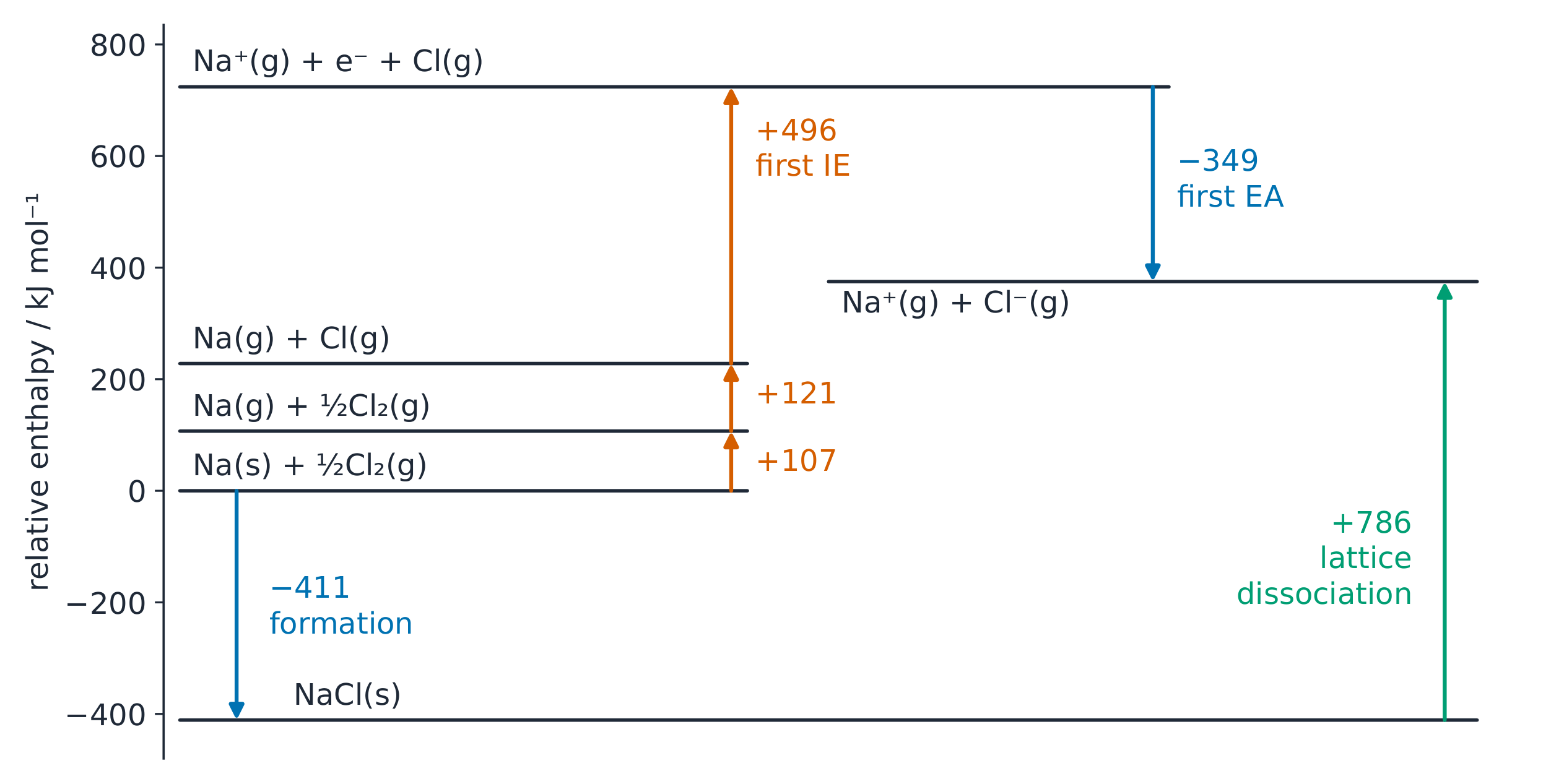
Lattice enthalpy cannot be measured directly, because you cannot separate a crystal into gaseous ions in one step. A Born–Haber cycle 玻恩-哈伯循环 is an energy cycle for forming an ionic compound from its elements, through gaseous atoms and gaseous ions. Combine independently determined atomic, ionic and formation data to calculate lattice enthalpy. Values may themselves require indirect measurements or models; a cycle does not make every individual step directly measurable.
Sodium chloride crystals: a Born–Haber cycle finds the lattice enthalpy that holds this giant ionic lattice together
The steps for sodium chloride:
Step
Process
ΔH / kJ mol⁻¹
atomization of Na
Na(s) → Na(g)
+107
atomization of Cl
½Cl₂(g) → Cl(g)
+121
first IE of Na
Na(g) → Na⁺(g) + e⁻
+496
first electron gain of Cl
Cl(g) + e⁻ → Cl⁻(g)
−349
formation of NaCl
Na(s) + ½Cl₂(g) → NaCl(s)
−411
lattice dissociation
NaCl(s) → Na⁺(g) + Cl⁻(g)
unknown
The enthalpy of atomization 原子化焓 is the enthalpy change to form one mole of gaseous atoms from the element in its standard state. For chlorine it is half the Cl–Cl bond enthalpy, because one mole of Cl atoms comes from half a mole of $\text{Cl}_2$.
Two routes from NaCl(s) to the gaseous ions have the same total enthalpy change
Calculating the lattice enthalpy
Going round the cycle, the route from $\text{NaCl}(\text{s})$ to the gaseous ions directly must equal the route back through the elements:
A different reference table may give a nearby value. Use one internally consistent set of supplied data; do not force the result to match a separate rounded table.
Electron affinity here means the signed enthalpy for electron gain: Cl(g) + e⁻ → Cl⁻(g) is −349 kJ per mole with the supplied data. A table that instead reports the positive energy released uses a different sign convention. Read the defining equation. The IB lattice convention here is dissociation, positive for separating the stable solid; the reverse lattice-formation arrow has the same magnitude and opposite sign.
For a group 2 compound such as $\text{MgO}$, the cycle includes the first and second ionization energies of magnesium, and the first and second electron affinities of oxygen. The second electron affinity is positive: adding an electron to $\text{O}^{-}$ means pushing it against the negative charge already there.
Worked divalent example: magnesium oxide
Use the following supplied rounded teaching data, all in kJ per mole of the defined process: Mg atomization +148; O₂ bond dissociation +498; Mg first IE +738 and second IE +1451; O first electron-gain enthalpy −141 and second +798; MgO formation −602. These numbers define this calculation rather than claiming exact agreement with a reference table.
The MgO cycle with supplied teaching data: L = 3845 kJ mol⁻¹
One mole of MgO needs one mole of Mg atoms and one mole of O atoms, so oxygen atomization is half a mole of O₂ dissociation: +249. The two successive magnesium ionizations cost $738+1451=2189$; the two oxygen electron-gain steps total $-141+798=+657$. Electron counts balance: two electrons lost by Mg are gained by O.
If $L$ is the positive lattice-dissociation enthalpy, formation along the atomic route gives $-602=148+249+738+1451-141+798-L$. Thus $L=3243+602=3845\ \text{kJ mol}^{-1}$. Do not halve either Mg ionization energy, omit the positive second affinity or treat −141 as the entire conversion O→O²⁻. The larger lattice magnitude for small, doubly charged ions is consistent with stronger electrostatic attraction, but the cycle is needed for a quantitative result.
Interpret supplied cycles by labelling species, arrows and their signs. The current syllabus asks for interpreting and determining values from cycles, rather than constructing a complete Born–Haber cycle from memory. Charge and atom conservation are still essential checks.
enthalpy of atomization/enˈθælpi ɒv ˌætəmaɪˈzeɪʃn/
原子化焓
yuán zi huà hán
13.6
练习
English
Explain, in terms of bonds, why the combustion of methane is exothermic.
Use bond enthalpies (H–H 436, Cl–Cl 242, H–Cl 431 kJ mol$^{-1}$) to calculate $\Delta H$ for $\text{H}_2(\text{g}) + \text{Cl}_2(\text{g}) \rightarrow 2\text{HCl}(\text{g})$.
Use bond enthalpies (C=C 614, H–H 436, C–C 346, C–H 414 kJ mol$^{-1}$) to calculate $\Delta H$ for $\text{C}_2\text{H}_4(\text{g}) + \text{H}_2(\text{g}) \rightarrow \text{C}_2\text{H}_6(\text{g})$.
Give two reasons why an enthalpy change calculated from average bond enthalpies differs from the measured value.
State Hess's law.
Given $\text{S}(\text{s}) + \text{O}_2(\text{g}) \rightarrow \text{SO}_2(\text{g})$, $\Delta H = -297$, and $2\text{SO}_2(\text{g}) + \text{O}_2(\text{g}) \rightarrow 2\text{SO}_3(\text{g})$, $\Delta H = -198\ \text{kJ mol}^{-1}$, calculate $\Delta H$ for $\text{S}(\text{s}) + \tfrac{3}{2}\text{O}_2(\text{g}) \rightarrow \text{SO}_3(\text{g})$.
A supplied enthalpy change for $2\text{H}_2(\text{g})+\text{O}_2(\text{g})\rightarrow2\text{H}_2\text{O}(\text{l})$ is −572 kJ. Find the change for decomposition of four moles of water and the heat released when 0.250 mol of water forms.
Explain why H₂O(l) on one side of a Hess sum cannot simply cancel against H₂O(g) on the other. If a gas-product estimate is −808 kJ per mole of methane and condensation is −44 kJ per mole of water, find the liquid-product estimate.
For $\text{CH}_3\text{Cl}(\text{g})+\text{H}_2(\text{g})\rightarrow\text{CH}_4(\text{g})+\text{HCl}(\text{g})$, supplied average C–H, H–H and H–Cl values are 414, 436 and 431 kJ per mole. A gas-phase reaction enthalpy is −70 kJ per mole. Estimate the C–Cl bond enthalpy within this model.
Supplied teaching data give A→B +35 kJ and A→C −80 kJ for the same amount and conditions. Find B→C and C→B; explain why a catalyst cannot change either endpoint difference.
A learner calls a reaction exothermic because it breaks many weak bonds and says its average-bond answer proves the mechanism. Explain both errors. Draw the full bond inventory for ethene hydrogenation before using the shortcut.
AHL. Use $\Delta H_f^\ominus$ values ($\text{NH}_3$$-46$, $\text{NO}$$+90$, $\text{H}_2\text{O}(\text{g})$$-242\ \text{kJ mol}^{-1}$) to calculate $\Delta H^\ominus$ for $4\text{NH}_3(\text{g}) + 5\text{O}_2(\text{g}) \rightarrow 4\text{NO}(\text{g}) + 6\text{H}_2\text{O}(\text{g})$.
AHL. Use $\Delta H_c^\ominus$ values (C $-394$, $\text{H}_2$$-286$, $\text{C}_2\text{H}_6$$-1560\ \text{kJ mol}^{-1}$) to calculate $\Delta H_f^\ominus$ of ethane. Also explain why graphite, but not diamond, has zero standard formation enthalpy at 298 K.
AHL. Write oxygen first electron-gain and MgO lattice-dissociation equations. For KCl use atomizations K +89 and Cl +121, IE +419, electron gain −349 and formation −437 kJ/mol; find positive lattice enthalpy. For MgO use the data above; explain ½O₂ and both electron-transfer steps.
Answers.
Breaking 4 C–H and 2 O=O absorbs 2652 kJ; forming 2 C=O and 4 O–H releases 3460 kJ. Net release: 808 kJ per mole methane.
Cancel four matching average C–H terms: $614+436-346-2(414)=-124\ \text{kJ mol}^{-1}$. The full inventory is explained above.
The supplied values average different molecular environments; gases-only bond data also omit any required state-change steps.
The enthalpy change of a reaction is independent of the route taken, provided the initial and final conditions are the same.
Keep the first equation and halve the second: $\Delta H = -297 + \tfrac{1}{2}(-198) = -297 - 99 = -396\ \text{kJ mol}^{-1}$.
Reverse and double the original: decomposition of four moles gives $+1144$ kJ. Formation of 0.250 mol gives $0.250(-572/2)=-71.5$ kJ, so 71.5 kJ is released.
Different phases have different enthalpies. Add the state-change equation; two product water molecules per methane give $-808+2(-44)=-896\ \text{kJ mol}^{-1}$. This is still the stated average-bond estimate.
Three matching C–H contributions cancel. With $x=D(\mathrm{C-Cl})$, $-70=x+436-414-431=x-409$, giving $x=339\ \text{kJ mol}^{-1}$. The number is an estimate, not an exact bond measurement.
Reverse A→B then add A→C: B→C gives $-35-80=-115$ kJ; the reverse gives +115 kJ. A catalyst supplies another pathway but does not change these specified endpoints.
Bond breaking absorbs energy; compare total absorbed with total released. Break C=C, 4 C–H and H–H; form C–C and 6 C–H. Cancelling four average C–H terms gives −124 kJ/mol. This route is bookkeeping, not proof of a mechanism.
AHL.$2\text{C} + 3\text{H}_2 \rightarrow \text{C}_2\text{H}_6$: $\Delta H_f^\ominus = [2(-394) + 3(-286)] - (-1560) = -1646 + 1560 = -86\ \text{kJ mol}^{-1}$. Graphite is the chosen elemental reference form at 298 K; diamond has a different enthalpy relative to that reference.
AHL. O(g) + e⁻ → O⁻(g); MgO(s) → Mg²⁺(g) + O²⁻(g). KCl: 437+89+121+419−349 = +717 kJ/mol. MgO: 602+148+249+738+1451−141+798 = +3845 kJ/mol. One O atom requires ½O₂; Mg loses two electrons and O gains two.
13.7
考试技巧
English
Write broken minus formed, count every bond and use gaseous states. Cancel matching average terms only after checking the full inventory.
Reverse an equation: reverse its sign. Multiply coefficients: multiply its enthalpy. Match phases and state the mole basis.
AHL. Formation data: products minus reactants; combustion data: reactants minus products. Include coefficients and reference states.
AHL. Read the defining arrow: lattice dissociation is positive here. Divalent cycles need both ionizations and both electron gains.