A potato cylinder gains mass in one solution and loses mass in another. A nerve cell admits an ion through one membrane protein but uses energy to export ions through another. The same thin boundary must act as a barrier, permit controlled exchange and respond to signals. How can one structure do all three?
This unit covers B2.1 SL understandings: membrane structure, simple and facilitated diffusion, osmosis, active transport, selective permeability, surface carbohydrates and the fluid mosaic model. Prerequisites are water polarity, phospholipid structure and protein interactions.
9.2
磷脂双分子层将两个水性环境隔开
English
Phospholipids are amphipathic: a hydrophilic head interacts with water, while hydrophobic hydrocarbon tails tend to associate away from it. In a bilayer, heads face water on both surfaces and tails form the interior. A cell has water in its cytoplasm as well as outside it. A diagram with heads exposed to water on only one side misses this arrangement.
A phospholipid has a polar head and two nonpolar tails, so phospholipids form a bilayer
The hydrophobic core presents a barrier to many hydrophilic particles, especially ions and large polar molecules. Small non-polar molecules generally cross more readily. This difference gives the membrane a boundary function without making it completely impermeable. A cell wall is a separate structure and does not replace this selectively permeable boundary.
Membranes form continuous sheets that can close around compartments. They also contain proteins, carbohydrates and, in animal cells, cholesterol, with different functions.
9.3
阅读并绘制流体镶嵌模型
English
“Fluid” describes the movement of many lipids and proteins within the membrane plane. “Mosaic” describes the variety and distribution of components. The membrane is a dynamic structure, not a rigid row of identical tiles. Movement can be restricted by attachments, so the model does not imply every protein drifts freely everywhere.
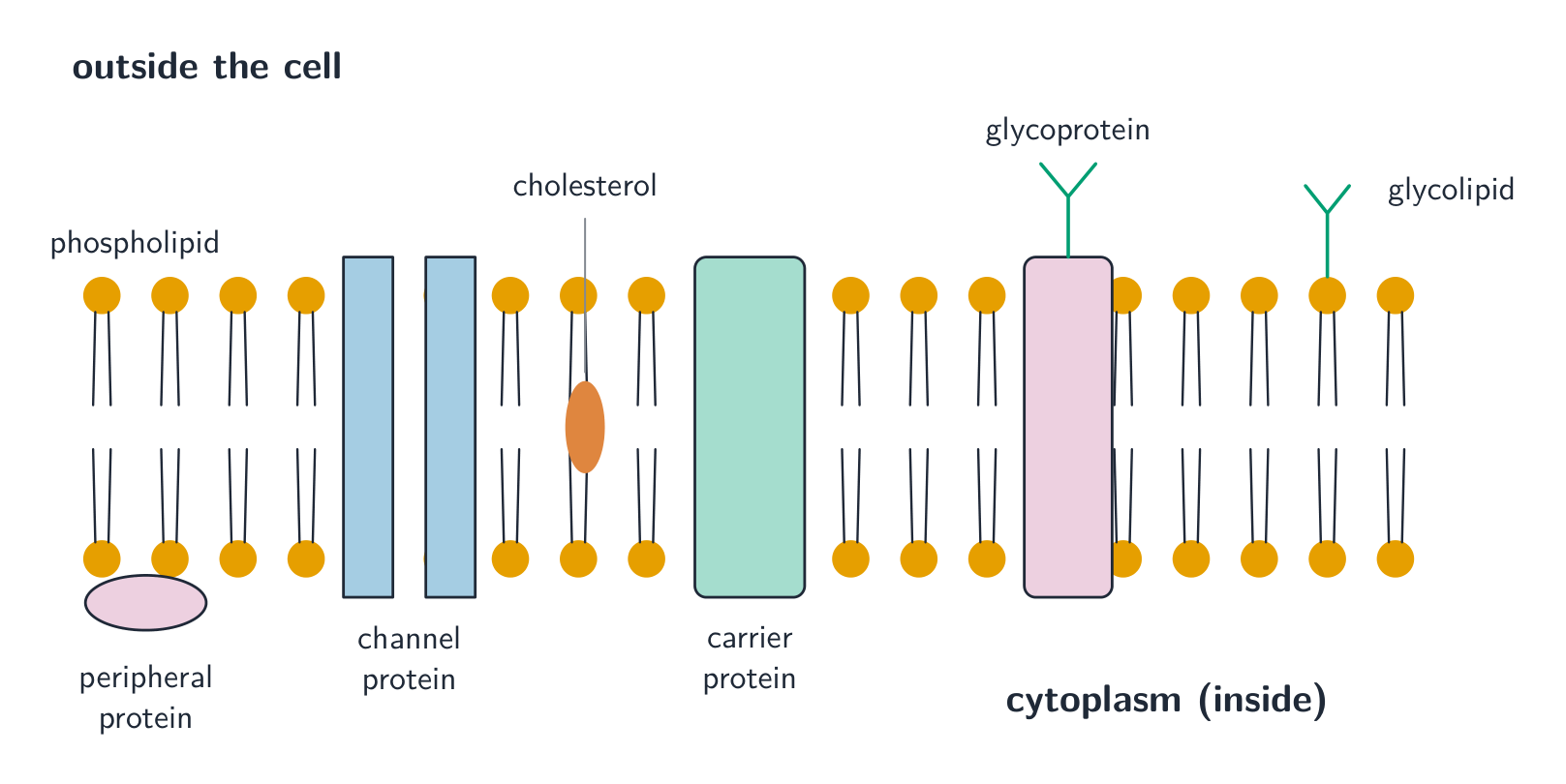
An integral protein is embedded in one or both lipid layers; a transmembrane protein spans the bilayer. A peripheral protein attaches at a membrane surface rather than extending through the hydrophobic core. Proteins can form channels, carriers, pumps, receptors, enzymes or attachment sites. Location and molecular shape help explain their role.
Carbohydrate branches face the extracellular side. Heads contact water; tails lie inside. Protein shapes are schematic. Cholesterol sits among the lipid tails, while a peripheral protein attaches at a surface.
To draw the model, label both aqueous sides. Add two rows of phospholipids, tails inward, integral and peripheral proteins, external carbohydrate and cholesterol. Label hydrophilic and hydrophobic regions; leave the channel pore clear.
9.4
简单扩散遵循随机运动和浓度梯度
English
Diffusion is the net movement of particles from higher to lower concentration due to their random motion. Individual particles can move in either direction; the net transfer reflects unequal numbers moving across a boundary in each direction. At equilibrium particles continue moving, although there is no net concentration-driven transfer.
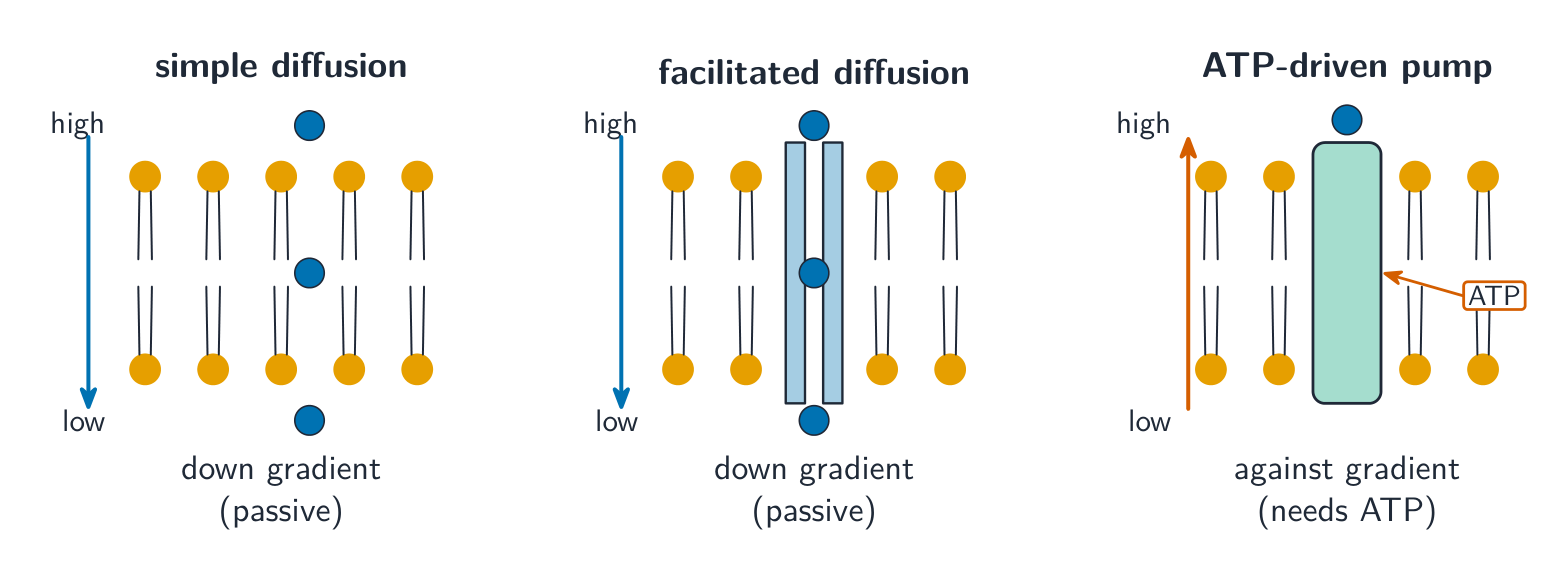
Diffusion: particles spread from higher to lower concentration, down the gradient
Oxygen and carbon dioxide can move between phospholipids by simple diffusion. No transport protein or direct ATP use is needed for each crossing. Net direction depends on the concentration gradient. If oxygen concentration is higher outside than inside, net entry is expected under otherwise comparable conditions; reverse the gradient and net movement reverses. The membrane does not permanently label oxygen as “incoming”.
Diffusion rate depends on permeability, concentration gradient, area, distance and temperature. A gradient cannot drive passage through an impermeable barrier. Simple diffusion depends on particle size and polarity rather than specific carrier binding.
9.5
通道蛋白允许协助扩散
English
A channel protein provides a hydrophilic pathway through the hydrophobic core. Suitable ions can diffuse through an open channel, while its shape and chemical environment help determine which particles can pass. A potassium channel is not simply a wide hole that admits every particle smaller than a potassium ion.
Facilitated diffusion uses a membrane protein but does not move the transported substance uphill by spending ATP. For an uncharged solute, net movement follows its concentration gradient. For an ion, both concentration difference and electrical attraction or repulsion matter; together these form an electrochemical gradient. An open channel does not automatically mean net entry, and a closed channel does not imply the concentration gradient has disappeared.
Some facilitated transport uses carriers that bind a solute and change conformation instead of forming an open pore. A carrier can also form part of an active transport system, so “carrier” and “active” are not synonyms. Identify energy coupling and net direction, not only the presence of a protein.
The pump panel is an ATP-driven example. Protein-mediated transport is not automatically active, and the same blue symbol is a generic particle rather than the same chemical in every panel.
9.6
渗透作用是水通过选择性透过膜的净移动
English
Osmosis 渗透作用 is net water movement through a selectively permeable membrane in response to a difference in water potential. For solutions at equal pressure, with a solute that cannot cross, net water movement is generally from the more dilute solution toward the more concentrated one. Pressure differences can oppose this tendency, so “toward more solute” is not a complete rule for every situation.
Red blood cells: water moves in and out of cells by osmosis.A plant cell becomes turgid or plasmolysed; an animal cell may burst (lysis) or shrink
Water molecules move randomly in both directions. A membrane can be permeable to water while restricting a dissolved solute. Aquaporins are channel proteins that allow rapid water movement; they do not pump water using ATP. Some water can cross the lipid bilayer directly, but aquaporins greatly increase permeability in many cells.
At no net water movement, crossings can balance rather than stop. A plant cell wall can resist expansion and help generate pressure as water enters. An animal cell lacks that wall, so its response to water entry differs. A whole-tissue mass measurement is evidence about the sample under its experimental conditions; it is not a direct movie of every membrane crossing.
Active transport couples movement of a substance to an energy source and can move it against its gradient. An ATP-driven pump binds particular particles and changes conformation through an energy-coupled cycle. It is not an open channel through which particles simply fall downhill.
Maintaining a concentration difference requires continuing work when diffusion or other transport tends to dissipate it. A cell can therefore consume ATP while an average concentration appears constant: input and loss can balance. Constant concentration is not proof that transport has stopped.
Specific channels and carriers help make a membrane selectively permeable. A membrane may pass one ion rapidly through an open channel, restrict another, and actively transport a third. Changes in channel opening, protein number or energy supply can change the overall permeability and net transfer. “Small molecules always enter” and “large molecules can never cross a membrane” are inadequate generalizations.
9.8
细胞表面的碳水化合物支持识别和黏附
English
A glycoprotein has carbohydrate groups linked to a protein; a glycolipid has carbohydrate linked to a lipid. Their carbohydrate regions project from the extracellular surface of the plasma membrane. These arrangements help create specific recognition features and can contribute to cell adhesion.
Recognition can involve a receptor binding a particular surface structure. Adhesion involves attachment between cells or between a cell and surrounding material. These are related roles but not identical. A membrane protein used for attachment need not form a transport channel. The external carbohydrate arrangement is part of membrane asymmetry: the two faces have different components and environments.
9.9
用公平的马铃薯实验检验渗透作用
English
Use similar potato tissue and cylinders of equal dimensions, place them in measured concentrations of a suitable solution for a fixed time, then measure initial and final masses. A control variable 控制变量 is a factor kept constant so that the comparison can be interpreted. Control temperature, immersion time, solution volume, cylinder dimensions, tissue source and blotting method. Independent repeats help estimate variation.
A potato osmometer: the sugar solution rises up the tube as water enters the potato by osmosis
Blot each sample consistently before weighing. Liquid left on the surface adds mass without showing that water entered cells. A miscalibrated balance or wrongly prepared solution can bias every repeat; repetition alone does not correct a systematic error. State the assumptions that membranes remain sufficiently intact and that short-term mass changes mainly reflect water transfer rather than substantial solute uptake or tissue loss.
$$\text{percentage mass change}=\frac{\text{final mass}-\text{initial mass}}{\text{initial mass}}\times100.$$
Worked example: compare changes relative to the starting mass
A cylinder changes from 2.50 g to 2.75 g. Its change is +0.25 g, so percentage change is $0.25/2.50\times100=+10\%$. A 4.00 g cylinder ending at 3.60 g changes by $-0.40/4.00\times100=-10\%$. A 6.40 g cylinder ending at 8.00 g gives $1.60/6.40\times100=+25\%$.
Raw mass change can mislead when starting masses differ. Sample A gains 0.25 g from 2.50 g: +10%. Sample B gains 0.40 g from 8.00 g: +5%. B gains more grams, but A has the larger proportional gain. Percentage change allows this comparison; it does not correct every difference in tissue properties or surface area.
Worked example: estimate a zero crossing rather than invent an exact value
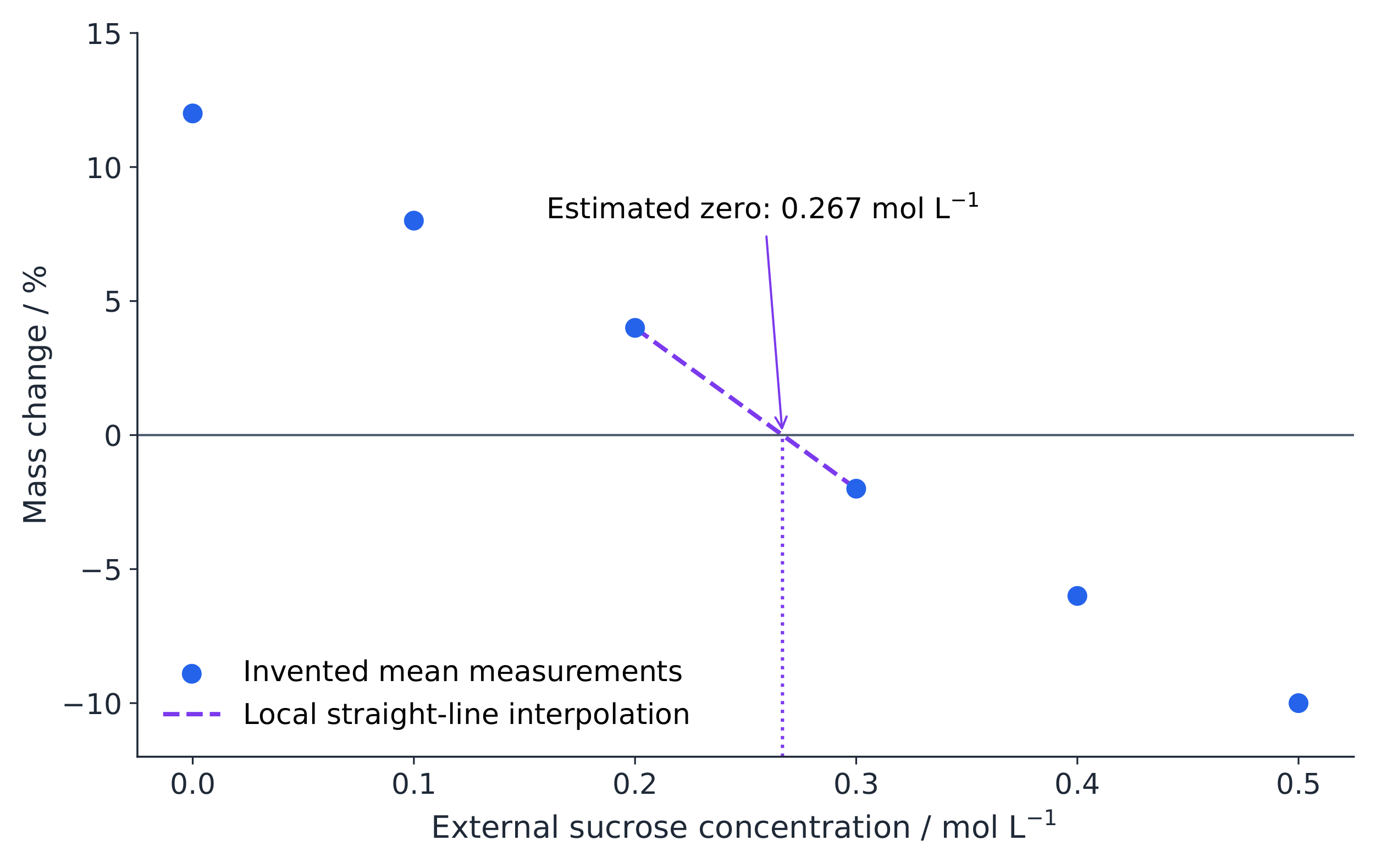
Mean percentage changes at external concentrations of 0.00, 0.10, 0.20, 0.30, 0.40 and 0.50 mol per litre are +12, +8, +4, −2, −6 and −10 respectively. Use comparable repeats at each concentration.
*The dashed interpolation joins the neighbouring means around zero. *
The zero lies between +4% at 0.20 and −2% at 0.30. With a local linear approximation, the fraction of the interval is $4/(4+2)=2/3$. The estimate is $0.20+(2/3)(0.10)=0.267$ mol per litre, to three significant figures. Do not select 0.30 simply because it is one of the tested concentrations, or divide by the final mass instead of the initial mass.
A zero-change concentration estimates the external condition at which the tissue has no net mass change over the observation period. It does not prove every cell has exactly that solute concentration, remove pressure effects, or show that water molecules stop moving. More measurements near the crossing and error estimates improve the inference.
State assumptions about pressure, membrane permeability and coupling ratios where needed.
Explain bilayer orientation in water on both sides and why its interior restricts many ions but permits oxygen more readily. Distinguish the membrane from a cell wall.
Draw a labelled fluid mosaic model with phospholipids, integral and peripheral proteins, glycoprotein and cholesterol. Identify hydrophilic and hydrophobic regions and the external side of the carbohydrate chain.
Explain net oxygen entry when its concentration is higher outside. What changes if the gradient reverses, and what continues at equilibrium? Why does simple diffusion not need a specific carrier?
Explain how a selective open channel enables facilitated diffusion. Distinguish concentration and electrochemical gradients, and explain why channel opening does not guarantee net entry of an ion.
Define osmosis and explain aquaporin function. For equal-pressure solutions separated by a membrane that passes water but not the stated solute, predict the net water direction and explain zero net movement.
Compare an ATP-driven pump, an open channel and a facilitated-diffusion carrier. Explain why constant concentration does not prove that no energy-consuming transport occurs.
Compare glycoproteins and glycolipids. State which side of the plasma membrane their carbohydrate groups face and distinguish recognition from adhesion.
Calculate percentage mass changes for 2.50 → 2.75 g, 4.00 → 3.60 g and 6.40 → 8.00 g. Compare a 0.25 g gain from 2.50 g with a 0.40 g gain from 8.00 g.
Mean changes are +4% at 0.20 mol per litre and −2% at 0.30 mol per litre. Estimate the zero crossing by linear interpolation. Explain two limits of interpreting it as an exact intracellular concentration.
Plan a fair potato-cylinder investigation. Give five control variables, explain blotting, and distinguish a benefit of independent repeats from a systematic error that repeats cannot remove.
A solute enters through a protein while its concentration is lower inside than outside. Does that observation alone establish active transport? Propose evidence needed to distinguish passive movement from energy-coupled transport and give one experimental caution.
Worked answers
Hydrophilic heads face the aqueous exterior and cytoplasm; hydrophobic tails point inward. Charged ions interact unfavourably with the non-polar core, whereas small non-polar oxygen can pass between lipids. A cell wall is a separate supporting structure, not a substitute for the selectively permeable membrane.
Draw two lipid rows, tails inward, embedded integral proteins, a surface-attached peripheral protein, and a glycoprotein with carbohydrate facing the exterior. Place cholesterol among the tails with its polar region near the heads. Label outside/cytoplasm and hydrophilic/hydrophobic regions. Fluidity means lateral rearrangement of many components; it does not mean every protein moves without restriction.
Random motion produces unequal crossing rates when concentrations differ, giving net entry down the gradient. Reversal gives net exit. At equilibrium particles still cross both ways with no net transfer. Simple diffusion depends on physical permeability, including size and polarity, rather than recognition by a specific transport carrier.
An open channel provides a hydrophilic, selective path through the core without direct ATP use for each crossing. An ion responds to both concentration difference and membrane voltage. Its electrochemical gradient may favour entry, exit or no net movement. Closing a gate blocks that pathway even if a gradient remains.
Osmosis is net water movement through a selectively permeable membrane in response to a water-potential difference. Under the supplied equal-pressure/non-penetrating-solute assumptions, net water moves from the more dilute toward the more concentrated solution. Aquaporins increase water permeability without pumping. No net movement can mean equal opposing crossing rates, not stationary water.
A pump couples transport to ATP and can move particles uphill. An open channel permits passive movement down an electrochemical gradient. A facilitated carrier binds and changes conformation for passive transfer, without direct uphill energy coupling. Constant concentration can reflect balanced active input and passive loss, so ATP consumption can continue.
A glycoprotein has carbohydrate attached to protein; a glycolipid has carbohydrate attached to lipid. Plasma-membrane carbohydrate groups project extracellularly. Recognition involves specific binding/identification of surface structures; adhesion is attachment. Neither function implies that the component is an open transport pore.
$(2.75-2.50)/2.50\times100=+10\%$; $(3.60-4.00)/4.00\times100=-10\%$; $(8.00-6.40)/6.40\times100=+25\%$. The two gains correspond to $0.25/2.50=10\%$ and $0.40/8.00=5\%$: the smaller gain in grams is the larger proportional gain.
The interval fraction is $4/(4+2)=2/3$, giving $0.20+(2/3)(0.10)=0.267$ mol per litre to three significant figures. It is an interpolation from finite, variable tissue measurements, not an exact value. Pressure, tissue compartments, membrane integrity and possible solute exchange complicate a direct inference about every cell's solute concentration. Water still crosses at no net mass change.
Use comparable tissue and cylinder dimensions; control solution volume, temperature, immersion time and blotting/weighing procedure. Any five appropriate controls suffice. Vary the prepared external concentration deliberately between treatments. Blotting removes external liquid. Independent repeats estimate random variation; they do not repair a wrongly calibrated balance or a consistently misprepared solution.
Protein-mediated downhill entry could be facilitated diffusion. Establish the relevant gradient, including voltage for ions, and investigate energy coupling and transport behaviour under controlled conditions. A change after ATP depletion can also reflect indirect effects on gradients, membrane integrity or protein function; it is not sufficient by itself to call the observed protein an ATP-driven pump. Keep the assay conditions and cell viability comparable.
9.11
考试技巧
English
Identify the particle, pathway, net direction and energy source. Show water on both sides of a bilayer, external carbohydrate branches and the correct protein locations. Use initial mass in percentage change, distinguish net movement from individual crossings, and state the limits of an interpolated zero. A protein in a pathway does not by itself establish active transport.





 *The dashed interpolation joins the neighbouring means around zero. *