An egg white becomes opaque and firm when heated. Cooling it does not restore the original liquid. Yet digestion can still break its proteins into smaller molecules. Why are changing a protein's shape and cutting its chain different processes?
This unit covers B1.2 SL understandings: amino-acid structure, peptide formation, dietary amino acids, sequence variety and denaturation. Prerequisites are covalent bonds, condensation, hydrolysis and interactions with water.
8.2
氨基酸具有共同骨架和可变侧链
English
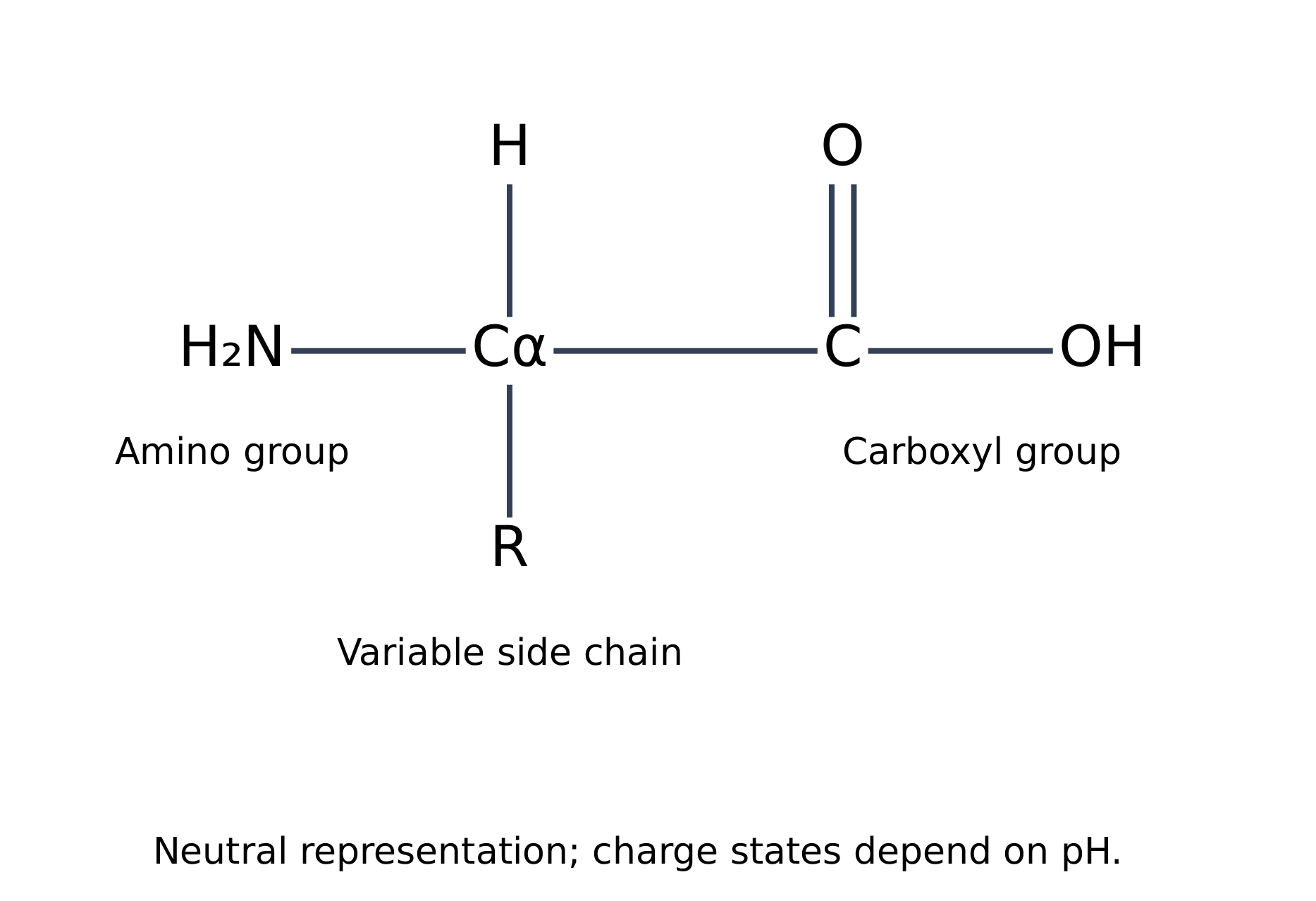
A protein 蛋白质 contains one or more polypeptide chains. Many proteins have a specific fold that supports their function; an unfolded chain does not stop being a protein. The amino acids used to build these chains share a central alpha carbon attached to four groups: an amino group, a carboxyl group, a hydrogen atom and a variable R-group or side chain. In the neutral drawing convention these groups can be shown as $\mathrm{-NH_2}$ and $\mathrm{-COOH}$. In aqueous solution their charge states depend on pH; a common form has $\mathrm{-NH_3^+}$ and $\mathrm{-COO^-}$.
The R-group varies among amino acids. This neutral structural convention makes the four attachments clear; the amino and carboxyl groups can gain or lose hydrogen ions in solution.
The R-group distinguishes one amino acid from another. The R is a placeholder for a chemical group, not an extra element called “R”. Glycine has H as its side chain, so its alpha carbon is attached to two hydrogens. Most other standard amino acids have a more complex side chain. Counting the amino group and carboxyl group as part of R would erase the useful distinction between the shared framework and the variable part.
A good generalized drawing shows all four attachments. For the carboxyl group, show the carbonyl C=O and the hydroxyl –OH attached to the same carbon. An oxygen atom cannot silently replace that carbon. Follow the bonds rather than copying a decorative shape.
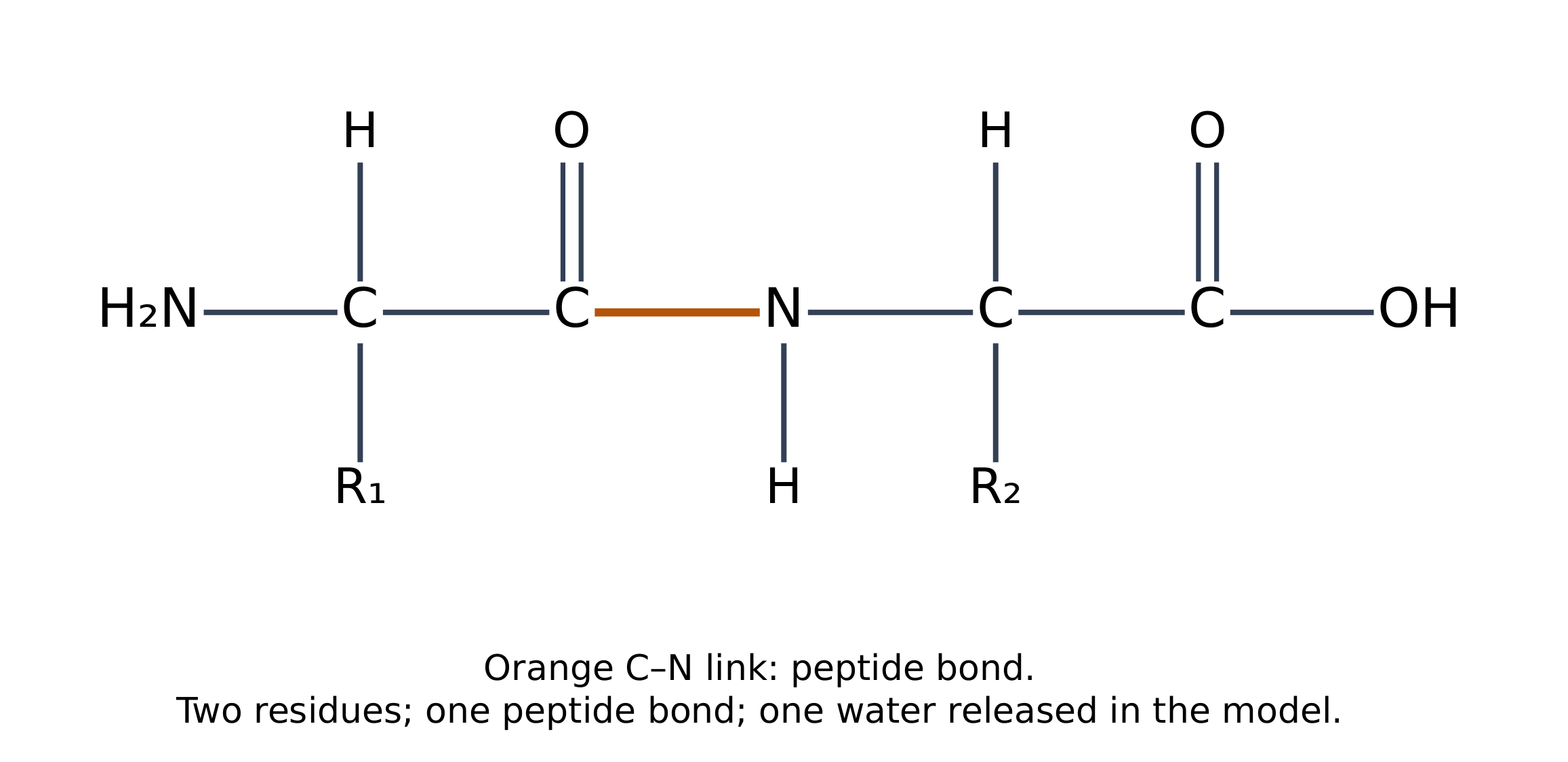
In the simple condensation model, the carboxyl group of one amino acid reacts with the amino group of another. A peptide bond 肽键 forms between the carboxyl carbon and amino nitrogen. OH from the carboxyl group and H from the amino group account for one released water molecule. The products are a dipeptide and water:
The highlighted carbon–nitrogen link is the peptide bond. A carbonyl C=O remains beside it. The R-groups remain attached to their own alpha carbons.
A residue is the part of an amino acid incorporated into the chain. Repeated linkage produces a polypeptide with a repeating backbone and side chains projecting from it. The amino end and carboxyl end are different, so sequence order has a direction. Hydrolysis uses water to break peptide bonds, producing shorter peptides or free amino acids depending on how many links are cut.
The condensation equation is an accounting model. Protein synthesis in cells uses ribosomes, tRNAs, activated amino acids and energy-transfer reactions; it is not simply free amino acids spontaneously releasing water in a beaker. The model is useful for identifying the linkage, counting residues and conserving atoms.
Worked example: residue count is not bond count
One linear chain of 35 residues has $35-1=34$ peptide bonds. In the simple model, making the chain from free amino acids releases 34 water molecules; complete peptide-bond hydrolysis uses 34. A 120-residue chain has 119 peptide bonds, not 120.
Two separate chains of 12 and 18 residues contain $11+17=28$ peptide bonds. Joining their ends by one additional peptide bond gives one 30-residue chain with 29. Merely holding two chains together by other interactions does not create that extra backbone bond. Cross-links between side chains must not be counted as peptide bonds.
Digestion breaks dietary proteins into smaller products, including amino acids that can be absorbed and used to synthesize the body's own proteins. Eating a particular protein does not mean that intact protein is placed directly into a matching body tissue. Cells use amino-acid supplies according to their own gene expression and metabolism.
Food supplies amino acids, not ready-made body proteins. Essential amino acids must come from the diet.
An essential amino acid cannot be synthesized by the body in sufficient amounts and therefore must be obtained from food. A non-essential amino acid can be synthesized, for example through reactions involving other amino acids. “Non-essential” does not mean unnecessary: both types are needed for appropriate protein synthesis.
Different foods provide different proportions of amino acids. A high total protein mass alone does not prove that every essential amino acid is supplied adequately. A vegan diet needs attention to the availability and balance of essential amino acids as well as total protein. Diverse plant sources can contribute different amino-acid profiles; “plant proteins contain no essential amino acids” is false.
The Biuret test provides evidence of peptide bonds: add Biuret reagent to a food sample and look for a lilac or purple colour. Compare a known protein solution and water as positive and negative controls under the same conditions. A positive result does not identify the protein, its amino-acid sequence or its three-dimensional structure.
Worked example: identify the limiting supply
In a synthesis model, each copy of a short peptide requires two residues of amino acid X and three of Y. A cell has 50 available X residues and 60 Y residues, with every other required resource abundant. X permits $50/2=25$ copies; Y permits $60/3=20$ copies. Y limits production to 20 complete copies, leaving $50-2(20)=10$ X residues. This is a simplified resource calculation, not a recommended diet or a claim about a real cell.
The scarcer residue per copy sets the limit: 20 copies, not 25
8.5
长度与序列创造巨大多样性
English
The standard genetic code specifies 20 common amino acids used in polypeptide synthesis. Chains can be short or contain hundreds to thousands of residues. Both the number of residues and their order can vary. The primary structure 一级结构 is the amino-acid sequence, read in a specified direction. Two chains can have the same length and amino-acid composition but different sequences.
With 20 choices at every position, the number of possible sequences is 20ⁿ for a chain of n residues. Order matters as well as composition.
For example, the three-residue sequences A–B–C and A–C–B use the same three types but place them differently. They are not the same primary structure. With three available types, repetition allowed and three positions, there are $3^3=27$ possible sequences. With 20 types and four positions, there are $20^4=160000$ possibilities. “20 amino acids” does not mean “only 20 proteins”. For any fixed length the number is finite; allowing different lengths produces an enormous range of possible chains.
Different sequences can support different structures and functions. Insulin is a protein hormone, collagen is a structural protein, and many enzymes are proteins that catalyse reactions. Not every protein is an enzyme; some catalysts are RNA molecules rather than proteins. Many proteins need a specific fold and suitable conditions to function.
Proteins interact with surrounding water and with groups within their own chains. A specific folded arrangement helps create a binding surface, active site or structural role. Denaturation 变性 is disruption of the normal functional conformation, often with loss of activity. Heating can disturb interactions stabilizing a fold and increase unfolding or aggregation. A pH change can alter charges and interactions. The effect depends on the protein, conditions and duration of exposure.
Top: heat denatures albumin, so clear raw egg white turns white and solid. Bottom: the paper-clip analogy, from separate folded chains to a tangleDenaturation loses the shape but keeps the peptide bonds; digestion hydrolyses the bonds
Ordinary denaturation does not require hydrolysis of the peptide backbone. A protein can lose its working shape while retaining its amino-acid sequence. Digestion, by contrast, cuts peptide bonds. This distinction does not mean every bond survives every extreme chemical treatment: severe conditions can cause additional damage. Explain the process actually being tested.
Some proteins can regain a functional conformation after suitable conditions are restored. Others aggregate or undergo changes that prevent recovery. Heating egg-white proteins causes unfolding and association into an opaque network; ordinary cooling does not reverse the cooked structure. “Every denaturation is reversible” and “no protein can ever refold” are both too strong.
Worked example: test recovery under the same assay conditions
An experiment exposes equal enzyme samples to different temperatures for five minutes. Every sample is then assayed at 25°C, at the same pH and substrate concentration. Relative activities are:
Pre-treatment
Activity after return to 25°C
Kept at 25°C
100 units
Heated to 45°C
87 units
Heated to 65°C
20 units
Kept cold at 5°C
98 units
The 65°C sample retains $20/100\times100=20\%$ of control activity, an 80% loss. Because all assays take place at the same temperature, the result is not explained simply by particles moving faster or slower during the assay. It supports lasting damage to function after the hot treatment. Activity alone does not reveal the complete molecular structure or prove which interaction changed. Repeats, an unheated control and checks for evaporation or changed concentration strengthen the comparison.
Every sample is assayed under the same conditions, so the low 65 °C bar shows lasting damage, not slower particles.
A low reaction rate while an enzyme is cold would not by itself establish denaturation. The recovery test asks whether function returns after the original conditions are restored. Keep treatment conditions separate from measurement conditions.
Use the simple condensation-accounting model where specified.
Draw a generalized amino acid. Label the alpha carbon, hydrogen, amino group, carboxyl group and R-group. Explain what R represents and why pH can change the charge of the amino and carboxyl groups.
Write the word equation for forming a dipeptide. Identify the peptide bond, the groups supplying the atoms of water, and the groups that remain attached to each alpha carbon.
A linear polypeptide contains 120 residues. Calculate its peptide bonds and the water molecules released in the simple formation model. How many waters are needed for complete peptide-bond hydrolysis?
Two linear chains contain 12 and 18 residues. Count their peptide bonds before and after joining their ends by one peptide bond. Distinguish this from holding the two chains together without a new backbone link.
Define essential and non-essential amino acids. Explain why total protein mass alone does not establish the adequacy of every essential amino acid, including in a vegan diet.
A synthesis model requires two X and three Y residues per peptide. Available supplies are 50 X and 60 Y. Calculate the maximum complete peptides and unused X. State one limitation of this model.
Using three permitted amino-acid types, repetition allowed, calculate the number of four-position sequences. Explain why same length and composition do not necessarily mean same primary structure.
Distinguish denaturation from peptide-bond hydrolysis. Explain why a cooked egg does not regain its initial liquid structure merely on cooling, without claiming that all proteins can never refold.
Samples assayed at 25°C after treatment give activities 100, 87, 20 and 98 units after 25°C, 45°C, 65°C and 5°C treatments respectively. Calculate retained activity and percentage loss for the 65°C sample. Explain why assay temperature matters.
Design a comparison to test whether low activity after heating persists on cooling. Give four controlled variables and one source of uncertainty or alternative explanation.
Correct these claims: every protein is an enzyme; all catalysts are proteins; a low rate while an enzyme is cold proves denaturation; non-essential amino acids are unnecessary.
Worked answers
The alpha carbon has four attachments: H, R, an amino group and a carboxyl group. The carboxyl carbon is bonded to O by a double bond and to OH by a single bond in the neutral representation. R is the variable side chain, not an element. Binding or loss of hydrogen ions changes charge; a common aqueous form has an ammonium and a carboxylate group.
Amino acid + amino acid → dipeptide + water. The new C–N link connects a carboxyl carbon with an amino nitrogen. OH from the first carboxyl and H from the second amino group account for water. Each residue retains its own side chain on its alpha carbon. The product still contains a carbonyl beside the peptide C–N link.
$120-1=119$ peptide bonds; formation from free amino acids releases 119 waters in the simple model. Complete hydrolysis uses 119 waters. Cutting only some bonds produces shorter peptides, not necessarily free monomers.
Initially $(12-1)+(18-1)=11+17=28$ bonds. One new end-to-end peptide bond gives 29 in the 30-residue chain and releases one additional water in the model. Association without that new backbone bond leaves two chains and 28 peptide bonds.
Essential amino acids must come from food because synthesis is insufficient; non-essential ones can be synthesized but are still needed. Amino-acid proportions differ among foods. Total protein mass does not identify the supply of each required essential type. Vegan diets therefore need attention to amino-acid balance and supply; plant sources do contain essential amino acids.
X permits 25 copies; Y permits 20, so the maximum is 20. X used $=2(20)=40$; X left $=50-40=10$. Real synthesis also depends on other amino acids, energy, enzymes and regulation, which the model treats as non-limiting.
$3^4=81$ possible sequences. With the same composition, A–B–C–A and A–A–B–C have different orders and thus different primary structures when read in the same direction. Neither length nor composition alone specifies all positions.
Denaturation changes functional conformation and can leave the peptide backbone intact. Hydrolysis cuts peptide bonds using water. Heated egg-white proteins unfold and associate into an altered network that ordinary cooling does not undo. Some other proteins can refold under suitable conditions, so irreversibility must be tied to the example and conditions.
Retained activity $=20/100\times100=20\%$; loss $=(100-20)/100\times100=80\%$. All assays at 25°C allow comparison after treatment instead of confusing pretreatment with an immediate temperature effect during measurement. The result supports persistent functional damage but does not identify a complete molecular mechanism alone.
Heat equal samples for a fixed time, return them and an unheated control to the same assay conditions, then compare activity with repeats. Control enzyme concentration/volume, treatment duration, assay temperature, pH, substrate concentration and measurement interval; any four appropriate controls suffice. Evaporation, concentration errors or unequal timing could alter results and should be checked.
Proteins include structural proteins and hormones as well as enzymes. Some catalytic RNAs are not proteins. Cold conditions can reversibly slow a reaction; test recovery after restoring conditions. Non-essential means synthesizable, not dispensable.
8.8
考试技巧
English
Identify which carbon and nitrogen make a peptide link, and retain the carbonyl oxygen in a dipeptide drawing. State the number of separate chains before using residues minus chains to count peptide bonds. Separate treatment conditions from assay conditions, and distinguish loss of a functional fold from cutting a backbone. In a structure–function explanation, connect a specific feature to the interaction or mechanical property it permits.