A running animal coordinates contraction with gas exchange, circulation and fuel supply. A seedling likewise connects growth in distant parts through chemical signals.
This handout covers full C3.1 common content: organization and integration, nervous/endocrine coordination, reflexes, sleep rhythms, cardiovascular/ventilation feedback and gut control.
Prerequisites: cell specialization, membrane signalling, neurons, circulation and gas exchange. Interpret supplied traces and use approved seedling observations rather than provoking pain, altering breathing or administering hormones.
20.2
整合使系统产生孤立部分无法实现的功能
English
Integration means coordinating component parts so that they contribute to a combined function. Cells form tissues, tissues contribute to organs, and organs interact within and between body systems. An organ commonly contains several tissue types: a stomach has muscle, epithelium, connective tissue and nervous tissue, not one uniform cell type.
Integration during a sprint: each system's output is another system's input
An emergent property depends on interactions among components. A cheetah's effective pursuit of prey combines sensory processing, coordinated skeletal-muscle contraction, supporting bones and joints, gas exchange, circulation, energy metabolism and temperature control. No isolated muscle cell has the whole animal's hunting behaviour. Listing the systems is only a start: explain how an output from one supports another.
Connection during vigorous activity
Why the connection matters
Lungs → blood → active muscle
Oxygen supports aerobic ATP production; blood also removes carbon dioxide
Gut/stores → circulation → cells
Digestion, absorption and mobilization make respiratory substrates available
Nervous system → muscle groups
Timing and recruitment coordinate force and movement
Circulation → skin and other tissues
Material transport and heat transfer support suitable internal conditions
The blood system carries materials and heat; nerves and hormones provide information that changes target activity. These roles interact. A nervous command cannot replace oxygen supply, while oxygen-rich blood does not specify which opposing muscles should contract at each instant.
20.3
神经和激素信号协调不同途径抵达靶标
English
Nervous signalling uses impulses along neurons and neurotransmitter release at synapses. Connections can deliver signals to particular cells rapidly. Endocrine cells secrete hormones into the circulation; blood distributes them, and compatible receptors determine which cells respond. Widespread delivery is not the same as every cell responding.
Nervous control is fast and electrical; hormonal control is slow and chemicalNervous control is fast but brief; hormonal control is slower but longer-lasting
Nervous effects are often rapid and localized, while hormonal responses can coordinate widespread and longer-lasting changes. These are useful comparisons, not absolutes: some hormones act within seconds, and neural signalling can initiate lasting changes in learning. A hormone's route, receptor mechanism and target context matter more than the slogan “hormones are always slow”.
Homeostasis 稳态 maintains internal conditions within suitable limits despite disturbances. Receptors detect relevant changes, integration centres coordinate information, and effectors change activity. In negative feedback 负反馈, the response opposes the initiating change. A delay can produce temporary departures and oscillations; a control system need not keep a quantity perfectly constant at every instant.
As a familiar hormonal example, raised blood glucose can stimulate insulin-linked uptake/storage and reduced liver glucose output. Low glucose can stimulate glucagon-linked liver glycogen breakdown and glucose production. Both responses oppose the original disturbance, through different actions. Insulin does not insert GLUT4 into every liver cell, and all diabetes is not simply failure to produce insulin.
In a concentration trace, a value rises from 5.0 to 8.0 arbitrary units. The increase is $3.0/5.0\times100=60\%$. A return from 8.0 to 5.0 is a $3.0/8.0\times100=37.5\%$ decrease. The denominators differ. A doubling from 2.0 to 4.0 is a 100% increase, not 200%. Such arithmetic describes change; a value is not a medical diagnosis.
The brain combines information from several inputs, compares it with prior experience, and coordinates outputs. Learning changes how later information is processed; memory allows information from earlier events to influence present behaviour. These are interacting neural functions rather than a single “memory cell” holding every experience.
The brain coordinates the body through the nervous system.
Sensory neurons carry input from receptors toward the central nervous system, or CNS. Signals can reach spinal-cord circuits and pathways leading to the cerebral hemispheres. Information processed in the cerebral hemispheres can influence motor-neuron output, through intervening circuits, so skeletal muscles contract in a coordinated way. The brain does not directly pull tendons; motor neurons communicate with muscle cells.
The spinal cord is also an integrating centre. It contains circuits for unconscious responses, rather than serving only as a cable carrying messages to and from the brain. An unconscious process does not require a deliberate decision, although brain activity can still influence it. Conscious awareness of an event and the first protective motor response need not begin at the same time.
The cerebellum contributes to coordination of skeletal-muscle contraction, posture and balance. It helps compare intended movement with sensory information and adjust timing and force. This supports smooth movement; it is not the sole origin of every motor command. Movement depends on interactions among cerebral, cerebellar, spinal and peripheral components.
20.5
神经将神经纤维束集在一起,同时保持各细胞通路独立
English
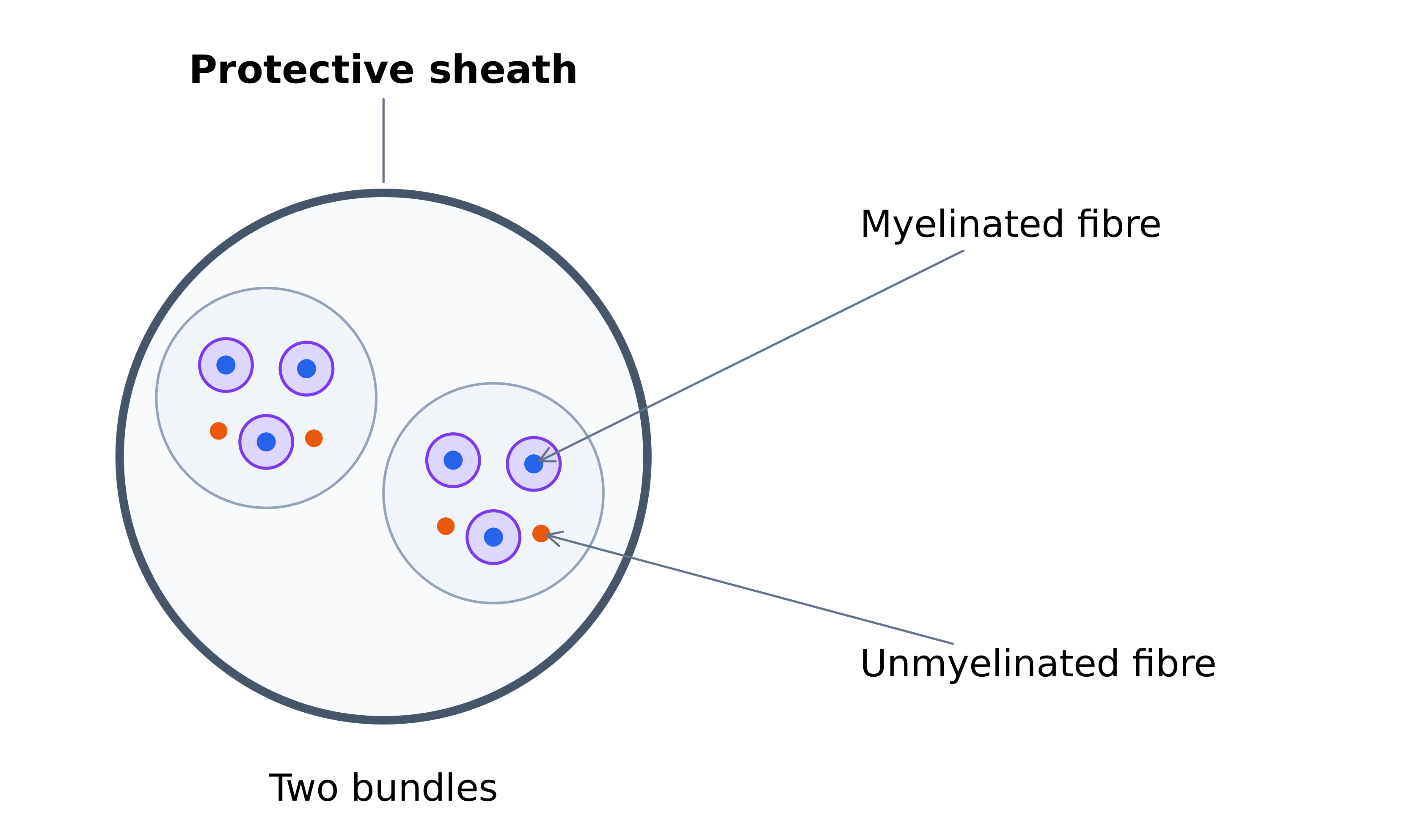
Many peripheral nerves contain both sensory and motor fibres. In a transverse section, individual axons appear as small profiles; some have surrounding myelin, others are unmyelinated. Connective tissues organize fibres into bundles and provide protective sheaths. Supporting cells are present; an unmyelinated fibre is not necessarily an axon floating without any cellular support.
Rings represent myelin around selected axons; small solid profiles represent unmyelinated fibres in this simplified section. A transverse section does not reveal each fibre's sensory or motor direction by shape alone.
A sensory fibre carries impulses toward the CNS; a motor fibre carries them toward an effector. Their presence in one nerve does not make every individual axon switch between those functional roles. A bundle provides common routing and protection while many separate membrane pathways operate in parallel.
20.6
退缩反射将感受器与骨骼肌收缩联系起来
English
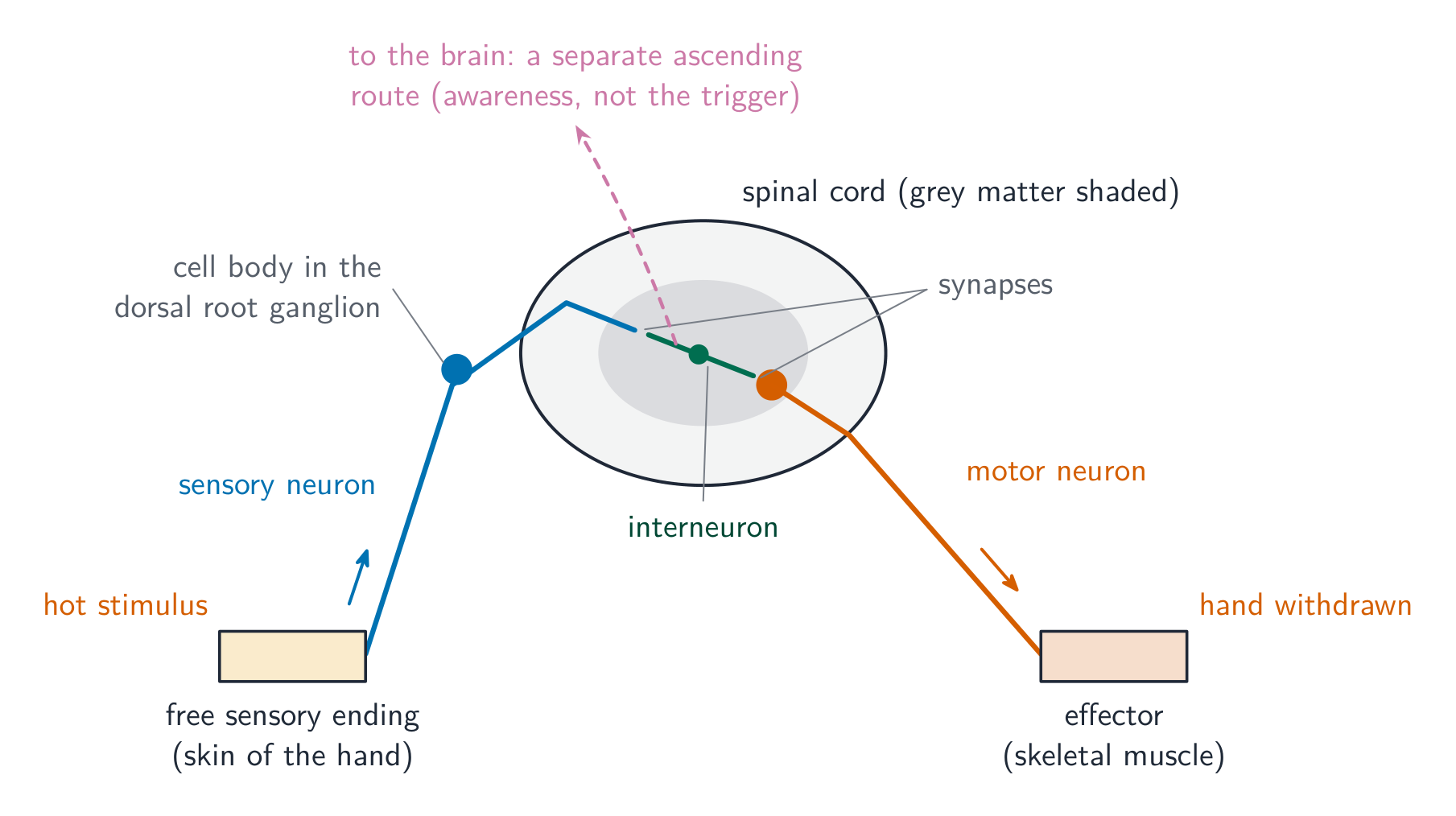
Consider a free sensory ending in the hand detecting a potentially damaging hot stimulus. Ion-channel activation can initiate impulses in a sensory neuron. Its central process enters the spinal cord and synapses with an interneuron in grey matter. In this simplified reflex arc, that interneuron communicates with a motor neuron, whose axon carries impulses to a skeletal muscle that flexes the limb away.
Testing the knee jerk: a tap stretches a tendon and a spinal reflex contracts the thigh muscle before the brain is involvedThe illustrated arc has one interneuron and two neuronal synapses in the spinal cord. The brain arrow summarizes additional ascending pathways, permitting conscious processing without requiring a conscious decision to initiate withdrawal.
The sensory cell body is in a dorsal-root ganglion outside the spinal cord. The interneuron and motor-neuron cell bodies are in spinal grey matter in this model, and motor output leaves through a ventral root. Do not move the sensory cell body into the skin or make the interneuron run all the way to the muscle.
This is an involuntary response with skeletal muscle as the effector. It shows that skeletal muscle is not used only for voluntary movements. Other reflex circuits differ in their connections and number of interneurons, and withdrawal normally involves coordinated excitation and inhibition of muscle groups. The simple arc teaches the essential route without claiming it is the whole network.
20.7
褪黑素将光暗周期与昼夜节律联系起来
English
Circadian rhythms are approximately 24-hour patterns generated within an organism and adjusted by environmental cues. In humans, information about light reaching the eyes helps synchronize brain timing pathways. The pineal gland normally secretes more melatonin during the biological night and less during the day; light at night can suppress secretion.
Melatonin peaks in the biological night; bright light at night suppresses it
Melatonin helps signal biological night and modulate the sleep–wake pattern. Its daily pattern does not mean it instantly switches every person into unconsciousness. Sleep also depends on other neural processes and prior wakefulness. Light exposure, individual timing and environmental schedules influence how the internal cycle aligns with local day and night.
For a supplied time series, identify the rising phase, peak interval and fall, and compare them with darkness and sleep timing. Repeated days help distinguish a daily pattern from a single fluctuation. A phase shift means the timing moved; an amplitude change means the high–low difference changed. They are different descriptions of a rhythm.
20.8
肾上腺素和下丘脑-垂体调控连接内分泌反应
English
The adrenal medulla secretes epinephrine, also called adrenaline, as part of preparation for vigorous activity. It can increase heart rate and contraction strength, promote rapid fuel mobilization and widen airways. Changes in vascular activity help redistribute flow toward active tissues. These coordinated effects support substrate and oxygen delivery as muscular ATP demand rises.
Adrenaline prepares the body for action by acting on several target organs
The response is not an order for every tissue to do the same thing. Receptor types and intracellular pathways differ; some vessels constrict while others can dilate. Epinephrine is a chemical signal, not the respiratory substrate that directly supplies all the energy for contraction. Glucose and other substrates must still undergo metabolic reactions to support ATP production.
The hypothalamus integrates neural and internal information and helps control the pituitary gland. Pituitary hormones can regulate other endocrine glands, whose hormones act on target tissues and can feed back on the control system. This creates coordinated pathways across several organs. Different pituitary hormones have different targets; “the pituitary controls every gland in exactly the same way” is too broad.
For example, hypothalamic signals can influence pituitary output that controls a peripheral endocrine gland. A rise in the gland's hormone can reduce earlier stimulation through negative feedback. Name the controlled pathway and direction of influence when interpreting such a diagram. Full details of anterior versus posterior pituitary mechanisms are not needed here.
20.9
压力感受器和化学感受器调节心血管功能
English
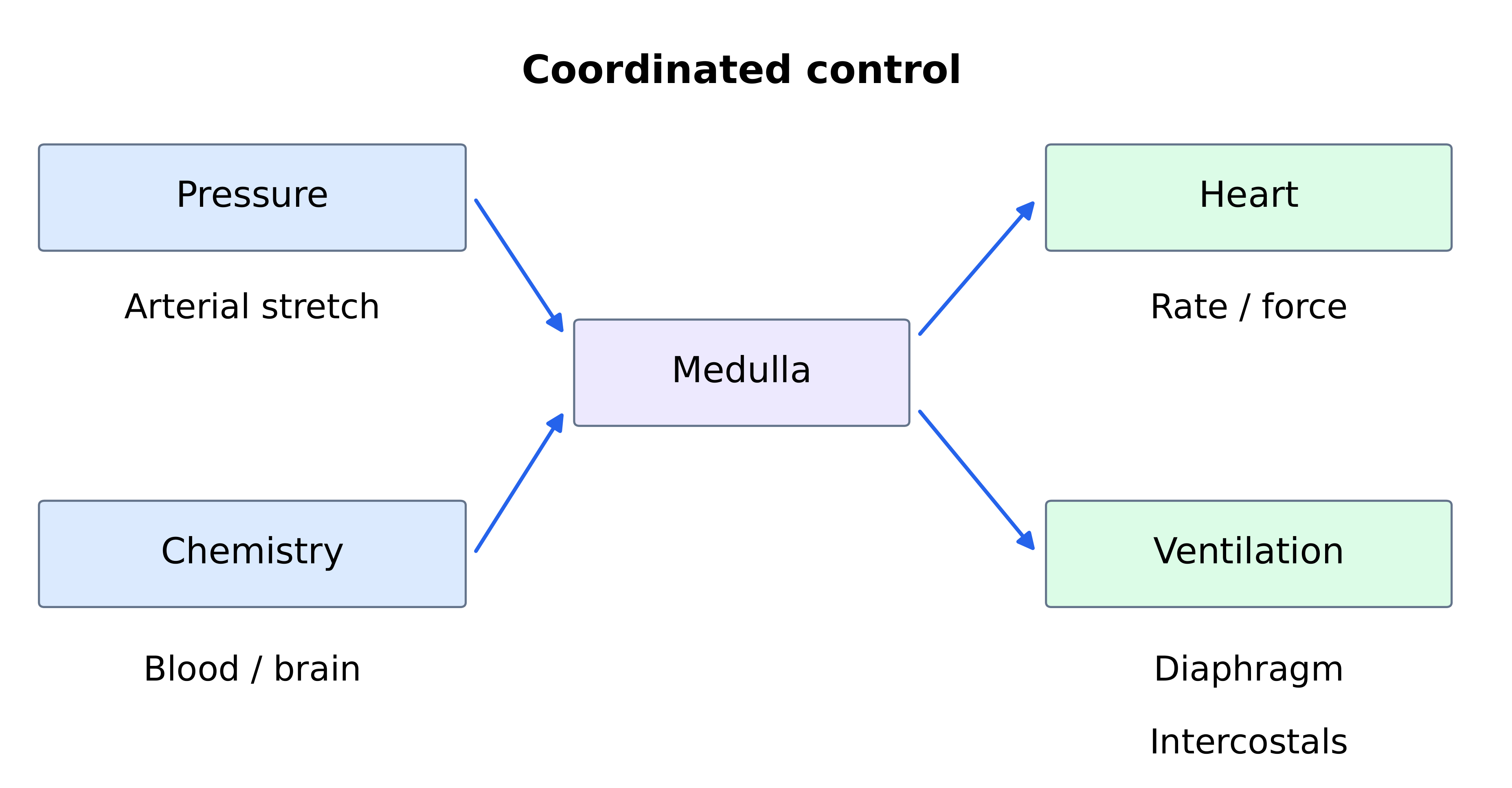
Baroreceptors respond to stretch in arterial walls, notably at the carotid sinuses and aortic arch. Stretch changes with blood pressure. Sensory input reaches cardiovascular control centres in the medulla, which adjust autonomic output to the heart and blood vessels. The heart's own pacemaker generates its basic rhythm; autonomic nerves modify it rather than supplying every heartbeat's initial trigger.
A fall in arterial pressure usually reduces baroreceptor firing. Increased sympathetic and reduced parasympathetic activity can raise heart rate and increase contractile force, supporting cardiac output and pressure. A pressure rise normally produces opposing adjustments. Cardiac output equals heart rate multiplied by stroke volume, but stroke volume also depends on filling and other conditions; it is not fixed by heart rate alone.
Chemoreceptors provide information about oxygen, carbon dioxide and acidity. Peripheral receptors in the carotid and aortic bodies monitor arterial conditions and help coordinate cardiovascular and respiratory responses. The carotid body is not the same structure as a carotid-sinus baroreceptor. Name the detected variable as well as the anatomical region.
Pressure receptors and chemical receptors provide different information. The medulla coordinates outputs; changes in heart activity or ventilation then influence the monitored conditions.
In a pressure disturbance, the recorded pressure falls from 110 to 90 arbitrary units, an $20/110\times100\approx18.2\%$ decrease. Heart rate then rises from 70 to 84 beats per minute, a 20% increase. If pressure subsequently recovers, the pattern is consistent with a compensating response. Timing and association alone do not prove that a single receptor pathway caused every change; other controls and repeat measurements matter.
20.10
二氧化碳和pH值有助于调节通气
English
Respiring tissues produce carbon dioxide, which is carried in blood. Carbon dioxide reacts with water through a reversible system involving carbonic acid, hydrogen ions and hydrogencarbonate. Increased carbon dioxide tends to increase hydrogen-ion concentration and lower pH, if other conditions are comparable. A lower pH means greater acidity, not “less carbon dioxide in every circumstance”.
Ventilation control is negative feedback: the response removes the carbon dioxide that started it
Carbon dioxide can cross into brain extracellular fluid and cerebrospinal fluid, changing local pH. Central chemoreceptive pathways in the brainstem respond importantly to this carbon-dioxide-linked acidity. They are not simply oxygen meters directly exposed to arterial blood. Peripheral chemoreceptors add information about arterial oxygen, carbon dioxide and pH.
Respiratory control centres adjust motor output to the diaphragm and intercostal muscles. More frequent and/or deeper contractions can increase ventilation, removing more carbon dioxide and opposing the initiating rise. Appropriate gradients and functioning exchange surfaces and circulation remain necessary. Breathing rate alone is not the entire gas-exchange rate.
A comparison changes breathing frequency from 12 to 20 breaths per minute and tidal volume from 0.50 to 0.75 litres. Minute ventilation rises from $12\times0.50=6.0$ to $20\times0.75=15$ litres per minute, a 150% increase. This is total moved air; some remains in conducting airways, so it is not automatically alveolar ventilation. Do not infer an exact blood-gas change from that multiplication alone.
Exam tips: Name the disturbance, detected variable, receptor, coordinating centre, effector and returning influence. Distinguish carotid sinus from carotid body, and blood chemistry from brain-fluid chemistry. Feedback has a direction; a graph's recovery does not by itself identify every causal step.
The enteric nervous system, or ENS, contains networks within the digestive tract that coordinate gut movement, including peristalsis. Contraction behind a food bolus and relaxation ahead help propel contents. Local sensory information about contents and stretch can guide coordinated smooth-muscle activity, rather than each gut segment contracting independently at random.
Peristalsis: contraction behind and relaxation ahead move the bolus along
The CNS influences this activity through autonomic pathways; the ENS also carries out substantial local processing. It is therefore misleading either to make the brain consciously direct every wave or to claim the gut never receives central influences. The contracting gut muscle is smooth muscle, unlike the skeletal-muscle effector in the hand-withdrawal example.
Beginning a swallow can be voluntary, followed by coordinated involuntary phases. Defecation combines reflex activity with voluntary control of appropriate external sphincter muscles when conditions permit. Saying “swallowing and egestion have voluntary control” does not mean every part of each process is a conscious action. Between these endpoints, peristaltic movement normally proceeds involuntarily.
20.12
练习
English
Use causal links rather than lists of organs.
Explain the hierarchy from cells to body systems using an organ containing several tissues. Explain how interactions among at least three systems support a running animal's performance as an emergent function.
Compare nervous and endocrine routes, target specificity and typical time courses. Explain why “every hormonal response is slow” is unreliable and why blood transport is still needed alongside information transfer.
Distinguish brain and spinal-cord integration, sensory input, motor output and cerebellar coordination. Explain why an unconscious response can occur before conscious pain perception.
Describe what a transverse section of a mixed nerve shows, including its sheath and fibre types. Can one circular profile's shape alone identify sensory versus motor function?
Trace the simplified hand-withdrawal reflex with one interneuron. Locate the sensory cell body, spinal synapses and muscle effector. Explain why this does not make every reflex identical.
Describe the usual daily melatonin pattern and its relation to light and sleep. Distinguish a phase shift from an amplitude change and suggest why repeated days are useful.
Explain three effects of epinephrine that support vigorous activity. Outline hypothalamus–pituitary coordination and negative feedback from a peripheral endocrine gland.
Pressure falls from 120 to 96 arbitrary units, followed by heart rate rising from 60 to 78 beats per minute. Calculate both percentage changes and outline a baroreceptor–medulla–heart explanation, including receptor location and its limits.
Explain how raised carbon dioxide can affect brain-fluid pH and ventilation. Distinguish central and peripheral chemoreceptor information. Calculate minute ventilation for 10 breaths per minute at 0.60 litres and 18 breaths per minute at 0.80 litres, and its percentage increase.
Explain ENS coordination of peristalsis and CNS influence. Distinguish voluntary initiation or sphincter control from the involuntary phases of swallowing and gut movement.
Explain negative feedback in high and low blood-glucose control. Calculate the increase from 4.0 to 5.0 units, the increase from 5.0 to 8.0, the decrease back from 8.0 to 5.0, and the increase on doubling. Explain why none is a diagnosis by itself.
20.13
例题答案
English
Cells form tissues; several tissues contribute to organs, which interact in systems. A stomach includes epithelial, muscle, connective and nervous tissues. Running combines nervous coordination, skeletal support, respiratory exchange and circulatory delivery for ATP-producing metabolism. Their interactions produce whole-animal movement, an emergent function absent from an isolated cell.
Neurons carry impulses and release transmitter at connected targets; blood-borne hormones act through compatible receptors/pathways. Nervous effects are often rapid/local and endocrine effects broader/longer, but hormones can act quickly and neural changes persist. Blood also carries oxygen, substrates and heat; information does not replace material transport.
The brain combines current inputs with prior information and supports learning/memory. Sensory neurons provide CNS input; motor neurons carry effector output. Spinal circuits integrate unconscious responses before conscious processing of ascending information, although brain activity can modulate them. The cerebellum contributes movement timing/correction and balance.
Protective connective tissues organize bundles of axons, some myelinated and others unmyelinated with supporting cells. A mixed nerve contains sensory and motor fibres. A profile’s shape alone does not identify functional direction; routing or other evidence is needed.
Free hand ending → sensory neuron → spinal interneuron → motor neuron → skeletal-muscle contraction withdrawing the limb. The sensory cell body lies in a dorsal-root ganglion; the illustrated synapses lie in spinal grey matter and output exits via a ventral root. Other reflex circuits differ; withdrawal coordinates several muscle groups.
Melatonin is generally higher at biological night, lower by day and suppressible by light at night. It helps align sleep–wake timing without instantly switching sleep on. A phase shift changes timing; amplitude changes the high–low difference. Repeated days reveal consistency and variation.
Higher heart rate/contractility supports output; wider airways support ventilation; mobilized fuels supply substrates for ATP-producing metabolism. Receptors permit different tissue effects. Hypothalamic control influences pituitary hormones that can regulate other glands; peripheral hormones can reduce earlier stimulation by negative feedback. Different targets require appropriate pathways.
Pressure decrease: $(120-96)/120\times100=20\%$. Heart-rate increase: $(78-60)/60\times100=30\%$. Reduced carotid-sinus/aortic-arch stretch lowers baroreceptor input; medullary autonomic adjustments can increase heart rate and contractile force, helping oppose the pressure fall. Other vascular, filling and control changes also matter; the trace alone cannot isolate their contributions.
Raised carbon dioxide can lower brain extracellular/CSF pH; central chemoreceptive pathways inform respiratory control. Carotid/aortic bodies also monitor arterial chemistry, including oxygen. Motor output adjusts diaphragm/intercostal activity to increase carbon-dioxide removal. Minute ventilation: $10\times0.60=6.0$ and $18\times0.80=14.4$ litres per minute; increase $8.4/6.0\times100=140\%$. Conducting-airway volume means this is not automatically alveolar ventilation.
Enteric networks coordinate contraction behind and relaxation ahead of contents, producing involuntary smooth-muscle propulsion. Autonomic CNS pathways modulate this local control. Swallow initiation and appropriate external-sphincter control can be voluntary, while later swallowing and defecation include reflex phases. The CNS does not consciously direct every gut contraction.
Insulin-linked responses oppose high glucose through appropriate uptake/storage and reduced liver output; glucagon-linked liver responses oppose low glucose. $(5-4)/4\times100=25\%$; $(8-5)/5\times100=60\%$; $(8-5)/8\times100=37.5\%$ decrease; doubling is a 100% increase. These describe relative changes and do not specify an individual's diagnosis or mechanism of disease.