Pulling a hand away from a hot surface requires messages along cells and across junctions. Ion movements produce electrical signals; neurotransmitters communicate between cells. Follow both parts of the pathway.
This handout covers full C2.2 common content: neurons, resting potentials, impulses, conduction speed, correlation skills and chemical synapses.
Prerequisites: selective membrane permeability, diffusion, ion gradients and ATP-dependent transport. Use supplied data or simulations rather than electrical stimulation of people.
19.2
神经元连接专门的接收和传导区域
English
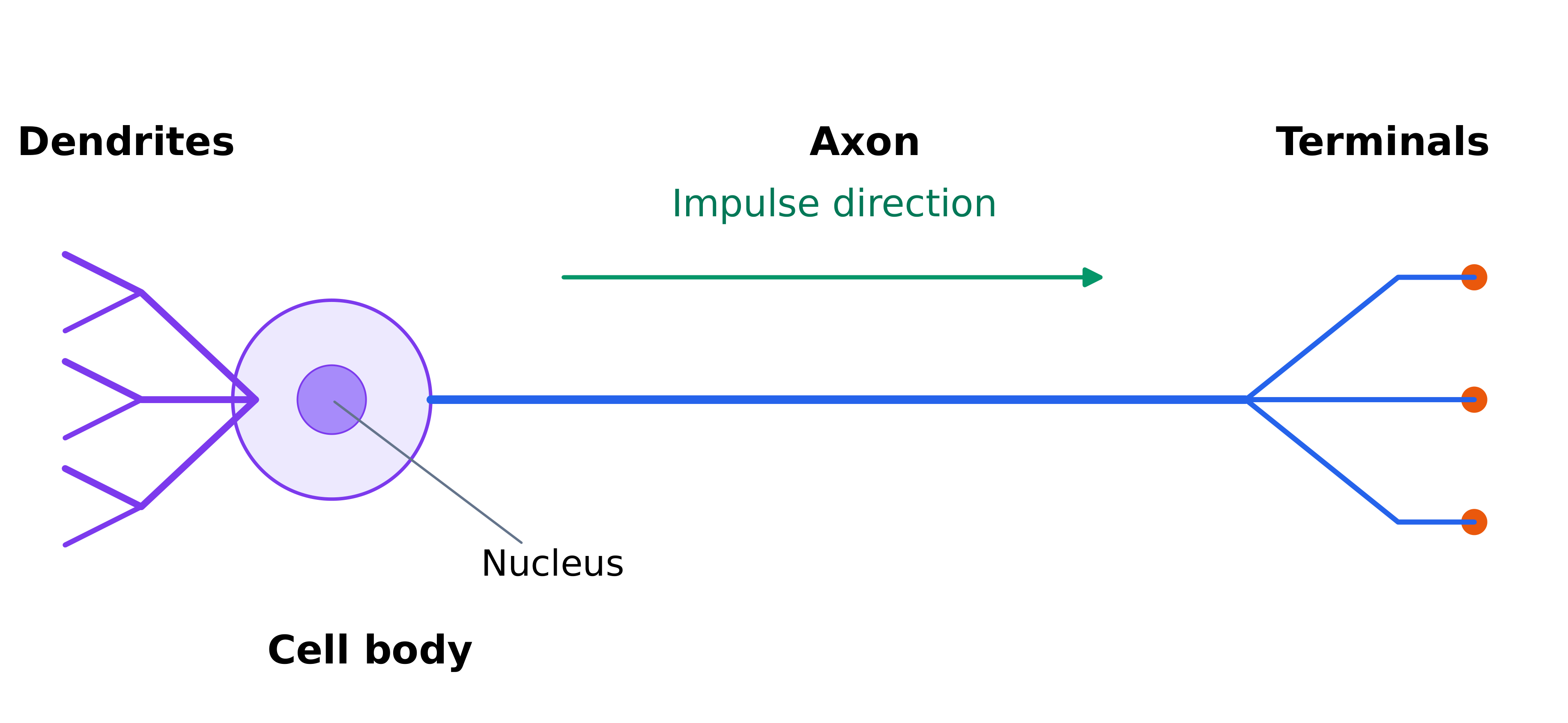
A neuron has a plasma membrane, cytoplasm and nucleus. The cell body contains the nucleus and machinery for maintaining cell components. Usually several short, branching dendrites receive inputs, while one axon extends toward terminal branches. Length and arrangement vary; the diagram models a typical organization rather than every neuron’s shape.
Real neurons stained brown under the microscope, showing their cell bodies and branching processesReceiving regions influence impulse initiation; impulses travel along the axon toward terminals. These processes are continuous with the cell body, not separate cells joined end to end.
A long axon permits rapid communication between distant regions without releasing a hormone throughout the circulation. Branching can connect one neuron to several targets, while many inputs can converge on another neuron. A nerve is a bundle of nerve fibres with supporting tissues; it is not one unusually large neuron. Neurons depend on supporting cells as well as their own metabolism.
The membrane and its channels allow the electrical behaviour. A nerve impulse involves ion movement in aqueous solutions and across membranes. It is not an electron current flowing along a metal wire. The same individual sodium ion does not travel the whole axon length to carry one message.
19.3
泵送和选择透过性维持静息电位
English
Membrane potential is the electrical potential difference between the cell interior and the surrounding fluid. A resting neuron commonly has a negative interior relative to the outside; −70 mV is a representative teaching value, not a universal fixed voltage. Saying “negative” needs this reference: it does not mean both fluids contain only negative particles.
An action potentialThe pump keeps the gradients (3 Na⁺ out, 2 K⁺ in per ATP); K⁺ leaking out leaves the inside negative
Sodium–potassium pumps use ATP to move sodium ions out and potassium ions in, against their concentration gradients. In the standard model, one cycle exports three sodium ions and imports two potassium ions. Sodium becomes more concentrated outside, potassium inside. The unequal charge transfer contributes directly to voltage, while the maintained gradients support much of the voltage through selective ion movement.
At rest, potassium leak channels make the membrane relatively permeable to potassium. Potassium tends to diffuse outward down its concentration gradient, leaving a small charge separation. The increasingly negative interior opposes further loss of positive charge. Sodium permeability is lower at rest, and large intracellular negative ions do not freely leave. Resting voltage therefore depends on gradients and relative permeabilities, not just the pump moving “more positive ions out”.
Feature
Contribution and limit
ATP-dependent pump
Maintains sodium and potassium gradients over time; three sodium out and two potassium in per standard cycle
Potassium leak channels
Permit passive movement; electrical and concentration effects oppose each other as voltage develops
Selective membrane
Prevents immediate unrestricted mixing of ions
Charge separation
Involves a small fraction of ions near the membrane; the bulk fluids remain close to electrically neutral
In a pump count, eight cycles export 24 sodium ions, import 16 potassium ions and use eight ATP molecules. The net outward transfer is eight positive charges. Do not interpret this bookkeeping as a calculation of −70 mV: membrane area, capacitance, ion concentrations and permeabilities would also be needed.
Rest means no impulse is occurring at that location, not that all transport has stopped. ATP supply and membrane integrity remain important. Conversely, switching off a pump does not instantly erase every gradient; the time course depends on continued ion movements and the cell's reserves.
19.4
动作电位在健康的轴突上传导时不会衰减
English
An action potential 动作电位 is a brief, self-propagating change in membrane potential. A sufficiently strong local depolarization brings an excitable region to threshold, initiating the rapid change. Successive regions of membrane generate their own action potentials, so the impulse can cover a long axon without simply shrinking like a passive voltage change.
Local currents bring the next region to threshold; the refractory region behind stops the impulse running backwards
For a given healthy fibre under stable conditions, each action potential is approximately all-or-none: a subthreshold input does not produce a smaller travelling action potential, while a threshold-crossing input triggers a full one. This does not mean every possible neuron has exactly the same voltage trace. Temperature, ion gradients, channel types and physiological state affect the waveform.
A stronger sustained stimulus can increase impulse frequency and recruit additional sensory neurons. It need not make each action potential taller. Compare recordings from the same fibre and distinguish the number of active fibres from the frequency within one fibre. A larger compound signal from a nerve can reflect recruitment of more fibres rather than a larger individual action potential.
For a counted time window, frequency is count divided by elapsed time. Thirty impulses in 0.50 s give $f=30/0.50=60\ \mathrm{Hz}$. Twenty-one in 0.30 s give 70 Hz. These numbers describe impulses per second, not metres travelled per second. Count only events in the stated window; do not divide the number of plotted peaks by the interval between the first and last peak without considering the sampling convention.
Conduction speed is distance along a fibre divided by propagation time. An impulse covers 0.80 m in 0.016 s, giving $v=0.80/0.016=50\ \mathrm{m\,s^{-1}}$. A whole reflex delay includes receptor processes, synaptic delays and muscle activation as well as axon conduction, so it cannot usually be inserted into this equation to isolate one axon's speed.
Diameter helps; myelin helps moreThe impulse jumps node to node — saltatory conduction — so a myelinated neurone conducts much faster
Larger axon diameter lowers internal electrical resistance and can allow faster propagation. Giant unmyelinated squid axons illustrate the benefit of diameter compared with smaller unmyelinated fibres under comparable conditions. A myelin sheath, produced by supporting cells, electrically insulates portions of an axon and can greatly increase speed without requiring a giant diameter. Small myelinated fibres can therefore conduct faster than some larger unmyelinated ones.
Compare like with like: species, temperature, diameter and myelination can all differ. There is no sound universal rule that every larger animal must have slower impulses, or that body size alone determines conduction speed. A dataset covering one sampled group may show a pattern that does not generalize to all animals.
19.6
相关系数描述数据集而非证明机制
English
A positive correlation means larger values of one variable tend to accompany larger values of another; a negative correlation means larger values tend to accompany smaller values. Pearson's correlation coefficient $r$ describes the direction and strength of a linear association, from −1 to +1. A value near zero means little linear association, which does not rule out a curved relationship.
Positive correlation rises together; negative correlation moves in opposite directions
Consider these measurements from four comparable unmyelinated fibres at one temperature:
Diameter / micrometres
Conduction speed / metres per second
10
1
20
2
30
2
40
5
The diameter mean is 25 and the speed mean 2.5. In the Pearson calculation, sum each product of paired deviations from the means. Here $\sum(x-\bar x)(y-\bar y)=60$, $\sum(x-\bar x)^2=500$ and $\sum(y-\bar y)^2=9$. Thus:
$$r=\frac{60}{\sqrt{500\times9}}\approx0.894.$$
This is a strong positive linear association in the four supplied pairs. In a simple linear regression with an intercept, $R^2=r^2=0.80$: 80% of the observed variation in speed is accounted for by the fitted linear relationship with diameter in this dataset. It is not a claim that diameter causes 80% of every neuron's speed, nor that a new animal's speed can be predicted exactly.
Small samples, measurement uncertainty, confounding and limited ranges restrict inference. Plot the pairs to inspect outliers and possible curvature, standardize conditions and use independent fibres. Repeated timings on one fibre estimate timing variation, not variation among four independent fibres. A negative $r=-0.70$ gives $R^2=0.49$; squaring removes the direction, so report the sign of $r$ as well as $R^2$.
19.7
化学突触将到达的冲动转化为神经递质释放
English
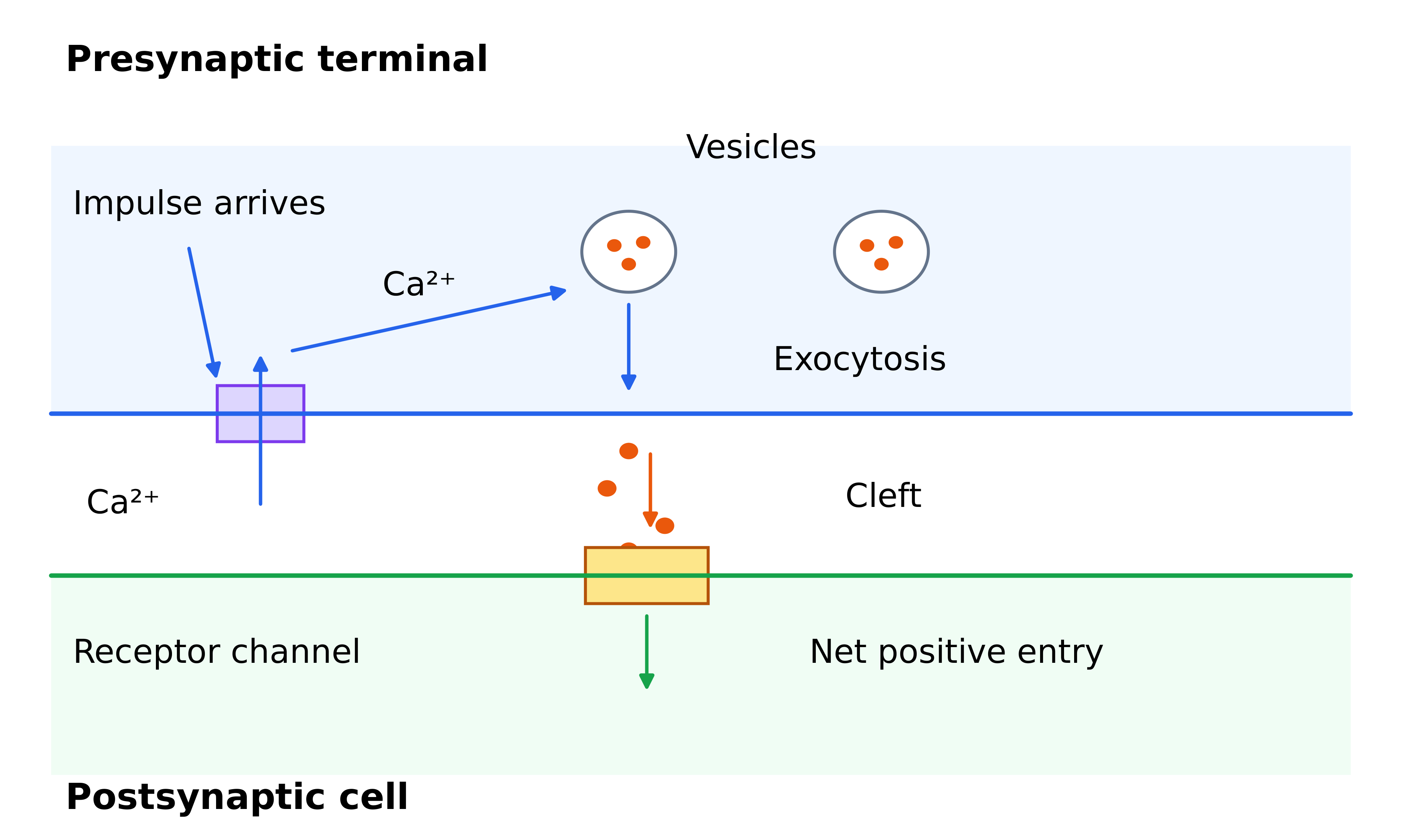
A synapse 突触 is a junction through which a neuron communicates with another neuron or an effector such as a muscle cell. This topic concerns chemical synapses. The presynaptic terminal and postsynaptic membrane are separated by a narrow fluid-filled synaptic cleft. Vesicles in the terminal contain neurotransmitter molecules.
When an action potential depolarizes the presynaptic membrane, voltage-gated calcium channels open. Calcium ions enter down their electrochemical gradient. Increased cytosolic calcium acts as an internal signal that promotes vesicle fusion with the presynaptic membrane. Exocytosis releases neurotransmitter into the cleft. The arriving electrical event therefore triggers a chemical release step; sodium does not simply jump across and become a neurotransmitter.
The model separates calcium entry into the terminal from transmitter binding at the target membrane. The two channel types have different triggers and locations.
Transmitter diffuses across the cleft and binds compatible transmembrane receptors on the postsynaptic cell. A typical synapse transmits in one direction because release vesicles and their machinery are presynaptic, while receptors for that signal are postsynaptic. This structural asymmetry explains direction better than saying the transmitter “knows which way to move”. Diffusion itself is random; the release site and receptors organize the communication.
A chemical synapse introduces a delay because release, diffusion and receptor activation take time. Communication is selective: the target needs the appropriate receptors. One neuron may receive inputs from many presynaptic cells rather than passively copying one incoming impulse into one outgoing impulse.
Acetylcholine is used at many synapses, including neuromuscular junctions. At a nicotinic receptor, binding opens a ligand-gated cation channel. Near resting voltage, the net movement of positive charge is inward, with sodium entry important. The postsynaptic membrane becomes less negative: an excitatory postsynaptic potential, or EPSP.
Calcium entry triggers release; acetylcholine opens ligand-gated channels; acetylcholinesterase ends the signal
An EPSP is a local graded voltage change. It is not automatically a new action potential. If the resulting depolarization brings an excitable region to threshold, an action potential can be initiated in the target cell. At a neuromuscular junction the target is muscle membrane, not another neuron; its local depolarization is called an end-plate potential. Potassium can also pass through nicotinic channels; “a sodium-only channel at every acetylcholine synapse” is an oversimplification.
Acetylcholinesterase breaks acetylcholine into choline and acetate, helping end receptor stimulation. Choline can be taken back into the terminal for reuse. Distinguish this from claiming that all released acetylcholine is taken back intact. Other transmitters can have different removal mechanisms, including reuptake of the transmitter itself. Removing a signal allows a later message to be distinguished from a continuously present one.
Exam tips: Trace presynaptic depolarization → calcium entry → vesicle fusion → transmitter diffusion → receptor binding → postsynaptic voltage change. Keep voltage-gated calcium channels separate from ligand-gated target channels. State why a postsynaptic response may remain below threshold.
19.9
练习
English
Explain mechanisms as well as calculating results.
Describe the cell body, dendrites, axon and terminal branches of a typical neuron. Distinguish a neuron from a nerve.
Explain how pumping and selective permeability contribute to a negative resting potential. Why is “the cytoplasm contains only negative ions” wrong?
A pump completes 12 cycles. Calculate sodium ions exported, potassium ions imported, ATP used and net positive charges moved outward. Explain why this does not determine a voltage by itself.
Explain all-or-none propagation. Give two ways a stronger stimulus can produce a larger nervous-system response without increasing each individual impulse's amplitude.
A fibre carries 24 impulses in 0.40 s. Calculate frequency and distinguish it from propagation speed.
A supplied recording shows an impulse travelling 1.20 m in 0.020 s. Calculate speed. Explain why using the full time from a skin stimulus to a muscle response could underestimate this axon's speed.
Compare giant unmyelinated squid axons, smaller unmyelinated fibres and myelinated fibres. Name two conditions to control in a diameter–speed investigation.
For the four-pair diameter–speed dataset, use the supplied deviation sums 60, 500 and 9 to calculate $r$ and $R^2$. Interpret both without claiming causation.
Another dataset has $r=-0.70$. Calculate $R^2$ and interpret the direction, strength and limits of the linear association. Does $r=0$ prove that two variables have no relationship of any kind?
Trace events from an arriving presynaptic action potential to transmitter binding. Explain the usual one-way transmission of a chemical synapse.
Explain how acetylcholine can produce an EPSP, why an EPSP may not trigger an action potential, and how acetylcholine signalling is ended.
19.10
例题答案
English
The cell body contains cytoplasm, nucleus and maintenance machinery. Usually several branching dendrites receive inputs; one axon conducts impulses toward terminal branches, which communicate with targets. A nerve bundles many nerve fibres with supporting tissue rather than being one cell.
ATP-dependent pumps maintain high external sodium and internal potassium. Greater resting potassium permeability allows potassium loss, producing a small charge separation opposed by electrical attraction. Trapped intracellular anions and low sodium permeability also contribute. Both bulk fluids contain positive and negative ions and remain nearly neutral away from the membrane.
$12\times3=36$ sodium out; $12\times2=24$ potassium in; 12 ATP used; net 12 positive charges outward. Voltage also depends on membrane capacitance/area, concentrations and permeability, so these counts alone do not specify it.
Threshold-crossing input initiates a full action potential that is regenerated at successive excitable regions. Subthreshold input does not produce a smaller travelling action potential. Stronger stimulation can increase firing frequency and recruit more neurons; those changes differ from increasing a single impulse's height.
$f=N/t=24/0.40=60\ \mathrm{Hz}$. This is impulses per second. Speed needs distance divided by travel time and has units such as metres per second.
$v=d/t=1.20/0.020=60\ \mathrm{m\,s^{-1}}$. Whole-response time includes receptor, synaptic and muscle delays; using that larger time as axon travel time would give too small a speed for the same distance.
Larger unmyelinated diameter reduces internal resistance, helping explain fast giant squid axons relative to smaller unmyelinated fibres. Myelin improves conduction without requiring giant diameter, so diameter alone cannot rank mixed fibre types. Control temperature and myelination/species, and use independent fibres with reliable distance/timing measurements.
$r=60/\sqrt{500\times9}\approx0.894$; $R^2=0.80$. The sample shows strong positive linear association. With a simple linear fit including an intercept, 80% of sample speed variation is accounted for by the fitted diameter relationship. Four pairs and possible confounders limit inference; the result is not a percentage causal contribution.
$R^2=(-0.70)^2=0.49$. The association is negative and reasonably strong as a linear pattern, but strength labels depend on context. The corresponding simple linear fit accounts for 49% of sample variation. Zero Pearson correlation can coexist with a curved association; no coefficient alone proves causation.
Depolarization opens presynaptic voltage-gated calcium channels → calcium entry → increased cytosolic calcium → vesicle fusion/exocytosis → transmitter diffusion → binding to compatible postsynaptic receptors. Typical release machinery is presynaptic and target receptors postsynaptic, creating structural directionality. Transmitter does not carry an intact action potential across the cleft.
Nicotinic receptor binding opens cation channels; net inward positive current near rest depolarizes the target membrane. The graded EPSP may remain below threshold. Acetylcholinesterase hydrolyses acetylcholine; choline can be taken back for reuse. This differs from reuptake of intact transmitter at other synapses.