跳到主要内容

D.3.1 · 繁殖

IB 生物 HL知识点 35

本主题的视频课程 打开视频页面
4:46

繁殖

配子通常含有一组染色体,而受精 受精将两组染色体结合。维持世代间的染色体数目需要两者共同作用……

英语旁白 · 英中内嵌字幕

35.1

范围与先修条件

English

This handout covers D3.1: sexual and asexual reproduction, human reproductive systems and hormonal cycles, fertilization, IVF, and reproduction in flowering plants. Sections marked AHL are for Higher Level only.

Prerequisites: meiosis, chromosomes, membranes, hormones and negative feedback. They are not observations from real students or claims about examination papers.

35.2

有性生殖与无性生殖解决不同的问题

English

A strawberry runner can establish another plant without fertilization. A flower can instead produce offspring after gametes fuse. Both can increase plant numbers, but they have different consequences for inherited combinations.

Asexual reproduction has one parent producing identical clones; sexual reproduction has two parents whose gametes join to give varied offspring
Asexual reproduction needs one parent and gives identical clones; sexual reproduction needs two and gives varied offspring

Asexual reproduction has no fusion of gametes. Offspring usually have the same inherited genotype as the parent, apart from mutations and other exceptions. Rapid reproduction by an individual already suited to a stable environment can be advantageous. Finding a mate is unnecessary, but similar inherited susceptibility can leave many offspring vulnerable to the same environmental change or disease.

Sexual reproduction involves gamete fusion and produces new combinations of alleles through meiosis and fertilization. Variation can increase the chance that some offspring suit a changed environment. It does not ensure that every offspring is better adapted. Time, energy and successful gamete transfer impose costs; producing a new combination is not automatically an improvement.

Neither process creates exactly the same outcome in every species. Mutation can introduce variation into an asexual lineage. Sexual reproduction between very similar parents may produce relatively little variation. Compare the mechanism and conditions rather than claiming that one method is always superior.

35.3

减数分裂和受精作用维持染色体组

English

A haploid 单倍体 cell has one chromosome set in the stated life cycle. A diploid cell has two sets, including pairs of homologous chromosomes. Replication copies DNA before meiosis without changing the number of chromosome sets: each duplicated chromosome has two sister chromatids.

A diploid cell with one chromosome pair divides by meiosis I into two cells, then by meiosis II into four haploid gametes
Two divisions halve the chromosome number: meiosis I separates the homologous pair, meiosis II separates the chromatids — giving four haploid gametes

Meiosis I separates homologues and meiosis II separates sisters. Crossing over and independent orientation of homologous pairs generate new allele combinations. Fertilization 受精 combines the haploid contributions of two gametes, restoring a diploid set. Replication alone does not turn a diploid cell into a tetraploid one.

For a species with $2n=12$, a normal gamete contains six chromosomes and the zygote twelve. Ignoring crossing over, six independently orienting pairs allow $2^6=64$ whole-chromosome combinations across possible gametes. One meiosis still gives four haploid nuclei, not 64. A species with $2n=20$ has normal gametes with ten chromosomes.

In animals, meiosis directly contributes to gamete formation. Flowering plants include haploid stages that develop after meiosis and produce gametes by mitosis. Do not replace the whole plant life cycle with the claim that each pollen grain is one sperm cell.

探索

Replication copies DNA; meiosis separates chromosome sets

Track the lesson's 2n=12 model through stable endpoints. Compare chromosome counts with DNA molecules, restore 12 chromosomes at fertilization, and explore the 64 possible origin combinations across many meioses without crossing over.

词汇 训练
English 中文 拼音
fertilization/ˌfɜːtɪlaɪˈzeɪʃn/ 受精 shòu jīng
haploid/ˈhæplɔɪd/ 单倍体 dān bèi tǐ
35.4

配子的大小与运动能力关联生殖策略

English

The smaller gamete defines the male reproductive role and the larger gamete the female role. Animal sperm typically travel toward the egg, have relatively little cytoplasm and food reserve, and are produced in large numbers. Eggs are larger and retain resources for early development. In flowering plants, male gametes are carried within the pollen-tube pathway rather than swimming freely through the air.

One large egg with food reserve beside many small motile sperm
Few large gametes, many small ones

Producing many small gametes and fewer resource-rich eggs leads to different constraints on reproductive success. Gamete number alone does not determine the number of offspring: transfer, fertilization, development and survival also matter. A flower containing both male and female structures still reproduces sexually if gametes fuse; one organism can supply both reproductive roles.

35.5

人类雄性结构支持产生和转移

English
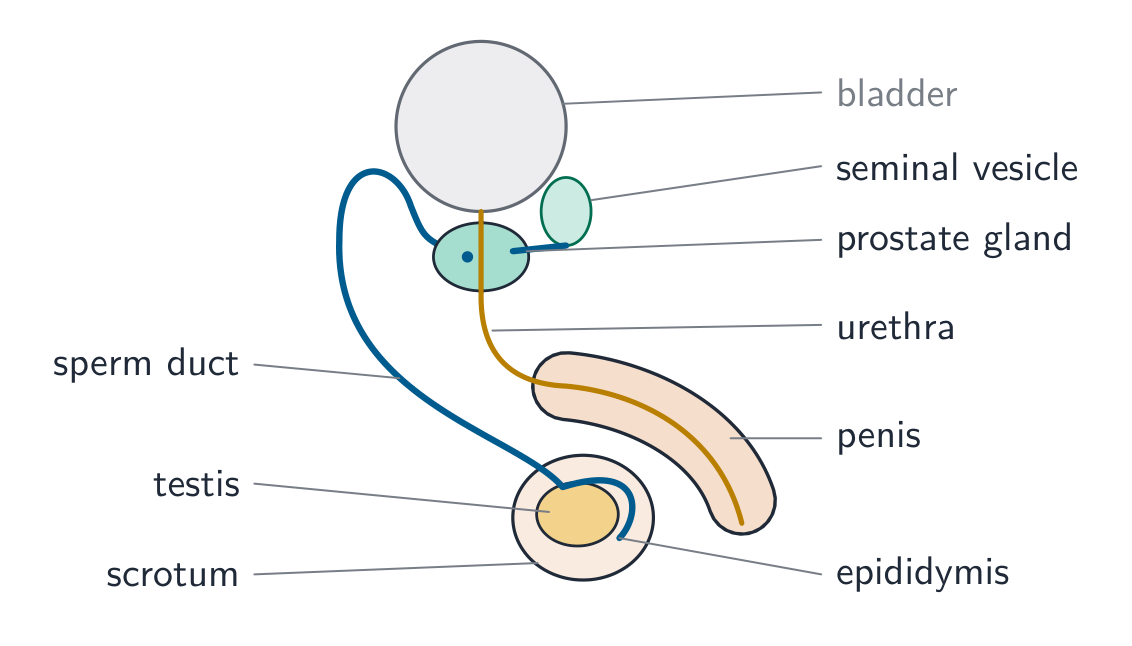
Simplified side view of male-typical reproductive structures with accessory glands and sperm pathway
The bladder provides orientation and stores urine, not sperm. The drawing shows one representative testis and duct; paired structures are present in the typical system.

Testes contain seminiferous tubules where sperm develop and also produce testosterone. The scrotum holds the testes outside the main body cavity, supporting a temperature suitable for sperm production. Sperm mature further and are stored in the epididymis, then pass along the sperm duct, or vas deferens.

Seminal vesicles and the prostate add secretions that contribute to semen and support sperm transfer and function. Semen is not pure sperm. The urethra carries semen through the penis during ejaculation; it also carries urine at other times, rather than being a dedicated sperm-production tube.

Trace the sperm pathway as testis → epididymis → sperm duct → urethra → outside. Glands contribute secretions along the route. For a drawing, place structures and connections before adding leader lines and functions. The bladder, prostate and testis must not be labelled as interchangeable containers.

35.6

人类女性生殖结构将受精与着床分开

English
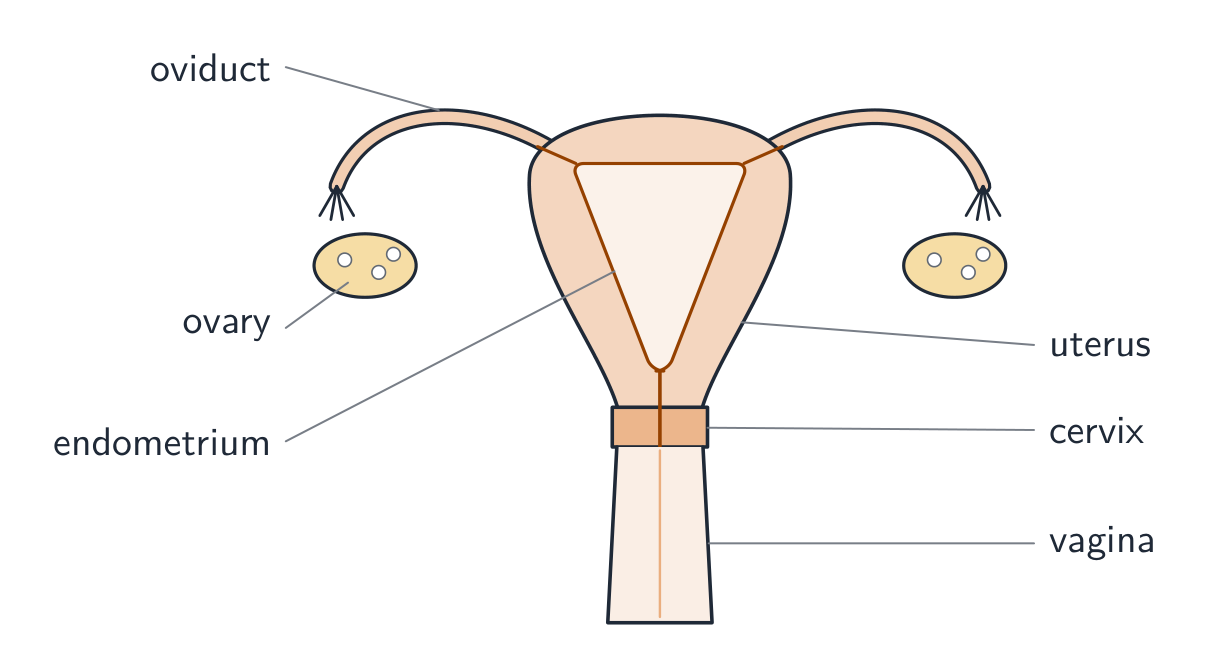
Front view of female-typical reproductive structures, with ovaries beside open oviduct funnels
An ovary is not a sealed continuation of an oviduct. The endometrium lines the uterine cavity; the cervix is the neck of the uterus above the vagina.

Ovaries contain developing oocytes and produce ovarian hormones. At ovulation an oocyte is released and can enter an oviduct, also called a uterine or fallopian tube. Cilia and muscular activity help move it. Fertilization normally occurs in the oviduct, rather than in the ovary or vagina.

The uterus has a muscular wall and an endometrium that changes during the cycle and supports implantation and pregnancy. The cervix connects the uterus to the vagina through a narrow canal. The vagina receives semen and forms part of the birth canal. Do not draw the urinary outlet as a continuation of the vagina: the urethra is a separate structure.

A released human “egg” is normally a secondary oocyte whose meiosis is not yet complete. The familiar word egg is useful, but it does not mean every meiotic event finished before ovulation.

35.7

卵巢和子宫的变化由激素协调

English

The ovarian cycle concerns follicle development, ovulation and corpus-luteum formation. The uterine cycle concerns changes in the endometrium, including its shedding during menstruation. Together they form the menstrual cycle. Day 1 is the beginning of menstrual bleeding, not the day of fertilization.

FSH from the anterior pituitary promotes follicle development. Developing follicles produce oestradiol, which supports rebuilding of the endometrium. For much of this phase, ovarian hormones exert negative feedback on hypothalamic/pituitary signalling, limiting further stimulation.

Sustained high oestradiol near the end of the follicular phase produces positive feedback in the appropriate physiological context. The resulting LH surge triggers ovulation and development of the corpus luteum from the remaining follicular tissue. A brief rise or low concentration of oestradiol is not the same signal as a sustained high pre-ovulatory level.

The corpus luteum produces progesterone and oestradiol. Progesterone supports a maintained, secretory endometrium, while ovarian hormones exert negative feedback on FSH/LH release. Without a continuing pregnancy signal, the corpus luteum degenerates; progesterone and oestradiol fall, and the endometrium is shed. Falling inhibition also permits recruitment for another cycle.
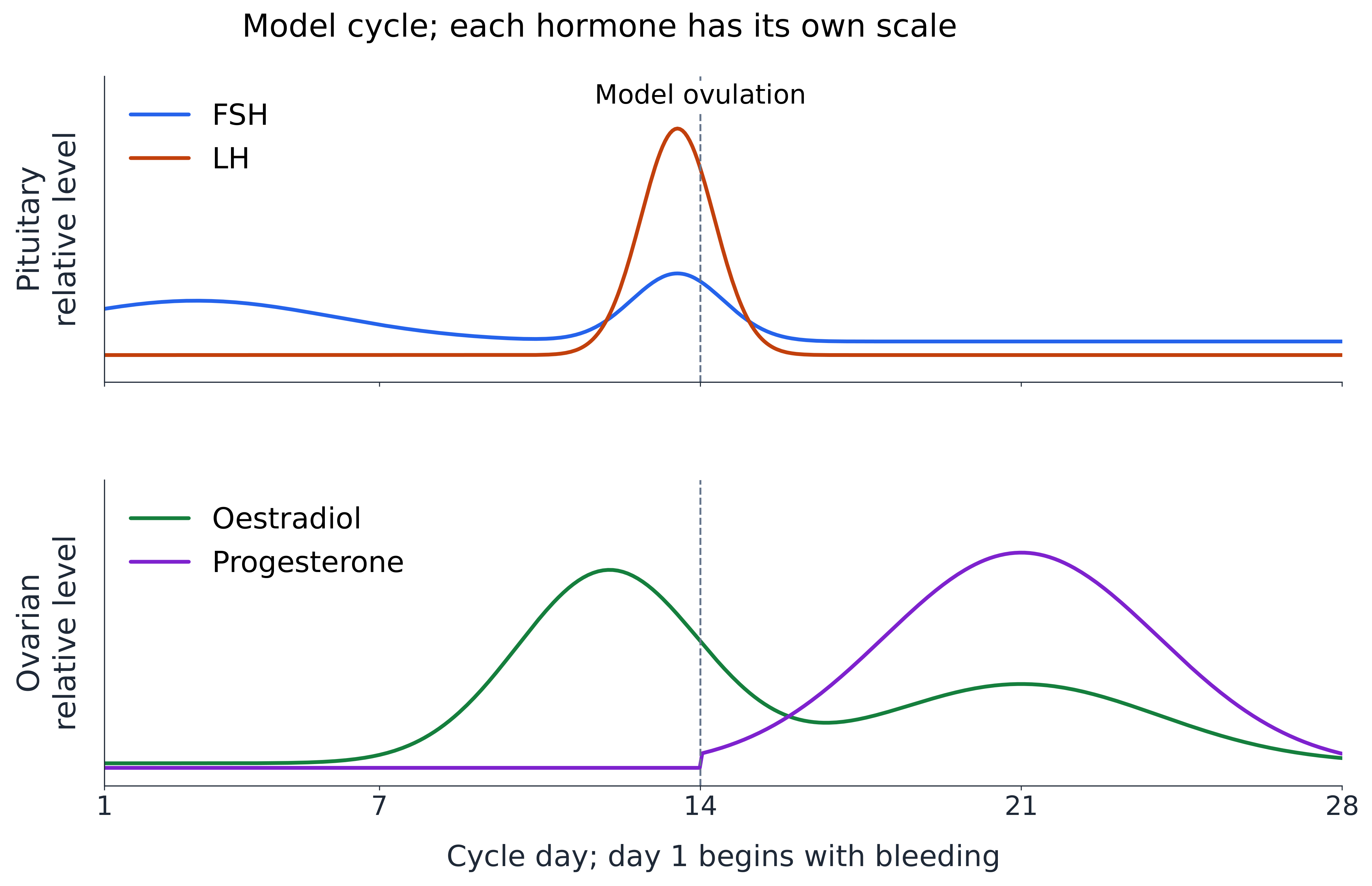
Hormone profiles across a model 28-day menstrual cycle *Each hormone has its own relative scale. Compare its timing, not the absolute concentration of one hormone with another. *

Read a graph in causal order: follicle growth and oestradiol rise → positive feedback and LH surge → ovulation → corpus luteum and progesterone rise. The progesterone maximum is after ovulation, not the trigger for the preceding LH surge. Cycle length and ovulation timing vary; a teaching graph is not a reliable personal fertility prediction.

35.8

人类受精结合贡献而不复制尾部

English

Sperm reaching the oocyte must interact with its surrounding layers. A sperm plasma membrane fuses with the oocyte membrane, permitting entry of the sperm's contribution, including its nucleus. The paternal tail and mitochondria are normally broken down rather than functioning as a permanent second set of organelles in the embryo.

Three stages: a sperm's membrane fuses with the oocyte; inside are two haploid pronuclei while the tail is broken down; the first joint mitosis gives two diploid nuclei
Fertilisation joins two haploid contributions; the sperm's tail and mitochondria do not persist

The maternal and paternal pronuclei bring haploid chromosome complements into the same cell. Their nuclear envelopes break down and the condensed chromosomes participate in the first joint mitotic division, giving two diploid nuclei. “Fusion of gametes” is a useful overall description; it should not force an inaccurate picture of two intact nuclear envelopes simply merging into one permanent envelope before division.

The first divisions distribute the restored diploid complement. Fertilization is distinct from implantation: an embryo must develop and reach the uterus before it can implant. Successful membrane fusion does not alone establish successful pregnancy or later birth.

35.9

体外受精利用激素协调多个阶段

English

In vitro fertilization means fertilization outside the body under controlled laboratory conditions, followed by transfer of an embryo to the uterus. In a common treatment approach, normal ovarian-cycle signalling is suppressed or controlled, then administered gonadotropins stimulate development of several follicles. This controlled stimulation is often called superovulation.

IVF stages in order: hormone treatment, egg collection, fertilization in the laboratory, embryo culture and embryo transfer
IVF stages from hormone treatment to embryo transfer

Monitoring helps coordinate final maturation and oocyte collection. Collected oocytes are exposed to sperm, or a sperm may be introduced by an appropriate laboratory method. Embryos are cultured and a selected embryo can be transferred to the uterus; additional hormonal support may maintain suitable endometrial conditions. The exact regimen varies. Hormones support the physiological stages; they do not guarantee that every collected oocyte fertilizes or every transferred embryo implants. See the NHS outline of IVF stages.

A laboratory sequence has 10 collected oocytes, eight fertilized and four embryos reaching a stated later stage. Fertilization is $8/10=80\%$ of collected oocytes; later-stage development is $4/8=50\%$ of fertilized oocytes or $4/10=40\%$ of those collected. These are different denominators, and none is a live-birth rate. State the outcome and population before reporting “success”.

35.10

花包含产生和接收配子的结构

English
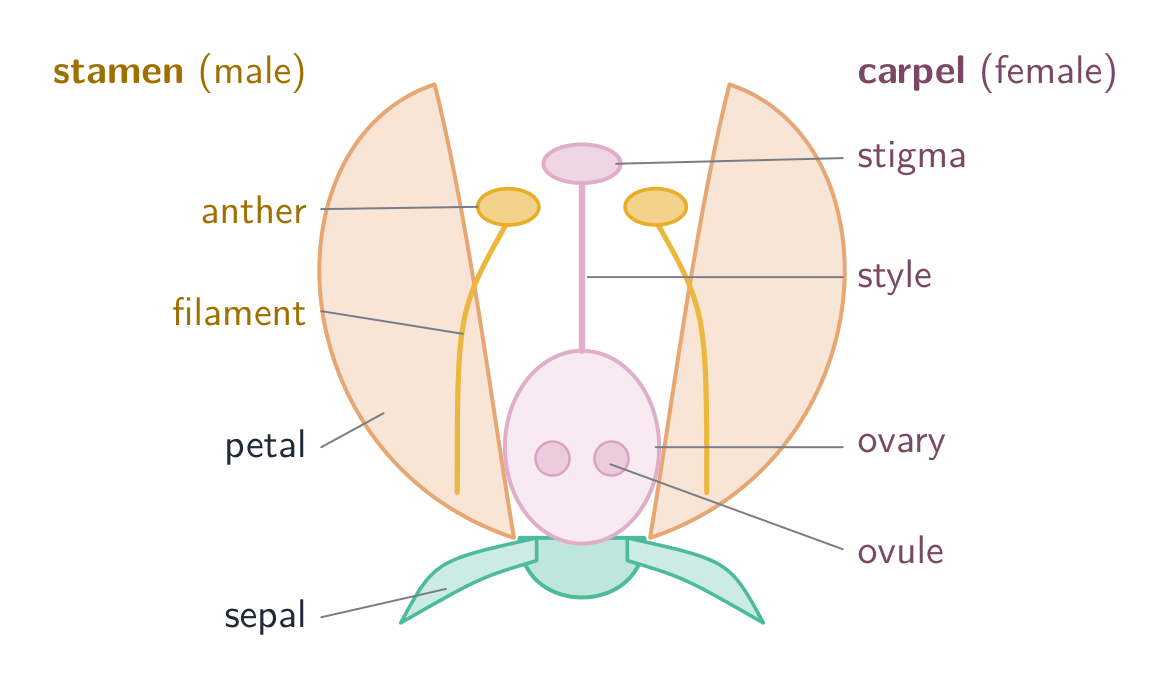
Section of an insect-pollinated flower with stamens, carpel and surrounding structures
The stamen comprises anther and filament; the carpel comprises stigma, style and ovary. Ovules are inside the ovary. A whole pollen grain is not a naked male gamete.
Close-up of a real lily flower: six stamens, each a long filament holding a dark red anther covered in pollen, surround a central style topped by a sticky stigma
A real lily: the long stamens make pollen and the central stigma receives it

Anthers produce pollen grains, supported by filaments. The stigma receives compatible pollen, and the style provides a route toward the ovary. Ovules within the ovary contain the female gametophyte and egg. Petals can attract insects through colour or other signals; nectar and scent can also encourage visits. Sepals protect the developing bud. Avoid assuming that every flower has the same shape or depends on insects.

In the anther, meiosis contributes to haploid spores that develop into pollen grains. The male gametes are produced within the pollen lineage. In an ovule, meiosis and subsequent development produce the embryo sac containing the egg. This connects the plant life cycle with chromosome reduction without pretending that pollen and ovule are equivalent single cells.

35.11

传粉、受精和传播是不同的转移过程

English

Pollination transfers pollen from anther to stigma. If compatible pollen germinates, a pollen tube grows through the style toward an ovule and delivers male gametes. One male gamete fuses with the egg to form the diploid zygote that develops into an embryo. In flowering plants a second fertilization produces endosperm, supporting development; the embryo and its food-supporting tissue are different products.

A scanning electron micrograph of pollen grains from three different plants, given false colours; each kind has its own surface pattern of ridges and spikes
Pollen grains seen under an electron microscope (colour added); each plant has its own pattern
Pollination moves pollen from anther to stigma, fertilization delivers a male gamete through the pollen tube to the egg, dispersal moves the seed away from the parent
Three different transfers

The fertilized ovule develops into a seed, and the ovary commonly develops into a fruit. Seed dispersal transfers seeds away from the parent by mechanisms such as wind, animals or explosive release. It is not pollination, because the transferred structure and life-cycle stage differ. An insect carrying pollen is not transporting an already formed embryo to fertilize a stigma.

35.12

异花授粉与自交不亲和性影响变异

English

Cross-pollination transfers pollen between different plants of the same species. Self-pollination can involve the same flower or another flower on the same plant. Self-fertilization is sexual reproduction: two gametes still fuse, even though one individual supplies them.

A bee on a yellow flower, its body dusted with pollen from the anthers
A bee carries pollen from one flower to another — insect pollination in action

Different maturation times for pollen and stigma can reduce self-pollination. Separate male and female flowers, especially on separate plants, can also promote cross-pollination. Animals or wind can move pollen between individuals; a pollinator visiting several flowers on one plant does not necessarily achieve crossing between plants.

Many species have genetically controlled self-incompatibility systems that reject self or otherwise incompatible pollen at an appropriate stage. Pollen may reach a stigma without achieving fertilization. These mechanisms favour crossing and help maintain genetic diversity.

Repeated selfing can increase homozygosity and expose harmful recessive alleles, contributing to inbreeding depression. It need not make every selfed plant unfit: some species regularly self. The outcome depends on genetic background and environment. Outcrossing changes combinations of alleles rather than creating every new allele itself.

35.13

萌发调动储存物质以供胚生长

English

After dispersal, a viable seed can remain dormant until suitable conditions and any dormancy requirements are met. Water uptake rehydrates tissues and supports metabolic activity. Oxygen supports aerobic respiration, and a suitable temperature permits enzyme activity. Light requirements vary among species; light is not a universal requirement for every seed to begin germinating.

A germinating seed in soil with stored reserves, a radicle growing down and a shoot growing up, with labels for water, oxygen, suitable temperature, enzyme mobilisation of reserves, and light needed only by some species
Germination needs water, oxygen and a suitable temperature; enzymes mobilise stored reserves

Stored food is mobilized: enzymes break reserves into soluble products that can be transported and used in respiration and biosynthesis. The embryo grows; the radicle establishes the root and the shoot develops. The seedling initially depends on reserves before photosynthesis can supply enough new organic material.

For an investigation, compare defined conditions using enough viable seeds, independent replicate groups, a consistent germination criterion and a fixed observation period. A group with 18 of 24 seeds germinated has a germination percentage of $18/24\times100=75\%$. A lower value does not identify one cause without controls for viability, dormancy and environment.

35.14

AHL:青春期涉及内分泌调控通路

English

Increased pulsatile GnRH release from the hypothalamus stimulates the anterior pituitary to release LH and FSH. These act on the gonads, increasing sex-steroid production and supporting reproductive maturation. Testosterone, oestradiol and other relevant signals contribute to secondary sexual characteristics and changes in reproductive function.

The hormones are chemical signals acting through responsive cells; they do not physically become gametes. Feedback regulates the axis. Timing and development vary among individuals, and a simplified pathway does not mean every hormone is absent before puberty or that one signal alone explains every developmental change.

35.15

AHL:配子发生中染色体和细胞质的分配不同

English

In spermatogenesis, mitosis maintains precursor populations, cells grow, and meiosis I and II generate haploid products. Differentiation produces streamlined sperm with a flagellum, an acrosome and a midpiece containing mitochondria. Four haploid products can develop from one primary spermatocyte in the simplified normal sequence; mitosis of precursors is not itself the chromosome-halving step.

In oogenesis, precursor mitoses occur before birth. Primary oocytes enter meiosis and pause in prophase I. From puberty, selected oocytes can resume development; unequal division retains most cytoplasm in a large secondary oocyte and gives much less to a polar body. The secondary oocyte normally pauses in metaphase II and completes that division after fertilization-related activation.

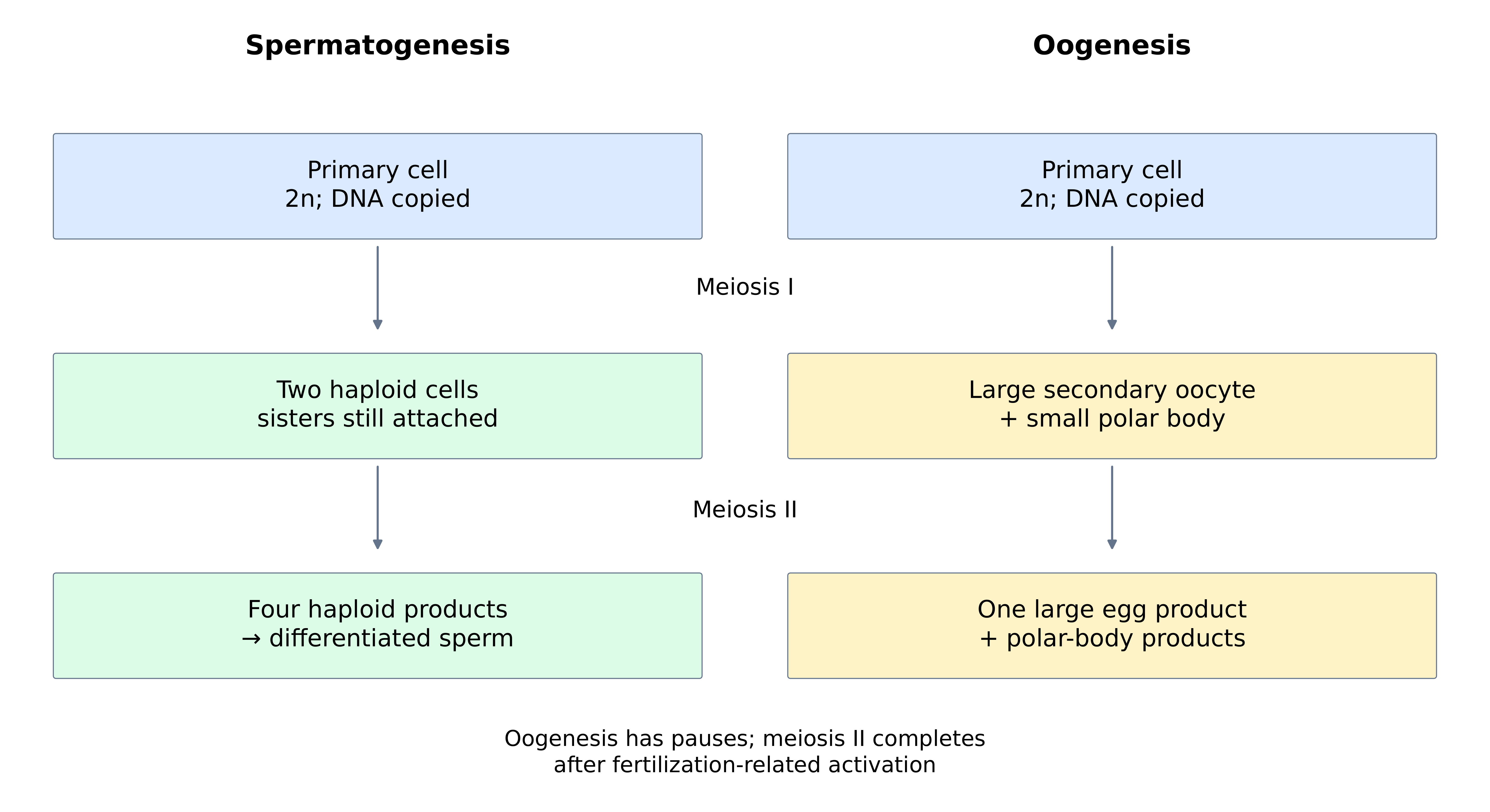
Comparison of chromosome reduction and unequal cytoplasm allocation in human gametogenesis
Each route begins with one diploid primary cell after DNA replication. Polar-body fate varies; the diagram emphasizes one large functional egg rather than four equal eggs.

Both routes include growth, two meiotic divisions and differentiation, but their timing, numbers and allocation differ. Do not infer that four equal eggs must result because four haploid nuclei are possible. In a model with six primary spermatocytes completing normal development, up to 24 sperm result; six primary oocytes completing the normal unequal sequence yield six large functional egg products, not 24.

35.16

AHL:受精和早期发育需要受控的过渡

English

The sperm acrosome reaction releases components that help it penetrate the zona pellucida. After sperm–oocyte interaction, the cortical reaction releases granule contents from the oocyte and modifies the surrounding zona, limiting further sperm penetration and preventing polyspermy. The acrosome belongs to the sperm; cortical granules belong to the oocyte. Do not exchange their roles.

A sperm head at the zona pellucida releasing acrosome enzymes, and cortical granules inside the oocyte releasing their contents to modify the zona and block further sperm
The acrosome belongs to the sperm; cortical granules belong to the oocyte and prevent polyspermy

Early mitoses produce more cells while initially partitioning the existing material. A blastocyst develops, with an outer cell population and an inner cell mass. It reaches the uterus and implants in the endometrium. Cell division alone is not implantation: attachment and interaction with the uterine lining are additional steps.

The embryo's developing trophoblast/placental tissues produce human chorionic gonadotropin, hCG, which supports the corpus luteum early in pregnancy. Pregnancy tests use monoclonal antibodies that bind hCG. A test detects a hormone, not a visible embryo or every feature of embryo development. Sampling time and detection threshold affect a negative result; the mechanism does not imply perfect detection immediately after fertilization.

35.17

AHL:胎盘物质交换和孕酮支持妊娠

English

Placental villi provide a large exchange area between closely apposed maternal and fetal circulations. Maternal and fetal blood normally remain in separate vascular spaces, rather than simply mixing in one shared tube. Oxygen and nutrients pass toward the fetus; carbon dioxide and metabolic wastes pass toward the maternal circulation. Different substances use different transport mechanisms, and the placenta is not an absolute barrier to every harmful agent.

A fetus curled in the uterus: the placenta on the uterus wall is joined to the fetus's belly by the umbilical cord, and the fetus floats in amniotic fluid inside the amniotic sac, with the cervix below
The fetus develops in the uterus, supported by the placenta, cord and amniotic sac

The placenta supports retention of the developing fetus within the uterus by sustaining exchange as it grows. The umbilical vein carries blood from placenta to fetus and the umbilical arteries return it; “vein” and “artery” describe direction relative to the fetal heart, not a universal oxygen-content rule.

Progesterone initially comes mainly from the corpus luteum and later from the placenta. It supports the endometrium and a relatively quiet uterus. Near childbirth, loss of progesterone's inhibitory effect permits greater uterine activity. In humans this includes functional progesterone withdrawal: circulating progesterone need not simply fall before labour. Changes in tissue responsiveness matter. This distinction is supported by human myometrial receptor research.

During labour, cervical stretching promotes oxytocin release from the posterior pituitary, increasing uterine contractions. Stronger contractions cause more stretch, reinforcing oxytocin release: positive feedback. Delivery removes the major stretching stimulus. This amplifies a process toward an endpoint; it differs from negative feedback that opposes a deviation to stabilize a variable.

35.18

AHL:激素替代疗法说明相关性并非治疗效应

English

Earlier observational comparisons associated hormone-replacement therapy with lower coronary-heart-disease incidence. Treatment groups could differ in socioeconomic conditions, health behaviours and access to care. Such confounding can produce an association without the proposed protective hormone effect.

A completely randomized experiment compares a treatment group with a control group

The 2002 Women's Health Initiative randomized trial compared one combined oral estrogen–progestin regimen with placebo in 16,608 postmenopausal women aged 50–79 with an intact uterus. It reported an excess of seven coronary-heart-disease events per 10,000 person-years in that regimen. This challenged the earlier simple cardioprotection claim. Original trial report.

Randomization reduces systematic baseline differences and supports causal inference for the tested comparison. Attrition, adherence, uncertainty and generalizability still matter. The study did not test every formulation, route, age group or purpose of hormone therapy; it does not justify a universal statement about every patient's treatment. Seven extra events per 10,000 person-years is an excess event rate, not “7% of all women” or seven events per individual.

35.19

练习

English
  1. Compare sexual and asexual reproduction in a stable environment and after an environmental change. Give a limitation of each claimed advantage.
  2. A species has $2n=8$. State normal gamete and zygote chromosome counts, and the number of whole-chromosome gamete combinations if crossing over is ignored. Distinguish this from the number of products of one meiosis.
  3. Explain how differences in gamete size, resources and transfer connect to male and female reproductive roles. Why can a hermaphroditic flower reproduce sexually?
  4. Draw the male and female reproductive systems, label the structures taught here, and annotate functions. Trace sperm transport and distinguish the usual fertilization and implantation sites.
  5. Explain FSH, LH, oestradiol and progesterone changes in a model menstrual cycle. Identify one positive-feedback interval and one negative-feedback relationship. Explain why ovulation is not fixed on day 14 in everyone.
  6. Explain sperm–oocyte membrane fusion and the contributions to the first joint mitosis. Why should fertilization not be confused with implantation?
  7. Outline hormonal control in a common IVF approach. Results are 12 oocytes collected, nine fertilized and three reaching a stated later embryo stage. Calculate fertilization per collected oocyte and later-stage development using each relevant denominator. Are these live-birth rates?
  8. Draw an insect-pollinated flower and annotate the functions of anther, filament, stigma, style, ovary, ovule, petal and sepal. Explain the route from pollen arrival to an embryo.
  9. Distinguish self-pollination, cross-pollination and self-incompatibility. Give two mechanisms promoting crossing and explain how repeated selfing can reduce vigour without claiming that every selfed offspring is unfit.
  10. Distinguish pollination from seed dispersal. Explain the need to mobilize reserves during germination and the roles of water, oxygen and suitable temperature.
  11. In an investigation, 21 of 28 seeds germinate. Calculate the percentage and propose controls and replication for investigating one germination factor. Why would a poor result not identify that factor alone as the cause?
  12. AHL: Trace GnRH to gonadal steroid effects, then compare spermatogenesis and oogenesis in timing, meiotic divisions, cytoplasm allocation and products. How many sperm and large egg products could eight primary cells of each type yield under the stated normal model?
  13. AHL: Explain the acrosome and cortical reactions, blastocyst implantation, hCG detection, placental exchange and the changing source of progesterone. Describe the oxytocin feedback loop and explain functional progesterone withdrawal in humans.
  14. AHL: Explain why an observational HRT–CHD association may be confounded. Describe what the named randomized trial adds and one limit on generalizing it. If its stated excess rate remained constant, how many extra CHD events would correspond to 20,000 person-years? Why is this not a personal risk prediction?
35.20

例题答案

English
  1. Asexual reproduction rapidly propagates a successful genotype without a mate, but shared susceptibility can be harmful after change. Sexual reproduction generates potentially favourable combinations, with transfer costs and no guaranteed improvement. Mutation also varies asexual lineages.
  2. Gamete four chromosomes; zygote eight. Four independently orienting pairs give $2^4=16$ possible whole-chromosome combinations across gametes. One meiosis produces four haploid nuclei. Replication before meiosis copies chromatids without making the starting cell tetraploid.
  3. Small, numerous male gametes carry fewer reserves; larger female gametes retain resources. Transfer and offspring survival constrain success. A hermaphroditic flower supplies both gamete types; fusion remains sexual during self-fertilization.
  4. Use the annotated diagrams. Sperm: testis → epididymis → sperm duct → urethra; glands add semen components. Fertilization: oviduct; implantation: uterine endometrium. Ovaries supply oocytes/hormones. Cervix and vagina are separate from the urinary outlet.
  5. FSH supports follicles; oestradiol rebuilds endometrium. Sustained high pre-ovulatory oestradiol gives positive feedback and an LH surge, triggering ovulation and corpus-luteum formation. Progesterone supports secretory endometrium with negative feedback on gonadotropins. Without pregnancy support, corpus-luteum decline lowers hormones and permits shedding. Timing varies.
  6. Membranes fuse; the paternal nuclear contribution enters while tail and mitochondria are normally destroyed. Pronuclear envelopes break down; both complements participate in the first mitosis, giving diploid nuclei. Implantation follows development and uterine arrival.
  7. Control/suppress the natural cycle, stimulate several follicles with administered hormones, monitor maturation and collect oocytes; fertilize, culture and transfer an embryo with appropriate endometrial support. $9/12=75\%$ fertilized; $3/9\approx33.3\%$ of fertilized oocytes or $3/12=25\%$ of collected oocytes reach the stated stage. No birth outcome is given.
  8. Anther/filament: pollen production/support; stigma/style: reception/tube route; ovary contains ovules with eggs. Petals can attract insects; sepals protect buds. A compatible tube delivers male gametes; egg fertilization produces zygote and embryo. Pollen is neither an embryo nor one naked sperm.
  9. Self-pollination stays within one plant; crossing transfers pollen between plants. Different maturation times, separate male/female plants and animal/wind transport promote crossing. Self-incompatibility can block fertilization after pollen arrival. Selfing increases homozygosity, potentially exposing harmful recessives; effects depend on genotype/environment.
  10. Pollination moves pollen to stigma; dispersal moves seeds containing embryos. Water supports rehydration/metabolism, oxygen aerobic respiration, and temperature enzyme activity. Mobilized reserves supply respiration and growth before sufficient photosynthesis. Light and dormancy requirements vary.
  11. $21/28\times100=75\%$. Use comparable viable seeds, independent replicate groups, random allocation, controlled other conditions and consistent time/criteria. Viability, dormancy and contamination also affect outcomes; one poor group identifies no unique cause.
  12. AHL: GnRH stimulates pituitary LH/FSH, which act on gonads and increase sex-steroid production. Both gametogenic routes involve precursor mitosis, growth, two meiotic divisions and differentiation. Spermatogenesis can yield four functional sperm per primary cell; oogenesis pauses before birth and before fertilization, with unequal divisions retaining cytoplasm in one egg. Eight primary cells give up to 32 sperm or eight large egg products in this model.
  13. AHL: Sperm acrosome activity helps zona penetration; the oocyte cortical reaction modifies the zona to limit polyspermy. A blastocyst implants in endometrium; monoclonal antibodies detect hCG from developing trophoblast/placental tissues. Placental villi support exchange without normal free mixing of the blood supplies. Corpus luteum then placenta provide progesterone. Reduced progesterone effect permits contraction; human functional withdrawal need not require falling circulating concentration. Stretch → oxytocin → stronger contractions → more stretch is positive feedback, ended by delivery.
  14. AHL: Socioeconomic and health differences can confound observational comparisons. Randomization supports inference for the tested regimen and population, while adherence, uncertainty and generalizability remain limits. $7\times(20{,}000/10{,}000)=14$ excess events under a constant-rate assumption. Person-years are population exposure time; the estimate is neither 7% of women nor a specific individual's probability.
35.21

考试技巧

English

Name the transferred structure, process and location. Separate pollination, fertilization, implantation and dispersal. State hormone sources, targets and feedback direction. Define each rate’s outcome and denominator.

  • AHL: Distinguish sperm acrosome from oocyte cortical granules, chromosome reduction from cytoplasm allocation, and placental exchange from blood mixing. Apply trial findings to their tested comparison and distinguish functional hormone withdrawal from blood concentration.
这有帮助吗?

更多 IB 生物 HL 知识点

登录或创建账户

IGCSE, A-Level & AP