A small skin cut is usually sealed quickly, yet protection against a new virus can take days to develop. These responses solve different problems: closing an entry route, removing invaders and building a response that recognizes a particular molecular target.
This handout covers the full shared SL and HL content of C3.2: barriers, clotting, innate and adaptive responses, antibody production and memory, HIV, antibiotics and resistance, zoonoses, vaccination, herd immunity and infection data. There is no additional Higher-Level-only content in this topic. Prerequisites: cells, proteins, membrane receptors and mitosis.
Use supplied data, safe simulations or approved school cultures; do not collect or grow unknown pathogens.
A pathogen 病原体 is an agent that causes disease. Pathogenic bacteria are cellular prokaryotes; pathogenic fungi and protists are eukaryotes. Viruses are acellular and depend on host cells for replication. These groups contain human pathogens, but most members are not pathogenic. Archaea are another prokaryotic group; none is an established human pathogen. Association with illness alone does not demonstrate causation. Infection means an agent has entered and established itself; disease involves harmful disruption of normal function. Infection can occur without obvious symptoms.
Goblet cells make mucus that traps dust and microbes; the cilia sweep it up to the throatMucus traps particles and microbes; beating cilia carry it away to be swallowed or removed
Intact skin has closely packed cells and a tough outer layer that limits entry. Its surface conditions and secretions also inhibit many microorganisms. Damage makes an entry route available, so a protective surface is more than an outer covering.
Mucous membranes line passages such as the airways. Mucus traps particles and microbes; airway cilia move the mucus toward regions where it can be removed or swallowed. Mucus production and ciliary movement cooperate. Tears and saliva help wash surfaces and contain antimicrobial components, including lysozyme, which attacks bacterial cell-wall material. Stomach acid inhibits many swallowed organisms. These defences are effective barriers, not guarantees that every pathogen is destroyed.
Historical observations helped test infection routes. Semmelweis compared childbed-fever deaths in Vienna and introduced hand disinfection; Snow compared cholera mortality among London households with different water supplies. These comparisons supported practical controls before every microbial mechanism was understood. Compare groups and alternative explanations, rather than treating a famous name as proof. See Semmelweis’s translated account and Snow’s water-supply study.
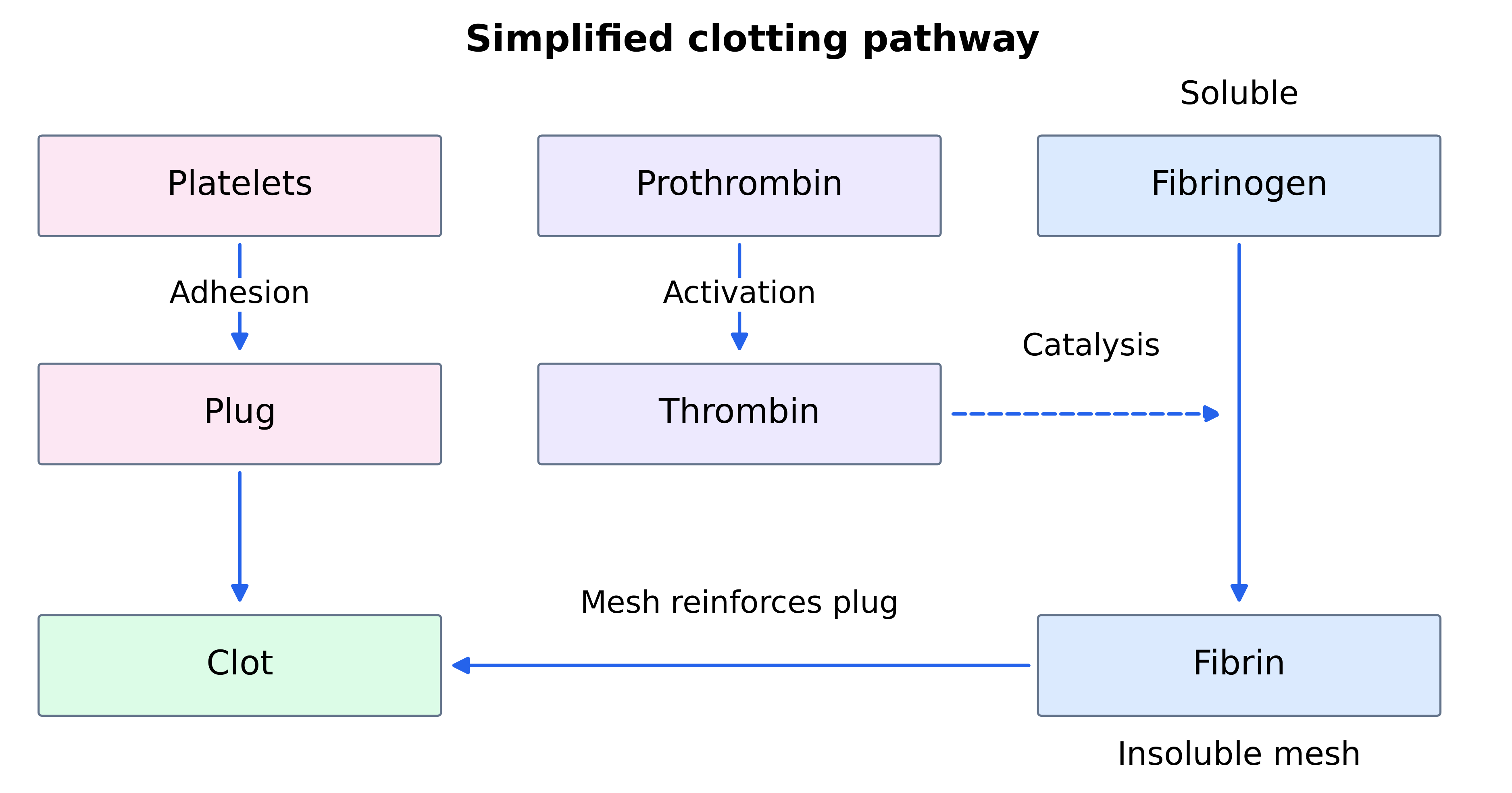
When a small vessel is damaged, platelets adhere at the damaged region, become activated and recruit more platelets. They form an initial plug and contribute signals and surfaces that support clotting reactions. Platelets are cell fragments, not small red blood cells and not the antibodies of the immune system.
A blood clot (scanning electron micrograph): red blood cells trapped in a mesh of fibrin threads
Clotting factors activate other factors in a cascade. In the simplified final sequence, prothrombin is converted to the active enzyme thrombin. Thrombin converts soluble fibrinogen into fibrin, which forms an insoluble network. The fibrin mesh reinforces the platelet plug and traps cells, including red blood cells, producing a more stable clot. The sealed region reduces blood loss and closes an entry route for pathogens.
The arrows show activation and conversion, not the transformation of platelets or red cells into fibrin. The full cascade has more steps than this teaching model.
A cascade allows a small initiating event to activate many downstream molecules. The response must also remain controlled and localized: clot formation throughout normal circulation would obstruct flow. Related machinery protects at a cut but can obstruct an important vessel. Fibrin is a protein product; it is not an enzyme that digests the pathogen.
26.4
先天反应识别广泛特征,吞噬细胞包裹入侵者
English
Innate defences are available without prior exposure to a particular antigen. Barriers and phagocytes are examples. They recognize broad features associated with microbes or tissue damage and respond rapidly. In contrast, adaptive responses select lymphocytes with receptors specific to particular targets and can generate long-lived memory. The two systems cooperate; they are not separate armies that never communicate.
A real neutrophil (yellow), one kind of phagocyte, reaching out to engulf rod-shaped bacteria (orange) by phagocytosisPhagocytosis: the phagocyte engulfs the pathogen, digests it, then displays its antigen
A phagocyte can leave small blood vessels and move through tissues by changing shape. It recognizes a particle, extends membrane around it and encloses it in an internal vesicle. Lysosomes supply digestive enzymes that break down the enclosed material. The membrane enclosure separates the digestion compartment from the rest of the cytoplasm. Some phagocytes also help activate adaptive responses by displaying fragments of ingested material.
This sequence is recognition → engulfment → enclosed digestion. It is not a red blood cell swallowing an antibody, and it is not a plasma cell releasing a digestive enzyme into every neighbouring cell. A phagocyte can attack different appropriate targets; an individual antibody does not bind every pathogen equally well.
26.5
特异性受体选择协同的淋巴细胞克隆
English
An antigen 抗原 is a molecular structure recognized by a specific antibody or immune receptor. Antigens include proteins and parts of glycoproteins; they can come from the body itself or from outside it. An antigen need not be a whole organism, and recognition does not automatically mean that a substance is dangerous. Red-cell surface antigens, for example, are normal body components, but incompatible blood can provoke an immune response in a recipient.
The B cell sees the whole shape; the T cell sees a peptide in an MHC groove — two recognition chemistries
B and T lymphocytes have different roles. Many different lymphocyte clones exist, with each clone carrying a particular receptor specificity. The appropriate receptor is already present before the encounter; the antigen does not instruct any random lymphocyte to manufacture a matching receptor from nothing. Cells circulate through blood and lymph and encounter antigen in lymphoid tissues, including lymph nodes.
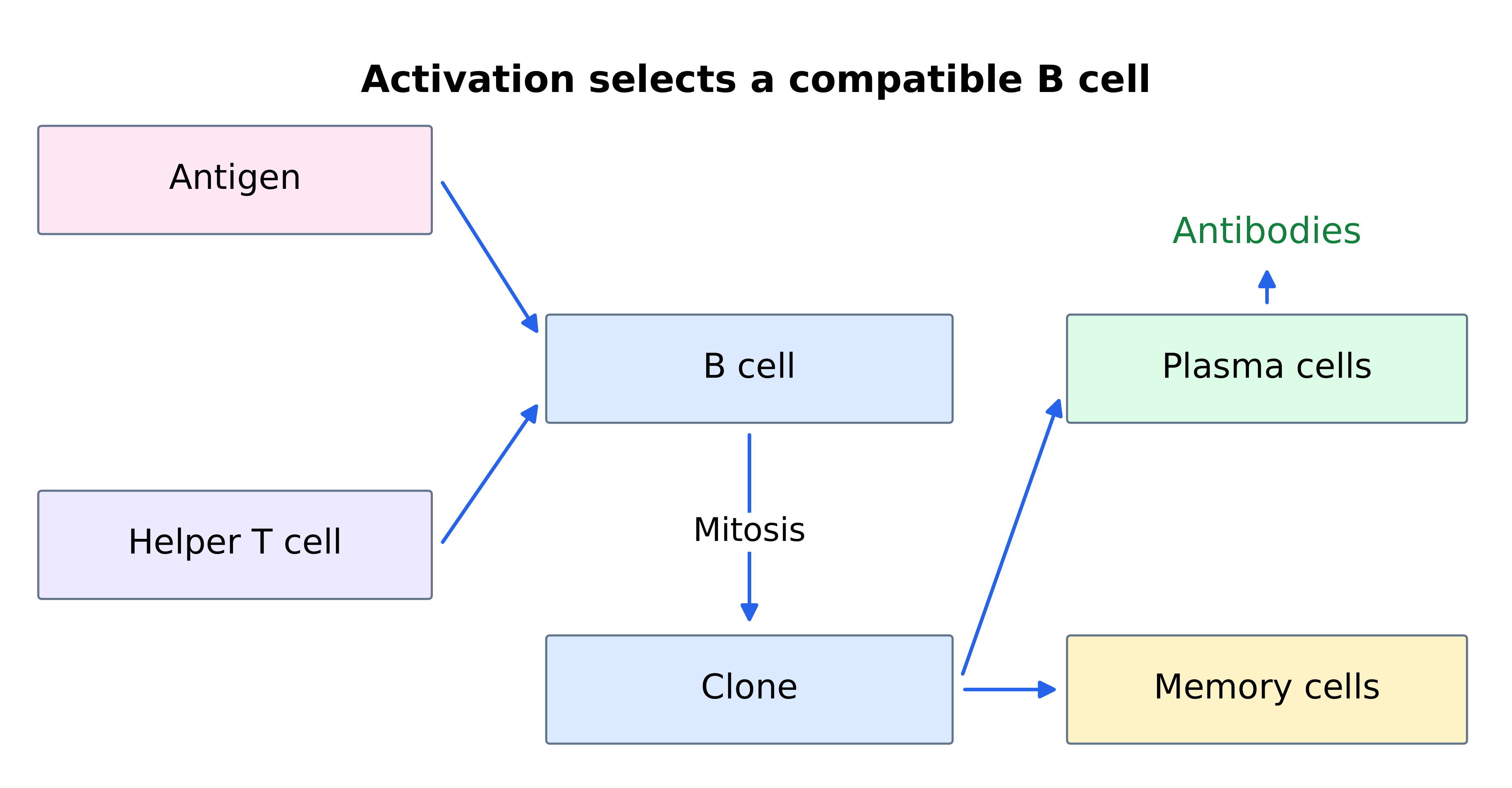
For a typical response to a protein antigen, a B cell binds the target through its receptor and takes it in. It displays antigen-derived material that can be recognized by a compatible helper T cell. Activation requires appropriate interaction and signals. Antigen-presenting cells also help activate helper T cells. This cooperation supports B-cell activation rather than making every passing B cell respond. Not all B-cell responses use exactly the same activation route, but this helper-T-dependent model explains the cooperation required here.
The selected B cell divides repeatedly by mitosis: clonal expansion. Descendants retain the relevant specificity. Many differentiate into plasma cells, which secrete large quantities of antibodies 抗体, while others become memory cells 记忆细胞. Helper T cells also form selected expanding populations and can contribute memory. Antibodies are proteins made by cells; they are not themselves cells that reproduce by mitosis.
Selection and multiplication explain why the first large antibody response takes time. The diagram summarizes cooperation rather than showing every antigen-presentation step.
An antibody binds a compatible antigenic site through its binding region. Binding can neutralize a toxin or interfere with a pathogen's attachment; it can also help other immune mechanisms remove the marked material. Molecular fit determines binding; antigen change may reduce it without abolishing all protection.
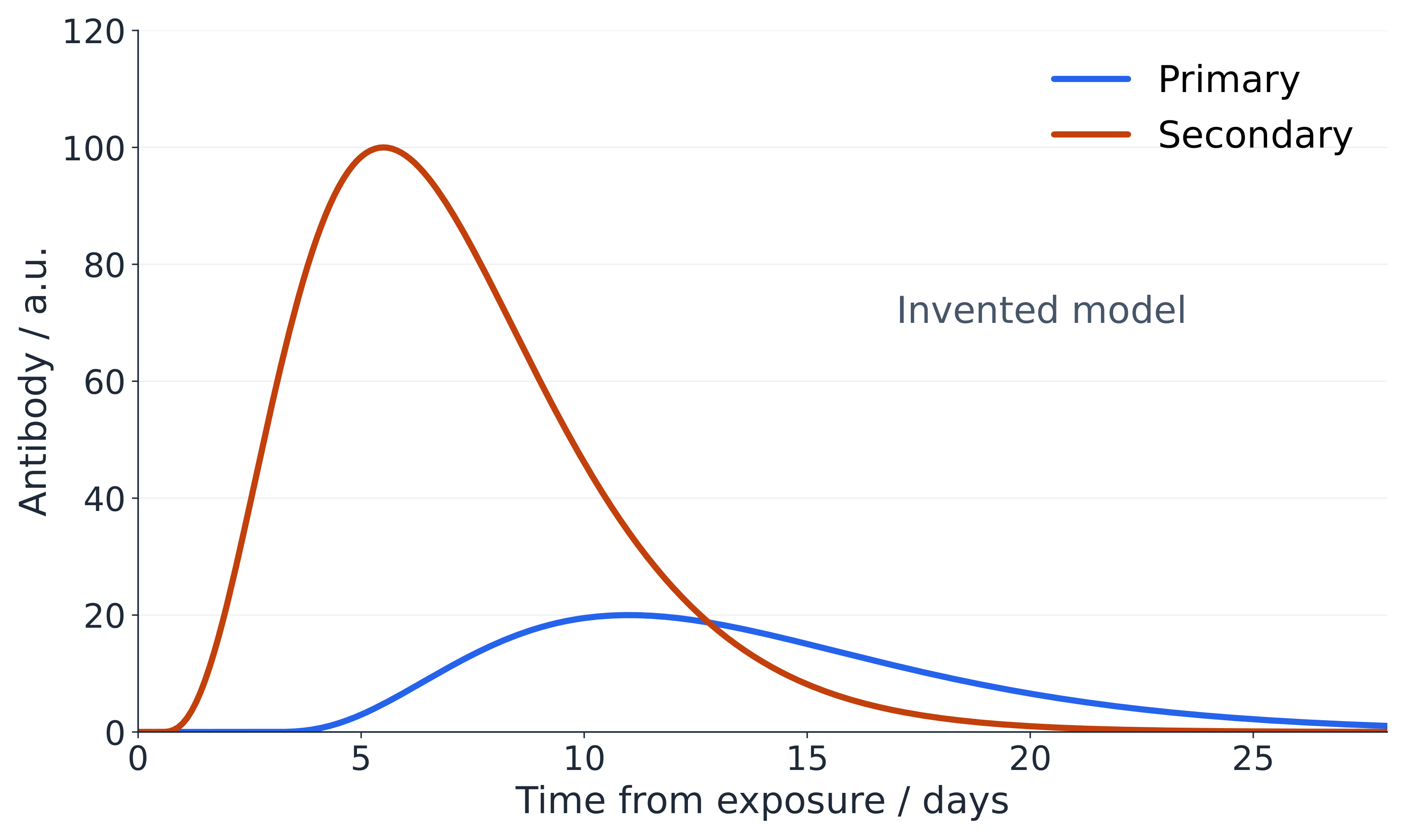
During a primary response, appropriate cells must be activated, expand and differentiate. The antibody concentration therefore rises after a delay. Many short-lived effector cells disappear after the antigen is cleared, but memory populations can persist. On later exposure to a sufficiently similar target, these populations can support a faster and larger secondary response.
In a separate comparison, the primary response first exceeds a stated detection level after six days and reaches 20 arbitrary units. A later exposure produces a response above that same detection level after two days, with a peak of 100 units. The peak is five times as large, a 400% increase; the detection delay is four days shorter, a decrease of about 66.7%. The graph must state its detection rule and time reference. A curve's first visible point is not necessarily the instant the first antibody molecule was made.
Both curves use time since their own exposure. Peaks, delays and persistence are schematic, not measurements for a named vaccine or disease.
Memory does not guarantee that infection is impossible or that protection is lifelong for every pathogen. Antigen change, waning protection and the site of infection matter. Many different viruses cause colds, so a later cold need not be the same antigenic challenge as an earlier one. A positive antibody result also needs context: sampling time, assay specificity and the measured target affect interpretation.
26.7
HIV 破坏辅助性 T 细胞的协调作用
English
HIV is a virus that infects CD4 helper T cells and some other susceptible cells. Progressive damage to the helper-T-cell population can weaken the coordination of immune responses, including effective B-cell responses. AIDS is the advanced syndrome associated with severe immune damage and vulnerability to particular opportunistic infections and other illnesses. HIV infection and AIDS are not interchangeable terms, and infection does not mean a person already has AIDS.
HIV removes the coordinators: fewer helper T cells weaken both antibody and cytotoxic responses
Transmission requires an appropriate route involving infectious body fluids, including blood, semen, pre-seminal fluid, vaginal or rectal fluids, and breast milk. Examples include sexual exposure, sharing contaminated injection equipment and transmission during pregnancy, birth or breastfeeding. A fluid must reach susceptible tissue or the bloodstream; simply being near a person does not provide such a route. HIV is not transmitted by ordinary touching, sharing classroom space or a mosquito transferring it between people. This biological distinction prevents stigma as well as incorrect explanations.
Effective antiretroviral treatment can suppress viral replication and preserve immune function; HIV does not inevitably progress rapidly to AIDS. CDC's transmission explanation and NIH's HIV and AIDS overview explain the CD4-cell target and transmission routes.
26.8
抗生素作用于细菌靶点并筛选耐药变异体
English
Antibiotics can inhibit bacterial processes such as cell-wall synthesis, bacterial ribosome function or particular metabolic pathways. Selectivity depends on differences between bacterial and human cells. Viruses do not have their own bacterial cell wall or bacterial ribosomes, so an antibiotic directed at those targets does not stop a viral infection by the same mechanism. Some viral illnesses can be complicated by bacterial infection; that does not mean the antibiotic directly kills the virus.
Antibiotic resistance spreads by natural selection: the antibiotic kills the rest, so the resistant survivors take overA clear zone shows bacterial growth was inhibited under the test conditions; it does not prove killing. Zone sizes depend on the drug, disc dose and diffusion. Interpret susceptibility using standards for that antibiotic and organism, rather than ranking different drugs by zone size alone.
Resistance is a heritable ability of a microorganism to survive exposure that would inhibit susceptible organisms under specified conditions. Resistant variants can arise through mutation, and bacteria can also acquire resistance genes by gene transfer. Drug exposure then changes survival and reproduction: susceptible bacteria are removed more effectively, while resistant survivors leave more descendants. Exposure selects variation; it does not make an individual bacterium decide to mutate because it needs protection.
Consider a population of 10,000 bacteria containing 100 resistant and 9,900 susceptible cells. After treatment, 50 resistant and 99 susceptible cells remain. The resistant fraction rises from 1% to $50/149\times100\approx33.6\%$, although the number of resistant cells has actually fallen. A higher proportion does not necessarily mean an immediate increase in the absolute resistant count. Subsequent reproduction can expand the survivor population.
Resistance to several antibiotics can accumulate through multiple mechanisms or acquired genes, producing multidrug-resistant strains. Appropriate prescribing, infection prevention and careful use can reduce selection and spread; they do not guarantee that resistance will never evolve. Research can screen chemical libraries for compounds that inhibit bacterial growth, then test mechanism, toxicity and effectiveness. A clear inhibition zone in an approved school test is evidence of growth inhibition under those conditions, not proof of a safe medicine for humans. Standardize the organism, inoculum, medium, disc dose, incubation and measurement, with suitable controls and repeats.
26.9
人畜共患病连接动物宿主、媒介和人类
English
A zoonosis is an infection that can pass naturally between other vertebrate animals and humans. Distinguish the reservoir that maintains an agent from a vector that carries it between hosts. A pathogen's successful entry into a new species also depends on compatible cells and subsequent transmission.
A mosquito can spread pathogens from person to person when it bites.Malaria needs a mosquito vector: the parasite passes from human to mosquito to human with each bite — which is why control targets the mosquito
Example
Relevant host and route
Bovine tuberculosis
Mycobacterium bovis is associated with cattle and can infect people through contaminated unpasteurized dairy products or close exposure; it is distinct from the mainly human-associated M. tuberculosis
Rabies
Virus in an infected mammal's saliva can enter through a bite; the bite introduces the pathogen rather than manufacturing it
Japanese encephalitis
Culex mosquitoes transmit virus maintained among pigs and water birds; people usually do not develop enough virus in blood to continue the mosquito cycle
COVID-19 emergence
SARS-CoV-2 has animal-virus relatives; evidence supports zoonotic emergence, while the precise original spillover route remains unresolved
CDC's bovine-TB account distinguishes M. bovis from M. tuberculosis. WHO's Japanese-encephalitis account explains the mosquito–animal cycle. Calling Japanese encephalitis zoonotic does not mean that ordinary contact with a patient transmits it. Likewise, an animal origin for a virus does not mean that every later human case comes directly from an animal.
For COVID-19, keep the uncertainty specific: an unresolved original route is not uncertainty about whether later human-to-human transmission occurred. WHO's SAGO assessment evaluates origins evidence and remaining gaps.
26.10
疫苗接种可在无需自然感染的情况下建立记忆
English
Vaccination 疫苗接种 introduces a vaccine that presents chosen antigens, or instructions that allow cells to produce an antigen, and stimulates a specific immune response. Vaccine types include inactivated pathogens, weakened live pathogens, purified components and nucleic-acid approaches. These differ in how the target is delivered; an mRNA vaccine does not contain a whole reproducing virus simply because cells make one antigen.
Memory from vaccination makes the response to a later exposure faster and larger
Antigen recognition and lymphocyte activation lead to clonal expansion, effector activity and memory. Later exposure can then produce a faster protective response. Booster doses can strengthen or renew responses. Protection may be measured against infection, severe disease or another defined outcome; these are different endpoints. A vaccine that reduces severe disease does not automatically prevent all infection or all transmission.
Vaccine evaluation tests benefits and harms, with safety monitoring continuing after introduction. Low risk does not mean zero side effects. Early media reports may appear before scientific evaluation is complete: examine study design, outcome, denominator and uncertainty. WHO’s vaccine-safety account explains testing and monitoring.
In a comparison with equal follow-up, 80 of 1,000 unvaccinated participants and 20 of 1,000 vaccinated participants develop the defined outcome. Risks are 8% and 2%. Relative risk is $2/8=0.25$, and the relative risk reduction is $1-0.25=75\%$. The absolute risk difference is six percentage points. These data alone do not show whether groups were comparable or whether the outcome was infection rather than severe illness. Randomization, complete follow-up, clear case definitions and uncertainty estimates strengthen the inference.
Herd immunity 群体免疫 means indirect population protection when immunity reduces transmission. In a simple uniformly mixing population, let $R_0$ be the average secondary cases caused by one infectious case in an otherwise fully susceptible population under the stated conditions. Let $p$ be the proportion completely protected against contributing to transmission. The model gives:
$$R=R_0(1-p).$$
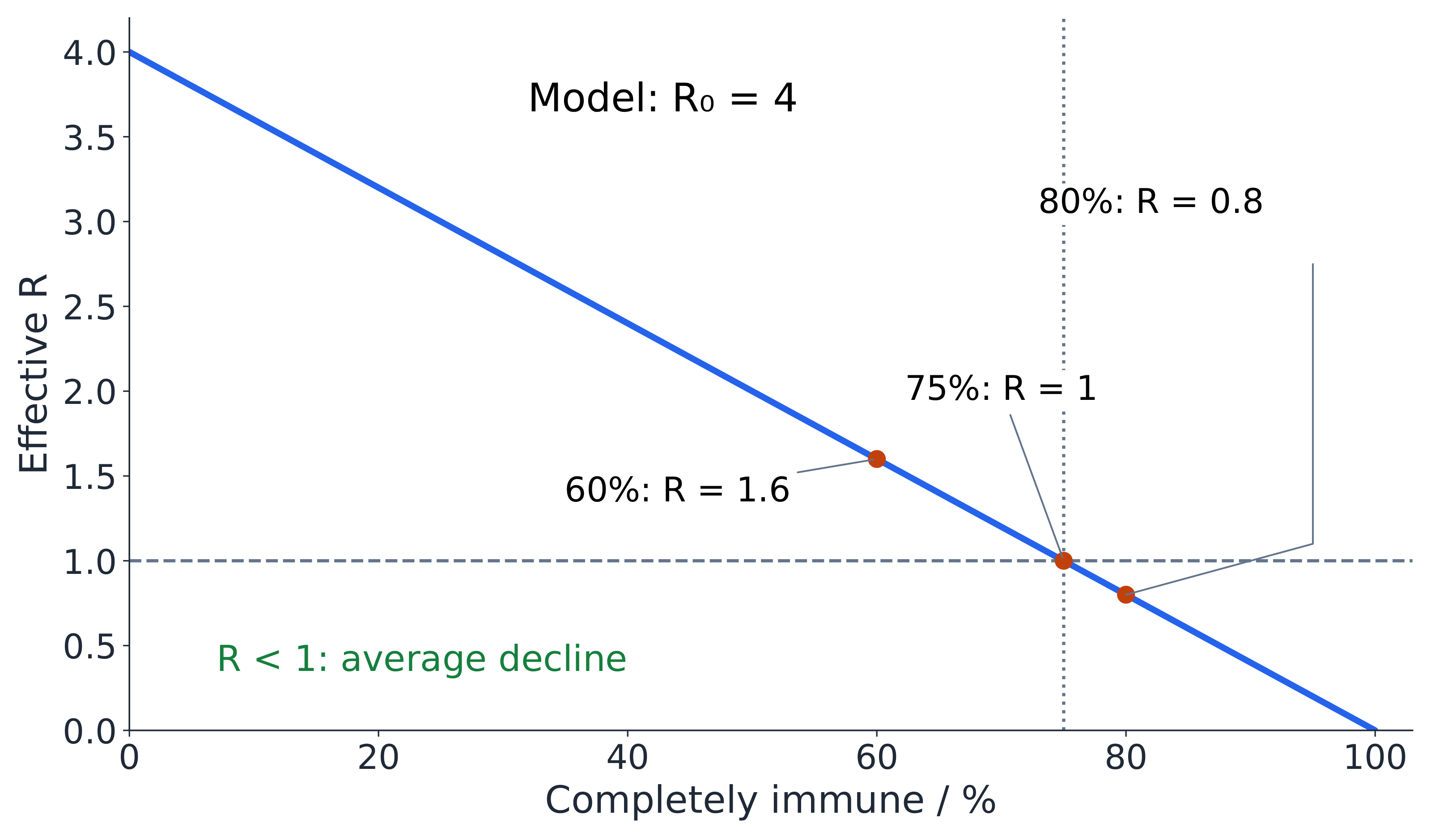
Transmission declines on average when $R<1$. Solving gives $p>1-1/R_0$ for $R_0>1$. At exactly $p=1-1/R_0$, the model gives $R=1$, the boundary rather than a declining average chain. With $R_0=4$, that boundary is 75%; 80% immune gives $R=0.8$, while 60% gives $R=1.6$. A value below one does not mean that no new case can ever occur.
The homogeneous model treats protection as complete and lasting. Exactly 75% is the boundary; values above it give average decline under these assumptions.
Vaccination coverage is not automatically the immune fraction. In a further simplified model, if a fraction $v$ is vaccinated and protection against contributing to transmission is $e$, use $p=ve$. At $R_0=4$ and $e=0.90$, the coverage boundary is $0.75/0.90\approx83.3\%$; decline requires more than that boundary. This assumes an otherwise susceptible population, uniform exposure and no other controls. Clustered contacts, waning protection, variants and uneven uptake can change outcomes. Disease severity and infectiousness are different properties; a milder illness need not have a smaller $R_0$.
探索
At the immune threshold, R equals one
Reproduce the reference's R₀ = 4 threshold of 75% completely immune and its R₀ = 2.5 threshold of 60%. Compare immunity below, at and above the boundary to distinguish replacement from declining transmission under uniform mixing and complete protection.
Prevalence describes existing cases at a specified time or over a defined period. Incidence concerns new cases arising over a stated period, with a suitable population-at-risk or person-time denominator. A cumulative count of all reported cases since the start is not the number currently ill. Always identify whether a dataset measures detected infections, symptomatic cases, admissions or another outcome.
Incidence counts new onsets in the window (two); prevalence counts cases at the snapshot (two)
WHO's historical situation report 1, published on 21 January 2020 with data reported by 20 January, gives 282 globally confirmed cases. Report 2, published on 22 January with data reported by 21 January, gives 314. The difference is 32 reported cases, and the increase is $32/282\times100\approx11.3\%$. These are early historical reported totals, not present-day pandemic totals or a complete count of every infection. The subtraction does not establish that exactly 32 people acquired infection during that day: testing, reporting delays and case definitions affect the count. Sources: WHO report 1 and WHO report 2.
Percentage change uses the initial value as denominator. A symmetric percentage difference, when that convention is requested, uses the mean of the two values: $32/298\times100\approx10.7\%$. State the formula because courses and questions can use different meanings of “percentage difference”.
For a published equal-population comparison, CDC's historical TB table gives annual US incidence of 2.5 cases per 100,000 people in 2022 and 2.9 in 2023. Multiplying each by ten gives 25 and 29 per million: the displayed difference is four cases per million per year. These are rounded surveillance rates for TB disease, not all latent infections or a snapshot of existing cases. Compare equivalent time windows, case definitions and detection, and consider age and exposure before claiming a biological cause.
26.13
考试技巧
English
Trace the actual material or signal: platelets recruit, thrombin catalyses fibrin formation, plasma cells secrete antibodies and memory cells support later responses.
Use antigen specificity and selected clones to explain the delay and secondary response. Do not say an antigen is always foreign or that all lymphocytes secrete antibodies.
Separate the pathogen, host, vector and transmission route. HIV does not spread by casual classroom contact; antibiotics do not target viruses as though they were bacteria.
Name the denominator and outcome. Distinguish percentage change, percentage points, relative risk, cumulative reported cases and current prevalence.
State the assumptions of a herd-immunity calculation and distinguish its boundary from $R<1$.
26.14
练习
English
Explain mechanisms as well as calculating answers.
Compare one physical and one chemical barrier. Explain why damage to skin can increase infection risk, and distinguish a pathogen from a harmless microorganism.
Trace platelet activity and the simplified clotting cascade through prothrombin, thrombin, fibrinogen and fibrin. State how the clot reduces both blood loss and pathogen entry.
Describe phagocytosis from movement to digestion. Compare its broad recognition with antigen-specific adaptive recognition, including one way the systems cooperate.
Define antigen, antibody and lymphocyte clone. Explain why an antigen can be a body component and why a B cell is not the same thing as its secreted antibody.
Explain helper-T-cell cooperation, B-cell activation, clonal expansion and differentiation into plasma and memory cells. Include the role of lymph nodes and the source of response specificity.
An antibody response first exceeds a fixed detection level after eight days and peaks at 15 units. A later response exceeds it after two days and peaks at 90 units. Calculate the peak ratio, peak percentage increase and percentage decrease in the delay. Explain why memory need not prevent every future infection.
Explain how HIV can weaken an antibody response without directly destroying every plasma cell. Name two transmission routes and reject the claim that sitting beside an infected person transmits HIV.
A population initially contains 200 resistant and 9,800 susceptible bacteria. After exposure, 100 resistant and 98 susceptible bacteria remain. Calculate the initial and final resistant percentages. Explain why selection can raise the fraction while lowering the resistant count, and why the same antibiotic need not act on a virus.
Distinguish the host and route for bovine tuberculosis, rabies and Japanese encephalitis. Explain why a zoonotic origin does not imply that every later human infection is acquired directly from an animal. State one limitation on claims about the first SARS-CoV-2 spillover.
In comparable groups followed for the same period, 60 of 1,200 unvaccinated and 15 of 1,200 vaccinated people develop the stated outcome. Calculate both risks, the risk ratio, relative risk reduction and absolute difference in percentage points. Give two design details needed to interpret protection.
For $R_0=5$, calculate the immune boundary and $R$ at 75% and 85% complete immunity. If protection against transmission is 90%, calculate the vaccination-coverage boundary using $p=ve$. Explain why severity alone cannot determine these quantities.
Two successive cumulative reported totals are 400 and 500. Calculate the percentage increase and the symmetric percentage difference using their mean. Explain why the difference is not necessarily the number of infections acquired between the report dates.
Over one month, group A has 24 new cases among 800 initially at-risk people, and B has 36 among 1,600. Calculate each risk and cases per 1,000, the risk ratio A/B and the difference in percentage points. Distinguish these new-case measures from a snapshot of existing cases, and propose a safe school investigation of a related question.
26.15
例题答案
English
Intact skin is a physical barrier; tear/saliva lysozyme attacks bacterial cell-wall material, or stomach acidity inhibits many swallowed organisms. A cut bypasses the surface. Pathogens cause disease; many microorganisms are harmless, and infection need not immediately cause visible disease.
Platelets adhere and activate at damage, recruiting a plug and supporting clotting reactions. The cascade activates thrombin from prothrombin. Thrombin converts soluble fibrinogen to insoluble fibrin; its mesh reinforces the plug and traps blood cells. Sealing limits leakage and pathogen entry. Platelets do not become fibrin, and red cells do not produce the clotting enzyme.
A phagocyte can leave vessels and move through tissue, recognize a target, surround it with membrane and enclose it. Lysosomal enzymes digest the enclosed material. Broad innate recognition differs from the selected receptor specificity of adaptive clones. Antigen presentation by appropriate cells helps connect engulfment with helper-T-cell activation.
An antigen is a structure recognized by a specific antibody or immune receptor; self and external molecules can both qualify. An antibody is a binding protein secreted by a plasma cell. A clone contains descendants of a selected lymphocyte retaining relevant specificity. B cells are living cells; antibodies are protein products and do not divide.
A pre-existing compatible B-cell receptor binds antigen; uptake and presentation can permit recognition and activating signals from an appropriate helper T cell. Selected cells divide by mitosis, producing a clone. Plasma descendants secrete matching antibodies; memory descendants persist. Blood and lymph transport cells, and lymph nodes provide sites for antigen–lymphocyte encounters. The antigen selects a compatible clone rather than teaching an arbitrary receptor to change into a matching one.
Peak ratio $90/15=6$; increase $(90-15)/15\times100=500\%$. Delay falls by six days, so $6/8\times100=75\%$. Memory supports faster expansion and effector production, but antigen changes, waning responses and infection-site differences can limit protection. Six times the original peak is not a 600% increase.
HIV damages CD4 helper T cells, weakening coordination and appropriate B-cell help. Two routes are sexual exposure to infectious fluids and contaminated injection equipment; pregnancy, birth or breastfeeding can also transmit the virus. Sitting nearby, touching and shared classroom air do not provide a transmission route. HIV infection is not automatically AIDS.
Initially $200/10{,}000\times100=2\%$; finally $100/(100+98)\times100\approx50.5\%$. Resistant cells fell from 200 to 100, but susceptible cells fell much more strongly. Differential survival changes the composition; survivors can then reproduce. Mutation or acquired genes supply heritable variation, not conscious adaptation. A virus lacks the bacterial cell wall or bacterial ribosomes targeted by many antibiotics.
Cattle-associated M. bovis can reach people through unpasteurized dairy products or close exposure; rabies virus can enter through an infected mammal's bite; infected Culex mosquitoes transmit Japanese-encephalitis virus from a pig/water-bird cycle. Human-to-human transmission can continue after an initial species jump. SARS-CoV-2 evidence supports zoonotic emergence, but its precise first route is unresolved; do not invent a proven intermediate animal.
Risks: $60/1200=5\%$ and $15/1200=1.25\%$. Risk ratio $1.25/5=0.25$; relative reduction 75%; absolute difference $5-1.25=3.75$ percentage points. Specify the measured outcome and equivalent follow-up; randomization or appropriate adjustment, comparable exposure, reliable case detection and uncertainty estimates also matter. The result does not automatically describe protection against transmission.
Boundary $1-1/5=0.80=80\%$. At 75% immunity, $R=5(0.25)=1.25$; at 85%, $R=5(0.15)=0.75$. At 90% protection, coverage boundary $0.80/0.90\approx88.9\%$; greater coverage is required for average decline under the assumptions. At the exact boundary $R=1$. Severity is harm to the host; $R_0$ concerns transmission under stated conditions. Uniform mixing, susceptibility and stable protection are model assumptions.
Increase $(500-400)/400\times100=25\%$. Mean $450$, so symmetric difference $100/450\times100\approx22.2\%$. These are reported cumulative cases; testing changes, reporting delays and revisions can affect the difference. Neither cumulative value measures the number currently ill, and report dates need not equal infection dates.
A: $24/800=3\%=30$ per 1,000. B: $36/1600=2.25\%=22.5$ per 1,000. Risk ratio $3/2.25\approx1.33$; difference 0.75 percentage points. A has fewer cases but higher risk. These are new cases over a month, not prevalence. Use supplied data or a repeated contact-network simulation with matched conditions; discuss limits.