跳到主要内容

C.1.2 · 细胞呼吸

IB 生物 HL · 知识点 21

本主题的视频课程 打开视频页面
4:36

细胞呼吸

运动时肌肉可利用氧气而不产生火焰。呼吸作用通过一系列受控反应传递能量。

英语旁白 · 英中内嵌字幕

21.1

范围与先修条件

English

A germinating seed can use oxygen without breathing through lungs, and a muscle can make ATP when oxygen delivery cannot meet its immediate demand. Both observations concern chemical reactions in cells. To explain them, follow energy transfers, carbon atoms and electron carriers, rather than treating respiration as another word for moving air.

This unit covers C1.2 SL and HL: ATP, its uses and recycling, respiratory substrates, aerobic and anaerobic pathways in humans, and measuring respiration. Sections marked AHL are for Higher Level only.

  • AHL Additional content covers NAD, glycolysis, lactate and yeast fermentation, the link reaction, Krebs cycle, electron transport, chemiosmosis, oxygen and differences between carbohydrate and lipid substrates.

Prerequisites are enzyme-controlled pathways, oxidation, membrane transport and rate calculations. Scope follows the IB Biology guide.

Exam tips: Write the quantity measured, its units, the control correction and the normalization. Separate ventilation, gas exchange, oxygen uptake and ATP production. ATP hydrolysis has an overall energy release; isolated bond breaking does not.

21.2

ATP连接能量释放与细胞功

English

ATP 三磷酸腺苷 stands for adenosine triphosphate. It is a nucleotide containing adenine, ribose and three phosphate groups. Adenosine is adenine plus ribose; ADP, adenosine diphosphate, has two phosphate groups. ATP is a transferable, short-term energy currency, not the main long-term energy store of a whole organism.

Marathon runners during a race
Aerobic respiration releases energy steadily for sustained exercise.
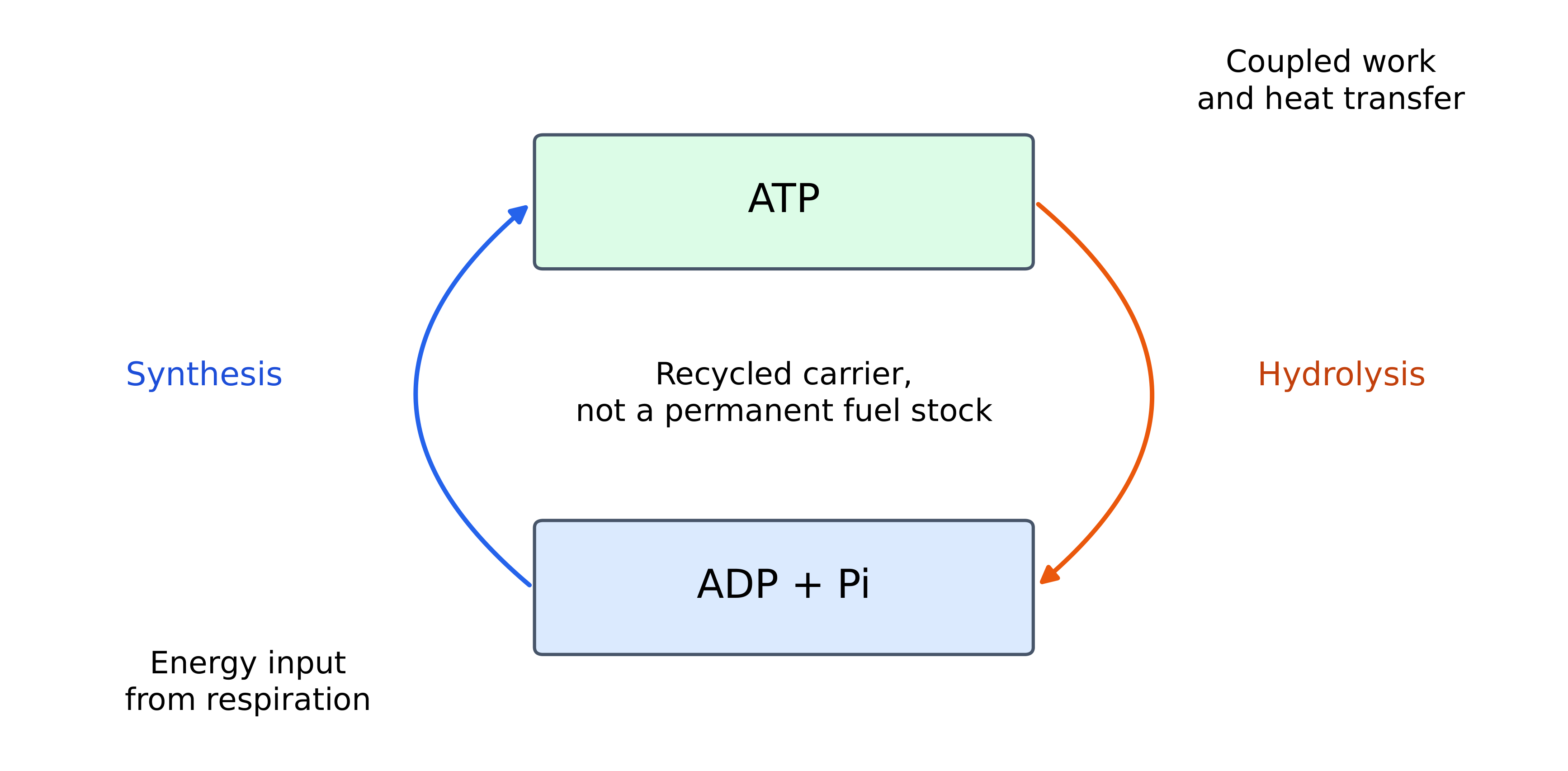
A cycle showing ADP plus phosphate turning into ATP using energy from respiration, and ATP turning back into ADP plus phosphate when energy is released for the cell
Respiration adds a phosphate to make ATP; the cell breaks it off again to release energy

Hydrolysis of ATP to ADP and inorganic phosphate releases energy overall under cellular conditions. Cells couple this reaction to processes that need energy. Breaking a phosphate bond alone does not release energy: bond breaking requires energy, and the overall hydrolysis, including formation and interactions of the products, has a favourable net energy change.

Energy from respiration can drive phosphorylation of ADP, rebuilding ATP from ADP and inorganic phosphate. ATP synthesis requires energy; ATP hydrolysis can support a coupled process. A cycling ATP supply links where energy becomes available to where it is needed. ATP is rapidly regenerated and used; a cell cannot rely on one permanent stock that is never replenished.

ATP can support active transport against an electrochemical gradient, macromolecule synthesis, muscle movement and chromosome movement during cell division. Specific proteins couple ATP use to each process; ATP does not release a free energy packet that acts at a distance. Different processes need not use the same ATP amount.

ATP synthesis and hydrolysis connecting respiration with cellular work
Pi is inorganic phosphate. The arrows represent coupled transfers. ATP is rebuilt using an energy supply; its hydrolysis can support work, with some energy dissipated as heat.

A cell makes and uses 600 ATP molecules per second while its average ATP pool stays at 120 molecules. Its turnover corresponds to $600/120=5$ pool-equivalents per second. A constant ATP concentration therefore does not imply no ATP use. If use remains high while synthesis falls, the pool can decline and energy-dependent work becomes harder to sustain.

词汇 训练
English 中文 拼音
ATP/ˌeɪ tiː ˈpiː/ 三磷酸腺苷 sān lín suān xiàn gān
21.3

呼吸作用是细胞化学过程,而非通气作用

English

Respiration 呼吸作用 transfers energy from organic substrates through enzyme-controlled reactions and supports ATP production. Glucose and fatty acids are principal substrates; other organic compounds can also enter respiratory metabolism after suitable conversion. The cell does not create energy. It transfers energy from chemical substrates into usable chemical forms, work and heat.

A flow diagram of aerobic respiration: glucose through glycolysis in the cytoplasm to pyruvate, then the link reaction and Krebs cycle in the matrix, then oxidative phosphorylation on the inner membrane making most of the ATP
The four stages and where each happens; reduced NAD and FAD carry hydrogen to the inner membrane where most ATP is made

Ventilation moves air into and out of an organ such as a lung. Gas exchange moves gases across a surface, often by diffusion. Cellular respiration consists of chemical reactions. A plant cell or a seed can respire without lungs, and lung ventilation alone is not ATP synthesis. Photosynthetic cells also respire, including when light is unavailable.

In aerobic respiration, oxygen is required for sustained complete oxidation of substrates through the aerobic system. For glucose, the simplified word equation is:

$$\text{glucose}+\text{oxygen}\rightarrow\text{carbon dioxide}+\text{water}$$

Energy released by the overall process supports ATP production; some becomes heat. ATP is not a carbon-containing waste product in that word equation, and heat is not matter. The balanced overall chemical equation is $C_6H_{12}O_6+6O_2\rightarrow6CO_2+6H_2O$. It summarizes many reactions, not a single explosive step.

In human cells, glycolysis begins in the cytosol and aerobic stages depend on mitochondria. Oxygen-rich blood cannot make a cell with no functioning aerobic machinery carry out all those mitochondrial reactions. Conversely, the cytosol can still support a limited ATP-producing pathway without mitochondrial participation.

词汇 训练
English 中文 拼音
respiration/ˌrespɪˈreɪʃn/ 呼吸作用 hū xī zuò yòng
21.4

人体无氧代谢途径维持较少的 ATP 供应

English

When oxygen supply cannot support the required aerobic rate, human cells can obtain ATP through anaerobic metabolism of carbohydrate, with lactate as a final product. The simplified word equation is glucose → lactate. This pathway yields much less ATP per glucose than complete aerobic respiration; a larger fraction of the substrate's chemical energy remains in the organic product.

A sprinter at full effort
A hard sprint relies on anaerobic respiration, building up lactic acid.
Without oxygen, glycolysis makes pyruvate, which becomes lactate in mammals or ethanol and carbon dioxide in yeast
Without oxygen, pyruvate becomes lactate (mammals) or ethanol (yeast); this regenerates NAD for glycolysis

The anaerobic pathway occurs in the cytosol and does not require mitochondria. Aerobic respiration of glucose includes cytosolic and mitochondrial stages, requires oxygen for the system to continue, and has carbon dioxide and water as overall products. Fatty acids can support aerobic respiration but cannot replace glucose in the human lactate-producing pathway.

Feature Human aerobic glucose respiration Human anaerobic glucose metabolism
Oxygen requirement Needed for sustained aerobic operation Not required for the ATP-producing pathway
Location Cytosol followed by mitochondrial stages Cytosol
Overall carbon-containing product Carbon dioxide Lactate
ATP per glucose Much larger yield Small yield; two net ATP in the full pathway
Mitochondria Required for aerobic stages Not required

A cell can use aerobic and anaerobic routes at the same time; this is not necessarily an instantaneous all-or-nothing switch. Lactate can be transported and used in later metabolism, so calling it a permanently useless poison is misleading. Aerobic respiration can use carbohydrate or fatty acids, while the anaerobic comparison here specifically concerns human carbohydrate metabolism.

21.5

呼吸计需控制气体体积、温度与压强

English

A sealed respirometer can estimate oxygen uptake by a living sample. A suitable carbon dioxide absorbent removes carbon dioxide produced by respiration. As oxygen is removed from the gas phase, the resulting pressure/volume change moves a liquid marker in a capillary. Under controlled conditions this provides an oxygen-uptake estimate; it does not directly count ATP molecules or measure every anaerobic reaction.

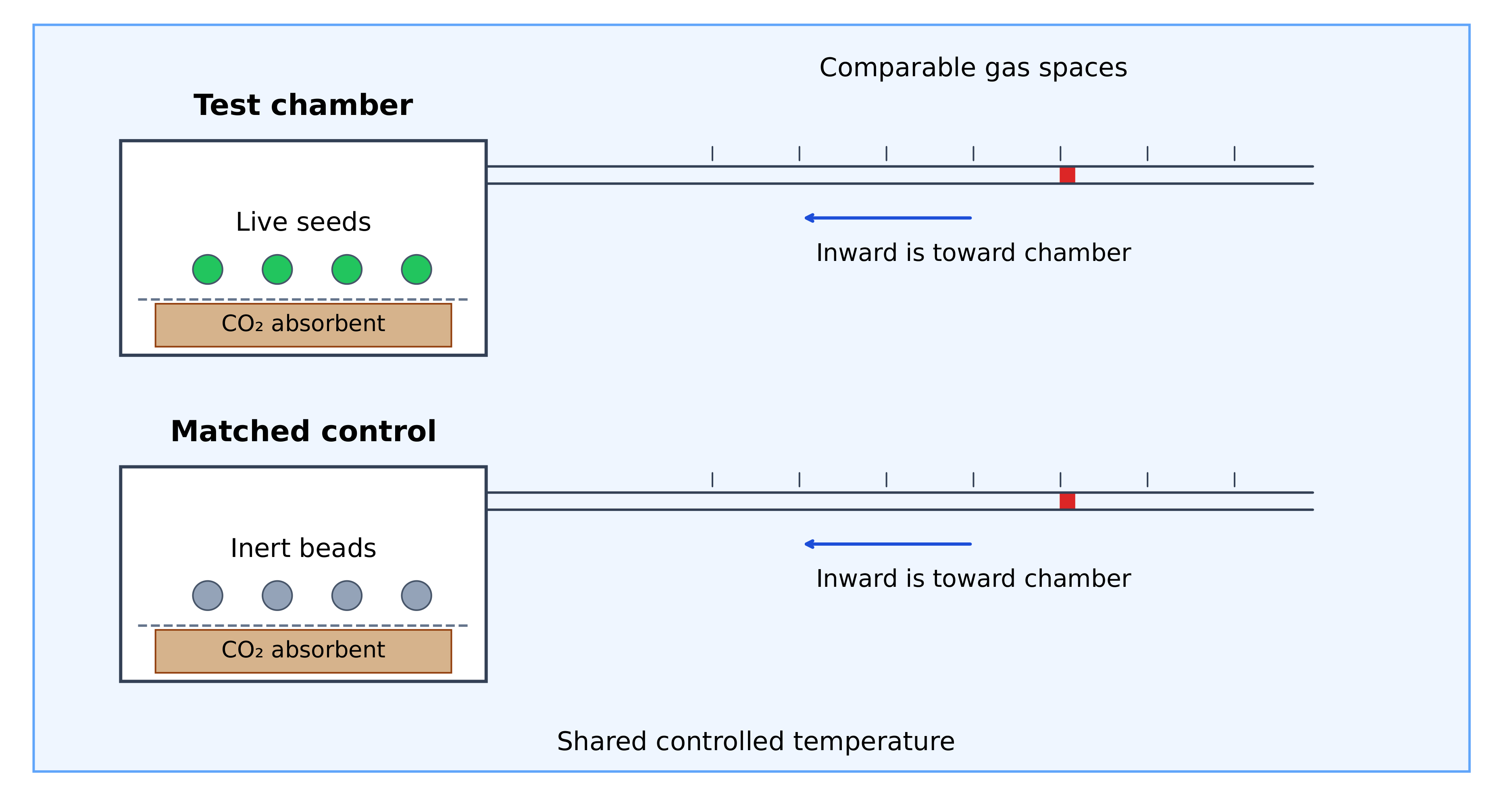
Temperature changes alter gas volume and pressure. External pressure changes, leaks, unequal starting gas spaces and incomplete equilibration can also move a marker or distort the result. A matched control with non-respiring material helps estimate background drift. Use comparable occupied volume and gas space, the same absorbent arrangement and a common temperature-controlled bath. A control is not made equivalent simply by giving glass beads the same mass as seeds.

Matched sample and non-respiring control with separate absorbent and capillary markers
Keep absorbent physically separated from organisms. Compare matched gas spaces, allow equilibration and account for background drift before attributing movement to oxygen uptake.

Use germinating seeds or another approved sample under a school protocol. Keep corrosive absorbent separated from living material with a suitable barrier, and follow the risk assessment. Set the starting marker position after equilibration, seal as required, use a fixed interval and check leaks. Repeated measurements on the same sample describe repeatability; independent biological samples are needed to estimate variation between samples.

If a calibrated apparatus indicates 0.80 cubic centimetres of oxygen uptake in 4.0 minutes for 2.0 g of tissue, the mass-specific rate is

$$\frac{0.80}{4.0\times2.0}=0.10\ \text{cubic centimetres per minute per gram}.$$

Normalizing for time and mass supports comparison, but does not remove differences in species, developmental stage, water content or tissue condition. State the mass basis and use comparable samples. An oxygen-uptake rate alone is not a direct measure of useful energy retained as ATP because substrates, coupling and maintenance costs can differ.

21.6

计算速率前先将标记物的位移换算为体积

English

For a uniform capillary, gas-volume change is cross-sectional area multiplied by displacement. If radius is $r$ and corrected distance is $d$, the volume is $\pi r^2d$. Keep all lengths in consistent units. A displacement in millimetres is not a volume in millilitres, and confusing radius with diameter changes the calculated area by a factor of four.

A capillary tube of radius 1.0 millimetre; the marker moves 24.0 millimetres toward the sample after subtracting 6.0 millimetres of control drift; volume equals pi r squared d, about 75.4 cubic millimetres or 0.0754 cubic centimetres, rate about 0.013 cubic centimetres per minute per gram
Turn a marker distance into a gas volume with pi r squared d before dividing by time and mass

In an apparatus, radius is 1.0 mm, inward test displacement is 30.0 mm and matched inward control drift is 6.0 mm. Under the stated subtraction model, corrected displacement is $30.0-6.0=24.0$ mm. Volume is $\pi(1.0)^2(24.0)\approx75.4$ cubic millimetres, or 0.0754 cubic centimetres. Over 4.0 minutes with 1.5 g of sample, rate is about $0.0754/(4.0\times1.5)=0.0126$ cubic centimetres per minute per gram, or 0.013 to two significant figures.

Subtract drift with its sign: if the control moves outward while test moves inward, using both positive magnitudes and subtracting them can be wrong. Define a positive direction and justify that the control estimates the relevant shared drift. Large or unstable drift suggests the apparatus needs improvement, rather than that any subtraction automatically recovers a valid respiration rate.

For a temperature investigation, compare fresh equivalent samples at several controlled temperatures after equilibration. Hold sample type, germination stage, mass basis, gas space, oxygen availability and measurement interval suitably constant. Repeat and plot the rate against temperature with variation shown. A rate change can reflect enzyme activity and sample physiology; high temperature can damage the tissue. Do not infer an exact optimum from two temperatures or confuse three readings on one seed group with three independent groups.

探索

耗氧量更多,还是每克组织的速率更高?

样本A的2 g组织在4分钟内消耗0.80 cm³氧气,即每分钟每克0.10 cm³。在同时考虑测量时间和组织质量后,比较第二个样本。

21.7

AHL:NAD 将底物氧化与另一还原反应联系起来

English

Oxidation is electron loss, while reduction is electron gain. Removing hydrogen with electrons from an organic substrate oxidizes it. Oxidized NAD accepts a pair of electrons and a proton to become reduced NAD, also called NADH. A simplified electron-accounting equation is:

$$\mathrm{NAD}^{+}+2e^-+H^+\rightarrow\mathrm{NADH}.$$

The paired reaction oxidizes a substrate as NAD is reduced. Later NADH transfers electrons to another acceptor, becoming oxidized NAD again. NAD is therefore a recyclable carrier, not a permanent sink or a source that creates electrons. Regeneration matters: a pathway requiring oxidized NAD slows or stops if its carrier pool remains reduced.

21.8

AHL:糖酵解先消耗ATP,之后才产生净收益

English

In glycolysis, one six-carbon glucose is phosphorylated using two ATP in the investment stage. A six-carbon intermediate splits into two three-carbon phosphorylated molecules. Their subsequent oxidation reduces two NAD to NADH per original glucose, and substrate-level phosphorylation forms four ATP in total. The two three-carbon products are pyruvate.

Glucose is phosphorylated using 2 ATP to fructose bisphosphate, split into two triose phosphates, then oxidised to two pyruvates, with a net gain of 2 ATP and reduced NAD
Glycolysis spends 2 ATP to start but makes 4, so the net gain is 2 ATP (plus reduced NAD) — and it needs no oxygen

Gross ATP production is four, but two were invested, giving a net gain of two ATP per glucose. Both the gross/net distinction and the duplication of reactions after splitting matter. Counting each later event once instead of twice loses half the products. Glycolysis itself does not release carbon dioxide and does not directly consume oxygen; whether it can continue depends on regeneration of the needed carriers and substrates.

In human anaerobic metabolism, pyruvate is reduced to lactate using NADH. This regenerates oxidized NAD so glycolysis can continue. Converting pyruvate to lactate does not add another ATP yield; the net two ATP came from glycolysis. Carbon remains in two three-carbon lactate molecules for each six-carbon glucose.

In yeast fermentation, pyruvate loses carbon dioxide to form ethanal; ethanal is reduced to ethanol using NADH, regenerating NAD. Per glucose, the products are two ethanol molecules and two carbon dioxide molecules, with the same net two ATP from glycolysis. Brewing uses ethanol production; baking uses carbon dioxide to expand dough. Oxygen conditions, temperature and substrate availability affect the process; yeast and human final products must not be swapped.

21.9

AHL:连接反应与克雷布斯循环分别解释碳元素去向

English

In aerobic eukaryotic respiration, pyruvate enters the mitochondrial matrix. Each three-carbon pyruvate is oxidized and decarboxylated in the link reaction: one carbon leaves as carbon dioxide, NAD is reduced, and the remaining two-carbon acetyl group attaches to coenzyme A. One glucose gives two pyruvate, hence two acetyl groups, two carbon dioxide and two NADH at this stage. The link reaction does not directly produce ATP.

The link reaction turns pyruvate into acetyl CoA, releasing carbon dioxide and reduced NAD. Acetyl CoA joins oxaloacetate (4C) to make citrate (6C), which becomes a 5C compound, then a 4C compound, then oxaloacetate again; arrows off the ring show carbon dioxide and reduced NAD released twice, then reduced NAD, reduced FAD and ATP. A box totals one turn: 2 carbon dioxide, 3 reduced NAD, 1 reduced FAD, 1 ATP
The link reaction feeds acetyl CoA into the cycle. Each turn releases 2 CO$_2$ (decarboxylation), 3 reduced NAD and 1 reduced FAD (dehydrogenation), and 1 ATP

In the Krebs cycle, a two-carbon acetyl group joins four-carbon oxaloacetate to form six-carbon citrate. Subsequent reactions regenerate oxaloacetate. Two decarboxylations release two carbon dioxide per turn; four oxidations transfer electrons to carriers. In standard bookkeeping these yield three NADH and one reduced FAD per acetyl group, together with one ATP-equivalent by substrate-level phosphorylation. Four oxidations do not mean four NADH: the electron acceptor differs at one step.

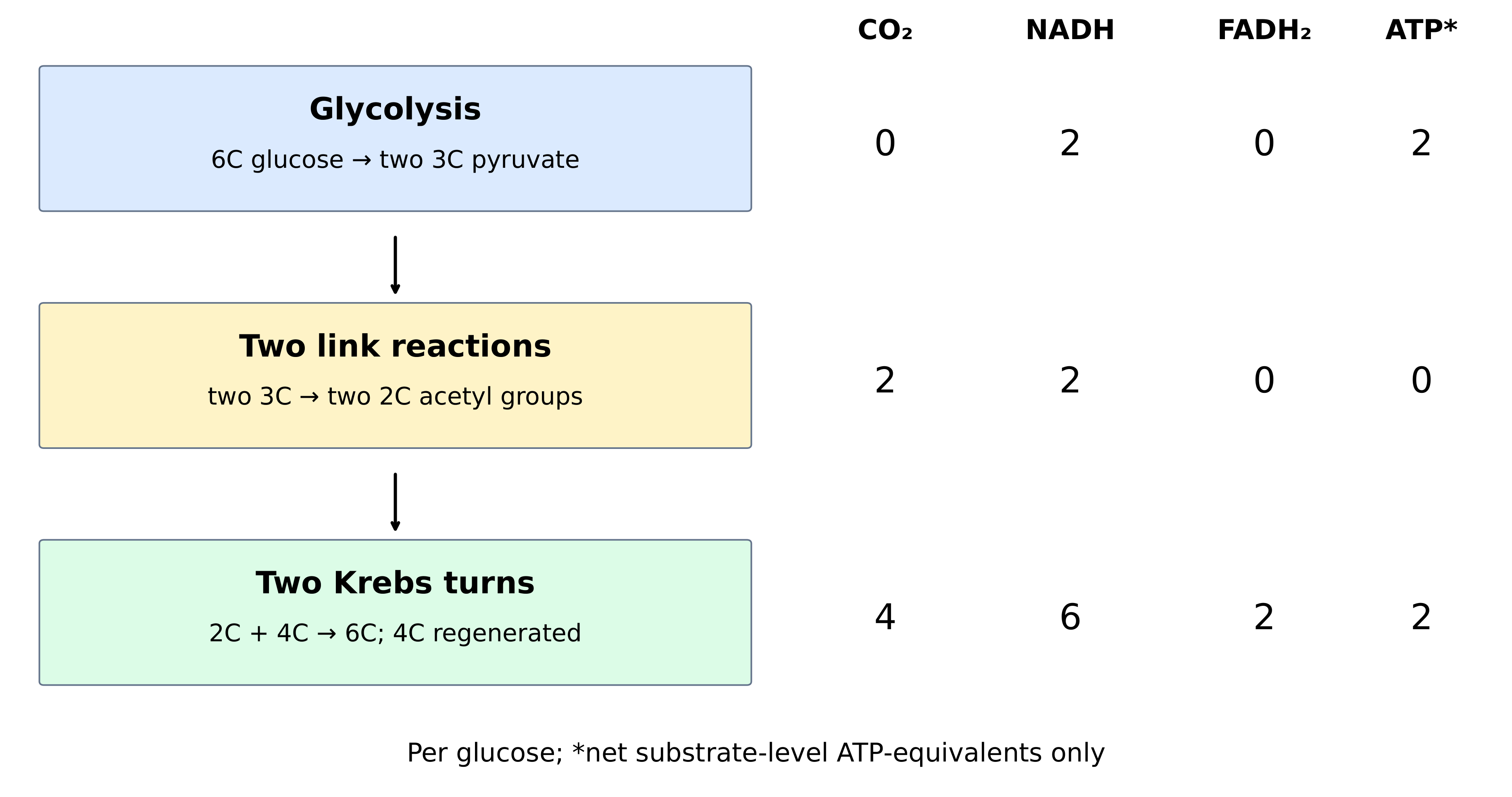
Carbon and carrier accounting from one glucose through glycolysis, the link reaction and two Krebs turns
Count per original glucose. Oxaloacetate is regenerated, so it is not a new four-carbon net input on every turn. Electron transport is not included in the substrate-level ATP column.
Stage per glucose Carbon dioxide Reduced NAD Reduced FAD Net substrate-level ATP-equivalents
Glycolysis 0 2 0 2
Two link reactions 2 2 0 0
Two Krebs turns 4 6 2 2
Total 6 10 2 4

The carrier totals describe the standard complete-glucose model, not ATP molecules made directly by those carriers. Oxaloacetate regeneration and carbon counts explain cycle organization, but do not identify which particular carbon atom leaves in the first turn. Other pathways can draw off intermediates and need replenishment.

21.10

AHL:电子传递在内膜两侧建立梯度

English

Reduced NAD supplies electrons from glycolysis, the link reaction and the Krebs cycle to the mitochondrial electron-transport system. Matrix NADH transfers a pair of electrons to the chain and is oxidized to NAD. Reducing equivalents from cytosolic NADH enter through shuttle systems; the NADH molecule does not simply diffuse freely across the inner membrane.

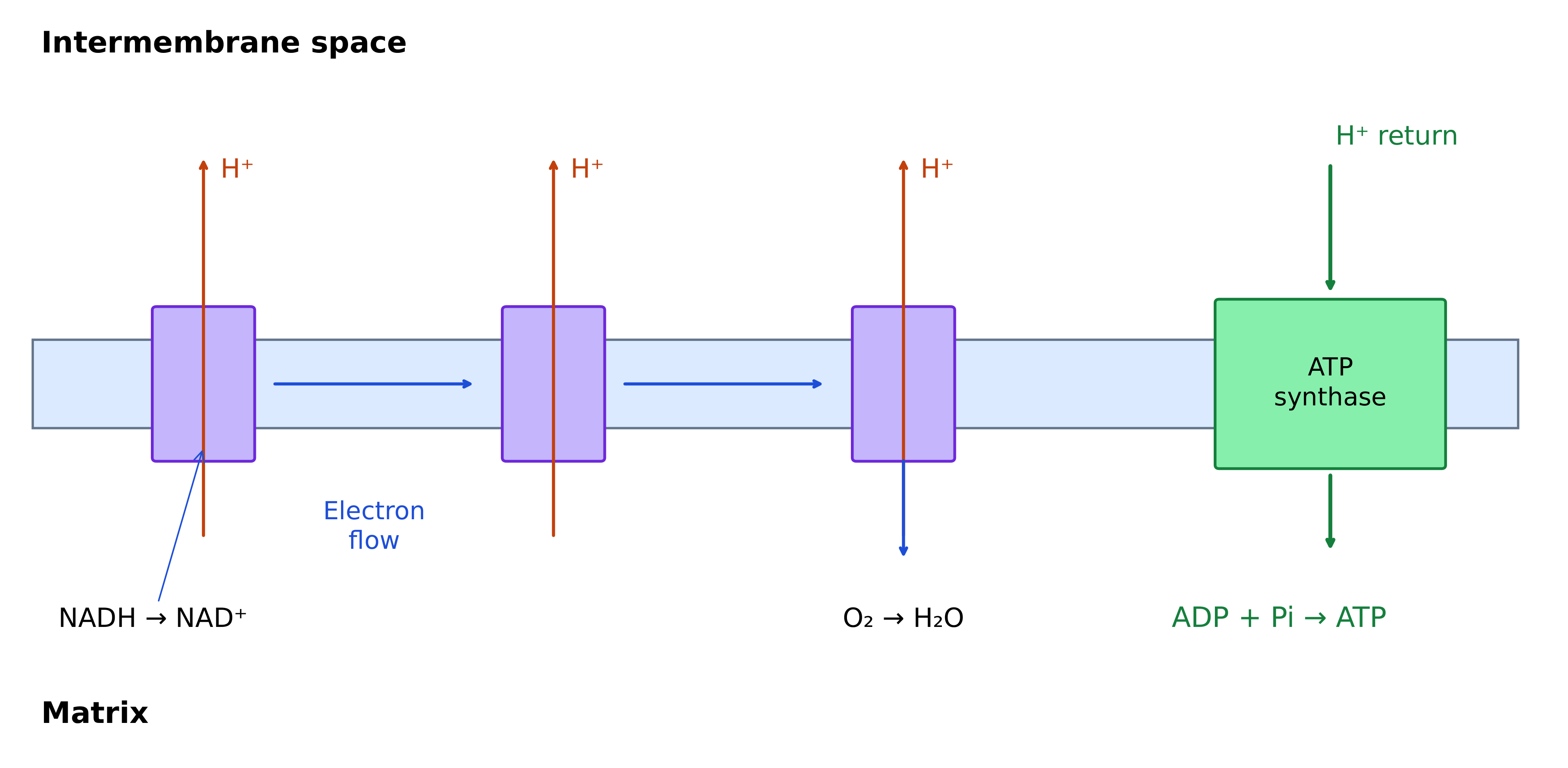
Energy transferred as electrons pass along carriers drives proton pumping from the matrix into the intermembrane space. This creates an electrochemical proton gradient: both concentration and electrical potential contribute. The inner membrane limits uncontrolled proton return; the gradient is across that membrane, not across the outer membrane or across the whole cell surface.

Oxygen is the terminal electron acceptor. It combines with electrons and protons to form water, allowing electron flow to continue. Oxygen is not converted into the carbon dioxide released by decarboxylation, and it does not directly join ADP to phosphate. A useful terminal step is $O_2+4e^-+4H^+\rightarrow2H_2O$.

Electron flow, proton pumping, oxygen reduction and proton return through ATP synthase
Electron flow pumps protons out of the matrix. Protons return through ATP synthase, coupling gradient energy to ATP formation on the matrix side.
21.11

AHL:化学渗透作用使质子回流与ATP合成偶联

English

Protons move from the intermembrane space toward the matrix through ATP synthase, down their electrochemical gradient. The enzyme couples that flow to phosphorylation of ADP using inorganic phosphate. This is chemiosmosis and supports oxidative phosphorylation. The return through ATP synthase is opposite to the proton-pumping direction driven by electron transport.

Two inner-membrane sections: when coupled, pumped protons return through ATP synthase and ATP is made; when leaky, protons return through a leak, oxygen use continues but little ATP is made
Coupled versus leaky membranes: oxygen use continues in both, but only proton flow through ATP synthase makes ATP

If electron flow stops, proton pumping falls; existing gradients can support ATP synthesis briefly but dissipate without continued maintenance. NADH oxidation is impaired, limiting regeneration of NAD and therefore upstream oxidation. If instead protons leak across the membrane without passing through ATP synthase, electron transport and oxygen uptake can continue while ATP yield falls. Oxygen consumption therefore does not by itself prove efficient ATP production.

Do not insist on one universal total such as 36 or 38 ATP per glucose for every eukaryotic cell. Shuttle pathways, proton leak, transport and other costs affect the final yield. The robust comparisons are the small anaerobic net yield, the greater aerobic yield, the substrate-level contributions and the role of the gradient. A stated model yield can still be used for a calculation if its assumptions are given.

21.12

AHL:脂质与碳水化合物以不同方式进入代谢途径

English

Fatty acids are broken down into acetyl groups, carried by coenzyme A into the Krebs cycle; the usual even-chain fatty-acid model enters downstream of glycolysis. These reactions also generate reduced carriers. Fatty acids contain relatively less oxygen and more oxidizable carbon/hydrogen per gram than carbohydrate, giving a higher energy yield per gram on complete oxidation.

Glucose enters through glycolysis and pyruvate; glycerol joins glycolysis; fatty acids are split into acetyl groups that join acetyl CoA, which needs oxygen; 8.0 g fat gives 312 kJ against 136 kJ for carbohydrate
Glucose enters at glycolysis, glycerol joins it, and fatty acids enter as acetyl groups: aerobic only, but more energy per gram

For a comparison using 39 kJ/g for fat and 17 kJ/g for carbohydrate, 8.0 g gives 312 kJ versus 136 kJ, a ratio about 2.29. These are supplied overall energy values, not a claim that every gram yields this much ATP energy. Physiological conditions and the chemical substrate matter.

Carbohydrate can feed glycolysis and support the human lactate-producing anaerobic route. Fatty-acid oxidation cannot sustain that route: its reduced carriers require the functioning aerobic system for continued reoxidation. “Fat has more energy” does not imply it can replace carbohydrate in every oxygen-limited situation. Glycerol and other lipid components have their own entry routes, so distinguish a fatty acid from every molecule associated with a lipid.

21.13

练习

English
  • AHL Marked questions use the additional sections.
  1. State ATP's full name and components. Explain how ATP synthesis and hydrolysis connect respiration with two named cellular processes, and correct “breaking the phosphate bond itself releases energy”.
  2. A cell maintains a pool of 150 ATP molecules while synthesizing and using 750 per second. Calculate pool-equivalents used per second. Explain why a steady concentration does not mean no ATP turnover.
  3. Distinguish ventilation, gas exchange and cellular respiration. Explain why a seed and a plant cell in darkness can respire.
  4. Compare human aerobic and anaerobic glucose pathways by oxygen requirement, location, products, mitochondrial requirement and relative ATP yield. Write simple word equations and state whether fatty acids can replace glucose in the lactate pathway.
  5. Explain why respiration transfers rather than creates energy, why oxidation need not involve a flame, and why oxygen uptake alone does not give the exact ATP output.
  6. Describe how a respirometer with carbon dioxide absorbent estimates oxygen uptake. Identify two non-respiratory causes of marker movement and the role of a matched inert-material control.
  7. A sample of mass 1.5 g uses 0.96 cubic centimetres of oxygen in 4.0 minutes. Calculate its mass-specific uptake rate and give the units.
  8. Capillary radius is 0.50 mm. Test and matched control move inward by 40.0 and 8.0 mm in 5.0 minutes. Sample mass is 0.80 g. Under the subtraction model, find corrected volume in cubic centimetres and mass-specific rate. What error follows from using the diameter as the radius?
  9. Plan a temperature comparison using germinating seeds. Explain equilibration, comparable sample/gas-space conditions, repeats and absorbent separation.
  10. A control moves outward by 2 mm while the test moves inward by 10 mm. Taking inward as positive, find corrected displacement. Why would large erratic control movement still undermine the experiment?
  11. Three independent seed samples give mass-specific rates 0.09, 0.11 and 0.10 in the same units. Calculate the mean and range. State why normalizing by mass does not remove all differences between samples and why the range is not automatically a confidence interval.
  12. AHL Account per glucose for glycolysis, the two link reactions and two Krebs turns: carbon products, carbon dioxide, NADH, reduced FAD and net substrate-level ATP. Explain NAD recycling, ATP investment versus gross production and oxaloacetate regeneration.
  13. AHL Explain electron transport, proton-pumping direction, oxygen's terminal role and proton return through ATP synthase. Predict the effects of blocking electron flow versus allowing proton leakage; why can oxygen uptake persist with reduced ATP yield?
  14. AHL Compare NAD regeneration and final carbon products in human lactate formation and yeast fermentation, including brewing/baking. Compare 6.0 g each of fat and carbohydrate using supplied values 39 and 17 kJ/g, and explain why the higher-energy substrate cannot replace carbohydrate in every anaerobic situation.
21.14

例题答案

English
  1. Adenosine triphosphate contains adenine, ribose and three phosphates; adenosine is adenine plus ribose. Respiration supports ATP synthesis from ADP and inorganic phosphate. Coupled hydrolysis supports active transport, macromolecule synthesis or movement of muscles/chromosomes. Hydrolysis releases energy overall, but isolated bond breaking requires energy; formation and interactions of products determine the net change.
  2. $750/150=5$ pool-equivalents per second. Equal synthesis and use maintain the pool while individual molecules cycle rapidly. If synthesis falls without a matching fall in use, ATP concentration can decline and ATP-dependent functions are limited.
  3. Ventilation moves air; gas exchange transfers gases across a surface; respiration is cellular chemistry supporting ATP production. Seeds use stored substrates in living cells. Plant cells also respire in darkness: respiration differs from photosynthesis and does not require lungs.
  4. Aerobic: glucose + oxygen → carbon dioxide + water; oxygen required, cytosolic glycolysis then mitochondrial stages, much greater ATP yield. Human anaerobic: glucose → lactate; cytosol, no mitochondria required, no oxygen required for that pathway, two net ATP per glucose. Both routes can operate simultaneously. Fatty acids do not replace glucose in the lactate-producing route.
  5. Chemical energy in substrates is transferred to ATP, work and heat rather than created. Enzyme-controlled steps can proceed without combustion or a visible flame. Oxygen uptake measures one gas flux; substrates, energy coupling and other costs vary, so it is not an exact count of ATP made.
  6. Absorbent removes respiratory carbon dioxide; oxygen uptake then reduces gas-phase amount and moves the marker under controlled conditions. Temperature/pressure drift, leaks or poor equilibration can distort movement. A non-respiring control with comparable gas space and apparatus estimates shared drift. Keep absorbent separated from organisms.
  7. $0.96/(4.0\times1.5)=0.16$ cubic centimetres per minute per gram. Divide by both duration and sample mass; retain the mass basis when comparing samples.
  8. Corrected distance $40.0-8.0=32.0$ mm. Area $\pi(0.50)^2\approx0.7854$ square millimetres; volume $0.7854\times32.0\approx25.13$ cubic millimetres $=0.02513$ cubic centimetres. Rate $0.02513/(5.0\times0.80)\approx0.00628$, or 0.0063 cubic centimetres per minute per gram to two significant figures. Using diameter 1.0 mm as radius would multiply area, volume and rate by four.
  9. Equilibrate equivalent samples in controlled baths before resetting/sealing markers as required and timing uptake. Match species/stage, mass basis, gas space, oxygen availability and duration; use matched controls and independent samples with repeats. Separate absorbent by a suitable barrier under the school protocol. Bath expansion or tissue damage can distort the comparison.
  10. Test $+10$ mm; control $-2$ mm; corrected displacement $10-(-2)=12$ mm. The subtraction assumes control drift represents the test's shared background. Large unstable changes can indicate leaks or poor equilibration, and subtraction cannot guarantee a valid oxygen estimate.
  11. Mean $(0.09+0.11+0.10)/3=0.10$; range $0.11-0.09=0.02$ in the stated units. Mass normalization leaves differences in tissue type, stage, water content and condition. Range describes observed spread; a confidence interval needs a defined statistical method and assumptions.
  12. AHL Glycolysis: 6C glucose → two 3C pyruvate, no carbon dioxide, two NADH, gross four ATP minus investment two = net two. Link: two 3C pyruvate → two 2C acetyl groups + two carbon dioxide, two NADH, no ATP directly. Krebs: two turns release four carbon dioxide, produce six NADH, two reduced FAD and two ATP-equivalents. Totals: six carbon dioxide, ten NADH, two reduced FAD and four net substrate-level ATP-equivalents before oxidative phosphorylation. Oxidized NAD accepts electrons/hydrogen and must be regenerated; oxaloacetate accepts acetyl groups and is regenerated, not consumed as a new net input each turn.
  13. AHL Electrons from reduced carriers pass through the inner-membrane chain; released energy pumps protons from matrix to intermembrane space. Oxygen accepts electrons and protons to form water. Protons return to matrix through ATP synthase, coupling gradient energy to ADP phosphorylation. Blocking electron flow stops continued pumping; the gradient then dissipates, ATP synthesis falls and NADH oxidation is impaired. Proton leakage instead bypasses ATP synthase: oxygen uptake/electron transport can continue while less gradient energy is captured in ATP, so oxygen flux alone does not establish efficiency.
  14. AHL In humans, pyruvate accepts reducing equivalents from NADH to form lactate, regenerating NAD; two 3C lactates per glucose and no extra ATP at that conversion. In yeast, pyruvate loses carbon dioxide, then ethanal is reduced to ethanol; two ethanols and two carbon dioxide per glucose, regenerating NAD. Both retain net two ATP from glycolysis. Brewing uses ethanol, baking carbon dioxide. Supplied energy comparison: $6.0\times39=234$ kJ versus $6.0\times17=102$ kJ; ratio $234/102\approx2.29$. Fatty acids enter mainly as acetyl groups and depend on aerobic carrier reoxidation; they cannot sustain the human glycolytic lactate route despite their larger energy per gram.
这有帮助吗?

更多 IB 生物 HL 知识点

登录或创建账户

IGCSE, A-Level & AP