A fertilized egg gives rise to cells that carry oxygen, shorten to produce force or pass electrical signals over long distances. Most of these cells retain essentially the same genome, yet their shapes and activities differ. How does one set of instructions support so many structures, and why does cell size matter?
This unit covers B2.3 SL understandings plus additional higher-level content (marked AHL): differentiation, stem-cell properties and niches, developmental potency, cell-size diversity, surface area and volume, exchange adaptations, pneumocytes, muscle cells and human gametes. Prerequisites are gene expression, membrane transport and organelle functions. Sections marked AHL are for Higher Level only.
14.2
分化改变基因表达与细胞结构
English
Following fertilization, mitotic divisions produce cells that can contribute to different tissues. Differentiation 分化 is the development of specialized structures and functions. It involves different patterns of gene expression 基因表达: genes are used to produce functional products, including proteins that affect a cell's activity and shape. An oxygen-carrying cell and a contracting cell need different combinations and amounts of proteins.
A stem cell differentiates into specialised cell typesA threshold model: position along a signal gradient decides which gene-expression programme a cell switches on
Differentiation does not usually require deleting most genes. Most nucleated body cells retain broadly the same DNA sequence while using different parts of it. Mature mammalian red blood cells are an important exception to the usual nucleated-cell pattern: they lose their nucleus during development. Do not extend that exception to every mature animal cell.
Cells also receive different signals. In an early embryo, a signalling substance can form a concentration gradient. Cells at different positions encounter different concentrations and can activate different gene-expression programmes. A threshold model helps explain how position becomes a difference in cell fate. It is not a claim that all embryos use one chemical or one universal concentration threshold.
In a model, cells exposed to signal below 2 units express programme A; from 2 up to but not including 5 units they express B; at 5 or above they express C. Exposures of 1, 3 and 6 units predict A, B and C respectively. A cell at exactly 2 belongs to B and one at exactly 5 to C. The genes did not need to disappear for the responses to differ. Testing this explanation needs gene-expression measurements and controlled signal exposure, not just different cell shapes.
A stem cell can produce more stem cells by self-renewal and can give rise to specialized descendants. These are different properties. A cell that divides many times but produces only one already specialized type has not thereby demonstrated broad developmental potency. A cell that differentiates once without maintaining a stem-cell population has not demonstrated long-term self-renewal.
A colony of human embryonic stem cells under the light microscopeOne unspecialised stem cell can differentiate into many specialised cell types
Stem cells can sustain repeated division under suitable conditions, potentially maintaining a population for a long period. This does not mean every stem cell divides continuously, survives forever or has unlimited capacity under any culture conditions. Some remain relatively inactive until suitable signals arrive. The NIH stem-cell introduction distinguishes renewal from differentiation; neither property makes a stem cell identical to a cancer cell.
Worked example: different division patterns give different populations
Begin with one stem cell. In a simplified asymmetric model, each round produces one continuing stem cell and one specialized descendant. After four rounds along that continuing stem-cell line, there is one stem cell and four specialized descendants, assuming descendants survive and do not divide. There are five cells in total, not sixteen stem cells.
In a different model, every stem cell divides into two stem cells in every round, with no death or differentiation. Four rounds give $2^4=16$ stem cells and no specialized descendants. These models hold different assumptions. State which population can divide and what each division produces before applying a power of two.
14.4
成体生态位调节更新和组织维持
English
A stem-cell niche is the local environment that influences stem-cell behaviour. Neighbouring cells, extracellular material and local signals can help preserve a stem-cell population or promote proliferation and differentiation. The niche is not simply an empty space in which any cell becomes pluripotent.
The niche's neighbouring cells and signals keep a stem-cell population while supplying cells that differentiate.
Two human examples are bone marrow and hair follicles. Bone marrow contains blood-forming stem cells that supply blood-cell lineages. Hair-follicle niches include epithelial stem cells involved in renewing follicular structures during hair cycles. These stem cells do not normally make every cell type in the body. Different niches provide different signals and support different tissue needs.
A useful experiment separates changes in cell number from changes in differentiation. In a culture, three control dishes each begin with 100 comparable cells and yield 8, 10 and 12 cells expressing a differentiation marker. Signal-treated dishes yield 38, 40 and 42. Each dish contains 100 viable cells at measurement. Mean marker-positive proportions are 10% and 40%, a difference of 30 percentage points and a fourfold ratio.
This supports an effect on the measured marker under the tested conditions. It does not by itself prove complete functional differentiation, identify every signalling step or show that the same signal has the same effect in a person. Control starting cells, culture conditions, observation time and marker threshold; measure survival and total cell number as well. A loss of marker-negative cells could change a proportion without producing more specialized cells.
14.5
区分全能、多能和多潜能细胞
English
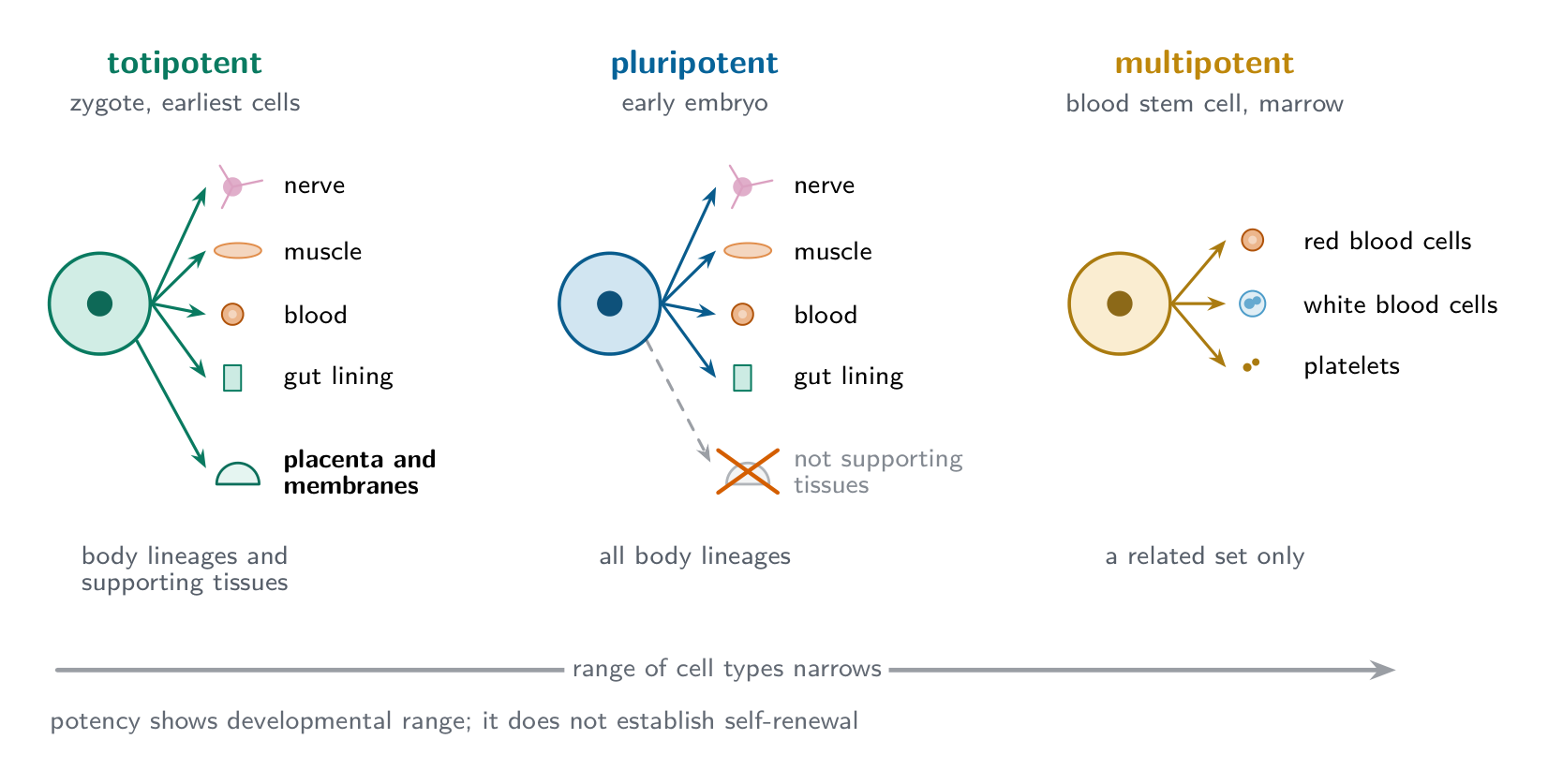
Potency describes the range of developmental outcomes a cell can produce under suitable conditions. It is not the rate at which the cell divides. The zygote divides into embryonic cells; it does not keep producing replacement zygotes. Its totipotency alone does not demonstrate stem-cell self-renewal.
Potency
Range of outcomes
Suitable context
Totipotent
Embryonic and supporting extraembryonic lineages needed for a complete conceptus
Zygote and certain very early embryonic cells
Pluripotent
The body's diverse cell lineages, without independently supplying every supporting lineage for a complete conceptus
Cells associated with the early embryo; established pluripotent cell lines
Multipotent
Several related cell types within a more restricted developmental range
Blood-forming stem cells in adult bone marrow
The fans compare developmental ranges, not a universal timetable or stages that every individual cell must pass through.
Early developmental cells soon become more restricted in their usual potential. A blood stem cell can produce several blood-cell types while remaining multipotent; that range does not make it pluripotent. Conversely, producing representatives of three body lineages in one experiment is evidence of breadth, but a few marker readings alone do not demonstrate every possible body lineage or a complete organism.
Keep the terms precise when reading a question. If cell X is specified to supply both body and supporting lineages of a complete conceptus, X is totipotent. If Y supplies the body's diverse lineages but not every necessary supporting lineage independently, Y is pluripotent. If Z supplies several related blood-cell lineages, Z is multipotent. The classifications follow the stated capacity, not the age of a donor alone.
14.6
细胞大小反映不同的功能需求
English
A diameter, cell-body width and total length are different measurements. Representative human red blood cells are about 7–8 μm across, many white blood cells are roughly 10–20 μm across, and a human egg cell is approximately 100–120 μm across. These are approximate biological ranges, not practice measurements or fixed sizes of every specimen.
Red blood cells under a scanning electron microscope: small, flexible biconcave discs, about 7–8 µm across, that squeeze through capillaries
A sperm head is only a few micrometres long, while the whole sperm, including its flagellum, is tens of micrometres long. A neuron may have a small cell body and an axon extending a great distance; a long axon does not imply a spherical cell body of the same diameter. A skeletal muscle fibre can extend centimetres while remaining much narrower than its length. Compare the same dimension and unit before ranking sizes.
Large cytoplasmic volume can supply material for early development in an egg. A long neuronal process supports communication over distance, and an elongated muscle fibre supports force along its length. Small size and thin regions can support exchange. Size therefore has benefits and constraints; there is no single best dimension for every cell function.
14.7
几何学将交换面积与体积相关的需求联系起来
English
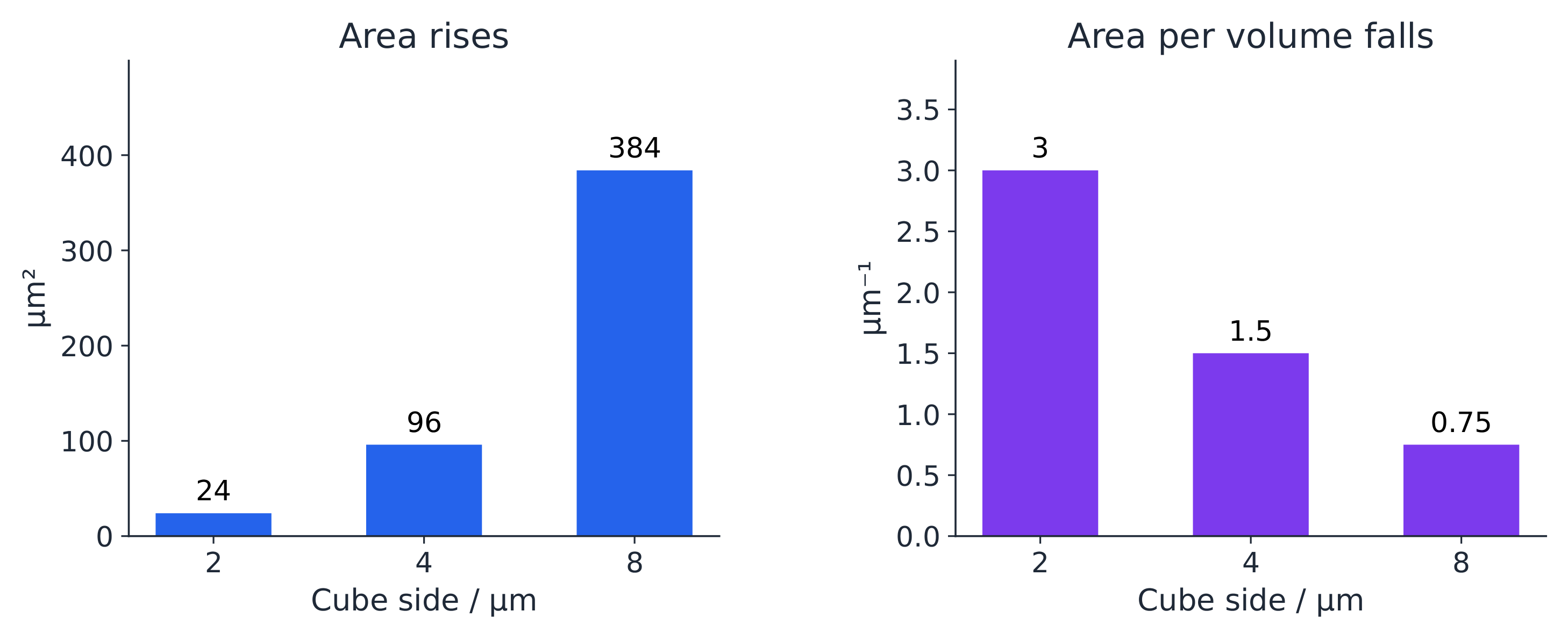
For similarly shaped cells, exchange capacity across the surface depends partly on available area, whereas material requirements and waste production are often related to volume. If linear size increases, volume grows faster than area. The ratio falls even though total surface area increases. Permeability, transport proteins, gradients, temperature and metabolic activity also affect real exchange.
As a cube (or cell) grows, its surface area : volume ratio gets smaller
For a cube of side $a$, surface area is $6a^2$, volume is $a^3$ and surface area-to-volume ratio is $6/a$. With $a$ measured in μm, the ratio has unit $\mathrm{\mu m^{-1}}$.
Cube side / μm
Area / μm²
Volume / μm³
Area/volume / μm⁻¹
2
24
8
3.0
4
96
64
1.5
8
384
512
0.75
Doubling side length multiplies area by four and volume by eight, halving the ratio. A larger cube has more area in total but less area per unit volume. For a sphere, the corresponding ratio is $3/r$: radii 2, 4, 6 and 10 length units give 1.5, 0.75, 0.50 and 0.30 per length unit. Do not use diameter as $r$.
All faces are assumed exposed. Cells touching each other in a tissue do not necessarily expose every face to the outside medium.
A 4 μm cube has volume 64 μm³ and area 96 μm². Eight separate 2 μm cubes have the same combined volume, $8(8)=64$ μm³, but total area $8(24)=192$ μm². Their exposed area is doubled under this model. This does not mean that cutting real cells into pieces creates eight viable cells: membranes, organelles and other requirements must be maintained.
Diffusion distance adds another constraint. Increasing the distance from surface to centre can slow transfer to the centre. Shape changes, internal transport and metabolic differences can help cells function despite a large length or volume. A cube or sphere isolates geometric scaling; it does not reproduce every cell's shape or predict an exact maximum cell size.
At fixed volume, changing shape can increase surface area and reduce a diffusion path. An 2 × 2 × 2 μm cube has volume 8 μm³ and area 24 μm². A 0.5 × 4 × 4 μm cuboid has the same volume but area $2(0.5\times4+0.5\times4+4\times4)=40$ μm². Its area/volume ratio is 5 μm⁻¹ instead of 3 μm⁻¹, and the shortest distance from its centre to a face is 0.25 μm instead of 1 μm. This compares model shapes, not a claim that cells are rectangular blocks.
Flattening the same volume raises the area and shortens the diffusion path (model shapes, values).
A mammalian erythrocyte has a biconcave, flexible form with thin regions, supporting exchange and passage through narrow capillaries. Loss of nucleus and other organelles leaves space for haemoglobin. These features work together.
Proximal convoluted tubule cells have apical microvilli forming a brush border, increasing area facing the filtrate. Infolding of the basolateral membrane provides additional area for transport proteins; many mitochondria support energy-requiring transport. Microvilli do not beat like cilia. Extra area cannot replace the necessary carriers, pumps and gradients. A root-hair extension offers another area-increasing example, but it serves a different tissue and environment.
14.9
AHL:肺泡组织结合两种肺泡细胞适应机制
English
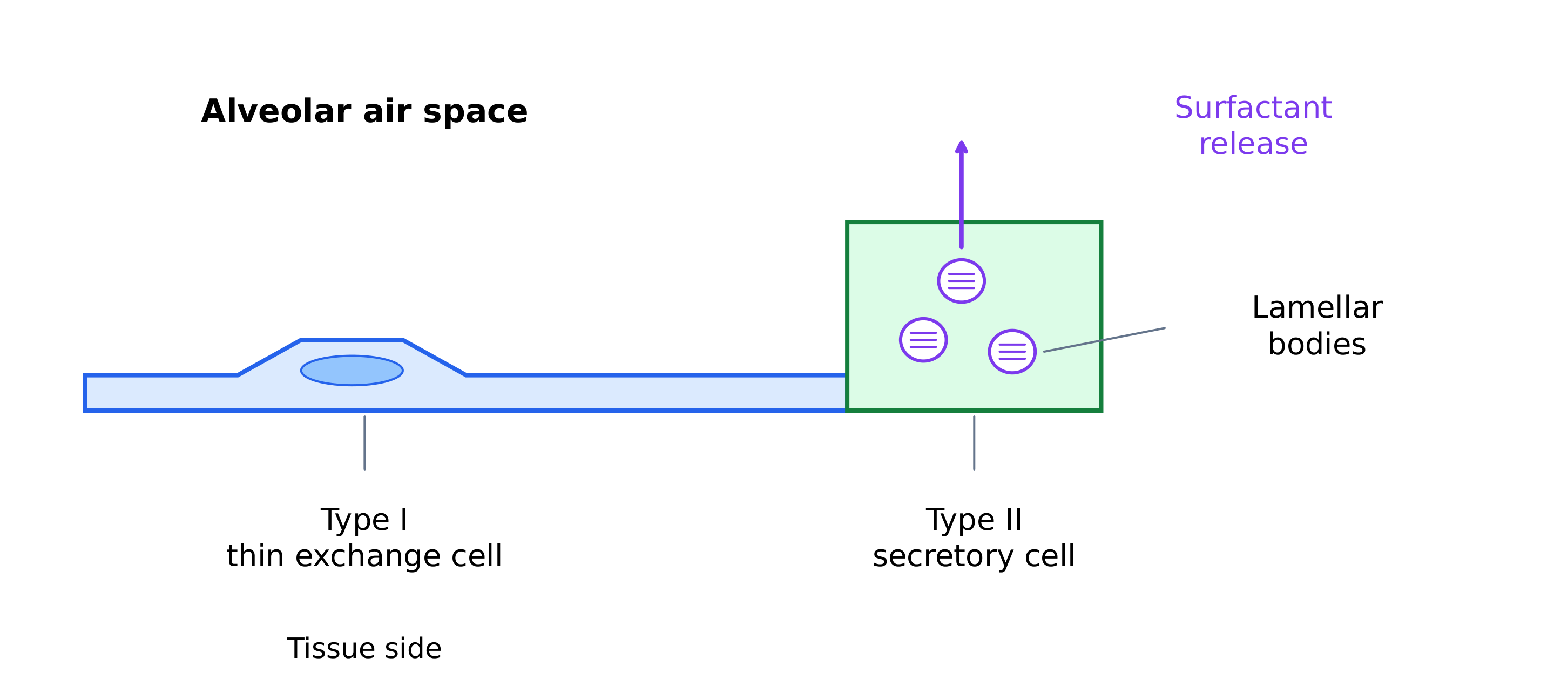
Type I pneumocytes are extremely thin, spreading over much of the alveolar surface. Their thin regions shorten the diffusion path between alveolar air and blood across the complete exchange barrier. They are not large bags storing oxygen.
Type II pneumocytes are more cuboidal and contain many lamellar bodies, secretory structures that release surfactant to the alveolar lumen. Surfactant lowers surface tension at the moist lining and helps stabilize alveoli during breathing. A type II cell's secretory apparatus serves a different role from the very thin type I exchange surface. Lamellar bodies are not mitochondria or openings through which oxygen is actively pumped.
The two cell types occupy the same epithelial tissue. The diagram is schematic and omits other components of the air–blood barrier.
The tissue therefore contains more than one specialized cell type because its overall function requires both efficient exchange and a stable lining. Do not replace this explanation with “all alveolar cells are thin” or “surfactant provides the oxygen concentration gradient”. Ventilation, blood flow, barrier thickness and available area also matter.
14.10
AHL:心肌细胞与骨骼肌纤维具有相同的收缩装置
English
Both cardiac muscle cells and skeletal striated muscle fibres contain myofibrils organized into repeating contractile units, producing striations. The presence of striations does not identify skeletal muscle uniquely. Compare branching, length, cell boundaries and nuclear arrangement as well.
Both are striated: compare branching, length, cell boundaries and where the nuclei sit.
Cardiac muscle cells are relatively short and branched, commonly with one central nucleus and sometimes two. Junctions at intercalated discs help connect cells mechanically and electrically, supporting coordinated contraction of a network. Skeletal muscle fibres are long, generally unbranched and multinucleated, with nuclei near the periphery. Their parallel organization supports force along the fibre's length.
A skeletal muscle fibre forms by fusion of precursor cells into a continuous cytoplasm within one plasma membrane. It is a multinucleate cell, or syncytium, rather than a bundle of many separate mature cells merely placed end to end. It challenges the simplistic rule that every cell has one nucleus, without overturning the usefulness of cell boundaries in identifying cells.
Treat function explanations as hypotheses supported by evidence: branching and connections can help coordinated network activity; long parallel fibres can support directed force; multiple nuclei can support the demands of a large cytoplasmic region. A still image of a branch or nucleus does not by itself measure contraction strength or prove the complete developmental mechanism.
14.11
AHL:人类精子与卵细胞具有互补的适应性特征
English
A sperm carries a haploid nuclear chromosome set in its head. The acrosome contributes molecules used in interactions with the egg's surrounding layers. A flagellum supports movement, and mitochondria in the midpiece contribute ATP; sperm also use other metabolic pathways, including glycolysis. Avoid treating the head as a tiny complete embryo or the acrosome as a mechanical drill.
A human egg cell (ovum) — a haploid gamete produced by meiosis
The egg cell has a much larger cytoplasm containing organelles, molecules and stored resources supporting the earliest stages of development. Its surrounding layers contribute interactions with sperm. Cortical granule release after fertilization contributes changes that reduce entry of additional sperm. The egg does not swim with a flagellum, and a human egg does not contain enough yolk to feed the whole pregnancy.
The human gametes each contribute a haploid set of 23 nuclear chromosomes; fusion of the parental chromosome sets restores 46 in the usual diploid zygote. This chromosome accounting does not imply identical contributions of cytoplasm or organelles. Fertilization combines genetic material, while subsequent differences in gene expression help produce the embryo's different cell types.
14.12
练习
English
Explain differentiation through gene expression. State why different protein patterns do not usually require loss of most genes, and name the mature mammalian-cell exception discussed here.
Apply the signal thresholds below 2, from 2 to below 5, and 5 or above to exposures 1, 2, 3, 5 and 6. Explain how a gradient can produce positional differences without changing DNA sequence.
Distinguish self-renewal from differentiation. Predict populations after four rounds when one continuing stem cell produces one specialized descendant each round, and when all stem cells instead produce two stem cells each round.
Describe bone-marrow and hair-follicle niches and explain how a niche can support renewal or differentiation. Why does location alone not prove pluripotency?
Calculate mean marker-positive proportions for control counts 8, 10, 12 and treated counts 38, 40, 42, each from 100 viable cells per dish at measurement. Give the difference in percentage points, fold ratio, two controls and a limitation.
Classify specified capacities: X supplies body and supporting lineages of a complete conceptus; Y supplies diverse body lineages without independently supplying all necessary supporting lineages; Z supplies several related blood-cell types. Explain why potency is not division rate.
Explain why a neuron with a long axon is not equivalent to a huge spherical cell. Compare dimensions needed to describe an egg, sperm, red blood cell and skeletal muscle fibre fairly.
Calculate area, volume and area/volume for cubes of sides 2, 4 and 8 μm. Explain why area increases while the ratio falls.
Compare one 4 μm cube with eight separated 2 μm cubes: combined volume and total exposed area. State an assumption and a biological limitation.
For spheres of radii 2, 4, 6 and 10 units, calculate $3/r$. What happens if a stated diameter of 4 units is mistakenly used as the radius?
Explain three reasons that surface area-to-volume ratio alone does not determine an exact maximum cell size. Describe one controlled way of comparing scaled drawings of cells.
AHL Compare the two equal-volume cuboid models, including areas, ratios and shortest centre-to-face distances. Explain erythrocyte flattening, proximal-tubule microvilli and basolateral infolding without assuming area alone guarantees transport.
AHL Compare type I and type II pneumocytes, then cardiac muscle cells and skeletal muscle fibres. Link each named structure to function and explain why a skeletal fibre can count as one cell despite many nuclei.
AHL Compare human sperm and egg adaptations, including movement, cytoplasm, acrosome, lamellar versus cortical granules, and nuclear chromosome sets. Explain why different gamete shapes do not mean different haploid chromosome counts.
Worked answers
Different gene-expression patterns produce different functional products and structures. Most nucleated body cells retain broadly the same genome rather than deleting unused genes. Mature mammalian erythrocytes lose the nucleus; this is not the rule for all mature animal cells.
Exposures 1, 2, 3, 5 and 6 predict A, B, B, C and C. Cells in different positions can receive different concentrations and activate different programmes. The stipulated thresholds are a model, not universal embryonic values.
Self-renewal maintains stem-cell descendants; differentiation produces specialized descendants. Under the first assumptions: one continuing stem cell plus four non-dividing specialized descendants, five cells total. Under the second: $2^4=16$ stem cells, no specialized descendants. State survival and division assumptions.
Bone marrow supports blood-forming stem cells; hair-follicle niches support relevant epithelial stem cells and tissue renewal. Local signals and contacts can maintain a stem-cell population or promote proliferation/differentiation. A niche's location does not show capacity to produce all body lineages; test developmental potential separately.
Controls average $(8+10+12)/3=10$ marker-positive cells per 100, or 10%; treated average 40 per 100, or 40%. Difference $=40-10=30$ percentage points; ratio $=40/10=4$. Control starting cells, time, medium and marker threshold. A marker need not demonstrate full function; differential survival can also change proportions, so measure total cells and viability.
X is totipotent, Y pluripotent and Z multipotent under the stated capacities. Potency describes the range of outcomes; self-renewal and proliferation describe population behaviour. Producing several related types does not imply ability to make a complete conceptus.
An axon's length differs from cell-body width and diffusion distance across its narrow diameter; transport within a long cell also matters. Compare diameter with diameter or total length with total length, in common units. Egg diameter, sperm head/whole length, erythrocyte diameter and muscle-fibre length/width must be identified explicitly.
Areas 24, 96 and 384 μm²; volumes 8, 64 and 512 μm³; ratios 3.0, 1.5 and 0.75 μm⁻¹. Area scales as length squared while volume scales as length cubed. Doubling side multiplies area by four and volume by eight, so area per volume halves.
Single cube: volume 64 μm³ and area 96 μm². Eight small cubes: combined volume $8(8)=64$ μm³ and exposed area $8(24)=192$ μm², twice as much. Assume all faces are exposed; touching faces may not be exchange surfaces. Cutting a real cell does not automatically create eight viable cells.
Ratios are 1.5, 0.75, 0.50 and 0.30 per length unit. A diameter of 4 means radius 2, giving 1.5. Using 4 as radius gives 0.75, half the correct ratio. State inverse-length units when the length unit is specified.
Membrane permeability/proteins, maintained gradients, metabolic demand, diffusion distance, shape and internal transport affect function. Any three linked factors suffice. Use scale bars or calibrated dimensions, compare the same dimension, label observed structures and explain a feature–mechanism–function connection. Geometry alone is not a measured maximum size.
AHL Both volumes are 8 μm³. The cube has area 24 μm², ratio 3 μm⁻¹ and shortest centre-to-face distance 1 μm; the flattened cuboid has area 40 μm², ratio 5 μm⁻¹ and shortest distance 0.25 μm. Erythrocyte thin regions support exchange; microvilli increase apical area; infoldings increase basolateral area for transport machinery. Protein function, energy and gradients remain necessary.
AHL Thin type I pneumocytes shorten the exchange path. Type II cells release surface-tension-reducing surfactant from lamellar bodies, supporting a stable lining. Both muscle types have contractile myofibrils and striations. Cardiac cells are short/branched, usually with one or two central nuclei and junctions supporting a coordinated network; skeletal fibres are long, unbranched and multinucleated. A skeletal fibre has continuous cytoplasm within one plasma membrane following precursor fusion, so nuclear number alone does not define the cell boundary.
AHL Sperm: small head with haploid nucleus, acrosome for interactions with surrounding egg layers, flagellum for movement and metabolic ATP supply including midpiece mitochondria. Egg: large cytoplasm and early-development resources, surrounding layers for interactions and cortical granules contributing a block to additional sperm entry. Lamellar bodies belong to surfactant secretion by type II pneumocytes, not the egg's cortical reaction. Each gamete contributes 23 nuclear chromosomes in the usual human case; their union restores 46 despite unequal cell size and cytoplasm.
14.13
考试技巧
English
Name the cell, structure, mechanism and function. Keep developmental potency separate from division rate, percentage points separate from fold change, and length separate from diameter. In geometry questions report both total area and area per volume, including assumptions about exposed surfaces.
AHL: Compare cell types within a tissue rather than assigning one adaptation to every cell in that tissue.