A potato stores starch, a seed stores oil, and a plant cell wall contains cellulose. All three materials contain carbon, hydrogen and oxygen. Why can one be digested as a quick source of glucose, another store much energy in a small mass, and another resist stretching?
This unit covers all B1.1 understandings for SL and HL: carbon compounds, condensation and hydrolysis, monosaccharides, storage and structural polysaccharides, cell recognition, triglycerides, phospholipids, fatty-acid saturation, insulation, bilayers and steroids. There is no additional higher-level content in this unit. Prerequisites are covalent bonds, water polarity, cell structure and basic ratios.
10.2
碳可构成多种不同的分子结构
English
A covalent bond involves a shared pair of electrons. Carbon usually forms four covalent bonds in biological compounds. Four single bonds, or two single bonds and one double bond, both give a total bond order of four. A carbon–carbon double bond counts as two, not one, in this accounting. Carbon can bond to other carbon atoms and to elements such as hydrogen, oxygen, nitrogen, phosphorus and sulfur.
Chains, branches and rings: every unlabelled corner or line end is a carbon
Carbon skeletons can be unbranched chains, branched chains or rings. Several rings can be joined, as in steroids. Different arrangements of the same types of atoms can produce different properties. An element list is therefore insufficient to identify a carbohydrate, lipid or protein. Check the actual bonds and functional groups. Proteins usually contain nitrogen as well as carbon, hydrogen and oxygen; some also contain sulfur.
Biological diagrams use conventions. In a skeletal formula, an unlabelled corner or line end normally represents carbon; hydrogens attached to carbon may be omitted. An explicitly labelled O is oxygen, not an extra carbon. A ring containing five atoms can contain only four carbons if the fifth atom is oxygen. Count carbon atoms outside the ring too.
Metric prefixes also follow agreed conventions: kilo means a thousand, centi one hundredth, milli one thousandth, micro one millionth and nano one billionth of the base unit. Thus 1 mm = 1,000 μm and 1 μm = 1,000 nm. A membrane thickness of 7 nm is 0.007 μm, not 0.007 mm. Convert to the same unit before comparing a molecule with a cell.
10.3
缩合形成连接;水解断裂连接
English
A monomer is a small building unit; a polymer contains many linked units. Polysaccharides are polymers of monosaccharides, polypeptides contain amino-acid residues, and nucleic acids contain nucleotide residues. A residue is the part incorporated into a larger molecule; it is not necessarily chemically identical to the original free monomer.
Condensation removes water to join monomers; hydrolysis adds water to split them
In a simplified condensation model, two units become joined by a covalent linkage while a water molecule is released. Hydrolysis 水解 breaks a linkage by using water: H and OH from water become incorporated into the products. For a glycosidic linkage, distinguish the covalent bond between sugar residues from hydrogen bonds between neighbouring molecules or chains.
The linkage names matter: a glycosidic bond joins sugar residues; a peptide bond 肽键 joins amino-acid residues; a phosphodiester linkage joins nucleotides in a nucleic-acid backbone. Lipids such as triglycerides contain ester linkages but are not repeating-monomer polymers. “Large biological molecule” and “polymer” are not interchangeable.
Worked example: count bonds before counting water
One connected, unbranched chain made from 20 monomers has 19 links between successive units. In the simple condensation accounting model, joining those free units releases 19 water molecules; completely hydrolysing those links uses 19 water molecules. For $n$ units in a linear chain, there are $n-1$ links.
Counting links: a linear chain of n units has n − 1 links
Two separate chains of ten residues each initially have $2\times9=18$ links. Joining the chains end to end adds one new link, giving 19 links in the 20-residue chain. A calculation must state whether it concerns forming all links or making just the final connection. This is molecular accounting, not a complete description of enzyme-mediated biosynthesis in cells.
Digestion hydrolyses large food polymers into smaller soluble products that can be absorbed. Cutting a polymer into pieces does not automatically mean every piece is already a monomer. For complete hydrolysis, every relevant linkage must be broken.
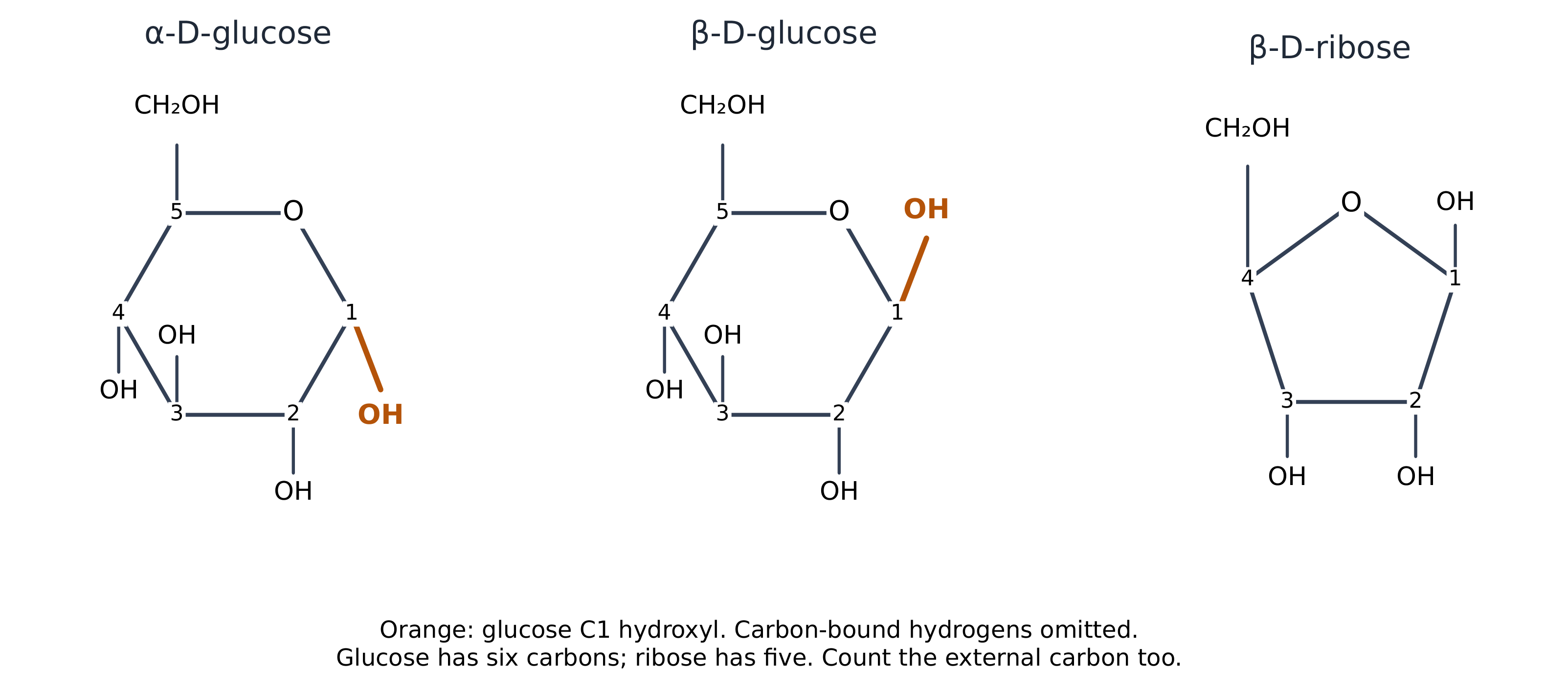
Monosaccharides are single sugar units. Pentoses contain five carbon atoms, as in ribose; hexoses contain six, as in glucose. In ring forms, glucose commonly has five carbons and one oxygen in its ring, with the sixth carbon outside it. Ribose commonly has four carbons and one oxygen in its ring, with one carbon outside. A pentagon is not automatically a pentose, and a hexagon is not automatically a hexose: inspect the labels and side groups.
The two ring forms differ only at carbon 1: the –OH points down in α, up in β
Glucose has several hydroxyl groups that interact with water, making it soluble. It can be transported in aqueous body fluids and supplied to cells. It is sufficiently chemically stable for controlled transport and storage in suitable forms, yet enzymes can catalyse its reactions. Oxidation in respiration can transfer energy to processes such as ATP production. Glucose does not release a useful burst of energy merely because it dissolves.
Alpha- and beta-glucose differ in the orientation of the hydroxyl group at carbon 1 in the usual ring representation. For D-glucose drawn as below, the alpha C1 hydroxyl is on the opposite side to the C5 hydroxymethyl group; the beta C1 hydroxyl is on the same side. Rotating the whole drawing does not turn alpha into beta. Compare the relative positions, not just “up” on the page.
These are simplified Haworth representations. Carbon-bound hydrogens are omitted. Glucose C6 and ribose C5 lie outside their rings. Orange highlights the glucose C1 hydroxyl.
A glucose molecule and a fructose molecule share the formula $\mathrm{C_6H_{12}O_6}$ but differ in structure. Their formula alone does not identify which sugar is present. The different arrangement of glucose units in polysaccharides likewise changes function even when the building units have the same overall formula.
Food tests give evidence under defined conditions, not a complete molecular structure. With controlled warming, Benedict's reagent gives a coloured precipitate when reducing sugars are detected. Iodine solution turns blue-black with starch; Biuret reagent turns violet with peptide-containing proteins. For lipids, dissolve the sample in ethanol, then add water: a cloudy emulsion is a positive result. Keep ethanol away from flames and use known positive and negative controls. A positive sugar test does not identify glucose specifically.
10.5
淀粉和糖原紧凑储存葡萄糖
English
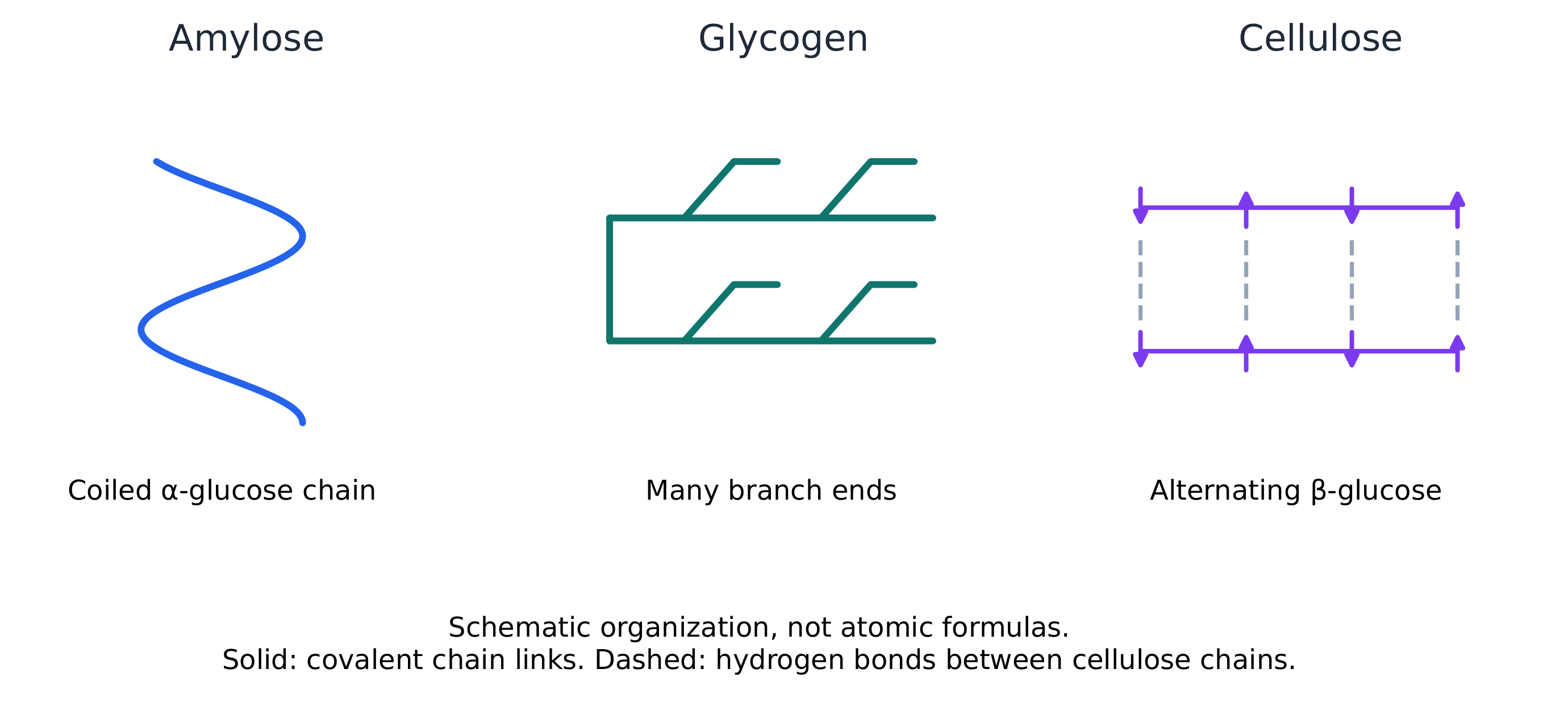
Plants store glucose as starch. Amylose consists mainly of unbranched alpha-glucose chains with alpha-1,4 links that coil. Amylopectin also contains alpha-1,6 branch points. Animals and fungi store glycogen, a more highly branched alpha-glucose polymer. A starch sample is not necessarily one perfectly unbranched chain.
Real starch grains inside a potato, stained by iodine. Each grain is a dense, insoluble package of amylose and amylopectin — note the scale: the largest are only about 0.1 mm across
Coiling and branching help pack many glucose residues into a relatively small volume. Glycogen's many branch ends provide sites at which residues can be added or removed during regulated metabolism. Do not confuse a branch point with a free chain end. The arrangement allows mobilization of a store when energy demand increases.
Large storage polysaccharides are relatively insoluble compared with glucose. They can be retained as granules instead of diffusing away as many small dissolved molecules. Converting many free glucose molecules into a smaller number of large storage particles reduces their contribution to the concentration of dissolved particles and therefore helps limit osmotic effects. This does not mean a living cell has no water movement or no osmotic regulation.
Hydrolysis of glycosidic bonds can ultimately yield glucose units for respiration. Condensation accounting describes building the store; hydrolysis describes breaking its links. In cells, enzymes and activated intermediates control these processes. A storage molecule does not choose when to break down.
10.6
纤维素通过不同的排列方式抵抗拉力
English
Cellulose is a structural polysaccharide in plant cell walls. It contains beta-glucose residues joined by beta-1,4 glycosidic bonds. Alternate residues have opposite orientations, producing straight chains rather than the coiled arrangement of amylose. Many chains lie alongside one another. Hydrogen bonds between chains help hold them in bundles called microfibrils.
A cotton boll: the fibres are almost pure cellulose, strong in tensionLines along a chain represent covalent glycosidic links. Dashed cross-links between cellulose chains represent hydrogen bonds. The cartoon shows organization, not a full atomic formula.
The covalent backbone and collective interactions between chains give cellulose high tensile strength. A plant cell wall can resist forces as water enters the cell. The wall is not the selectively permeable cell membrane, and its strength does not mean every small substance is excluded.
Humans digest starch using suitable enzymes but do not produce cellulase to hydrolyse cellulose's beta-1,4 links. “Both are glucose polymers” does not imply “both are digested by the same enzyme”. Cellulose contributes dietary fibre; some organisms use microbial partners to help digest it. Heating a material or disrupting some hydrogen bonds is not equivalent to completely hydrolysing every glycosidic bond.
10.7
表面碳水化合物有助于细胞识别
English
A glycoprotein has carbohydrate groups attached to a protein. Carbohydrate chains on the outer cell surface can act as recognition features. Different terminal sugar arrangements can be recognized by specific binding molecules, allowing cells or immune components to distinguish surfaces.
The fluid mosaic model: proteins, cholesterol and carbohydrate chains sit in a fluid phospholipid bilayer
ABO blood-group antigens provide an example. A and B antigens differ in their terminal carbohydrate structures. They occur on membrane glycoproteins and glycolipids, so it is inaccurate to call every ABO antigen simply a free protein. Group O lacks the A and B terminal modifications but still has other cell-surface molecules and antigens. “O means no antigens anywhere” is false.
Specific recognition depends on molecular structure and binding, not on a cell reading a written label. A change in a terminal sugar can change recognition without changing every molecule in the membrane. The ABO example connects carbohydrate structure with recognition; it is not a complete set of rules for clinical transfusion decisions.
10.8
脂质结构解释疏水行为
English
Lipids include fats, oils, waxes and steroids. They are generally poorly soluble in water and more soluble in non-polar solvents. Much of a typical lipid consists of non-polar hydrocarbon regions that do not interact favourably with water in the same way as polar or charged groups.
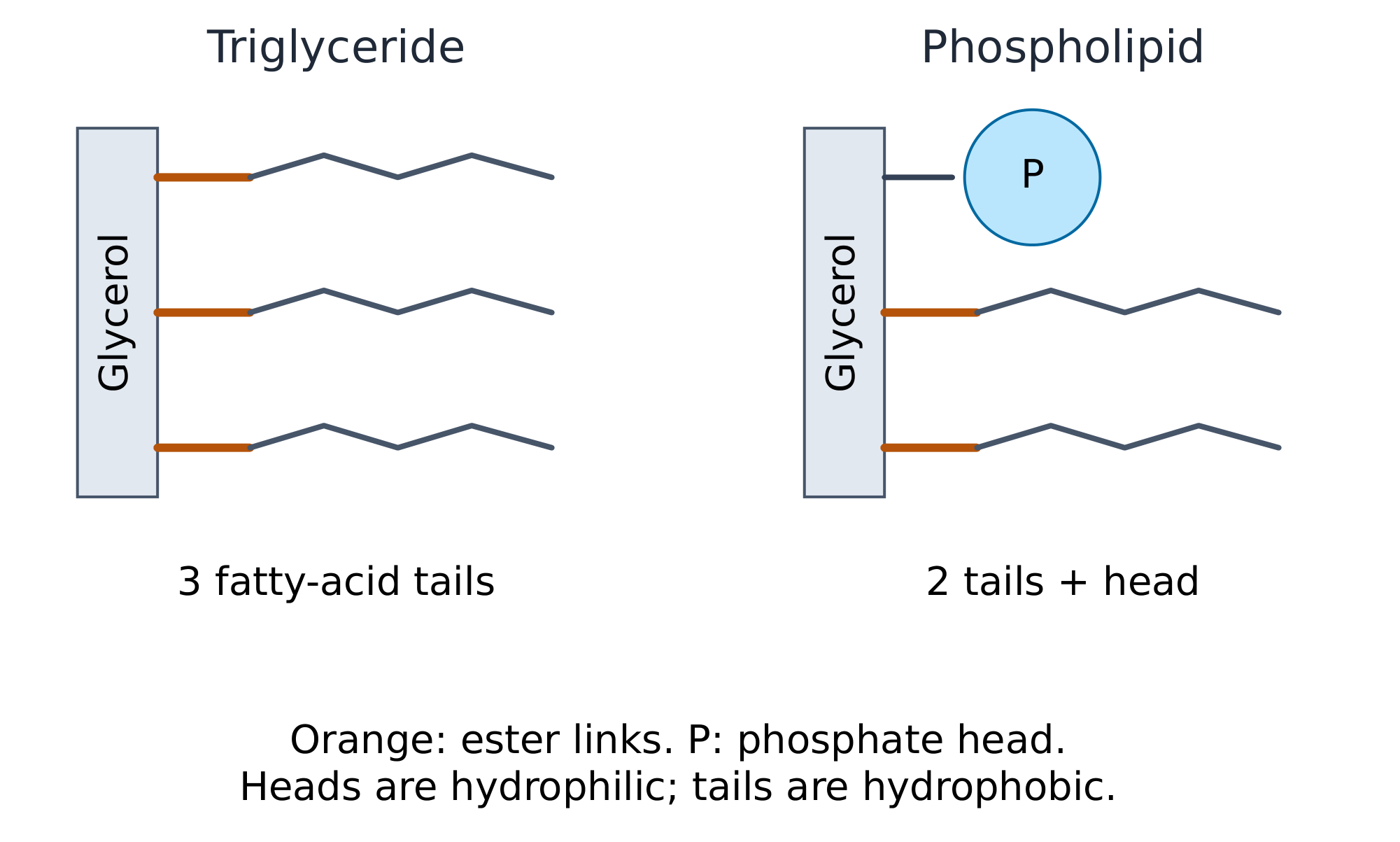
A triglyceride consists of glycerol linked to three fatty acids. Glycerol has three hydroxyl groups; a fatty acid has a carboxyl group and a hydrocarbon chain. In a simple esterification model, each fatty acid's carboxyl group reacts with a glycerol hydroxyl, forming an ester linkage and releasing water. Three linkages give three water molecules per triglyceride. Complete hydrolysis of those three ester links uses three waters and yields glycerol and three fatty acids.
A typical glycerophospholipid contains glycerol, two fatty-acid tails and a phosphate-containing head group. It is not a triglyceride with an extra phosphate simply added on top of three tails. The head is polar or charged, while the tails are largely non-polar. The detailed head-group chemistry varies among phospholipids.
The molecular cartoons label components rather than every atom. A typical glycerophospholipid has two hydrophobic tails and a hydrophilic phosphate-containing head.
Worked example: conservation of mass during condensation
For a molar-mass calculation, use glycerol 92, each of three identical fatty acids 256, and water 18, all in $\mathrm{g\,mol^{-1}}$. The triglyceride's molar mass is $92+3(256)-3(18)=806\,\mathrm{g\,mol^{-1}}$. The reactants total 860; the products are triglyceride 806 plus water 54. Matter is conserved. The released water has not vanished, and its mass must not be subtracted twice.
10.9
饱和度改变堆积和熔化行为
English
A saturated fatty acid has no carbon–carbon double bonds in its hydrocarbon chain. A monounsaturated fatty acid has one; a polyunsaturated fatty acid has two or more. The carbon–oxygen double bond of the carboxyl group does not make a fatty acid “unsaturated” in this classification.
Saturated tails pack closely; cis double bonds bend unsaturated tails and tend to disrupt close packing.
A cis carbon–carbon double bond introduces a bend that tends to disrupt close packing. For otherwise comparable chains, more cis unsaturation generally lowers the melting point. Saturated chains pack more closely and often have higher melting points. Chain length and the mixture of fatty acids matter too. A trans double bond has a different shape, so “every double bond produces the same kink” is false.
Many plant storage oils contain substantial unsaturated fatty acids and remain liquid at ordinary room temperatures. Many animal storage fats contain larger saturated fractions and are more solid under those conditions. These are tendencies, not universal plant-versus-animal rules: some plant fats are solid, and animal fats also contain unsaturated components. Endotherms maintain warm bodies, so a material's state must be compared at a stated temperature, not inferred from its origin alone.
10.10
甘油三酯提供能量储存和隔热功能
English
Triglycerides contain many reduced carbon–hydrogen bonds and have a high energy yield per unit mass when oxidized. They are stored with little associated water compared with hydrated carbohydrate stores. These features suit long-term energy storage, especially where carrying mass matters. They are hydrophobic and are not readily transported as free dissolved molecules in water; organisms use appropriate packaging and transport mechanisms.
One glycerol plus three fatty acid tails; a straight tail is saturated, a kinked one unsaturated
Adipose tissue contains cells that store triglycerides. A layer of this tissue reduces heat transfer between a warm body and colder surroundings, providing thermal insulation. It slows heat loss; it does not create heat by itself. Stored lipid can also be metabolized to supply energy. Insulation needs depend on body temperature, habitat and other adaptations such as fur, feathers or behaviour.
Worked example: compare equal energy, then hydration
Use comparison values of 38 kJ per gram of lipid and 17 kJ per gram of carbohydrate, with all stated energy available. To store 380 kJ requires $380/38=10.0$ g lipid or $380/17=22.4$ g dry carbohydrate, to three significant figures. If the model assigns 3 g water per gram of carbohydrate store, its hydrated mass is $4(380/17)=89.4$ g. The 3:1 hydration assumption is supplied for this calculation; it is not a universal measured constant.
Same stored energy, very different carried mass once the water held with carbohydrate is counted.
Glucose availability, speed of mobilization, oxygen supply and the organism's physiology also influence which fuel is used. Energy density and immediate accessibility answer different questions.
10.11
两亲性磷脂在水中形成双层
English
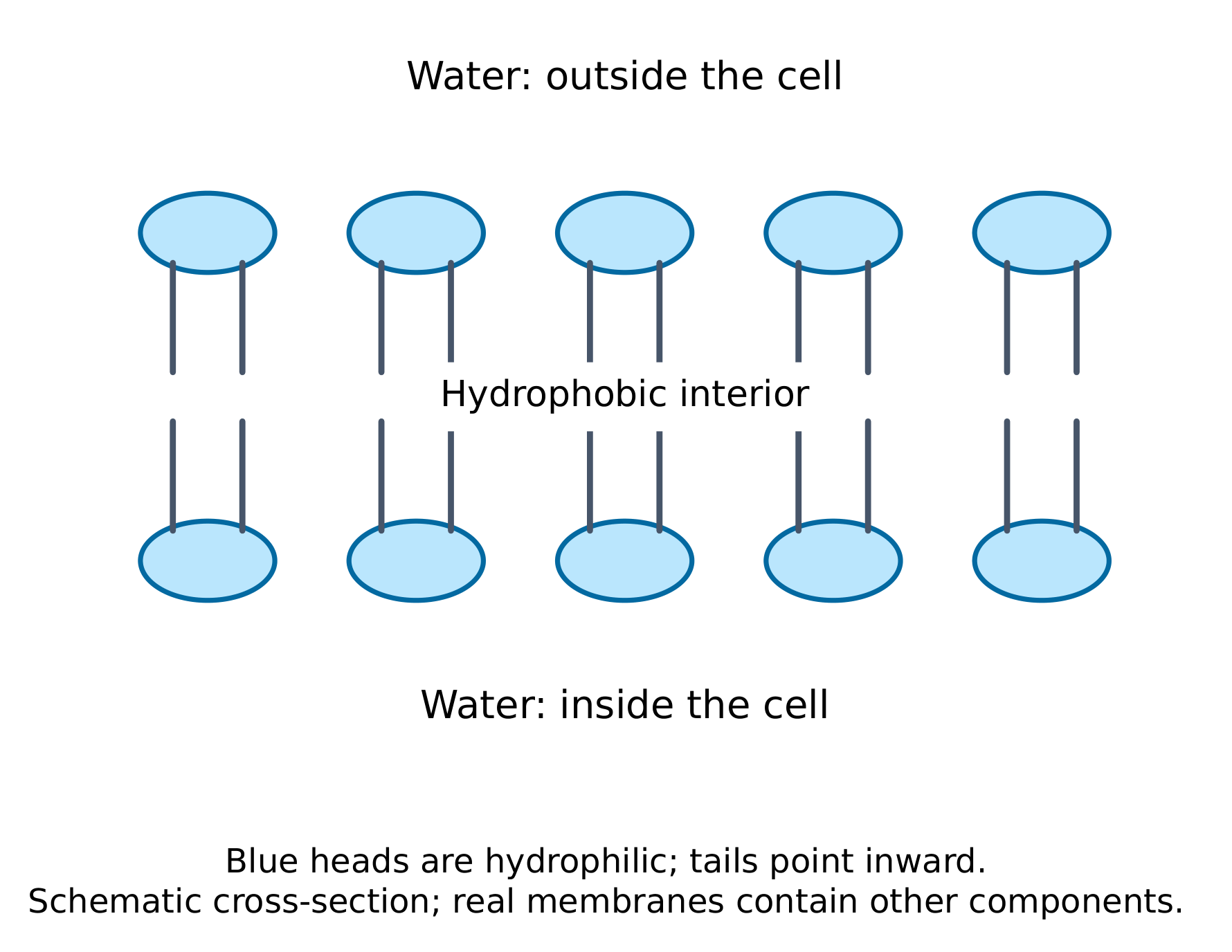
An amphipathic molecule has both a hydrophilic region and a hydrophobic region. In water, phospholipid heads interact with the aqueous environment while tails associate away from it. A bilayer places heads toward water on both outer surfaces and tails toward each other in the interior. Water can be present inside a cell and outside it; both surfaces need hydrophilic heads.
Cross-section through a bilayer: both surfaces meet water. The tails form the hydrophobic interior; this is not a layer with water on only one side.
Bilayer formation follows the molecules' interactions in their environment; it is not purposeful behaviour. The interior creates a barrier to many ions and polar substances. It is not absolutely impermeable to every molecule. Proteins, cholesterol and other components modify real membranes, which are dynamic structures rather than rigid sheets.
10.12
甾体环结构与膜通透性相关
English
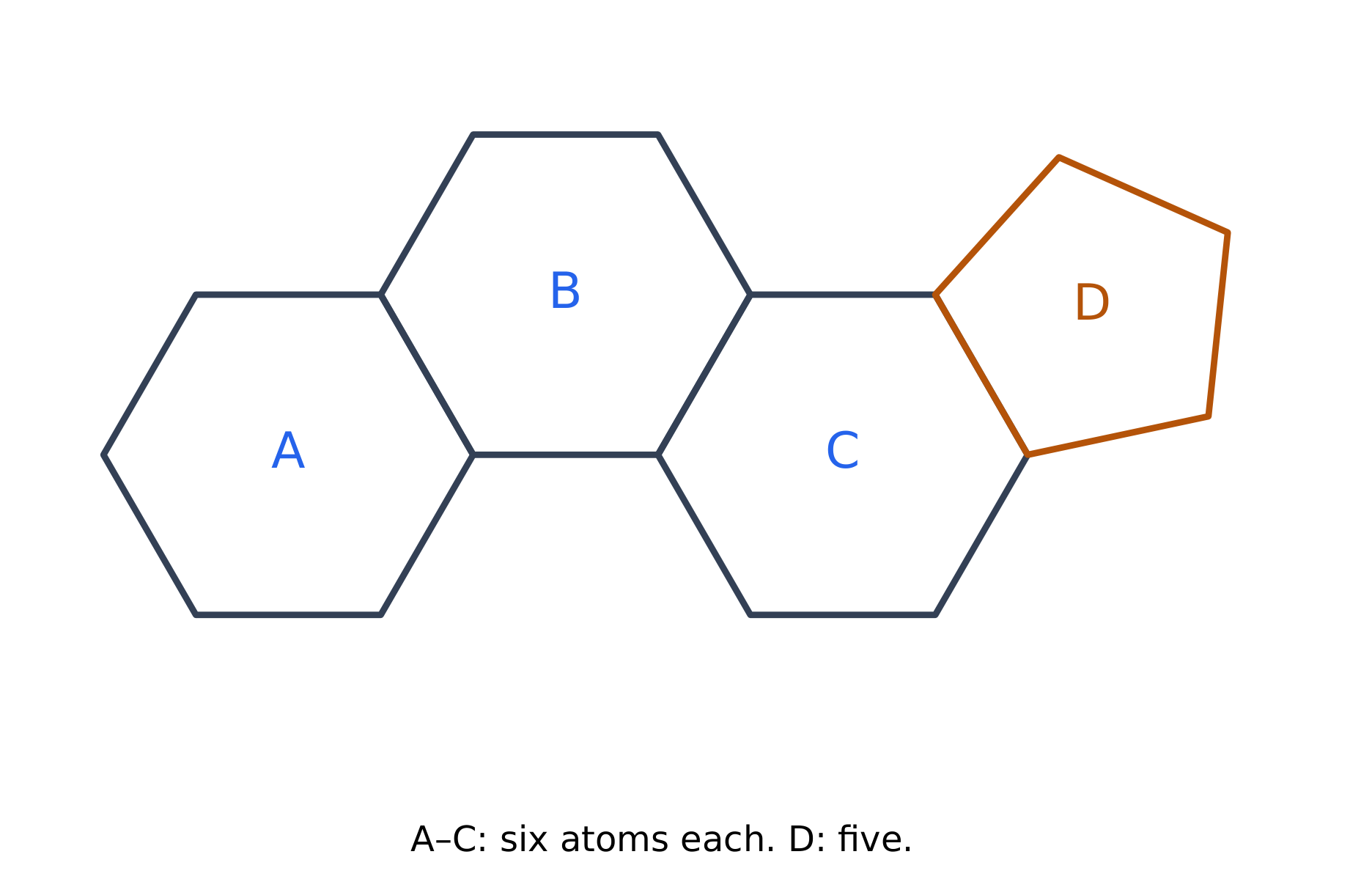
Steroids have a characteristic skeleton of four fused carbon rings: three six-membered rings and one five-membered ring. Fused rings share atoms and a bond; four separate circles are not an adequate molecular structure. Side groups and bond arrangements distinguish individual steroids.
This is a simplified steroid nucleus, not a complete formula of a hormone. Oestradiol and testosterone have this ring framework but different substituents and bonding.
Oestradiol and testosterone are steroid hormones whose overall lipid solubility allows them to pass through the phospholipid bilayer. Their structures still contain oxygen-containing groups; “lipid-soluble” does not mean “made only of carbon and hydrogen”. A charged water-soluble molecule faces a different barrier. Recognition by an appropriate receptor is needed for a specific cellular response.
10.13
练习
English
State the molecular model or assumption used.
Explain how carbon can form diverse biological molecules. A carbon is drawn with one double bond and three single bonds. Identify the problem. Convert 2.5 μm to nm and 7 nm to μm.
Distinguish a monomer, polymer and residue. Identify the linkage joining sugar residues and the linkage joining amino-acid residues. Why is a triglyceride not a repeating-monomer polymer?
A linear carbohydrate chain contains 35 monosaccharide residues. How many glycosidic links join them, and how many water molecules are used in complete hydrolysis? Two separate chains each contain ten residues; how many new links are needed to join them end to end?
A 30-residue linear peptide has its first six residues removed as a signal sequence. How many residues and peptide bonds remain in the mature chain? Distinguish this from the number of peptide bonds in the original chain.
A ring diagram contains one oxygen and five carbons within its ring, plus one carbon outside. Is it a pentose or hexose? Explain why counting ring corners alone fails. Distinguish alpha- and beta-D-glucose using the C1 hydroxyl and C5 hydroxymethyl group.
Explain three properties that make glucose useful to cells, then explain why storing the same number of glucose units as a polysaccharide can reduce osmotic problems.
Compare amylose, amylopectin and glycogen. Explain how coiling, branching and relative insolubility support storage. Distinguish a branch point from a chain end.
Explain why cellulose is suited to resisting tension. Identify the covalent links within chains and the interactions between chains. Why can a human digest starch but not cellulose using their own digestive enzymes?
Explain how carbohydrate groups on glycoproteins contribute to cell recognition, using ABO as an example. Correct the statement “group O red cells have no surface antigens”.
State the components and ester-link count of a triglyceride and compare them with a typical glycerophospholipid. Using glycerol 92, three fatty acids each 256, and water 18 in the stated molar-mass units, calculate the triglyceride molar mass and account for the water.
Classify fatty-acid chains with zero, one and three C=C bonds. For otherwise comparable cis fatty acids, predict the broad effect of increasing unsaturation on melting point. Give two reasons that source alone cannot identify whether a mixture is solid at a specified temperature.
Using 38 kJ per gram of lipid and 17 kJ per gram of dry carbohydrate, calculate the masses needed for 190 kJ. If the carbohydrate store carries 3 g water per gram of dry store, calculate its hydrated mass. Explain how adipose tissue insulates a warm animal.
Explain phospholipid bilayer orientation in water on both sides. Identify the steroid ring pattern and give two steroid-hormone examples. Explain why their passage through a bilayer does not imply that ions cross equally easily or that every cell responds identically.
Worked answers
Carbon forms four covalent bonds and can link into branched or unbranched chains and rings with different side groups. One double plus three single bonds gives bond order five, inconsistent with the usual carbon valence shown here. $2.5\,\mathrm{\mu m}=2500\,\mathrm{nm}$; $7\,\mathrm{nm}=0.007\,\mathrm{\mu m}$.
A monomer is a building unit; a polymer contains many linked units; a residue is the incorporated part of a unit. Sugar residues have glycosidic links; amino-acid residues have peptide bonds. A triglyceride combines one glycerol with three fatty acids rather than a long chain of repeating monomers.
$35-1=34$ links; complete hydrolysis consumes 34 waters. The two ten-residue chains initially have $9+9=18$ links and need one new link to produce a 20-residue chain with 19 links. Only one new water is released in the final joining model.
$30-6=24$ residues remain, so the linear mature chain contains $24-1=23$ peptide bonds. The original chain contained 29. Removing a connected six-residue segment is not the same as hydrolysing every bond in that segment.
Six carbons in total make it a hexose. One ring corner is oxygen, while an external carbon must also be counted. In the usual D-glucose ring representation, alpha has the C1 hydroxyl opposite the C5 hydroxymethyl group; beta has them on the same side. Whole-molecule rotation does not change this relationship.
Hydroxyl groups support solubility; dissolved glucose can be transported; it is sufficiently stable for controlled handling and can be oxidized through enzyme-catalysed respiration. Any three explained properties are suitable. A relatively insoluble large polymer produces fewer dissolved particles than many separate glucose molecules and can be retained as granules. This reduces the store's osmotic contribution without abolishing all water movement.
Amylose is mainly unbranched and coiled; amylopectin is branched; glycogen is more highly branched. All contain alpha-glucose residues. Coiling and branching compact the store, and branch ends provide sites for mobilization or addition. A branch point is where a side chain begins; a free chain end is the terminus of a chain. Relative insolubility helps retain a store with a smaller osmotic effect than free glucose.
Beta-1,4 glycosidic links connect alternating beta-glucose residues into straight chains. Parallel chains form hydrogen-bonded bundles; these collective interactions and covalent backbones provide tensile strength. Human digestive enzymes hydrolyse suitable starch linkages but humans do not produce cellulase for cellulose's beta-1,4 links. Same building unit does not imply same enzyme specificity.
Exposed carbohydrate groups have shapes recognized by specific binding molecules. A and B antigens have different terminal carbohydrate structures on surface glycoproteins and glycolipids. Group O lacks A and B terminal modifications, not every surface antigen or every membrane carbohydrate.
One glycerol plus three fatty acids gives three ester links; complete ester hydrolysis uses three waters. A typical glycerophospholipid has two fatty-acid tails and a phosphate-containing head. $92+3(256)-3(18)=806\,\mathrm{g\,mol^{-1}}$. Reactants total 860; triglyceride 806 plus three waters totalling 54 gives 860. These are simplified condensation-accounting quantities.
Zero C=C: saturated; one: monounsaturated; three: polyunsaturated. More cis bends generally disrupt packing and lower melting point for comparable chains. Chain lengths, cis/trans geometry and mixture composition affect the result. Plant and animal origins are broad tendencies, not fixed molecular compositions; compare the actual temperature with the material's melting range.
Lipid mass $=190/38=5.00$ g; dry carbohydrate $=190/17=11.2$ g; hydrated mass $=4(190/17)=44.7$ g, to three significant figures. Keep unrounded intermediate values. Adipose tissue reduces heat transfer from a warmer body to colder surroundings. It slows loss rather than generating heat by insulation alone.
Hydrophilic heads face water at both surfaces; hydrophobic tails face inward toward one another. A steroid has three fused six-membered rings and one fused five-membered ring. Oestradiol and testosterone are examples. Their overall lipid solubility permits bilayer passage, whereas a charged ion interacts unfavourably with the hydrophobic interior. A response also requires the appropriate receptor and cellular machinery.
10.14
考试技巧
English
Read bond types, carbon counts and side groups before naming a molecule. Distinguish a monomer from its residue, a glycosidic bond from a hydrogen bond, and a storage lipid from an amphipathic membrane lipid. Count links before calculating water or molar mass. Explain a function through structure and a mechanism; avoid claiming that every plant lipid is liquid, every animal lipid solid, or every large molecule a polymer.
Scope reference: IB Biology guide, B1.1. Numerical comparisons and molecular cartoons are original teaching examples.