跳到主要内容

复杂句型

HSK 4 · 知识点 25

本主题的视频课程 打开视频页面
2:59

HSK 4 语法 25:复句句型

三个成熟表达。先让步再撤回;紧密连接两个事件;权衡两面:这些是你英语中已有的表达。每种都有一个保持其…

英文讲解与普通话例句 · 字幕与原声同步

点击任意汉字可查看拼音和释义。
English

Patterns that build longer sentences. Adj + to be / is是shì + Adj,but但是dàn shì…… agrees with one point before raising a problem (cheap便宜pián yito be / is是shìcheap便宜pián yi,but但是dàn shì太远tài yuǎn(completed / change)了le); one / a一yī……then / just就jiù…… links two events that follow at once; on the one hand一方面yì fāng miàn……on the other hand另一方面lìng yì fāng miàn…… weighs two sides.

25.1

一目了然

English
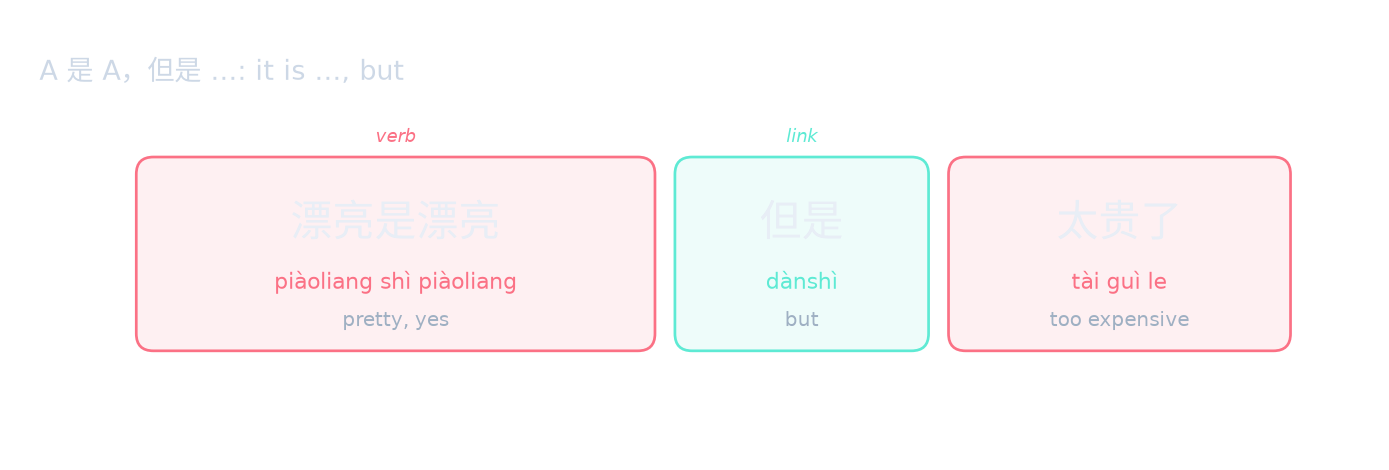
  • 1. Adj + to be / is是shì + Adj,but但是dàn shì … – concede, then object: pretty漂亮piào liàngto be / is是shìpretty漂亮piào liàng,but但是dàn shì太贵tài guì(completed / change)了le。
  • 2. one / a一yī … then / just就jiù … – as soon as / whenever: doorbell门铃mén líng一响yī xiǎng,it它tāthen / just就jiùto run跑pǎopast过去guò qù。
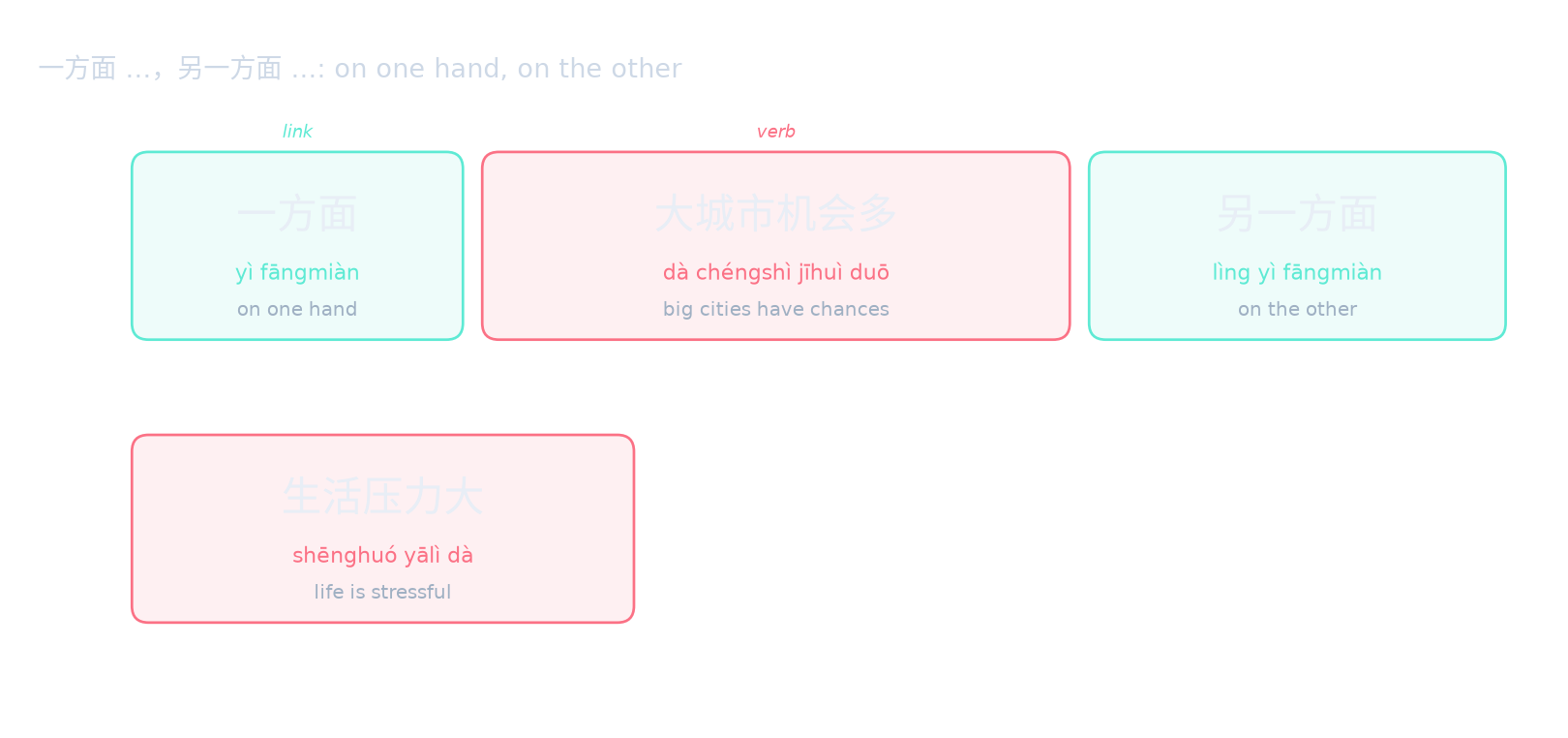
  • 3. on the one hand一方面yì fāng miàn … ,on the one hand一方面yì fāng miàn … – on one hand / on the other: on the one hand一方面yì fāng miàn,major city大城市dà chéng shìopportunity机会jī huìmany; much多duō;on the other hand另一方面lìng yì fāng miàn,life; to live生活shēng huóalso也yěmore更gèngconvenient方便fāng biàn。
25.2

1. 形容词 + 是 + 形容词,但是 …(先让步,再提出异议)

English

Form: X to be / is是shì X,but但是dàn shì / but可是kě shì / exactly就是jiù shì + objection

  • pretty漂亮piào liàngto be / is是shìpretty漂亮piào liàng,but但是dàn shì太贵tài guì(completed / change)了le。 Piàoliang shì piàoliang, dànshì tài guì le. – It's pretty, all right, but it's too expensive.
  • tasty好吃hǎo chīto be / is是shìtasty好吃hǎo chī,but但是dàn shì太辣tài là(completed / change)了le。 – It's tasty, but it's too spicy.
  • to go去qùto be / is是shìwant / think / miss想xiǎngto go去qù,but可是kě shìnot / haven't没méitime时间shí jiān。 – I do want to go, but I don't have time.
  • this这zhè本书běn shūI / me我wǒto look at; to watch; to read看kànto be / is是shìto look at; to watch; to read看kàn(completed / change)了le,but但是dàn shìnot / haven't没méito look at; to watch; to read看kànto understand懂dǒng。 – I did read the book, but I didn't understand it.

How it works. X to be / is是shì X concedes a point ("it is …, admittedly"); the next clause brings the objection with but但是dàn shì, but可是kě shì or exactly就是jiù shì. It sounds more conversational than although虽然suī rán……but但是dàn shì……, and shows you have considered the point.

Watch out

  • Repeat the identical word: wrong: 贵是guì shìdegree / adjective linker很hěnexpensive贵guì → 贵是guì shìexpensive贵guì.
  • The second clause must object: wrong: good好hǎoto be / is是shìgood好hǎo,moreover而且ér qiě…….
A 是 A,但是 …: it is …, but
词汇 训练
汉字 拼音 English
可是 kě shì but
25.3

2. 一……就……

English

Form: subject₁ + one / a一yī + verb A,subject₂ + then / just就jiù + verb B

  • doorbell门铃mén líng一响yī xiǎng,it它tāthen / just就jiùto run跑pǎopast过去guò qù。 Ménlíng yì xiǎng, tā jiù pǎo guòqu. – As soon as the doorbell rings, it runs over.
  • (used after a verb) give it…一下yī xiàlesson课kè,he / him他tāthen / just就jiùto walk / to leave走zǒu(completed / change)了le。 – As soon as class ended, he left.
  • he / him他tāone / a一yī喝咖啡hē kā fēithen / just就jiù睡不着shuì bù zhe。 – Whenever he drinks coffee, he can't sleep.
  • I / me我wǒone / a一yīto look at; to watch; to read看kànthen / just就jiùto understand懂dǒng(completed / change)了le。 – I understood the moment I looked.

How it works. B follows immediately after A. It describes one event ("as soon as") or a habit ("whenever"). one / a一yī goes after the first subject, before its verb; then / just就jiù goes after the second subject.

one / a一yī……then / just就jiù…… just now刚gāng……then / just就jiù……
as soon as; also habits had only just … when (one past event)
he / him他tāone / a一yī喝咖啡hē kā fēithen / just就jiù睡不着shuì bù zhe 我刚wǒ gāngto / arrive / (result: get)到dào,he / him他tāthen / just就jiùto walk / to leave走zǒu(completed / change)了le

Watch out

  • wrong: one / a一yīI / me我wǒto / arrive / (result: get)到dào → I / me我wǒ一到yī dào; wrong: then / just就jiùhe / him他tāto walk / to leave走zǒu(completed / change)了le → he / him他tāthen / just就jiùto walk / to leave走zǒu(completed / change)了le.
一 …,就 …: the moment …
25.4

3. 一方面 … ,一方面 …(表示并列的两个方面)

English

Form: on the one hand一方面yì fāng miàn……,(other另lìng)on the one hand一方面yì fāng miàn……

  • on the one hand一方面yì fāng miàn,major city大城市dà chéng shìopportunity机会jī huìmany; much多duō;on the other hand另一方面lìng yì fāng miàn,life; to live生活shēng huóalso也yěmore更gèngconvenient方便fāng biàn。 Yì fāngmiàn, dà chéngshì jīhuì duō; lìng yì fāngmiàn, shēnghuó yě gèng fāngbiàn. – On the one hand, big cities have more opportunities; on the other, life is more convenient.
  • on the one hand一方面yì fāng miànto be / is是shìin order to为了wèi leto study; to learn学习xué xí,on the one hand一方面yì fāng miànto be / is是shìin order to为了wèi leto make friends交朋友jiāo péng yǒu。 – Partly to study, partly to make friends.
  • on the one hand一方面yì fāng miànI / me我wǒwant / think / miss想xiǎngto go去qù,on the other hand另一方面lìng yì fāng miànagain又yòuanxious担心dān xīnto spend money花钱huā qiántoo太tàimany; much多duō。 – On the one hand I want to go; on the other, I worry about spending too much.

How it works. on the one hand一方面yì fāng miàn yì fāngmiàn presents two aspects or reasons with equal weight, in an argument or explanation. They can point the same way or contrast. Each half starts its own clause, and the two halves keep the same shape.

on the one hand一方面yì fāng miàn……on the one hand一方面yì fāng miàn…… not only不但bù dàn……moreover而且ér qiě……
two points, equal weight builds up to a stronger point

Watch out

  • on the one hand一方面yì fāng miàn needs its partner clause: wrong: on the one hand一方面yì fāng miànI / me我wǒwant / think / miss想xiǎngto go去qù。 alone is incomplete.
一方面 …,另一方面 …: on one hand, on the other
词汇 训练
汉字 拼音 English
生活 shēng huó life; to live
不但 bù dàn not only
25.5

练习

English

Cover the teaching pages before you answer. The answers are at the end.

1. Adj + to be / is是shì + Adj,but但是dàn shì … (concede, then object)

1. Complete: “It's cheap, all right, but the quality is poor.” cheap便宜pián yito be / is是shì…………,but但是dàn shìquality质量zhì liàngno good不好bù hǎo。

2. Which sentence is correct?

  • A. to be / is是shìtasty好吃hǎo chītasty好吃hǎo chī,but但是dàn shì太辣tài là(completed / change)了le。
  • B. tasty好吃hǎo chīto be / is是shìtasty好吃hǎo chī,but但是dàn shì太辣tài là(completed / change)了le。
  • C. tasty好吃hǎo chīto be / is是shìtasty好吃hǎo chī,moreover而且ér qiě太辣tài là(completed / change)了le。
  • D. tasty好吃hǎo chītasty好吃hǎo chīto be / is是shì,but但是dàn shì太辣tài là(completed / change)了le。

3. Build: “I do want to go, but I don't have time.”

Put in order: but可是kě shì / , / to go去qùto be / is是shìwant / think / miss想xiǎngto go去qù / not / haven't没méitime时间shí jiān。

4. True or false? pretty漂亮piào liàngto be / is是shìpretty漂亮piào liàng,but但是dàn shì… concedes a point before objecting. If false, correct it.

5. Your friend loves a jacket in a shop. You agree it's pretty, but the price is crazy. Use Adj + to be / is是shì + Adj,but但是dàn shì …. Write your answer in Chinese, then say it aloud.

2. one / a一yī … then / just就jiù … (as soon as / whenever)

6. Complete: “As soon as class ended, he left.” (used after a verb) give it…一下yī xiàlesson课kè,he / him他tā…………to walk / to leave走zǒu(completed / change)了le。

7. Which sentence is correct?

  • A. one / a一yīI / me我wǒto / arrive / (result: get)到dàohome / family / (measure: shops)家jiā,then / just就jiùhe / him他tāto walk / to leave走zǒu(completed / change)了le。
  • B. I / me我wǒto / arrive / (result: get)到dàohome / family / (measure: shops)家jiāone / a一yī,he / him他tāto walk / to leave走zǒuthen / just就jiù(completed / change)了le。
  • C. I / me我wǒ一到yī dàohome / family / (measure: shops)家jiā,he / him他tāthen / just就jiùto walk / to leave走zǒu(completed / change)了le。
  • D. I / me我wǒ一到yī dàohome / family / (measure: shops)家jiā,then / just就jiùhe / him他tāto walk / to leave走zǒu(completed / change)了le。

8. Build: “Whenever he drinks coffee, he can't sleep.”

Put in order: 睡不着shuì bù zhe。 / he / him他tā / then / just就jiù / one / a一yī喝咖啡hē kā fēi

9. True or false? one / a一yī…then / just就jiù… can describe a habit. If false, correct it.

10. Your friend's dog gets excited every time someone rings the doorbell. Use one / a一yī … then / just就jiù …. Write your answer in Chinese, then say it aloud.

3. on the one hand一方面yì fāng miàn … ,on the one hand一方面yì fāng miàn … (on one hand / on the other)

11. Complete: “On the one hand it's cheap; on the other, it's close to home.” on the one hand一方面yì fāng miàndegree / adjective linker很hěncheap便宜pián yi,other另lìng…………离家lí jiā很近hěn jìn。

12. What is wrong with on the one hand一方面yì fāng miànI / me我wǒwant / think / miss想xiǎngto go去qù。?

  • A. It needs (yes/no ?)吗ma
  • B. Nothing
  • C. on the one hand一方面yì fāng miàn needs its partner clause
  • D. on the one hand一方面yì fāng miàn must come last

13. Build: “Partly to study, partly to make friends.”

Put in order: to make friends交朋友jiāo péng yǒu。 / on the one hand一方面yì fāng miànto be / is是shìin order to为了wèi le / , / on the one hand一方面yì fāng miànto be / is是shìin order to为了wèi leto study; to learn学习xué xí

14. True or false? on the one hand一方面yì fāng miàn…on the one hand一方面yì fāng miàn… weighs two points equally. If false, correct it.

15. In a class debate, you explain why many young people move to big cities. Use on the one hand一方面yì fāng miàn … ,on the one hand一方面yì fāng miàn …. Write your answer in Chinese, then say it aloud.

25.6

混合练习

English

These questions mix the patterns and use new situations.

16. Your friend says the flat is cheap. You agree, but it is far. Use Adj to be / is是shì Adj.

17. Say "As soon as I get home I'll call you."

18. Give two sides with on the one hand一方面yì fāng miàn……on the other hand另一方面lìng yì fāng miàn……: save money / save time.

19. Find and fix the problem. You hear cheap便宜pián yito be / is是shìcheap便宜pián yi,but但是dàn shì太远tài yuǎn(completed / change)了le. Does the speaker think it is expensive?

20. Use it yourself. Say you will call as soon as you get home, and give two reasons for a choice with on the one hand一方面yì fāng miàn……on the other hand另一方面lìng yì fāng miàn…….

25.7

答案与解析

English

Mark your work, then correct each mistake in your own words.

1. Adj + to be / is是shì + Adj,but但是dàn shì … (concede, then object)

1. cheap便宜pián yi

The same word repeats on both sides of to be / is是shì.

2. B. tasty好吃hǎo chīto be / is是shìtasty好吃hǎo chī,but但是dàn shì太辣tài là(completed / change)了le。

tasty好吃hǎo chīto be / is是shìtasty好吃hǎo chī,but但是dàn shì太辣tài là(completed / change)了le is right: X to be / is是shì X repeats the same word with no degree / adjective linker很hěn, then a contrast with but但是dàn shì. moreover而且ér qiě adds a point instead of objecting.

3. to go去qùto be / is是shìwant / think / miss想xiǎngto go去qù,but可是kě shìnot / haven't没méitime时间shí jiān。

A to be / is是shì A,but可是kě shì ….

4. True.

That is the purpose of the pattern.

5. Model answer: pretty漂亮piào liàngto be / is是shìpretty漂亮piào liàng,but但是dàn shì太贵tài guì(completed / change)了le。

Check your answer:

  • Use the same word on both sides: 贵是guì shìexpensive贵guì (the second one can take degree / adjective linker很hěn or quite挺tǐng: 贵是guì shì挺贵tǐng guì(modifier / structural particle)的de).
  • The second clause must object; good好hǎoto be / is是shìgood好hǎo,moreover而且ér qiě… does not work.

2. one / a一yī … then / just就jiù … (as soon as / whenever)

6. then / just就jiù

one / a一yī A,then / just就jiù B.

7. C. I / me我wǒ一到yī dàohome / family / (measure: shops)家jiā,he / him他tāthen / just就jiùto walk / to leave走zǒu(completed / change)了le。

I / me我wǒ一到yī dàohome / family / (measure: shops)家jiā,he / him他tāthen / just就jiùto walk / to leave走zǒu(completed / change)了le is right: one / a一yī and then / just就jiù each come after their own subject (I / me我wǒone / a一yī…, he / him他tāthen / just就jiù…).

8. he / him他tāone / a一yī喝咖啡hē kā fēithen / just就jiù睡不着shuì bù zhe。

Subject + one / a一yī + verb, then / just就jiù + result.

9. True.

It means whenever as well as as soon as.

10. Model answer: doorbell门铃mén líng一响yī xiǎng,it它tāthen / just就jiùto run跑pǎopast过去guò qù。

Check your answer:

  • one / a一yī goes before the first verb, after its subject: I / me我wǒ一到yī dào, not one / a一yīI / me我wǒto / arrive / (result: get)到dào.
  • then / just就jiù goes after the second subject: he / him他tāthen / just就jiùto walk / to leave走zǒu(completed / change)了le, not then / just就jiùhe / him他tāto walk / to leave走zǒu(completed / change)了le.

3. on the one hand一方面yì fāng miàn … ,on the one hand一方面yì fāng miàn … (on one hand / on the other)

11. on the one hand一方面yì fāng miàn

on the one hand一方面yì fāng miàn…,on the other hand另一方面lìng yì fāng miàn….

12. C. on the one hand一方面yì fāng miàn needs its partner clause

on the one hand一方面yì fāng miàn introduces one side and needs its partner: on the one hand一方面yì fāng miànI / me我wǒwant / think / miss想xiǎngto go去qù,on the other hand另一方面lìng yì fāng miànI / me我wǒnot have / haven't没有méi yǒutime时间shí jiān. On its own the sentence is incomplete.

13. on the one hand一方面yì fāng miànto be / is是shìin order to为了wèi leto study; to learn学习xué xí,on the one hand一方面yì fāng miànto be / is是shìin order to为了wèi leto make friends交朋友jiāo péng yǒu。

Parallel halves.

14. True.

not only不但bù dàn…moreover而且ér qiě… builds up instead.

15. Model answer: on the one hand一方面yì fāng miàn,major city大城市dà chéng shìopportunity机会jī huìmany; much多duō;on the other hand另一方面lìng yì fāng miàn,life; to live生活shēng huóalso也yěmore更gèngconvenient方便fāng biàn。

Check your answer:

  • Keep both halves in the same shape: on the one hand一方面yì fāng miànto be / is是shì…,on the one hand一方面yì fāng miànto be / is是shì….
  • Do not use on the one hand一方面yì fāng miàn alone; it needs its partner.

Mixed practice

16. cheap便宜pián yito be / is是shìcheap便宜pián yi,but但是dàn shì太远tài yuǎn(completed / change)了le。The first half agrees; the second half gives the problem.

17. I / me我wǒ一到yī dàohome / family / (measure: shops)家jiāthen / just就jiùto / for / give给gěiyou你nǐto make a telephone call打电话dǎ diàn huà。

18. on the one hand一方面yì fāng miànI / me我wǒwant / think / miss想xiǎngto save money省钱shěng qián,on the other hand另一方面lìng yì fāng miànalso也yěwant / think / miss想xiǎng节省时间jié shěng shí jiān。

19. No. The speaker agrees it is cheap, then gives a problem: it is too far.

20. Model answer. I / me我wǒ一到yī dàohome / family / (measure: shops)家jiāthen / just就jiùto / for / give给gěiyou你nǐto make a telephone call打电话dǎ diàn huà。I / me我wǒwant / think / miss想xiǎng坐火车zuò huǒ chē,on the one hand一方面yì fāng miàncan / be able to能néngto save money省钱shěng qián,on the other hand另一方面lìng yì fāng miànon the road路上lù shàngcan / may可以kě yǐto read看书kàn shū。

Review later. Tomorrow, make one Adj to be / is是shì Adj sentence about your school.

该知识点的互动课程

逐步完成,配合即时检查练习。

更多 HSK 4 知识点

登录或创建账户

IGCSE, A-Level & AP