跳到主要内容

动词

HSK 4 · 知识点 12

本主题的视频课程 打开视频页面
4:59

HSK 4 语法 12: 动词

一课掌握八个动词句式。四个使动式、一个视情况而定、一个模糊表达、一个论文动词、一个错误认知动词、一个双重身份的通过/来自,以及虚义来。每个……

英文讲解与普通话例句 · 字幕与原声同步

点击任意汉字可查看拼音和释义。
English

Verbs that do more than describe an action. to let / make让ràng/to call / be called / (animals) cry, bark叫jiào/please; to invite请qǐng/to make使shǐ make or ask someone to act; to think以为yǐ wéi is a belief that turned out wrong; to seem; as if好像hǎo xiàng says something seems true; want / will / need要yàoto look at; to watch; to read看kàn says the answer depends on something; to rest with在于zài yú names what something really comes down to. to pass; through; by means of通过tōng guò, to come from来自lái zì and to come来lái complete the set.

12.1

一目了然

English
  • 1. to let / make让ràng / to call / be called / (animals) cry, bark叫jiào / please; to invite请qǐng / to make使shǐ – causative: manager经理jīng lǐto let / make让ràngI / me我wǒto notify / notice通知tōng zhīeveryone大家dà jiāFriday星期五xīng qī wǔto hand in; to make (friends)交jiāoreport; to report报告bào gào。
  • 2. to come来lái as a dummy verb – I'll do it: to come来lái一碗yī wǎnbeef noodle soup牛肉面niú ròu miàn。
  • 3. to think以为yǐ wéi – mistakenly think: I / me我wǒto think以为yǐ wéifilm; movie电影diàn yǐngto be / is是shìtoday今天jīn tiān!
  • 4. to seem; as if好像hǎo xiàng – it seems / as if: he / him他tāto seem; as if好像hǎo xiàngnot不bù太高兴tài gāo xìng。
  • 5. want / will / need要yàoto look at; to watch; to read看kàn / (degree marker)得deto look at; to watch; to read看kàn – it depends on: 去不去qù bù qùwant / will / need要yàoto look at; to watch; to read看kànweather天气tiān qì。
  • 6. to rest with在于zài yú – lies in / consists in: to succeed; success成功chéng gōng(modifier / structural particle)的de关键在于guān jiàn zài yúto keep at; to insist坚持jiān chí。
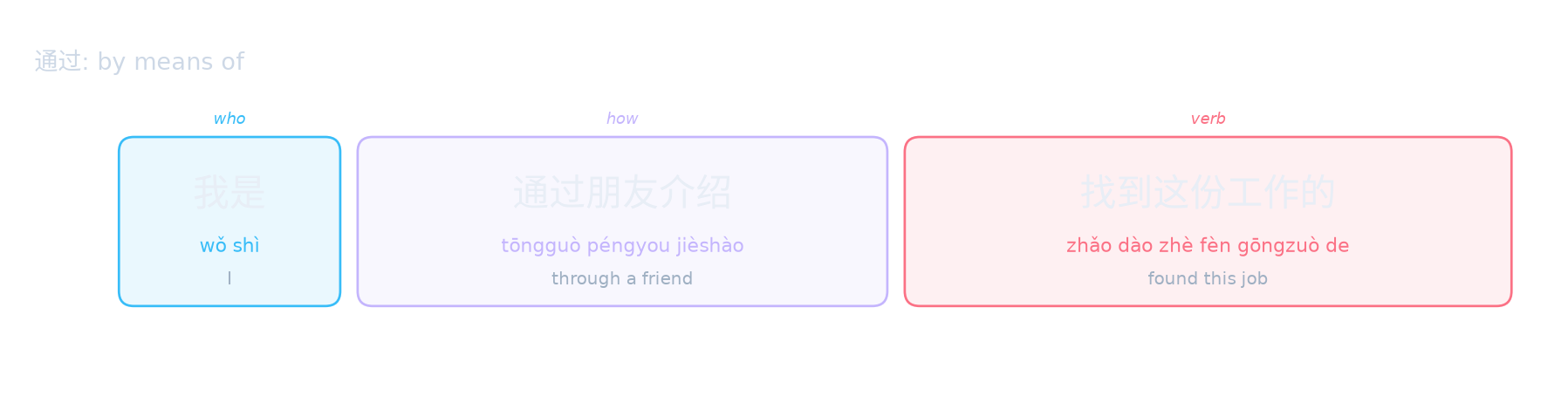
  • 7. to pass; through; by means of通过tōng guò – through / by means of: I / me我wǒto be / is是shìto pass; through; by means of通过tōng guòfriend朋友péng yǒuto introduce介绍jiè shàoto find找到zhǎo dào这份zhè fènto work; job工作gōng zuò(modifier / structural particle)的de。
  • 8. to come from来自lái zì – come from: these这些zhè xiēstudent学生xué shēngto come from来自lái zì十多个shí duō gècountry国家guó jiā。
12.2

1. 让 / 叫 / 请 / 使(使役)

English

Form: A + to let / make让ràng / to call / be called / (animals) cry, bark叫jiào / please; to invite请qǐng / to make使shǐ + B + verb · to let / make让ràng / to make使shǐ + B + feeling

  • manager经理jīng lǐto let / make让ràngI / me我wǒto notify / notice通知tōng zhīeveryone大家dà jiāFriday星期五xīng qī wǔto hand in; to make (friends)交jiāoreport; to report报告bào gào。 Jīnglǐ ràng wǒ tōngzhī dàjiā xīngqīwǔ jiāo bàogào. – The manager asked me to tell everyone to hand in their reports on Friday.
  • he / him他tāif (coming after a…的话de huàto let / make让ràngI / me我wǒdegree / adjective linker很hěnmoved (emotionally); to move感动gǎn dòng。 Tā de huà ràng wǒ hěn gǎndòng. – What he said moved me deeply.
  • this这个zhè genews; message消息xiāo xīto make使shǐeveryone大家dà jiāvery非常fēi chángsurprised吃惊chī jīng。 – The news greatly surprised everyone.
  • doctor医生yī shēng不让bù rànghe / him他tāto drink (alcohol)喝酒hē jiǔ。 – The doctor won't let him drink.

How it works. B is the object of the first verb and the doer of the second.

Verb Use Register
to let / make让ràng let, make, ask; cause a feeling everyday
to call / be called / (animals) cry, bark叫jiào tell someone to spoken, direct
please; to invite请qǐng invite, ask politely polite: we / us我们wǒ menwant / think / miss想xiǎngplease; to invite请qǐngto rule王wángprofessor教授jiào shòuto come来láito do; to make做zuòreport; to report报告bào gào
to make使shǐ cause a change of state written

不让bù ràng / not / haven't没méito let / make让ràng refuse or didn't ask; to let / make让ràng……don't别bié…… tells someone not to: mum; mother妈妈mā māto let / make让ràng我别wǒ biéto play玩wánmobile phone手机shǒu jī.

Watch out

  • to make使shǐ is not for permission: wrong: mum; mother妈妈mā māto make使shǐI / me我wǒto go去qù → mum; mother妈妈mā māto let / make让ràngI / me我wǒto go去qù.
  • To a teacher, please; to invite请qǐngyou (polite)您nín…… sounds right; to call / be called / (animals) cry, bark叫jiàoyou (polite)您nín…… sounds rude.
让 + person + verb: pass on a request
词汇 训练
汉字 拼音 English
通知 tōng zhī to notify
交 jiāo to hand in; to make (friends)
感动 gǎn dòng moved (emotionally); to move
消息 xiāo xi news; message
吃惊 chī jīng surprised
教授 jiào shòu professor
12.3

2. 来作虚义动词(由我来做)

English

Form: (I / me我wǒ) to come来lái (+ verb) · to come来lái + amount + item (ordering)

  • 我来wǒ lái(suggestion)吧ba! Wǒ lái ba! – Let me do it!
  • 我来wǒ láito pay money付钱fù qián! – Let me pay!
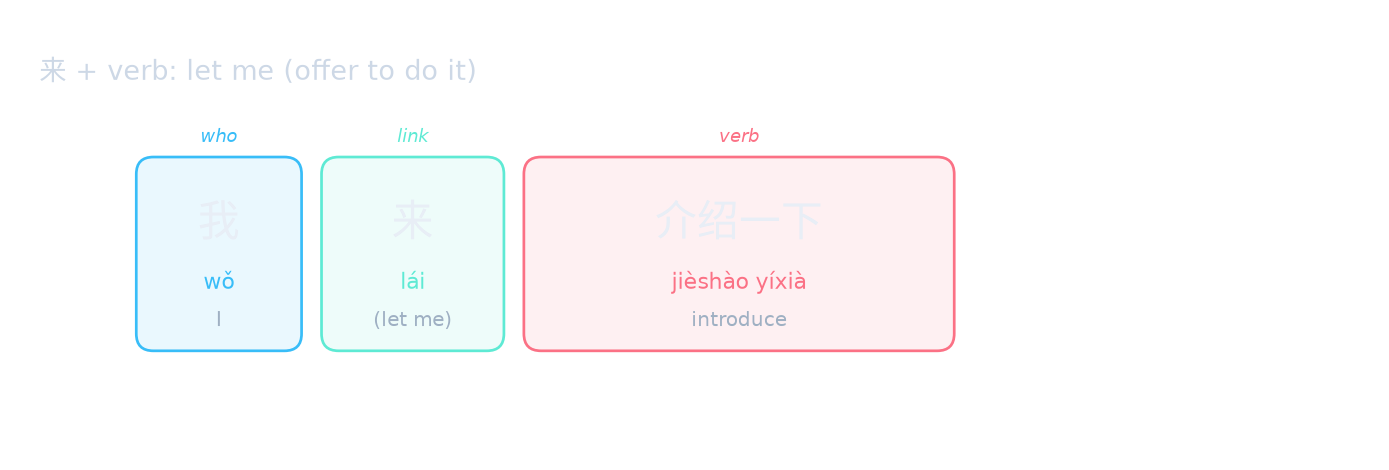
  • 我来wǒ láito introduce介绍jiè shào(used after a verb) give it…一下yī xià。 – Let me introduce (him).
  • to come来lái一碗yī wǎnbeef noodle soup牛肉面niú ròu miàn。 Lái yì wǎn niúròu miàn. – A bowl of beef noodles, please.

How it works. In casual speech, to come来lái can stand in for the real action: "let me take care of it". The action is clear from the situation (carrying, paying, introducing). In a restaurant, to come来lái + amount means "bring me": to come来lái两瓶liǎng píngbeer啤酒pí jiǔ, 再来一个zài lái yí gè!

我来wǒ láito do; to make做zuò I / me我wǒto go去qùto buy买mǎi
I'll take it on, here I'll go off and buy it

Watch out

  • Here to come来lái does not mean "come": 我来wǒ lái(suggestion)吧ba is "let me do it".
来 + verb: let me (offer to do it)
12.4

3. 以为(错误地认为)

English

Form: subject + (still / also / even还hái) to think以为yǐ wéi + belief,(originally / so it turns out原来yuán lái / didn't expect没想到méi xiǎng dào) + truth

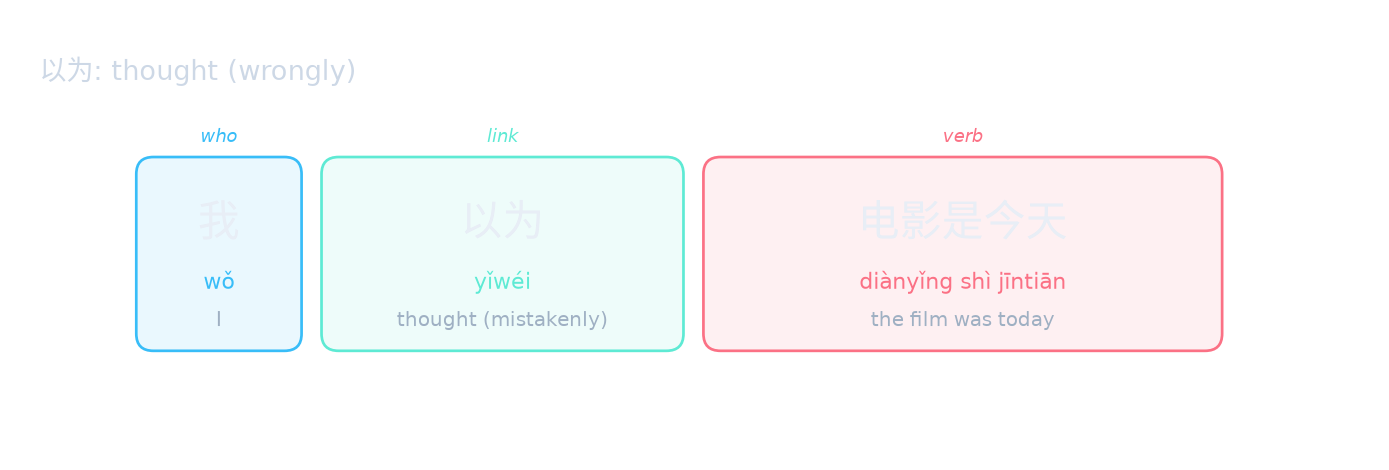
  • I / me我wǒto think以为yǐ wéifilm; movie电影diàn yǐngto be / is是shìtoday今天jīn tiān! Wǒ yǐwéi diànyǐng shì jīntiān! – I thought the film was today! (it wasn't)
  • I / me我wǒto think以为yǐ wéihe / him他tāto be / is是shìChina中国zhōng guóperson人rén,originally / so it turns out原来yuán láihe / him他tāto be / is是shìJapan日本rì běnperson人rén。 – I thought he was Chinese, but it turns out he's Japanese.
  • I / me我wǒto think以为yǐ wéiyou你nǐalready已经yǐ jīngto walk / to leave走zǒu(completed / change)了le,didn't expect没想到méi xiǎng dàoyou你nǐstill / also / even还háiat / in在zài。 – I thought you'd already left; I didn't expect you'd still be here.
  • I / me我wǒstill / also / even还háito think以为yǐ wéiyou你nǐnot不bùto come来lái(completed / change)了le。 – And here I was thinking you weren't coming.

How it works. to think以为yǐ wéi yǐwéi reports a belief that turned out to be wrong. A second clause often gives the truth, with originally / so it turns out原来yuán lái or didn't expect没想到méi xiǎng dào. still / also / even还háito think以为yǐ wéi stresses the mistake.

to think / believe认为rèn wéi to feel / think觉得jué de to think以为yǐ wéi
a considered opinion feel, think (everyday) thought, wrongly
I / me我wǒto think / believe认为rèn wéithis这个zhè gemeans办法bàn fǎdegree / adjective linker很hěngood好hǎo I / me我wǒto feel / think觉得jué deslightly有点儿yǒu diǎn ércold冷lěng I / me我wǒto think以为yǐ wéiyou你nǐto be / is是shìteacher老师lǎo shī

Watch out

  • In a debate, "I think this plan is reasonable" is I / me我wǒto think / believe认为rèn wéi…, not I / me我wǒto think以为yǐ wéi….
以为: thought (wrongly)
词汇 训练
汉字 拼音 English
原来 yuán lái originally; so it turns out
12.5

4. 好像

English

Form: subject + to seem; as if好像hǎo xiàng + guess · A + to seem; as if好像hǎo xiàng + B + the same一样yí yàng (+ adjective)

  • he / him他tāto seem; as if好像hǎo xiàngnot不bù太高兴tài gāo xìng。 Tā hǎoxiàng bú tài gāoxìng. – He seems a bit unhappy.
  • shop商店shāng diànto seem; as if好像hǎo xiàngto close (the door)关门guān mén(completed / change)了le。 – It seems the shop is closed.
  • I / me我wǒto seem; as if好像hǎo xiàngto see / meet见jiàn(experienced)过guohe / him他tā。 – I think I've seen him somewhere.
  • here这儿zhè ér(modifier / structural particle)的dewinter冬天dōng tiānto seem; as if好像hǎo xiàngspring (season)春天chūn tiānthe same一样yí yàngwarm暖和nuǎn huo。 – Winter here is as warm as spring.

How it works. to seem; as if好像hǎo xiàng hǎoxiàng gives a soft guess from what you notice: "it seems, apparently". It goes after the subject or at the start (to seem; as if好像hǎo xiàngwant / will / need要yàoto rain下雨xià yǔ(completed / change)了le). With the same一样yí yàng, it compares: "as if, like": he / him他tāhappy; glad高兴gāo xìng(degree marker)得deto seem; as if好像hǎo xiàng(measure word)个gèchild孩子hái zithe same一样yí yàng.

to seem; as if好像hǎo xiàng it seems (from this)看来kàn lái seemingly看起来kàn qǐ lái
a soft guess a conclusion from evidence an impression from looks
he / him他tāto seem; as if好像hǎo xiàngto fall ill生病shēng bìng(completed / change)了le he / him他tānot / haven't没méito come来lái,it seems (from this)看来kàn láito be / is是shìto fall ill生病shēng bìng(completed / change)了le he / him他tāseemingly看起来kàn qǐ lái很累hěn lèi

Watch out

  • to seem; as if好像hǎo xiàng is tentative, so not with definitely / certain一定yí dìng: wrong: he / him他tāto seem; as if好像hǎo xiàngdefinitely / certain一定yí dìngillness / ill病bìng(completed / change)了le → he / him他tāto seem; as if好像hǎo xiàngillness / ill病bìng(completed / change)了le.
好像: seem, as if
词汇 训练
汉字 拼音 English
好像 hǎo xiàng to seem; as if
过 guò to pass; to spend (time)
暖和 nuǎn huo warm
12.6

5. 要看 / 得看(表示取决于)

English

Form: undecided matter + want / will / need要yàoto look at; to watch; to read看kàn / (degree marker)得deto look at; to watch; to read看kàn + deciding factor

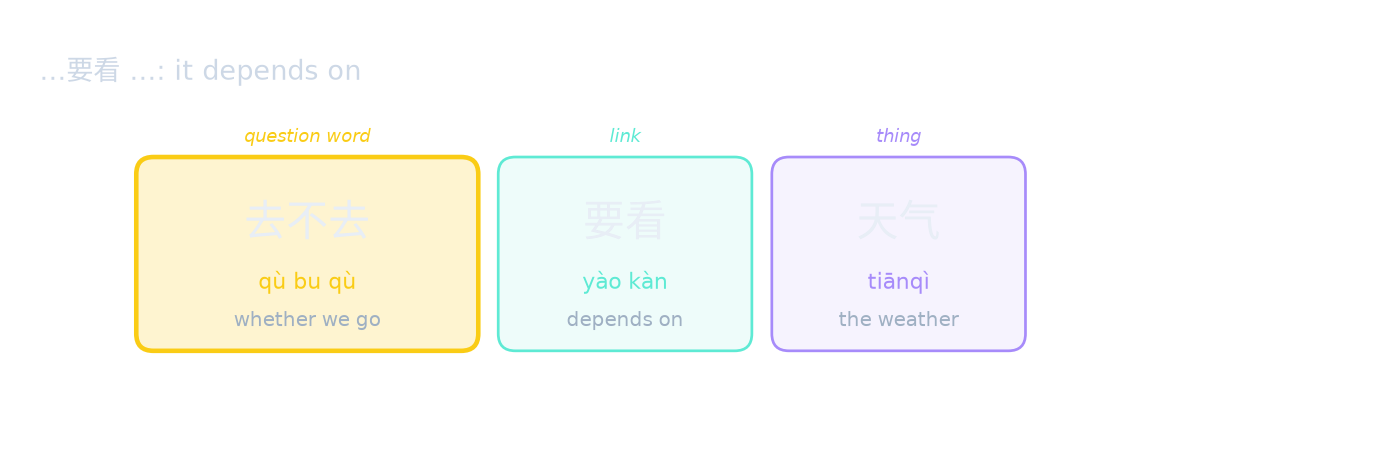
  • 去不去qù bù qùwant / will / need要yàoto look at; to watch; to read看kànweather天气tiān qì。 Qù bu qù yào kàn tiānqì. – Whether we go depends on the weather.
  • A: you你nǐtomorrow明天míng tiānto come来lái(yes/no ?)吗ma? B: (degree marker)得deto look at; to watch; to read看kànsituation情况qíng kuàng。 Děi kàn qíngkuàng. – "Are you coming tomorrow?" "It depends."
  • achievement成绩chéng jìOK? / good or not好不好hǎo bu hǎo,want / will / need要yàoto look at; to watch; to read看kànyou你nǐto work hard / effort努力nǔ lìnot不bùto work hard / effort努力nǔ lì。 – Whether your results are good depends on whether you work hard.

How it works. Put what is undecided first, often as A-not-A or with a question word (去不去qù bù qù, what什么shén metime; when时候shí hòu, how about怎么样zěn me yàng), then want / will / need要yàoto look at; to watch; to read看kàn / (degree marker)得deto look at; to watch; to read看kàn + the factor that decides it. In (degree marker)得deto look at; to watch; to read看kàn, (degree marker)得de is read děi ("must").

Spoken Written
want / will / need要yàoto look at; to watch; to read看kàn / (degree marker)得deto look at; to watch; to read看kàn to hinge on取决于qǔ jué yú
result; as a result结果jié guǒwant / will / need要yàoto look at; to watch; to read看kàneveryone大家dà jiā(modifier / structural particle)的deto work hard / effort努力nǔ lì result; as a result结果jié guǒto hinge on取决于qǔ jué yúeveryone大家dà jiā(modifier / structural particle)的deto work hard / effort努力nǔ lì

Watch out

  • In most speech the undecided part comes first: wrong: want / will / need要yàoto look at; to watch; to read看kànweather天气tiān qì去不去qù bù qù → 去不去qù bù qùwant / will / need要yàoto look at; to watch; to read看kànweather天气tiān qì.
…要看 …: it depends on
词汇 训练
汉字 拼音 English
情况 qíng kuàng situation
结果 jié guǒ result; as a result
12.7

6. 在于(存在于 / 取决于)

English

Form: abstract subject (key (point)关键guān jiàn / question / problem问题wèn tí / reason; cause原因yuán yīn / difference区别qū bié) + to rest with在于zài yú + B

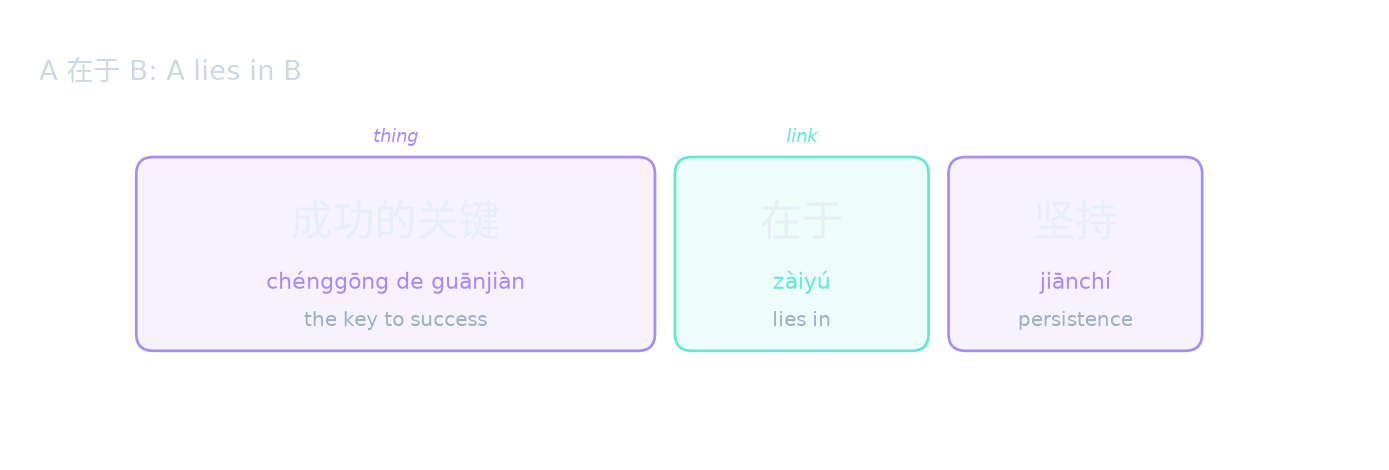
  • to succeed; success成功chéng gōng(modifier / structural particle)的de关键在于guān jiàn zài yúto keep at; to insist坚持jiān chí。 Chénggōng de guānjiàn zàiyú jiānchí. – The key to success lies in perseverance.
  • this这zhè两个liǎng gèmethod方法fāng fǎ(modifier / structural particle)的dedifference区别qū biéto rest with在于zài yúspeed速度sù dù。 – The difference between the two methods lies in speed.
  • question / problem问题wèn títo rest with在于zài yúmoney钱qiánnot enough不够bù gòu。 – The problem is that there isn't enough money.
  • to learn well学好xué hǎoforeign language外语wài yǔto rest with在于zài yúmany; much多duōto practice练习liàn xí。 – Learning a language well comes down to plenty of practice.

How it works. to rest with在于zài yú zàiyú names where the key point, problem, reason or difference lies. The subject is abstract, and the style is formal. In speech, main主要zhǔ yàoto be / is是shì…… often replaces it: question / problem问题wèn tímain主要zhǔ yàoto be / is是shìtime时间shí jiānnot enough不够bù gòu.

at / in在zài + place to be / is是shì to rest with在于zài yú
be located states identity stresses where the point lies
he / him他tāat / in在zàiBeijing北京běi jīng key (point)关键guān jiànto be / is是shìto keep at; to insist坚持jiān chí 关键在于guān jiàn zài yúto keep at; to insist坚持jiān chí

Watch out

  • Not for places: wrong: he / him他tāto rest with在于zài yúBeijing北京běi jīng → he / him他tāat / in在zàiBeijing北京běi jīng.
A 在于 B: A lies in B
词汇 训练
汉字 拼音 English
关键 guān jiàn key (point)
原因 yuán yīn reason; cause
区别 qū bié difference
成功 chéng gōng to succeed; success
坚持 jiān chí to keep at; to insist
方法 fāng fǎ method
速度 sù dù speed
12.8

7. 通过(经由,借助)

English

Form: to pass; through; by means of通过tōng guò + means,subject + result · subject + to pass; through; by means of通过tōng guò + exam / place

  • I / me我wǒto be / is是shìto pass; through; by means of通过tōng guòfriend朋友péng yǒuto introduce介绍jiè shàoto find找到zhǎo dào这份zhè fènto work; job工作gōng zuò(modifier / structural particle)的de。 Wǒ shì tōngguò péngyou jièshào zhǎodào zhè fèn gōngzuò de. – I found this job through a friend's introduction.
  • to pass; through; by means of通过tōng guò这次zhè cìactivity; to exercise活动huó dòng,everyone大家dà jiāeach other互相hù xiāngto understand了解liǎo jiě(completed / change)了le。 – Through this event, everyone got to know each other.
  • he / him他tāto pass; through; by means of通过tōng guò(completed / change)了leexam; to take an exam考试kǎo shì。 Tā tōngguòle kǎoshì. – He passed the exam.
  • car or other vehicle…车子chē zito pass; through; by means of通过tōng guò(completed / change)了lebig bridge大桥dà qiáo。 – The car crossed the bridge.

How it works. Before a verb or at the start, to pass; through; by means of通过tōng guò means "through, by means of": how a result is reached. As a verb, it means "pass" (an exam, a test, a vote) or "go through" a place.

to pass; through; by means of通过tōng guò to pass / process经过jīng guò
the means a process gone through
to pass; through; by means of通过tōng guònetwork网络wǎng luòto buy tickets买票mǎi piào to pass / process经过jīng guò三年sān nián(modifier / structural particle)的deto work hard / effort努力nǔ lì

Watch out

  • After a to pass; through; by means of通过tōng guò phrase, the result still needs a subject: wrong: to pass; through; by means of通过tōng guòto study; to learn学习xué xí,to make使shǐI / me我wǒprogress进步jìn bù(completed / change)了le → to pass; through; by means of通过tōng guòto study; to learn学习xué xí,I / me我wǒprogress进步jìn bù(completed / change)了le很多hěn duō. This is a classic exam trap.
通过: by means of
词汇 训练
汉字 拼音 English
通过 tōng guò to pass; through; by means of
活动 huó dòng activity; to exercise
互相 hù xiāng each other
12.9

8. 来自(来源于)

English

Form: subject + to come from来自lái zì + place / source (formal)

  • these这些zhè xiēstudent学生xué shēngto come from来自lái zì十多个shí duō gècountry国家guó jiā。 Zhèxiē xuésheng láizì shí duō ge guójiā. – These students come from more than ten countries.
  • she / her她tāto come from来自lái zìPeking University北京大学běi jīng dà xué。 – She is from Peking University.
  • this这个zhè genews; message消息xiāo xīto come from来自lái zìone (family / company)一家yì jiānewspaper报纸bào zhǐ。 – This news comes from a newspaper.
  • he / him他tā(modifier / structural particle)的depressure压力yā lìmain主要zhǔ yàoto come from来自lái zìto work; job工作gōng zuò。 – His stress comes mainly from work.

How it works. to come from来自lái zì láizì "come from" is the formal alternative to from从cóng……to come来lái. The place or source follows directly. It suits introductions and writing; in conversation, I / me我wǒ是从shì cóngChina中国zhōng guóto come来lái(modifier / structural particle)的de or I / me我wǒto be / is是shìChina中国zhōng guóperson人rén is more natural.

Watch out

  • No from从cóng and no to come来lái at the end: wrong: to come from来自lái zìfrom从cóngChina中国zhōng guó, wrong: to come from来自lái zìChina中国zhōng guóto come来lái → to come from来自lái zìChina中国zhōng guó.
来自: come from (formal)
词汇 训练
汉字 拼音 English
压力 yā lì pressure
12.10

练习

English

Cover the teaching pages before you answer. The answers are at the end.

1. to let / make让ràng / to call / be called / (animals) cry, bark叫jiào / please; to invite请qǐng / to make使shǐ (causative)

1. Complete: “His words moved me deeply.” he / him他tāif (coming after a…的话de huà…………I / me我wǒdegree / adjective linker很hěnmoved (emotionally); to move感动gǎn dòng。

2. You invite your professor to give a talk. Which verb fits? we / us我们wǒ menwant / think / miss想xiǎng___to rule王wángprofessor教授jiào shòuto come来láito do; to make做zuòreport; to report报告bào gào。

  • A. to call / be called / (animals) cry, bark叫jiào
  • B. to make使shǐ
  • C. please; to invite请qǐng
  • D. to let / make让ràng

3. Build: “The doctor won't let him drink.”

Put in order: doctor医生yī shēng / to drink (alcohol)喝酒hē jiǔ。 / he / him他tā / 不让bù ràng

4. True or false? to make使shǐ is the usual verb for giving permission in conversation. If false, correct it.

5. Your manager wants the report by Friday and tells you to inform the team. Use to let / make让ràng / to call / be called / (animals) cry, bark叫jiào / please; to invite请qǐng / to make使shǐ. Write your answer in Chinese, then say it aloud.

2. to come来lái as a dummy verb (I'll do it)

6. Offer to pay: “Let me pay!” I / me我wǒ…………to pay money付钱fù qián!

7. In a restaurant, what does to come来lái两瓶liǎng píngbeer啤酒pí jiǔ mean?

  • A. Two bottles of beer are coming.
  • B. Two bottles of beer, please.
  • C. Beer comes in two bottles.
  • D. Come and drink two beers.

8. Build: “Let me introduce (him/her) briefly.”

Put in order: to come来lái / to introduce介绍jiè shào / I / me我wǒ / (used after a verb) give it…一下yī xià。

9. True or false? 我来wǒ lái(suggestion)吧ba here means “let me come”. If false, correct it.

10. Your grandmother is struggling with a heavy box. You step in. Use to come来lái as a dummy verb. Write your answer in Chinese, then say it aloud.

3. to think以为yǐ wéi (mistakenly think)

11. Complete: “I thought you were a teacher (but you're not).” I / me我wǒ…………you你nǐto be / is是shìteacher老师lǎo shī。

12. In a debate: “I think this plan is reasonable.” Which verb fits?

  • A. originally / so it turns out原来yuán lái
  • B. to think / believe认为rèn wéi
  • C. to think以为yǐ wéi
  • D. to seem; as if好像hǎo xiàng

13. Build: “I thought you'd already left.”

Put in order: you你nǐ / already已经yǐ jīng / I / me我wǒto think以为yǐ wéi / to walk / to leave走zǒu(completed / change)了le。

14. True or false? I / me我wǒstill / also / even还háito think以为yǐ wéiyou你nǐnot不bùto come来lái(completed / change)了le suggests the speaker was wrong. If false, correct it.

15. You arrive at the cinema and the staff tell you your film was yesterday. Use to think以为yǐ wéi. Write your answer in Chinese, then say it aloud.

4. to seem; as if好像hǎo xiàng (it seems / as if)

16. Complete: “It seems the shop is closed.” shop商店shāng diàn…………to close (the door)关门guān mén(completed / change)了le。

17. Which sentence is natural?

  • A. he / him他tāto seem; as if好像hǎo xiàngto fall ill生病shēng bìng(completed / change)了le。
  • B. to seem; as if好像hǎo xiànghe / him他tādefinitely / certain一定yí dìngto fall ill生病shēng bìng。
  • C. he / him他tāto seem; as if好像hǎo xiàngdefinitely / certain一定yí dìngto fall ill生病shēng bìng(completed / change)了le。
  • D. he / him他tāto fall ill生病shēng bìngto seem; as if好像hǎo xiàng(completed / change)了le。

18. Build: “Winter here is as warm as spring.”

Put in order: here这儿zhè ér(modifier / structural particle)的dewinter冬天dōng tiān / to seem; as if好像hǎo xiàngspring (season)春天chūn tiān / warm暖和nuǎn huo。 / the same一样yí yàng

19. True or false? I / me我wǒto seem; as if好像hǎo xiàngto see / meet见jiàn(experienced)过guohe / him他tā means “I think I've seen him before.” If false, correct it.

20. Your roommate has been quiet all evening and didn't eat dinner. Use to seem; as if好像hǎo xiàng. Write your answer in Chinese, then say it aloud.

5. want / will / need要yàoto look at; to watch; to read看kàn / (degree marker)得deto look at; to watch; to read看kàn (it depends on)

21. Complete: “Whether we go depends on the weather.” 去不去qù bù qù…………weather天气tiān qì。

22. How is (degree marker)得de read in (degree marker)得deto look at; to watch; to read看kànsituation情况qíng kuàng?

  • A. děi
  • B. dé
  • C. de
  • D. dì

23. Build: “Whether your results are good depends on whether you work hard.”

Put in order: achievement成绩chéng jìOK? / good or not好不好hǎo bu hǎo / want / will / need要yàoto look at; to watch; to read看kànyou你nǐ / to work hard / effort努力nǔ lìnot不bùto work hard / effort努力nǔ lì。 / ,

24. True or false? to hinge on取决于qǔ jué yú is the formal written equivalent of want / will / need要yàoto look at; to watch; to read看kàn. If false, correct it.

25. Your friend asks if the hike is still on for Saturday. Use want / will / need要yàoto look at; to watch; to read看kàn / (degree marker)得deto look at; to watch; to read看kàn. Write your answer in Chinese, then say it aloud.

6. to rest with在于zài yú (lies in / consists in)

26. Complete: “The problem lies in a lack of money.” question / problem问题wèn tí…………money钱qiánnot enough不够bù gòu。

27. Which sentence is correct?

  • A. I / me我wǒ(modifier / structural particle)的dehome / family / (measure: shops)家jiāto rest with在于zài yúShanghai municipality…上海shàng hǎi。
  • B. he / him他tāto rest with在于zài yúschool学校xué xiàoto study; to learn学习xué xí。
  • C. to rest with在于zài yúhe / him他tāto be / is是shìteacher老师lǎo shī。
  • D. to succeed; success成功chéng gōng(modifier / structural particle)的de关键在于guān jiàn zài yúto work hard / effort努力nǔ lì。

28. Build: “The difference lies in speed.”

Put in order: to rest with在于zài yú / speed速度sù dù。 / difference区别qū bié

29. True or false? key (point)关键guān jiànto be / is是shìto keep at; to insist坚持jiān chí and 关键在于guān jiàn zài yúto keep at; to insist坚持jiān chí have similar meanings. If false, correct it.

30. In an interview, a famous athlete is asked why she keeps winning. Use to rest with在于zài yú. Write your answer in Chinese, then say it aloud.

7. to pass; through; by means of通过tōng guò (through / by means of)

31. Complete: “Through this event, everyone got to know each other.” …………这次zhè cìactivity; to exercise活动huó dòng,everyone大家dà jiāeach other互相hù xiāngto understand了解liǎo jiě(completed / change)了le。

32. Which sentence is correct?

  • A. to pass; through; by means of通过tōng guòto study; to learn学习xué xí,to make使shǐI / me我wǒprogress进步jìn bù(completed / change)了le很多hěn duō。
  • B. I / me我wǒto pass; through; by means of通过tōng guòto study; to learn学习xué xíto make使shǐprogress进步jìn bù(completed / change)了le。
  • C. to pass; through; by means of通过tōng guòto study; to learn学习xué xí,progress进步jìn bù(completed / change)了le很多hěn duōto make使shǐI / me我wǒ。
  • D. to pass; through; by means of通过tōng guòto study; to learn学习xué xí,I / me我wǒprogress进步jìn bù(completed / change)了le很多hěn duō。

33. Build: “He passed the exam.”

Put in order: exam; to take an exam考试kǎo shì。 / to pass; through; by means of通过tōng guò(completed / change)了le / he / him他tā

34. True or false? to pass / process经过jīng guò stresses a process; to pass; through; by means of通过tōng guò stresses the means. If false, correct it.

35. A friend asks how you got your new job so quickly. Use to pass; through; by means of通过tōng guò. Write your answer in Chinese, then say it aloud.

8. to come from来自lái zì (come from)

36. Complete (formal introduction): “She comes from Canada.” she / her她tā…………Canada加拿大jiā ná dà。

37. Which is correct?

  • A. he / him他tāfrom从cóngto come from来自lái zìUnited Kingdom 联合王国英国yīng guó。
  • B. he / him他tāto come from来自lái zìUnited Kingdom 联合王国英国yīng guóto come来lái。
  • C. he / him他tāto come from来自lái zìfrom从cóngUnited Kingdom 联合王国英国yīng guó。
  • D. he / him他tāto come from来自lái zìUnited Kingdom 联合王国英国yīng guó。

38. Build: “His stress comes mainly from work.”

Put in order: to come from来自lái zì / main主要zhǔ yào / to work; job工作gōng zuò。 / he / him他tā(modifier / structural particle)的depressure压力yā lì

39. True or false? to come from来自lái zì sounds more formal than 是从shì cóng…to come来lái(modifier / structural particle)的de. If false, correct it.

40. Your summer camp has students from all over the world. Use to come from来自lái zì. Write your answer in Chinese, then say it aloud.

12.11

混合练习

English

These questions mix the patterns and use new situations.

41. Choose to think以为yǐ wéi or to feel / think觉得jué de: I / me我wǒ…………today今天jīn tiāncan / will会huìto rain下雨xià yǔ,result; as a result结果jié guǒto be / is是shìclear sky晴天qíng tiān。

42. Say "Whether we go depends on the weather."

43. Which sentence is correct?

  • A. to pass; through; by means of通过tōng guò这次zhè cìactivity; to exercise活动huó dòng,to make使shǐstudent学生xué shēngmore更gèngto have / there is有yǒuconfidence信心xìn xīn(completed / change)了le。
  • B. 这次zhè cìactivity; to exercise活动huó dòngto make使shǐstudent学生xué shēngmore更gèngto have / there is有yǒuconfidence信心xìn xīn(completed / change)了le。
  • C. 这次zhè cìactivity; to exercise活动huó dòngto make使shǐmore更gèngto have / there is有yǒuconfidence信心xìn xīnstudent学生xué shēng(completed / change)了le。

44. Find and fix the problem. A notice says to pass; through; by means of通过tōng guò这次zhè cìactivity; to exercise活动huó dòng,to make使shǐstudent学生xué shēngmore更gèngconfident自信zì xìn(completed / change)了le. Give two ways to correct it.

45. Use it yourself. Say that whether you go depends on the weather, and that you thought it would rain, but it didn't.

12.12

答案与解析

English

Mark your work, then correct each mistake in your own words.

1. to let / make让ràng / to call / be called / (animals) cry, bark叫jiào / please; to invite请qǐng / to make使shǐ (causative)

1. to let / make让ràng

to let / make让ràng/to make使shǐ + person + feeling.

2. C. please; to invite请qǐng

please; to invite请qǐng is the polite invitation.

3. doctor医生yī shēng不让bù rànghe / him他tāto drink (alcohol)喝酒hē jiǔ。

A + 不让bù ràng + B + verb.

4. False.

Permission is to let / make让ràng; to make使shǐ is formal and causes a change.

5. Model answer: manager经理jīng lǐto let / make让ràngI / me我wǒto notify / notice通知tōng zhīeveryone大家dà jiāFriday星期五xīng qī wǔto hand in; to make (friends)交jiāoreport; to report报告bào gào。

Check your answer:

  • please; to invite请qǐng is for polite invitations; to your teacher, please; to invite请qǐngyou (polite)您nín… sounds right, to call / be called / (animals) cry, bark叫jiàoyou (polite)您nín… sounds rude.
  • to make使shǐ needs a cause and a change of state, usually in writing; do not use it for permission: mum; mother妈妈mā māto let / make让ràngI / me我wǒto go去qù, not mum; mother妈妈mā māto make使shǐI / me我wǒto go去qù.

2. to come来lái as a dummy verb (I'll do it)

6. to come来lái

我来wǒ lái + verb = let me do it.

7. B. Two bottles of beer, please.

to come来lái + item = bring me / I'll have.

8. 我来wǒ láito introduce介绍jiè shào(used after a verb) give it…一下yī xià。

我来wǒ lái + verb + (used after a verb) give it…一下yī xià.

9. False.

It means “let me (do it)”.

10. Model answer: 我来wǒ lái(suggestion)吧ba!

Check your answer:

  • This to come来lái is spoken; the real action must be clear from context (carrying, paying, ordering).
  • It does not mean "come" here: 我来wǒ lái(suggestion)吧ba is "let me (do it)", not "let me come".

3. to think以为yǐ wéi (mistakenly think)

11. to think以为yǐ wéi

to think以为yǐ wéi marks a mistaken belief.

12. B. to think / believe认为rèn wéi

A considered opinion takes to think / believe认为rèn wéi; to think以为yǐ wéi suggests a mistake.

13. I / me我wǒto think以为yǐ wéiyou你nǐalready已经yǐ jīngto walk / to leave走zǒu(completed / change)了le。

to think以为yǐ wéi + mistaken belief.

14. True.

The person did come; the belief was mistaken.

15. Model answer: I / me我wǒto think以为yǐ wéifilm; movie电影diàn yǐngto be / is是shìtoday今天jīn tiān!

Check your answer:

  • For a considered opinion, use to think / believe认为rèn wéi: I / me我wǒto think / believe认为rèn wéithis这个zhè gemeans办法bàn fǎdegree / adjective linker很hěngood好hǎo – "I think this method is good." to think以为yǐ wéi suggests the belief was wrong.
  • Do not use to think以为yǐ wéi for a correct belief that you are stating as fact.

4. to seem; as if好像hǎo xiàng (it seems / as if)

16. to seem; as if好像hǎo xiàng

to seem; as if好像hǎo xiàng + guess.

17. A. he / him他tāto seem; as if好像hǎo xiàngto fall ill生病shēng bìng(completed / change)了le。

to seem; as if好像hǎo xiàng is tentative and does not combine with definitely / certain一定yí dìng.

18. here这儿zhè ér(modifier / structural particle)的dewinter冬天dōng tiānto seem; as if好像hǎo xiàngspring (season)春天chūn tiānthe same一样yí yàngwarm暖和nuǎn huo。

A + to seem; as if好像hǎo xiàng + B + the same一样yí yàng + Adj.

19. True.

to seem; as if好像hǎo xiàng softens the memory into a guess.

20. Model answer: he / him他tāto seem; as if好像hǎo xiàngnot不bù太高兴tài gāo xìng。

Check your answer:

  • to seem; as if好像hǎo xiàng softens what you say; do not pair it with definitely / certain一定yí dìng (certainly): he / him他tāto seem; as if好像hǎo xiàngillness / ill病bìng(completed / change)了le, not he / him他tāto seem; as if好像hǎo xiàngdefinitely / certain一定yí dìngillness / ill病bìng(completed / change)了le.
  • For a looks-based impression, seemingly看起来kàn qǐ lái is also possible: he / him他tāseemingly看起来kàn qǐ lái很累hěn lèi – "He looks tired."

5. want / will / need要yàoto look at; to watch; to read看kàn / (degree marker)得deto look at; to watch; to read看kàn (it depends on)

21. want / will / need要yàoto look at; to watch; to read看kàn

Undecided matter + want / will / need要yàoto look at; to watch; to read看kàn + factor.

22. A. děi

Here (degree marker)得de means “must, have to” and is read děi: (degree marker)得deto look at; to watch; to read看kànsituation情况qíng kuàng “It depends on the situation.” As a particle after a verb it is de; dé means “obtain”.

23. achievement成绩chéng jìOK? / good or not好不好hǎo bu hǎo,want / will / need要yàoto look at; to watch; to read看kànyou你nǐto work hard / effort努力nǔ lìnot不bùto work hard / effort努力nǔ lì。

Undecided matter + want / will / need要yàoto look at; to watch; to read看kàn + factor.

24. True.

result; as a result结果jié guǒto hinge on取决于qǔ jué yú… = the result depends on ….

25. Model answer: 去不去qù bù qùwant / will / need要yàoto look at; to watch; to read看kànweather天气tiān qì。

Check your answer:

  • Put the undecided matter first, then want / will / need要yàoto look at; to watch; to read看kàn + factor: 去不去qù bù qùwant / will / need要yàoto look at; to watch; to read看kànweather天气tiān qì, not want / will / need要yàoto look at; to watch; to read看kànweather天气tiān qì去不去qù bù qù in most speech.
  • In (degree marker)得deto look at; to watch; to read看kàn, (degree marker)得de is read děi ("must"), not de.

6. to rest with在于zài yú (lies in / consists in)

26. to rest with在于zài yú

Abstract subject + to rest with在于zài yú + where it lies.

27. D. to succeed; success成功chéng gōng(modifier / structural particle)的de关键在于guān jiàn zài yúto work hard / effort努力nǔ lì。

to succeed; success成功chéng gōng(modifier / structural particle)的de关键在于guān jiàn zài yúto work hard / effort努力nǔ lì is right: to rest with在于zài yú means "lies in" and links an abstract subject (key (point)关键guān jiàn, question / problem问题wèn tí) to its cause. It does not mean "is in" a place, so it cannot replace at / in在zài.

28. difference区别qū biéto rest with在于zài yúspeed速度sù dù。

A + to rest with在于zài yú + B.

29. True.

to rest with在于zài yú stresses that the point lies there; to be / is是shì states it.

30. Model answer: to succeed; success成功chéng gōng(modifier / structural particle)的de关键在于guān jiàn zài yúto keep at; to insist坚持jiān chí。

Check your answer:

  • to rest with在于zài yú needs an abstract subject (key, problem, difference); not he / him他tāto rest with在于zài yúBeijing北京běi jīng for "he is in Beijing".
  • It is formal; in speech, main主要zhǔ yàoto be / is是shì… often replaces it: question / problem问题wèn tímain主要zhǔ yàoto be / is是shìtime时间shí jiānnot enough不够bù gòu – "The main problem is that there is not enough time."

7. to pass; through; by means of通过tōng guò (through / by means of)

31. to pass; through; by means of通过tōng guò

to pass; through; by means of通过tōng guò + means, then the result.

32. D. to pass; through; by means of通过tōng guòto study; to learn学习xué xí,I / me我wǒprogress进步jìn bù(completed / change)了le很多hěn duō。

The result clause needs its own subject; to pass; through; by means of通过tōng guò…,to make使shǐ… has none.

33. he / him他tāto pass; through; by means of通过tōng guò(completed / change)了leexam; to take an exam考试kǎo shì。

to pass; through; by means of通过tōng guò as a verb = pass.

34. True.

That is the key difference.

35. Model answer: I / me我wǒto be / is是shìto pass; through; by means of通过tōng guòfriend朋友péng yǒuto introduce介绍jiè shàoto find找到zhǎo dào这份zhè fènto work; job工作gōng zuò(modifier / structural particle)的de。

Check your answer:

  • A sentence starting with to pass; through; by means of通过tōng guò… still needs a subject in the result: to pass; through; by means of通过tōng guòto study; to learn学习xué xí,I / me我wǒprogress进步jìn bù(completed / change)了le, not to pass; through; by means of通过tōng guòto study; to learn学习xué xí,to make使shǐI / me我wǒprogress进步jìn bù(completed / change)了le.
  • That missing-subject error is a classic exam trap: after to pass; through; by means of通过tōng guò / to pass / process经过jīng guò …, check that the main clause has a subject.

8. to come from来自lái zì (come from)

36. to come from来自lái zì

to come from来自lái zì + place.

37. D. he / him他tāto come from来自lái zìUnited Kingdom 联合王国英国yīng guó。

to come from来自lái zì takes the place directly.

38. he / him他tā(modifier / structural particle)的depressure压力yā lìmain主要zhǔ yàoto come from来自lái zìto work; job工作gōng zuò。

Subject + main主要zhǔ yào + to come from来自lái zì + source.

39. True.

to come from来自lái zì suits introductions and writing.

40. Model answer: these这些zhè xiēstudent学生xué shēngto come from来自lái zì十多个shí duō gècountry国家guó jiā。

Check your answer:

  • Say to come from来自lái zìChina中国zhōng guó, not to come from来自lái zìfrom从cóngChina中国zhōng guó or to come from来自lái zìChina中国zhōng guóto come来lái.
  • to come from来自lái zì is formal; in conversation, I / me我wǒ是从shì cóngChina中国zhōng guóto come来lái(modifier / structural particle)的de or I / me我wǒto be / is是shìChina中国zhōng guóperson人rén is more natural.

Mixed practice

41. I / me我wǒto think以为yǐ wéitoday今天jīn tiāncan / will会huìto rain下雨xià yǔ,result; as a result结果jié guǒto be / is是shìclear sky晴天qíng tiān。to think以为yǐ wéi is for a belief that turned out to be wrong.

42. 去不去qù bù qùwant / will / need要yàoto look at; to watch; to read看kànweather天气tiān qì。want / will / need要yàoto look at; to watch; to read看kàn + the deciding thing.

43. B. to make使shǐ needs a subject (这次zhè cìactivity; to exercise活动huó dòng). A has no subject, because to pass; through; by means of通过tōng guò turns 这次zhè cìactivity; to exercise活动huó dòng into a phrase.

44. The sentence has no subject. Drop to pass; through; by means of通过tōng guò: 这次zhè cìactivity; to exercise活动huó dòngto make使shǐstudent学生xué shēngmore更gèngconfident自信zì xìn(completed / change)了le. Or drop to make使shǐ: to pass; through; by means of通过tōng guò这次zhè cìactivity; to exercise活动huó dòng,student学生xué shēngmore更gèngconfident自信zì xìn(completed / change)了le.

45. Model answer. 去不去qù bù qùwant / will / need要yàoto look at; to watch; to read看kànweather天气tiān qì。I / me我wǒto think以为yǐ wéitoday今天jīn tiāncan / will会huìto rain下雨xià yǔ,result; as a result结果jié guǒnot have / haven't没有méi yǒudown / next; to fall (rain), get off下xià。to think以为yǐ wéi shows the belief was wrong.

Review later. Tomorrow, write one sentence with to let / make让ràng and one with to think以为yǐ wéi.

该知识点的互动课程

逐步完成,配合即时检查练习。

更多 HSK 4 知识点

登录或创建账户

IGCSE, A-Level & AP