Who lives where, and what eats whom
A pond holds more than water: populations that feed each other, cycle carbon and nitrogen, and respond — sometimes catastrophically — to what humans add. Ecology asks four questions: who lives here (population, community, habitat, ecosystem), who eats whom (food chains, webs, pyramids), what goes round (the carbon and nitrogen cycles), and what we are doing to it (pollution, greenhouse gases, eutrophication, deforestation).
Edexcel International GCSE Biology 4BI1, Section 4 (statements 4.1–4.18B) rewards precise definitions and the carbon cycle drawn from memory.
The organism in the environment
A population 种群 is all the organisms of one species in a habitat; a community 群落 is all the populations in that habitat; a habitat 栖息地 is the place; an ecosystem 生态系统 is the community plus its non-living surroundings. Population size is set by abiotic 非生物 factors (light, water, temperature) and biotic 生物 factors (food, predators, disease, competition). Quadrat practicals estimate population size (mean per quadrat × total area ÷ quadrat area), and (B) quadrats along a transect show distribution and biodiversity 生物多样性.
Feeding relationships
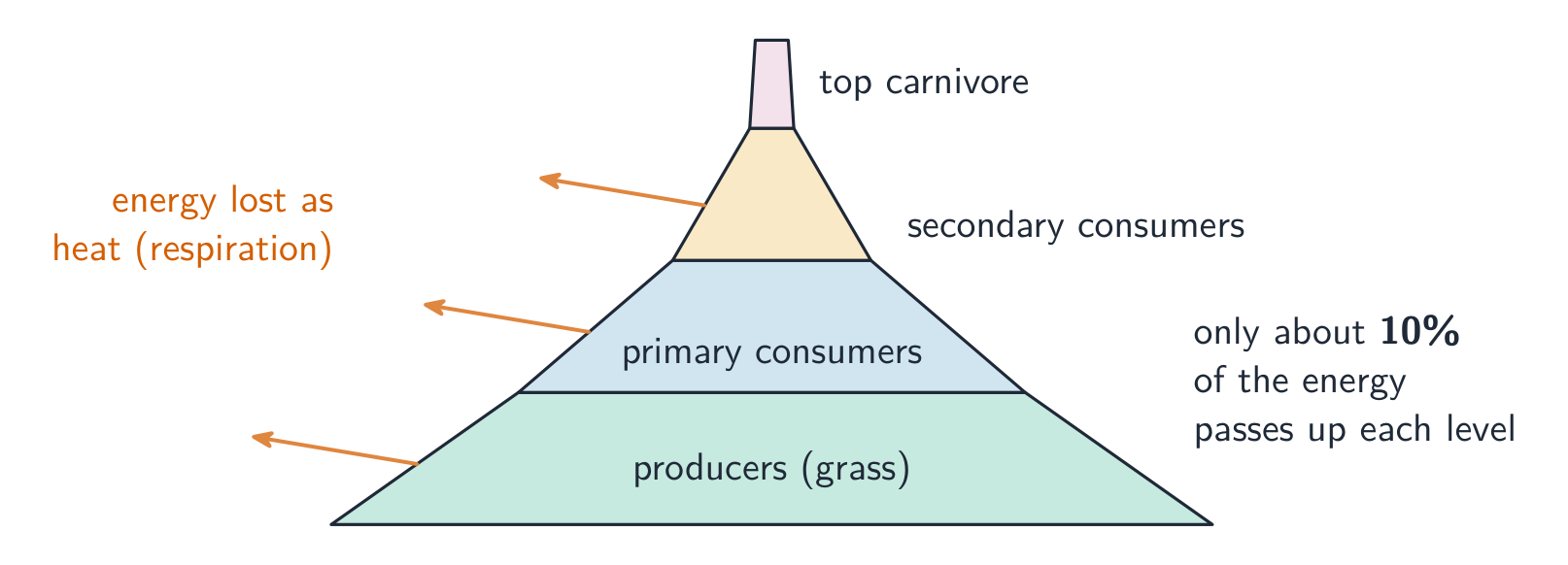
Producers 生产者 (plants) capture light energy; primary consumers 初级消费者 eat producers; secondary and tertiary consumers follow; decomposers 分解者 break down dead material. Arrows in a food chain point from eaten to eater — the direction energy flows. Pyramids of number can invert (one tree, many insects), but pyramids of energy transfer always narrow upward, and pyramids of biomass almost always do (a few water ecosystems, with fast-reproducing plankton, are the exception) — because only about 10 % of the energy at one level passes to the next: the rest is lost in respiration, movement and excretion, and as heat.
Cycles within ecosystems
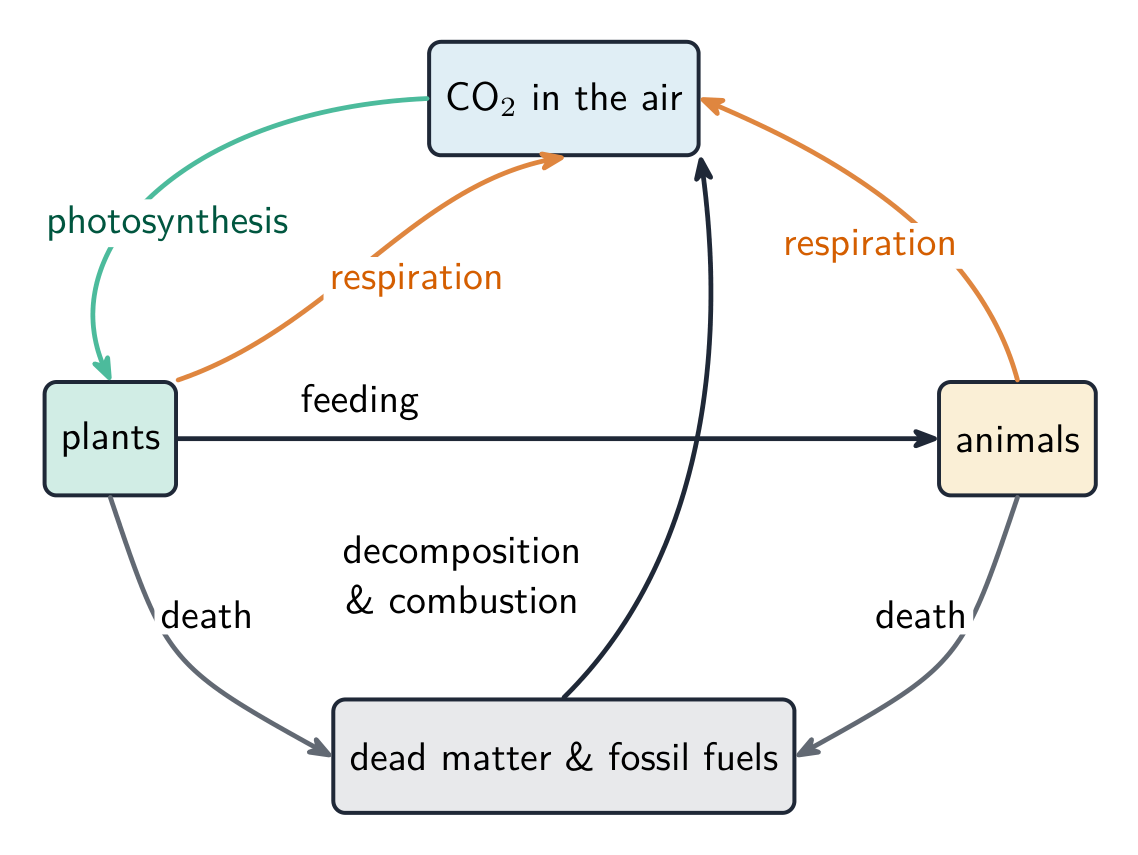
Carbon: photosynthesis removes CO₂ from the air; feeding passes carbon along chains; respiration 呼吸 (all organisms) and decomposition 分解 return it; combustion 燃烧 of fossil fuels releases carbon stored for millions of years.
(B) Nitrogen: nitrogen-fixing bacteria make nitrogen compounds from atmospheric N₂; decomposers break dead matter into ammonia; nitrifying bacteria convert ammonia to nitrates plants absorb; denitrifying bacteria return nitrogen to the air.
Human influences
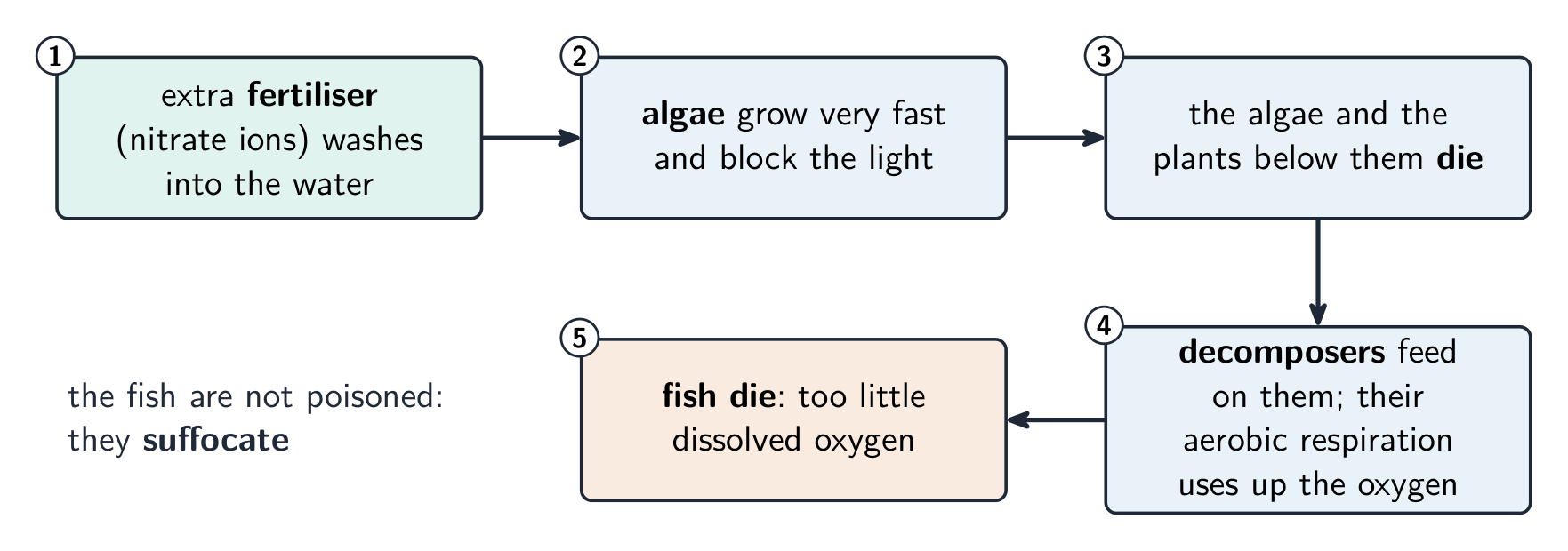
Air pollution: sulfur dioxide dissolves in rain to form acid rain (damages leaves, lakes, buildings); carbon monoxide binds haemoglobin, cutting the oxygen blood can carry. Greenhouse gases 温室气体 — water vapour, carbon dioxide, nitrous oxide, methane and CFCs — trap outgoing radiation; burning fossil fuels, deforestation, agriculture and industry add them, thickening the blanket (the enhanced greenhouse effect), bringing global warming with rising sea levels and shifting climates. Sewage in water feeds microbes that consume oxygen. Eutrophication 富营养化: fertiliser leaches into water, algae bloom, die, and decomposers strip the oxygen — fish suffocate.
(B) Deforestation removes roots and canopy: rain leaches soil minerals away, soil erodes, evapotranspiration falls (less cloud and rain), and stored carbon returns to the air, unbalancing atmospheric gases.
Check yourself
- Define population, community, habitat and ecosystem.
- Why can a pyramid of number be inverted when a biomass pyramid almost never is?
- Explain why only about 10 % of energy passes between trophic levels.
- Name the four processes of the carbon cycle.
- (B) Which bacteria convert ammonia to nitrates, and which return nitrogen to the air?
- Why does carbon monoxide kill?
- Name the five greenhouse gases.
- Describe the eutrophication sequence in four steps.
- (B) Give two consequences of deforestation for the carbon cycle and two for the soil.
Answers: 1 population — all organisms of one species in a habitat; community — all populations in a habitat; habitat — the place where organisms live; ecosystem — community plus its environment; 2 number counts individuals — one huge tree can feed many insects, inverting the shape — while biomass measures total mass, which almost always falls with each level; 3 energy is lost at each step through respiration (heat), movement, and egestion/excretion of uneaten parts; 4 photosynthesis, respiration, decomposition, combustion; 5 (B) nitrifying bacteria; denitrifying bacteria; 6 it binds to haemoglobin more strongly than oxygen, so blood carries less oxygen to tissues; 7 water vapour, carbon dioxide, nitrous oxide, methane, CFCs; 8 fertiliser runs into water → algal bloom → algae die and decomposers multiply → decomposers respire, using the oxygen, so fish and other organisms die; 9 (B) carbon: fewer trees photosynthesise, and burning releases stored carbon; soil: leaching of minerals and erosion without roots, with less evapotranspiration.