- Resources are used, reused and recycled; potable water 饮用水 — filtered and sterilised fresh water, or desalinated sea water — is the first essential.
- Life cycle assessment 生命周期评估s weigh a product's environmental cost stage by stage; reduce–reuse–recycle cuts every stage.
- (Chem) corrosion 腐蚀 prevention, alloys, ceramics/polymers/composite 复合材料s, and the Haber process 哈伯法's compromise chemistry.
资源利用
AQA · GCSE · 化学 · 知识点 10
10.1
Using resources: sustainable chemistry
词汇
训练
| English | 中文 | 拼音 |
|---|---|---|
| potable water/ˈpəʊtəbl ˈwɔːtə/ | 饮用水 | yǐn yòng shuǐ |
| life cycle assessment/laɪf ˈsaɪkl əˈsesmənt/ | 生命周期评估 | shēng mìng zhōu qī píng gū |
| corrosion/kəˈrəʊʒn/ | 腐蚀 | fǔ shí |
| composite/ˈkɒmpəzɪt/ | 复合材料 | fù hé cái liào |
| Haber process/ˈheɪbə ˈprəʊses/ | 哈伯法 | hā bó fǎ |
10.1
资源与饮用水(4.10.1.1–4.10.1.3)
教学大纲
资源与饮用水(AQA 8462 陈述 4.10.1.1-4.10.1.4)。
- 区分不可再生资源与可再生资源,并定义可持续发展。
- 区分饮用水与纯水,描述英国的水处理过程;并与海水淡化进行比较。
- 按顺序描述污水处理流程,并比较从废水、地下水和海水中获取饮用水的难易程度。
- (HT)描述用于低品位铜矿的生物采矿和生物浸出法。
来源:Cambridge International 教学大纲
Humans use the Earth's resources for warmth, shelter, food and transport; finite resources (ores, fossil fuels) are processed for energy and materials; renewable ones replenish. Sustainable development 可持续发展 meets present needs without compromising future generations.
Potable water — safe to drink: low dissolved salts and microbes — but not pure water (it contains dissolved substances).
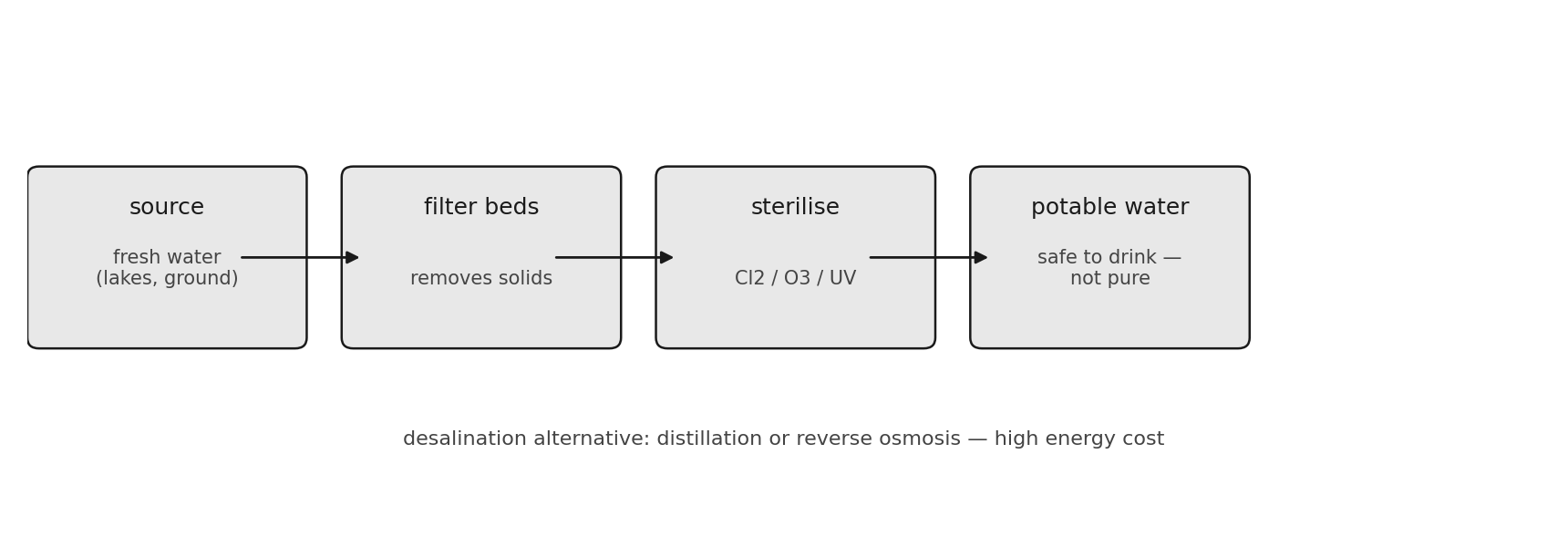
In the UK, fresh rainwater is made potable by: choosing a source → filter beds → sterilising (with chlorine, ozone or UV light). Where fresh water is scarce, desalination — distillation or reverse osmosis — needs large amounts of energy.
Waste water (sewage) treatment: screening and grit removal → sedimentation (sewage sludge + effluent) → anaerobic digestion of the sludge → aerobic biological treatment of the effluent. Potable water is easiest from ground water, harder from waste, hardest (energy-wise) from salt water.
(HT) Alternative metal extraction — copper ores are scarce: phytomining (plants absorb metal compounds; harvest, burn to ash, extract) and bioleaching (bacteria produce leachate solutions of the metal compounds) avoid moving huge amounts of rock.
词汇
训练
| English | 中文 | 拼音 |
|---|---|---|
| desalination/dɪˌsælɪˈneɪʃn/ | 海水淡化 | hǎi shuǐ dàn huà |
| sustainable development/səˈsteɪnəbl dɪˈveləpmənt/ | 可持续发展 | kě chí xù fā zhǎn |
10.2
生命周期评估与回收利用(4.10.2.1–4.10.2.2)
教学大纲
生命周期评估与回收(AQA 8462 陈述 4.10.2.1-4.10.2.2)。
- 列出LCA的四个阶段,并解释为何LCA并非完全客观。
- 针对给定材料评估减少使用、重复使用和回收利用,并说明理由。
来源:Cambridge International 教学大纲
LCA stages: extracting and processing raw materials; manufacturing and packaging; use and operation; disposal — including transport at each stage. Energy, water, resource use and waste are quantifiable; pollutant effects need value judgements — so LCAs are not purely objective, and selective LCAs can be misused (advertising). Compare plastic vs paper shopping bags.
Reduce, reuse, recycle: metals, glass, building materials, clay ceramics and most plastics come from limited raw materials; recycling cuts mining/quarrying impact and energy — e.g. glass crushed and remelted; scrap steel added to the blast furnace reduces iron-ore extraction. Some products (glass bottles) are reused; others recycled into different products; separation effort depends on the final product's requirements.
10.3
材料的应用——腐蚀与合金,仅限化学(4.10.3.1–4.10.3.2)
教学大纲
材料应用,仅限化学内容(AQA 8462 陈述 4.10.3.1-4.10.3.2)。
- 描述腐蚀及其预防措施,包括牺牲阳极锌保护法。
- 回忆具有特定成分和用途的具体合金名称,并能解读合金数据。
- 比较玻璃、黏土陶瓷、聚合物和复合材料,包括热塑性塑料与热固性塑料的区别。
来源:Cambridge International 教学大纲
Corrosion — destruction of materials by chemical reaction with the environment (e.g. iron + oxygen + water → rust). Prevention: greasing, painting, coating (galvanising with zinc, which gives sacrificial protection 牺牲保护 — it corrodes in place of the iron even when scratched) and alloying (stainless steel). Aluminium resists corrosion by its own protective oxide layer.
Alloys: bronze (copper + tin), brass (copper + zinc); gold jewellery alloyed with silver/copper/zinc — purity in carats (24 = 100 %; 18 = 75 %). Steels — iron + carbon (+ metals): high-carbon steel strong but brittle; low-carbon steel softer, shaped easily; stainless steel (Cr, Ni) hard and corrosion-resistant; aluminium alloys low density (aircraft).
Ceramics, polymers, composites: soda-lime glass (sand + sodium carbonate + limestone), borosilicate glass (sand + boron trioxide — higher melting point); clay ceramics (pottery, bricks — shaped wet clay, then fired). Polymers depend on monomers and conditions — LD and HD poly(ethene) both from ethene. Thermosoftening polymers melt on heating (recyclable chains); thermosetting polymer 热固性聚合物 does not (cross-links). Composites — a matrix/binder surrounding a reinforcement (fibres/fragments); know examples (fibreglass, concrete, carbon-fibre).
词汇
训练
| English | 中文 | 拼音 |
|---|---|---|
| sacrificial protection/ˌsækrɪˈfɪʃl prəˈtekʃn/ | 牺牲保护 | xī shēng bǎo hù |
| thermosetting polymer/ˈθɜːməsɪtɪŋ ˈpɒlɪmə/ | 热固性聚合物 | rè gù xìng jù hé wù |
10.4
哈伯法与氮磷钾化肥——仅限化学(4.10.4.1–4.10.4.2)
教学大纲
哈伯法与NPK化肥,仅限化学内容(AQA 8462 陈述 4.10.4.1-4.10.4.2)。
- 陈述哈伯法的原料来源及反应条件。
- 描述氨气及未反应气体的分离与循环利用过程。
- (HT)运用平衡原理解释为何采用折中反应条件。
- 写出NPK化合物的名称及其生产方法,并评估化肥制造过程。
来源:Cambridge International 教学大纲
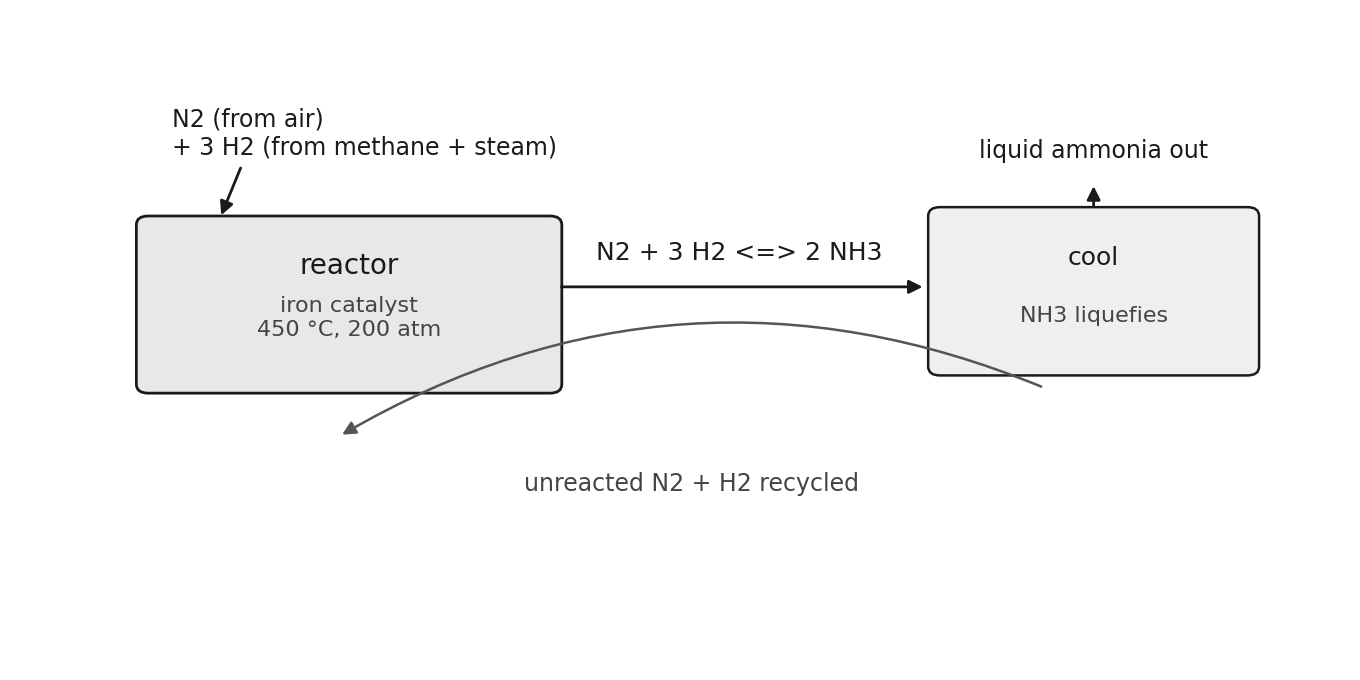
Haber process: N₂ + 3 H₂ ⇌ 2 NH₃ — nitrogen from air, hydrogen from natural gas (methane + steam) [or electrolysis of water]. Conditions: iron catalyst, ~450 °C, ~200 atmospheres; the reaction is reversible — cool the mixture, the ammonia liquefies and is removed; unreacted N₂/H₂ are recycled.
(HT) Higher pressure favours ammonia (fewer gas molecules) but is expensive and unsafe; lower temperature favours the exothermic forward reaction but is slow — so the chosen conditions are a compromise between rate, yield and cost. Apply Le Chatelier to each condition change.
NPK fertilisers — formulations of nitrogen, phosphorus and potassium compounds for plant growth: ammonia → nitric acid (Ostwald); ammonia + nitric acid → ammonium nitrate; potassium chloride/potassium sulfate mined; phosphate rock treated with acid to make superphosphate. Evaluate the industrial production of fertilisers given data (raw materials, energy costs, % yield — e.g. the lab vs industrial ammonium sulfate routes).
10.4
Checklist before you call this topic done
- Potable vs pure; the UK treatment sequence; desalination and its cost; sewage-treatment steps in order.
- (HT) phytomining and bioleaching described end to end.
- LCA four stages with the objectivity caveat; reduce-reuse-recycle examples with reasons.
- (Chem) corrosion prevention incl. sacrificial zinc; named alloys with compositions; thermosoftening vs thermosetting; matrix + reinforcement.
- (Chem/HT) Haber conditions with the compromise explained by equilibrium; the NPK compounds and their origins.