- The Sun's energy passes through ecosystems; carbon and water cycle between the living and non-living world.
- Communities compete and depend on each other; adaptations fit organisms to their conditions.
- Human activity — waste, land use, deforestation, global warming — threatens biodiversity, and trophic-level biology (bio only) explains why food chains are short.
生态学
AQA · GCSE · 生物 · 知识点 7
7.1
Ecology: communities, cycles and human impacts
7.1
适应性、相互依存与竞争(4.7.1)
教学大纲
适应性、相互依赖与竞争(AQA 8461 陈述 4.7.1)。
- 描述生态系统的组织结构层次,并定义生态系统、群落、生物因素和非生物因素。
- 列举动植物竞争的因素,并解释相互依赖关系。
- 解释给定的非生物和生物因素变化如何影响群落。
- 解释结构适应、行为适应和功能适应,以及极端微生物。
来源:Cambridge International 教学大纲
An ecosystem 生态系统 is the interaction of a community of living organisms (biotic 生物因子) with the non-living (abiotic factor 非生物因子) parts of their environment. Levels of organisation: individual → population → community → ecosystem.
Competition 竞争: plants compete for light, space, water and mineral ions; animals compete for food, mates and territory. Interdependence 相互依赖: each species depends on others for food, shelter, pollination, seed dispersal — remove one species and the whole community can be affected.
Abiotic factors affecting a community: light intensity, temperature, moisture levels, soil pH and mineral content, wind intensity and direction, carbon dioxide levels (plants), oxygen levels (aquatic animals). Biotic factors : availability of food, new predators arriving, new pathogens, one species outcompeting another until numbers fall too low to breed. Explain the effect of a change in any of these from given data.
Adaptations 适应性 — features that enable survival in normal conditions — are structural (shape/body), behavioural (actions) or functional (processes, e.g. camouflage chemistry, venom). Extremophiles 极端微生物 live in extreme environments — high temperature, pressure or salt — e.g. bacteria in deep-sea vents.
词汇
训练
| English | 中文 | 拼音 |
|---|---|---|
| ecosystem/ˈiːkəʊsɪstəm/ | 生态系统 | shēng tài xì tǒng |
| biotic factor/baɪˈɒtɪk ˈfæktə/ | 生物因子 | shēng wù yīn zi |
| abiotic factor/ˌæbɪˈɒtɪk ˈfæktə/ | 非生物因子 | fēi shēng wù yīn zi |
| competition/ˌkɒmpəˈtɪʃn/ | 竞争 | jìng zhēng |
| interdependence/ˌɪntədɪˈpendəns/ | 相互依赖 | xiāng hù yī lài |
| adaptation/ˌædæpˈteɪʃn/ | 适应性 | shì yìng xìng |
| extremophile/ekˈstreməfaɪl/ | 极端微生物 | jí duān wēi shēng wù |
7.2
生态系统组织与物质循环(4.7.2, RP9/RP10)
教学大纲
Organisation of an ecosystem and material cycles (AQA 8461 statement 4.7.2, RP9/RP10).
- Use food-chain vocabulary from producer to tertiary consumer and interpret predator-prey cycles.
- Describe RP9 sampling with transects and quadrats, with mean, mode and median.
- Explain the carbon and water cycles and the role of microorganisms.
- (Bio) Explain how temperature, water and oxygen affect decay rate, with RP10 and biogas.
来源:Cambridge International 教学大纲
Photosynthetic organisms are the producers 生产者 of biomass for life on Earth. Food chains: producer (green plant/alga making glucose by photosynthesis) → primary consumers 初级消费者 → secondary consumers 次级消费者 → tertiary consumers 三级消费者.
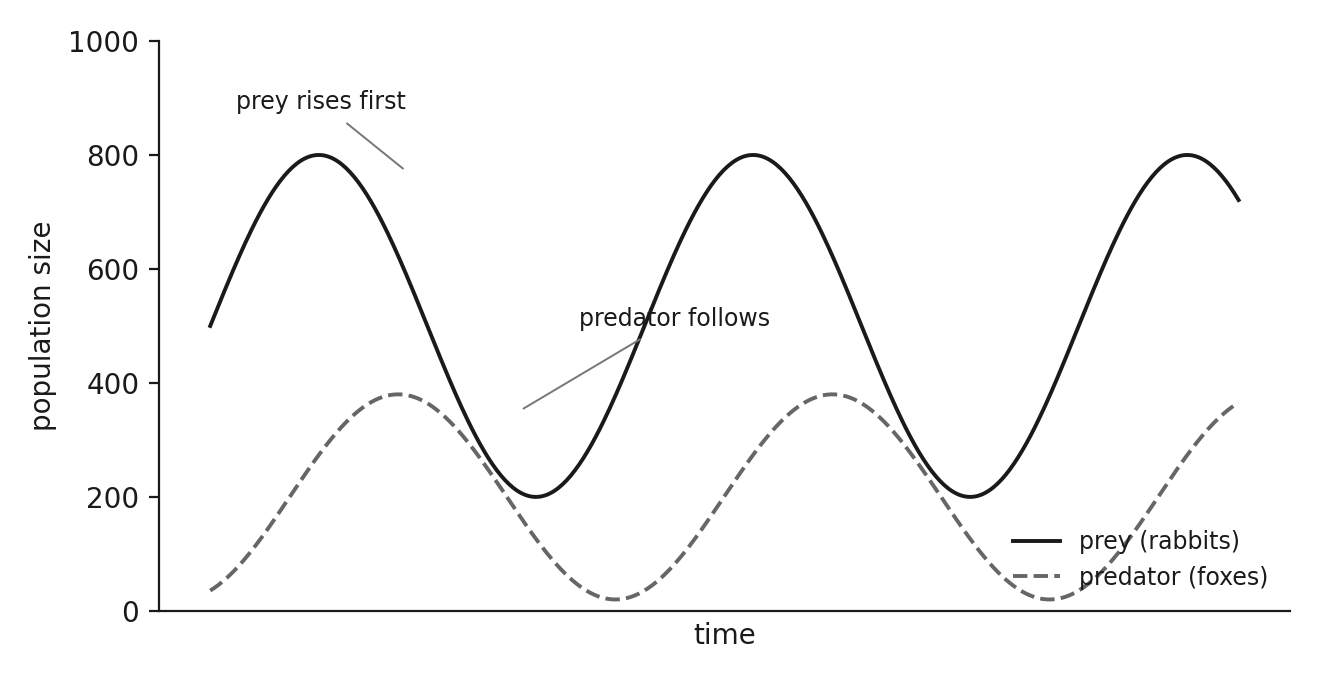
Predators kill and eat prey; in a stable community their numbers rise and fall in cycles — interpret the classic predator–prey graph (prey rises first, predator follows).
Sampling (RP9): transects and quadrats measure the distribution and abundance of species; calculate mean, mode, median of abundance; plot graphs with suitable scales.
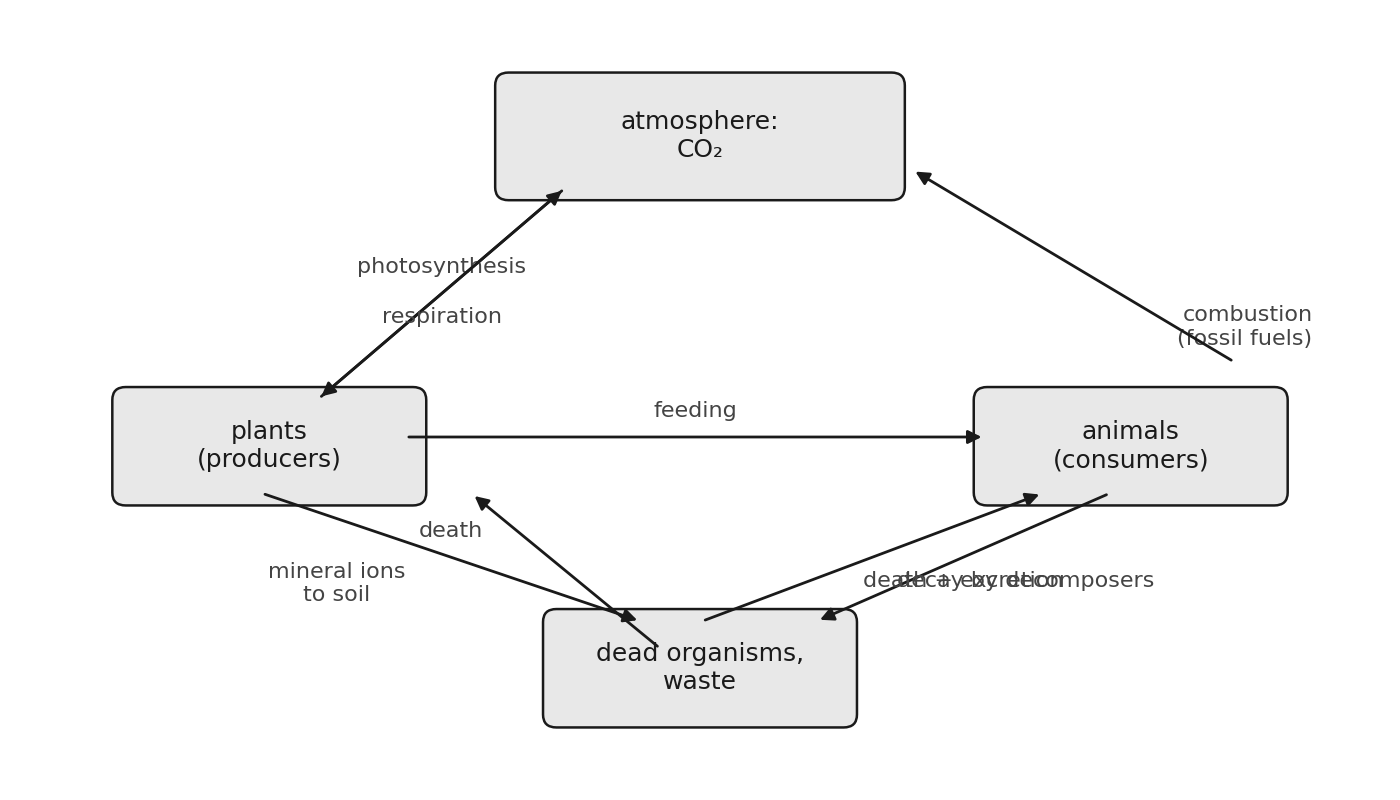
Carbon cycle: returns carbon from organisms to the atmosphere as carbon dioxide for photosynthesis — respiration (plants, animals, decomposers), decay, combustion. Water cycle: evaporation and precipitation provide fresh water before it drains to the sea. Microorganisms recycle materials — returning carbon to the atmosphere as CO₂ and mineral ions to the soil. The nitrogen cycle is NOT required.
(Bio) Decomposition (RP10): temperature, water and oxygen affect the rate of decay. Gardeners and farmers provide optimum conditions for rapid decay 腐解 of waste into compost — a natural fertiliser. Anaerobic decay produces methane — biogas generators. RP10: effect of temperature on the rate of decay of fresh milk by measuring pH change.
(HT Bio) Environmental change: temperature, water availability, atmospheric-gas composition — changes may be seasonal, geographic or human-caused — shift the distribution of species.
词汇
训练
| English | 中文 | 拼音 |
|---|---|---|
| producer/prəˈdjuːsə/ | 生产者 | shēng chǎn zhě |
| primary consumer/ˈpraɪməri kənˈsuːmə/ | 初级消费者 | chū jí xiāo fèi zhě |
| secondary consumer/ˈsekəndəri kənˈsuːmə/ | 次级消费者 | cì jí xiāo fèi zhě |
| tertiary consumer/ˈtɜːʃjəri kənˈsuːmə/ | 三级消费者 | sān jí xiāo fèi zhě |
| decomposition/ˌdiːkɒmpəˈzɪʃn/ | 腐解 | fǔ jiě |
7.3
生物多样性与人类互动(4.7.3)
教学大纲
生物多样性与人类相互作用(AQA 8461 陈述 4.7.3)。
- 定义生物多样性并解释其为何能维持生态系统的稳定性。
- 解释废弃物、土地利用、森林砍伐和全球变暖如何导致生物多样性减少。
- 描述旨在维持生物多样性的项目。
来源:Cambridge International 教学大纲
Biodiversity 生物多样性 is the variety of all different species on Earth or within an ecosystem; it stabilises ecosystems by reducing the dependence of one species on another, and our own future relies on maintaining it.
- Waste management: population growth and living standards increase resource use and waste → pollution 污染 in water (sewage, fertiliser, toxic chemicals), air (smoke, acidic gases) and on land (landfill, toxic chemicals) — killing plants and animals.
- Land use: building, quarrying, farming and dumping waste reduce land for other species; destroying peat bogs for garden compost destroys habitat and biodiversity, and decaying or burnt peat releases CO₂.
- Deforestation in tropical areas: land for cattle and rice fields, crops for biofuels.
- Global warming: rising atmospheric CO₂ and methane contribute to global warming; describe biological consequences (distribution shifts, migration changes, biodiversity loss).
Maintaining biodiversity — programmes reducing negative human effects: breeding programmes for endangered species; protection and regeneration of rare habitats; field margins and hedgerows reintroduced in single-crop areas; reduced deforestation and CO₂ emissions; recycling rather than landfill.
词汇
训练
| English | 中文 | 拼音 |
|---|---|---|
| biodiversity/ˌbaɪəʊdaɪˈvɜːsɪti/ | 生物多样性 | shēng wù duō yàng xìng |
| pollution/pəˈluːʃn/ | 污染 | wū rǎn |
7.4
营养级与粮食安全 — 仅限生物学(4.7.4–4.7.5)
教学大纲
营养级与粮食安全,仅限生物学部分(AQA 8461 陈述 4.7.4-4.7.5)。
- 列举营养级名称,描述分解者并构建生物量金字塔。
- 解释各营养级之间的生物量损耗并计算传递效率。
- 描述威胁粮食安全的生物学因素。
- 评估农业技术、可持续渔业以及生物技术的作用。
来源:Cambridge International 教学大纲
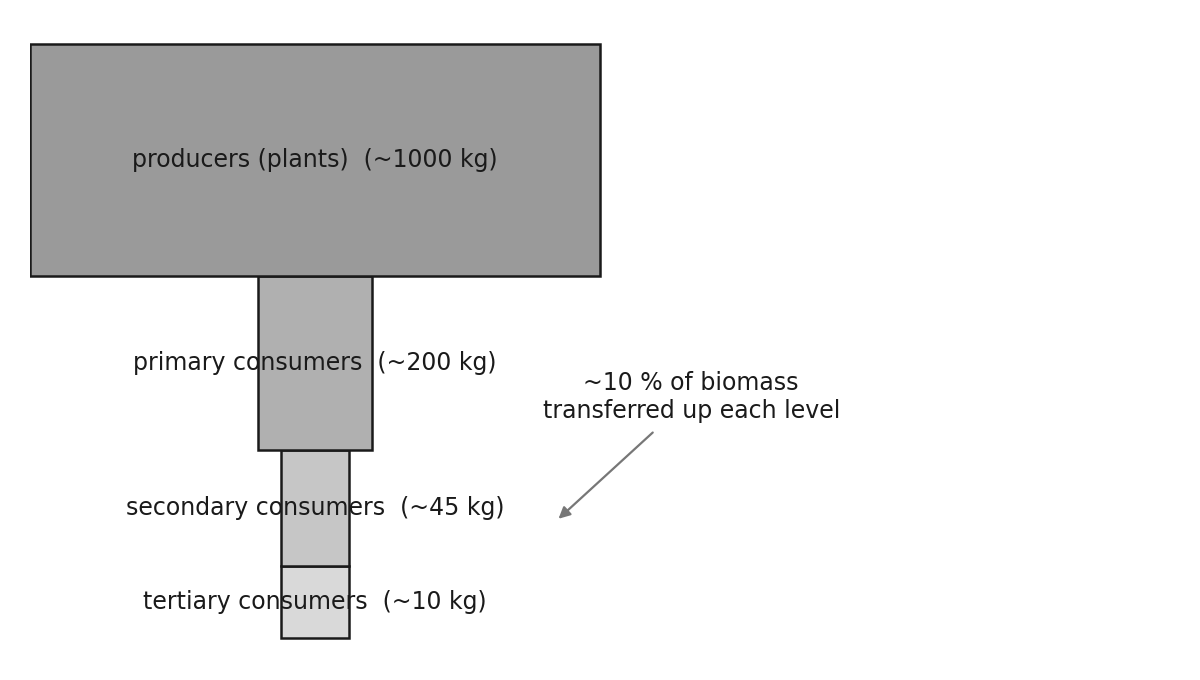
Trophic levels: 1 producers (plants, algae); 2 primary consumers (herbivores); 3 secondary consumers (carnivores eating herbivores); 4 tertiary consumers (carnivores eating carnivores). Apex predators have no predators. Decomposers secrete enzymes onto dead material and absorb the small soluble food molecules.
Pyramids of biomass: trophic level 1 at the bottom; construct from data. Transfer of biomass: producers transfer ~1 % of incident light energy into biomass; only ~10 % of biomass passes from each level to the next — losses from egested faeces (not all ingested material is absorbed) and waste (CO₂ and water from respiration, water and urea in urine); glucose used in respiration. Calculate efficiency by percentage or fraction of mass.
Food security 粮食安全 — having enough food for the population — is threatened by: rising birth rate; changing diets in developed countries; new pests and pathogens; environmental changes (famine when rains fail); the cost of agricultural inputs; conflicts affecting water or food availability.
Farming techniques improve efficiency by restricting energy transfer from food animals to the environment — limiting movement and controlling temperature; high-protein feeds increase growth. Weigh these against ethical objections to intensive farming.
Sustainable fisheries: maintain fish stocks where breeding continues — control net size and fishing quotas .
Role of biotechnology: culturing microorganisms for food — Fusarium fungus grown on glucose syrup in aerobic conditions produces mycoprotein 菌蛋白 (protein-rich, vegetarian); GM bacteria produce insulin; GM crops such as golden rice add food or nutritional value.
词汇
训练
| English | 中文 | 拼音 |
|---|---|---|
| food security/fuːd sɪˈkjʊərɪti/ | 粮食安全 | liáng shí ān quán |
| mycoprotein/ˈmaɪkəprəʊtiːn/ | 菌蛋白 | jūn dàn bái |
7.4
Checklist before you call this topic done
- Definitions chain: ecosystem, community, abiotic/biotic factors with examples.
- Plant vs animal competition; interdependence consequences; three adaptation types + extremophiles.
- Food-chain vocabulary; predator–prey cycle read off a graph; RP9 sampling with mean/mode/median.
- Carbon and water cycles with decomposers' role; (bio) decay factors + biogas + RP10.
- Four human threats + five biodiversity programmes named.
- (Bio) Trophic levels, pyramid shape, 10 % rule with efficiency calculation.
- (Bio) Six food-security threats; efficiency farming, net size and quotas, mycoprotein, golden rice.