- Sexual reproduction mixes genetic information; asexual reproduction clones it. Meiosis halves chromosomes for gametes; fertilisation restores them.
- DNA → genes → alleles → phenotype: the Punnett square turns this into probabilities.
- Natural selection changes inherited characteristics across generations. Selective breeding, genetic engineering and cloning (biology only) use different mechanisms. Fossils and resistant bacteria provide evolutionary evidence; classification uses evidence of relationships.
遗传、变异与进化
AQA · GCSE · 生物 · 知识点 6
6.1
Inheritance, variation and evolution: passing it on
6.1
生殖、DNA与基因组(4.6.1.1–4.6.1.5)
教学大纲
生殖、DNA与基因组(AQA 8461 陈述 4.6.1.1-4.6.1.5)。
- 比较有性生殖和无性生殖,并列举同时使用这两种方式的生物名称。
- 解释减数分裂如何使染色体数目减半以及受精如何使其恢复,并追踪胚胎发育过程。
- 描述DNA、基因和基因组,并讨论人类基因组的重要性。
- (生物) 描述DNA的核苷酸结构和碱基编码;(高中) 蛋白质合成及突变的影响。
来源:Cambridge International 教学大纲
Sexual reproduction — fusion of male and female gametes (sperm + egg in animals; pollen + egg in flowering plants). Meiosis forms gametes; mixing of genetic information gives variety in offspring. Asexual reproduction — one parent, no fusion, mitosis only: genetically identical offspring (clones 克隆).
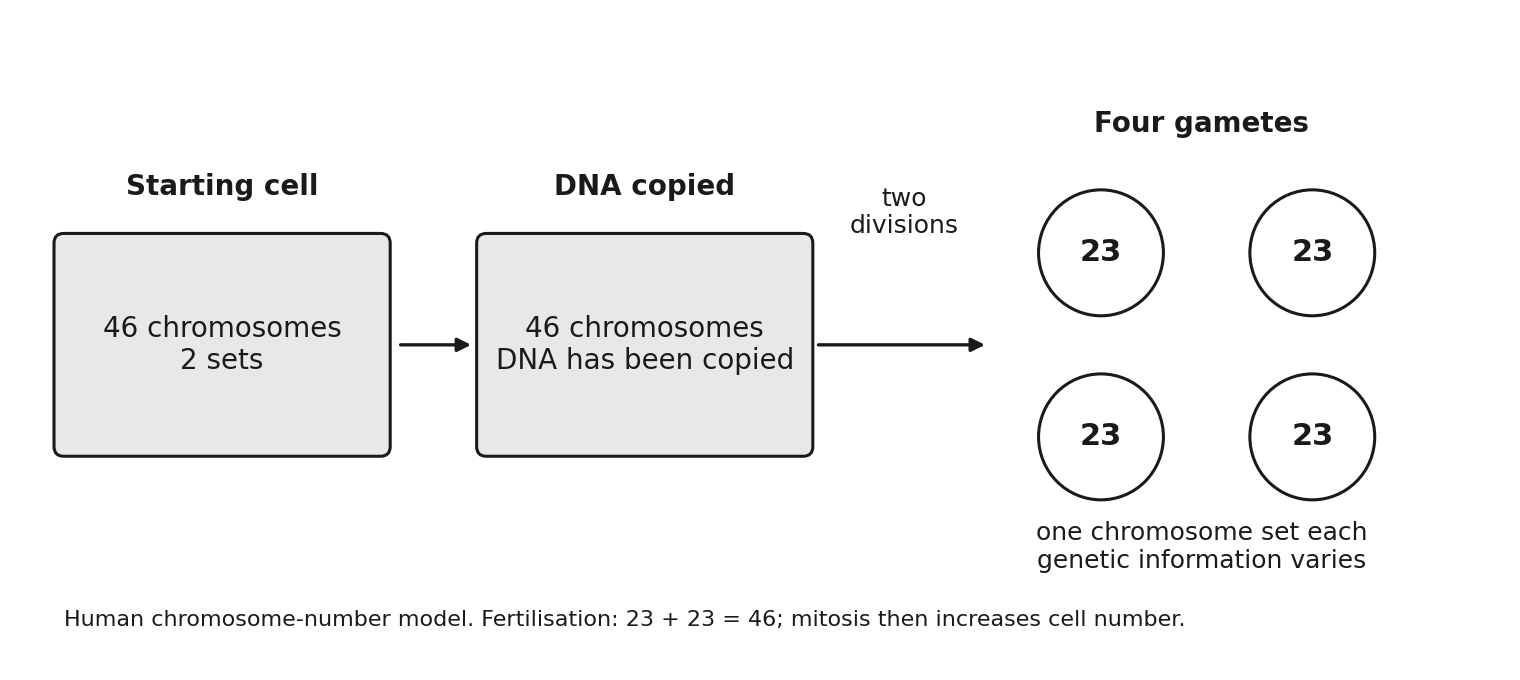
Meiosis 减数分裂: in reproductive organs, copies of the genetic information are made first, then the cell divides twice to form four gametes, each with a single set of chromosomes — all genetically different. Fertilisation restores the normal number; the new cell divides by mitosis and cells differentiate as the embryo develops.
(Bio) Sexual vs asexual: sexual gives variation — a survival advantage if the environment changes, and the variation selective breeding uses; asexual needs no mate (time and energy efficient), is faster, and produces many identical offspring when conditions are favourable. Malarial parasites: asexual in the human host, sexual in the mosquito; many fungi: asexual spores + sexual; strawberry plants: sexual seeds + asexual runners; daffodils: bulb division.
DNA and the genome: DNA is a polymer of two strands forming a double helix, held in the nucleus as chromosomes. A gene 基因 is a small section of DNA that codes for a sequence of amino acids → a specific protein. The genome 基因组 is the entire genetic material of the organism. Importance of the human genome: searching for genes linked to disease; understanding and treating inherited disorders; tracing human migration patterns from the past.
(Bio) DNA structure: a polymer of four different nucleotides 核苷酸 — common sugar + phosphate group + one of four bases — A 腺嘌呤, C 胞嘧啶, G 鸟嘌呤, T 胸腺嘧啶; alternating sugar–phosphate backbone; a sequence of three bases codes for one amino acid, and the base order controls the amino-acid order of the protein.
(HT Bio) Protein synthesis: on ribosomes, from a template; carrier molecules bring specific amino acids in the correct order; the chain folds into a unique shape that lets the protein work as an enzyme, hormone or structural protein (e.g. collagen). In complementary strands C pairs with G, T with A. Mutations change the base sequence: a mutation may leave the protein unchanged, alter it slightly, or change its shape so an enzyme no longer fits its substrate or a structural protein loses strength. Variants in non-coding DNA can switch genes on and off, changing how genes are expressed.
Apply the reproduction and DNA knowledge
Try first — strawberries. Seeds form after fertilisation; runners form without gamete fusion. Identify the two routes and explain which may help a population survive a new disease.
Worked reasoning. Seeds result from sexual reproduction: meiosis makes gametes and fertilisation mixes genetic information. Variation means some offspring may resist the disease. Runners form by mitosis from one parent: clones, apart from mutation. Asexual reproduction needs no mate and is fast in favourable conditions; neither route guarantees survival.
Try first — chromosome number. A human cell has 46 chromosomes before meiosis. Predict the number of gametes, their chromosome number, the number after fertilisation and the division growing the embryo.
Worked reasoning. DNA is copied before two divisions form four gametes, each with 23 chromosomes (one set). DNA copying does not change the count to 92 chromosomes at that point. Fertilisation combines 23 + 23 = 46; mitosis increases embryo cell number and cells differentiate. The diagram models chromosome numbers, not the stages of meiosis.
Try first — scale and code. Distinguish a gene, chromosome and genome. (HT Bio) Write the bases complementary to A C G T and explain whether a mutation must stop an enzyme working.
Worked reasoning. A gene is a DNA section coding an amino-acid sequence for a protein; a chromosome contains a long DNA molecule and many genes; a genome is all the organism’s genetic material. Complementary bases are T G C A. At ribosomes, a template and carrier molecules determine the amino-acid order; the chain folds. A mutation may leave the protein unchanged or change its shape and function. Non-coding variants can change whether genes are expressed.
词汇
训练
| English | 中文 | 拼音 |
|---|---|---|
| meiosis/meɪˈəʊsɪs/ | 减数分裂 | jiǎn shù fēn liè |
| clone/kləʊn/ | 克隆 | kè lóng |
| gene/dʒiːn/ | 基因 | jī yīn |
| genome/ˈdʒiːnəʊm/ | 基因组 | jī yīn zǔ |
| nucleotide/ˈnjuːklɪɒtaɪd/ | 核苷酸 | hé gān suān |
6.2
遗传、疾病与性别决定(4.6.1.6–4.6.1.8)
教学大纲
遗传、疾病与性别决定(AQA 8461 陈述 4.6.1.6-4.6.1.8)。
- 定义配子、染色体、基因、等位基因、显性、隐性、纯合子、杂合子、基因型和表现型。
- 完成并解读庞尼特方格和系谱图,计算比例和概率。
- 解释多指症和囊性纤维化的遗传方式,并评估胚胎筛查相关问题。
- 通过XX/XY杂交确定性别,包括比例计算。
来源:Cambridge International 教学大纲
Learn the terms: gamete 配子 (sex cell), chromosome 染色体 (DNA structure), gene (section coding a protein), allele 等位基因 (a form of a gene), dominant 显性 (expressed with one copy), recessive 隐性 (expressed only with two), homozygous 纯合 (two same alleles), heterozygous 杂合 (two different), genotype 基因型 (alleles present), phenotype 表现型 (characteristics expressed).
Single-gene examples: fur colour in mice; red-green colour blindness. Most characteristics result from multiple genes interacting.
Punnett squares and crosses: complete a Punnett square, extract ratios (e.g. 3:1, 1:1) and probabilities from genetic crosses and family trees. (HT) Construct a cross from parent genotypes and predict outcomes with probability.
Inherited disorders: polydactyly 多指症 (extra fingers or toes) — dominant allele; cystic fibrosis 囊性纤维化 (a disorder of cell membranes) — recessive allele. Make informed judgements about the economic, social and ethical issues of embryo screening.
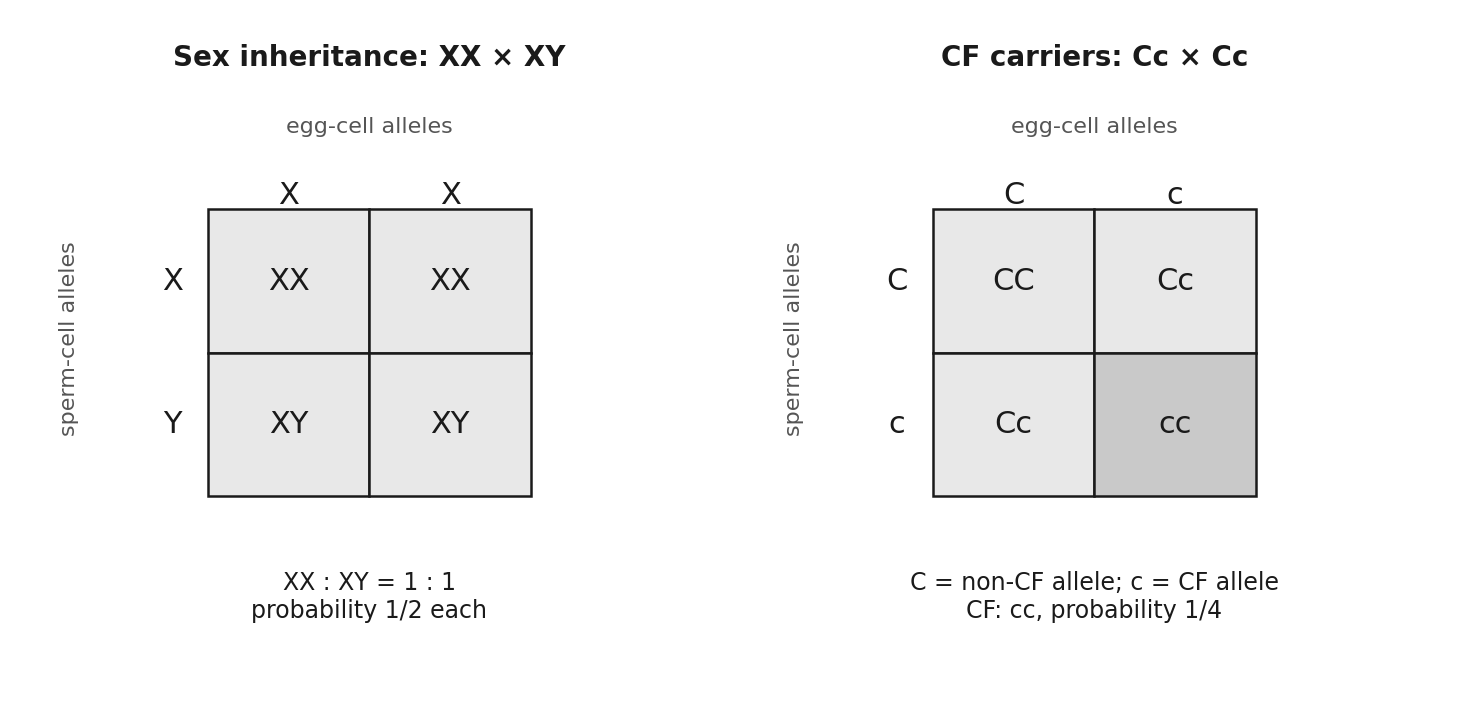
Sex determination: body cells have 23 pairs of chromosomes; 22 pairs control characteristics, one pair carries the sex genes — female XX, male XY. A sex cross (X×X, X×Y) gives a 1:1 ratio, 50 % chance each.
From terms to family inference and probabilities
Try first — terminology. D causes dominant polydactyly; d does not. Classify Dd and predict its phenotype and gamete alleles.
Worked reasoning. Dd is heterozygous (two different alleles); DD and dd are homozygous. Genotype means the alleles present; phenotype means the characteristics expressed. Dd is affected because one D is expressed. “Dominant” does not mean stronger or more common. Gametes contain D or d, not Dd.
Guided family inference — adapted from AQA June 2024 Paper 2H Q06.2. An affected father and unaffected mother have an unaffected son. Deduce the father’s genotype before reading the answer.
Worked reasoning. The mother and son are dd. The father passed d to his son, but must also carry D because he is affected. Therefore he is Dd. The child’s genotype supplies evidence that the father’s phenotype alone cannot provide.
Construct a cross (HT). Two unaffected CF carriers are Cc and Cc. Each produces gametes C or c. Combining them gives CC, Cc, Cc, cc: probability of CF = 1/4; probability of being a carrier = 1/2. Carriers do not have CF in this recessive model. The separate XX × XY cross gives XX, XX, XY, XY: probability 1/2 each in the GCSE sex-determination model.
Exam transfer — adapted from AQA June 2024 Paper 2H Q06.3. An affected mother Dd and unaffected father dd have three unaffected sons. Construct a cross and predict whether the fourth child will be affected.
Worked reasoning. Egg alleles D/d combine with sperm alleles d/d to give Dd, dd, Dd, dd. Two of four equally likely combinations are affected: probability = 2/4 = 1/2. Earlier births do not change this probability. The four boxes describe possible combinations, not four promised children.
Evaluate — teacher-written screening scenario. Screening can identify embryos with the CF genotype, but treatment is costly and some embryos may not be used. A biological benefit is identifying cc embryos to inform the couple’s decisions. Cost can limit access and creates funding choices. Some families object to selecting or not using embryos; others prioritise reducing inherited disease. An informed judgement uses the stated evidence and recognises different values.
词汇
训练
| English | 中文 | 拼音 |
|---|---|---|
| gamete/ˈɡæmiːt/ | 配子 | pèi zi |
| chromosome/ˈkrəʊməsəʊm/ | 染色体 | rǎn sè tǐ |
| allele/əˈliːl/ | 等位基因 | děng wèi jī yīn |
| dominant/ˈdɒmɪnənt/ | 显性 | xiǎn xìng |
| recessive/rɪˈsesɪv/ | 隐性 | yǐn xìng |
| homozygous/ˌhɒməˈzɪɡəs/ | 纯合 | chún hé |
| heterozygous/ˌhetrəˈzɪɡəs/ | 杂合 | zá hé |
| genotype/ˈdʒenətaɪp/ | 基因型 | jī yīn xíng |
| phenotype/ˈfenətaɪp/ | 表现型 | biǎo xiàn xíng |
| polydactyly/ˌpɒlɪˈdæktili/ | 多指症 | duō zhǐ zhèng |
| cystic fibrosis/ˈsɪstɪk fɪˈbrəʊsɪs/ | 囊性纤维化 | náng xìng xiān wéi huà |
6.3
变异、选择性育种、基因工程与克隆(4.6.2)
教学大纲
变异、选择性育种、基因工程与克隆(AQA 8461 陈述 4.6.2)。
- 描述基因组与环境的相互作用及变异的三个原因,并说明突变的作用。
- 解释自然选择驱动的进化及新物种的形成。
- 描述选择性育种、其用途及近亲繁殖的风险。
- 使用(HT)描述基因工程的主要步骤、益处、风险及反对意见。
- (Bio) 描述组织培养、扦插、胚胎移植和体细胞克隆。
来源:Cambridge International 教学大纲
Variation 变异 — differences between individuals in a population — comes from genes inherited (genetic), conditions of development (environmental), or a combination. There is usually extensive genetic variation within a population; all genetic variants arise from mutations — most have no effect on the phenotype, some influence it, very few determine it. A rare mutation giving a new phenotype suited to an environmental change can change the species rapidly.
Evolution: a change in the inherited characteristics of a population over time, through natural selection 自然选择, which may result in a new species. All species evolved from simple life forms that first developed over three billion years ago. Natural selection: variation → the phenotype best suited to the environment survives and breeds → those characteristics are passed on. If two populations become so different they cannot interbreed to produce fertile offspring, two new species have formed.
Selective breeding (artificial selection): choose parents with the desired characteristic from a mixed population → breed → choose the best offspring → repeat over many generations. Uses: disease resistance in food crops; animals with more meat or milk; dogs with gentle natures; large or unusual flowers. Risk: inbreeding 近交 — breeds prone to disease or inherited defects.
Genetic engineering: modifying the genome by introducing a gene from another organism to give a desired characteristic — GM crops resistant to insect attack or herbicides (increased yields); bacteria engineered to make human insulin. (HT) Steps: enzymes isolate the required gene → inserted into a vector (bacterial plasmid or virus) → vector inserts the gene into the required cells → transferred early in development so the organism develops with the desired characteristic. Weigh benefits (medicine, agriculture) against risks (wild-flower and insect populations, unexplored health effects) and ethical objections.
(Bio) Cloning: tissue culture — small groups of plant cells grown into identical new plants (preserving rare species; nurseries); cuttings — simple, older gardeners' method; embryo transplants — splitting unspecialised cells of a developing animal embryo into identical embryos placed in host mothers; adult cell cloning — nucleus removed from an unfertilised egg cell → nucleus from an adult body cell inserted → electric shock makes it divide into an embryo → ball of cells placed in the womb.
Apply variation, selection and biotechnology
Start with variation — teacher-written seedling case. Seedlings differ in inherited disease resistance. Genetically identical plants grow to different heights under different light conditions. Identify genetic and environmental variation, then explain what may happen during a disease outbreak.
Worked reasoning. Resistance alleles provide genetic variation; light conditions can cause environmental differences in height. Phenotype often depends on both. Resistant plants may survive the disease and reproduce more successfully, passing favourable alleles to offspring. Over generations, resistance alleles can become more common. Mutations change DNA; they do not occur because an organism needs a particular change.
Exam transfer — adapted from AQA June 2024 Paper 2H Q01.2. Describe natural selection using insects that already vary in inherited insecticide resistance.
Worked reasoning. The insecticide is a selection pressure: more susceptible insects die. Resistant survivors reproduce and pass resistance alleles to offspring. The population’s inherited characteristics change across generations; an individual does not evolve just by being sprayed. Speciation requires populations to become unable to interbreed to produce fertile offspring.
Compare mechanisms — teacher-written crop case. A grower wants inherited disease resistance without transferring a gene. Select resistant parents from a mixed population, breed them, select resistant offspring and repeat over many generations. This is selective breeding, not natural selection or genetic engineering. Repeatedly breeding close relatives risks inherited defects and reduced genetic variation.
Linked exam explanation — adapted from AQA June 2024 Paper 2H Q09.1. GM soya plants resist glyphosate. Explain how spraying the field can increase yield.
Worked reasoning. Glyphosate kills weeds but the resistant crop survives. Less competition gives the crop more light, water and mineral ions. More light and water can support photosynthesis, producing glucose for respiration and building biomass. Nitrate ions support amino-acid and protein synthesis. Link resources to growth and harvested yield; “GM means higher yield” omits the mechanism. These are authored explanation points checked against the scheme, not an official model or a guaranteed score.
HT — follow a gene. Enzymes isolate a required gene (for example, human insulin). Insert it into a vector such as a bacterial plasmid; use the vector to introduce it into the required cells. The modified cells express the gene and produce the substance. For a developing animal or plant, introduce the gene early so the organism develops with the desired characteristic.
Evaluate — teacher-written GM scenario. An insect-resistant crop suffers less target-pest damage, but a study reports fewer nearby non-target insects without establishing why. Reduced damage may improve harvest. The insect decline raises a food-web concern; compare modified and unmodified fields while accounting for habitat and pesticide use. Association alone does not prove the inserted gene caused the decline. Judge the particular modification and evidence.
Biology — choose and order cloning methods. A nursery can use tissue culture to grow plants from small groups of cells, or cuttings from a parent plant. Embryo transplants split cells before they specialise and place identical embryos into host mothers. Adult cell cloning removes an unfertilised egg’s nucleus, inserts an adult body-cell nucleus, stimulates division with an electric shock, and transfers the ball of cells to a womb. The adult body-cell donor supplies the nuclear genetic information. Environmental differences can still affect a clone’s phenotype.
词汇
训练
| English | 中文 | 拼音 |
|---|---|---|
| variation/ˌveərɪˈeɪʃn/ | 变异 | biàn yì |
| natural selection/ˈnætʃərəl sɪˈlekʃn/ | 自然选择 | zì rán xuǎn zé |
| inbreeding/ˈɪnbriːdɪŋ/ | 近交 | jìn jiāo |
| adenine/ˈædəniːn/ | 腺嘌呤 | xiàn piào líng |
| cytosine/ˈsaɪtəsaɪn/ | 胞嘧啶 | bāo mì dìng |
| guanine/ˈɡwɑːnaɪn/ | 鸟嘌呤 | niǎo piào líng |
| thymine/ˈθaɪmaɪn/ | 胸腺嘧啶 | xiōng xiàn mì dìng |
6.4
进化、遗传与证据(4.6.3)
教学大纲
进化、遗传与证据(AQA 8461 陈述 4.6.3,仅限生物)。
- 描述达尔文的理论、该理论为何被逐渐接受,以及拉马克的理论。
- 描述华莱士和孟德尔的贡献以及遗传学的发展。
- 解释化石及其形成过程、化石记录不完整的原因、灭绝原因及进化树。
- 解释抗生素耐药性细菌以及如何减缓耐药性的产生。
来源:Cambridge International 教学大纲
(Bio) Darwin's theory: wide variation within a species; individuals best suited to the environment survive to breed; the useful characteristics are passed on. Published in On the Origin of Species (1859). Accepted only gradually: it challenged the idea that God made all living things; insufficient evidence at publication; the mechanism of inheritance was unknown for another 50 years. Lamarck's rival theory — that changes acquired during an organism's lifetime are inherited — is now known to be wrong in almost all cases.
(Bio) Wallace: independently proposed evolution by natural selection; joint 1858 publications with Darwin prompted Darwin to publish; best known for warning colouration and pioneering work on speciation — the steps by which new species arise.
(Bio) Mendel and the growth of genetics: mid-19th-century breeding experiments showed each characteristic is inherited through 'units' passed unchanged to descendants; late 19th century — chromosomes observed in cell division; early 20th century — the units behave like chromosomes → genes on chromosomes; mid-20th century — DNA structure determined and gene function worked out. Mendel's work was unrecognised in his lifetime.
(Bio) Evidence for evolution: genes show characteristics pass to offspring; fossils; antibiotic resistance in bacteria.
(Bio) Fossils form when parts do not decay (a decay condition is absent), when parts are replaced by minerals as they decay, or as preserved traces (footprints, burrows, rootlet traces). Early soft-bodied life left few traces, mostly destroyed by geological activity — so science cannot be certain how life began. Extinction means no individuals of a species remain — causes include new diseases, new predators, competition, environmental change, catastrophic events. Evolutionary trees use current classification data and fossil data.
(Bio) Resistant bacteria: mutations produce genetic variants; some are resistant to a particular antibiotic. Susceptible bacteria are killed, while resistant survivors reproduce quickly and pass on resistance genes. The resistant strain becomes more common and can spread (for example, MRSA). This population change is evidence for evolution. Resistance can make infection harder to treat; it does not mean every antibiotic is ineffective or that people have no immune defence. Reducing inappropriate prescribing and unnecessary agricultural antibiotic use reduces avoidable selection pressure. Developing new antibiotics takes time and resources.
Try first — resistance explanation. A population contains susceptible and resistant variants before antibiotic exposure. Explain why resistant bacteria become more common, and correct “the antibiotic makes every bacterium mutate because it needs resistance”.
Worked reasoning. Genetic variation already exists; mutations are not directed by need. Antibiotic exposure selects survivors. Resistant bacteria reproduce and pass resistance genes to offspring, increasing their share of the population. Selection and inheritance explain the change without claiming that every individual becomes resistant.
Use historical and fossil evidence
Explain the history (Biology). Darwin and Wallace independently proposed natural selection; their joint writings appeared in 1858 and Darwin published his book in 1859. Acceptance was gradual: the theory challenged prevailing creation beliefs, some scientists found the evidence insufficient, and inheritance mechanisms were unknown. Mendel’s plant breeding suggested inherited units. His work’s importance was recognised after his death; later chromosome behaviour, genes on chromosomes and DNA structure connected these units to physical mechanisms.
Apply speciation — teacher-written case. A barrier separates a population into different habitats. Different selection pressures favour different variants; survivors reproduce and pass favourable alleles to offspring. Mutations supply genetic variants. Over many generations the populations may diverge. Separation alone does not prove a new species: inability to interbreed to produce fertile offspring is the stated species criterion.
Interpret evidence — teacher-written fossil case. A footprint preserved in rock is a trace fossil; a shell replaced by minerals illustrates mineral replacement. Conditions that prevent decay can also preserve remains. Soft-bodied organisms may leave no trace, and geological activity destroys fossils. An incomplete record still supplies evidence of past organisms and change. A species missing from one site is not necessarily extinct: extinction means no living individuals remain anywhere.
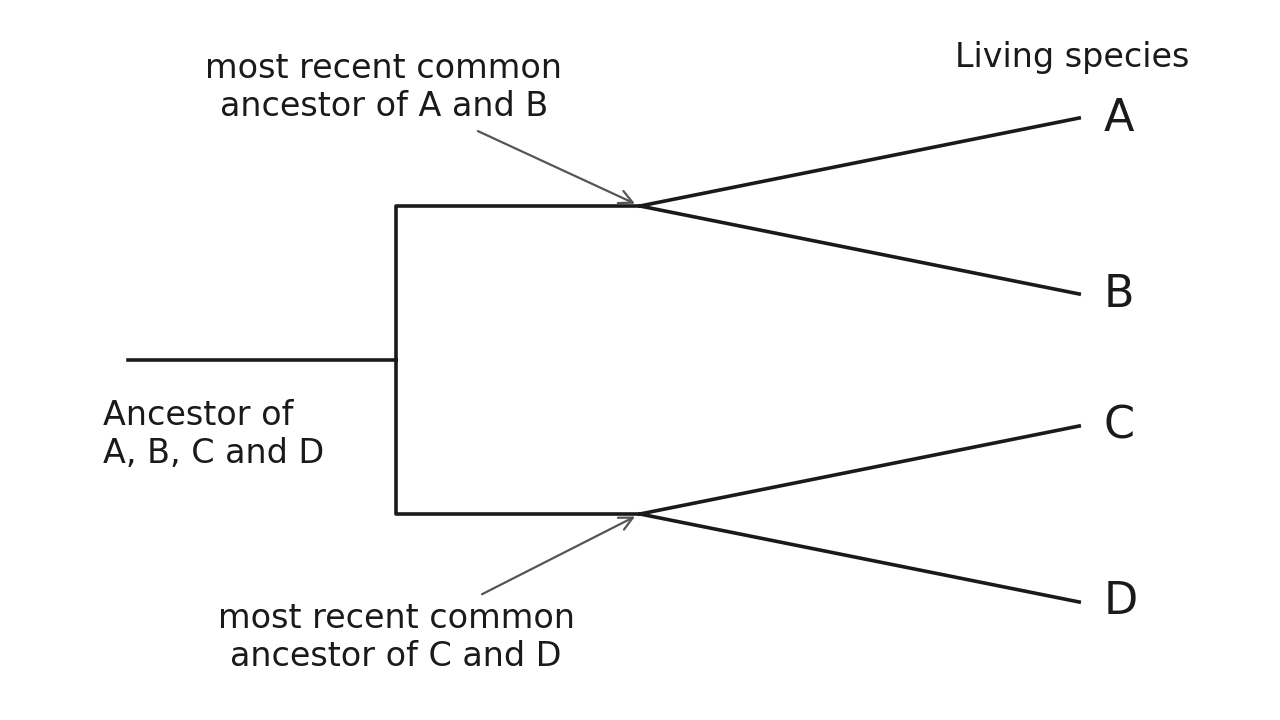
Read the diagram. Trace A and B back to their first shared fork: this is their most recent common ancestor. A and C share the older ancestor of all four species, so A and B are more closely related. This is a schematic without a time scale; do not infer dates from branch lengths or relationships from vertical spacing. Trees use classification and fossil evidence.
6.5
生物分类(4.6.4)
教学大纲
生物分类(AQA 8461 陈述 4.6.4)。
- 描述林奈系统及双名命名法。
- 描述沃氏的三域系统及其推动因素。
- 利用分类和化石数据解读进化树。
来源:Cambridge International 教学大纲
Linnaeus: classification by structure and characteristics into kingdom, phylum, class, order, family, genus, species; organisms named by the binomial system (genus + species).
Three-domain system (Carl Woese), from chemical-analysis evidence: archaea (a distinct domain of prokaryotes, including many organisms from extreme environments), bacteria (true bacteria), eukaryota (protists, fungi, plants, animals). Improvements in microscopes and biochemistry drove the new models.
Evolutionary trees show how scientists believe organisms are related — interpret them using classification and fossil data.
Apply classification. In Panthera leo and Panthera tigris, Panthera identifies the shared genus; the second word distinguishes the species within it. The ranks are kingdom → phylum → class → order → family → genus → species. New microscopy and chemical-analysis evidence can reveal relationships that external appearance does not show, leading to revised classification. Woese’s three domains are archaea, bacteria and eukaryota.
Final retrieval. Without the answers, explain (1) how 23-chromosome gametes restore 46 at fertilisation; (2) the next affected-child probability for Dd × dd after three unaffected births; (3) how antibiotic exposure changes a bacterial population. Check: two gamete sets combine; the cross gives a 1/2 probability independently at each birth; resistant survivors reproduce and pass on resistance genes. Then use the earlier worked examples to retrieve gene transfer, cloning order and common ancestry.
6.5
Checklist before you call this topic done
- Meiosis (four gametes, halved number) vs mitosis; sexual vs asexual advantages with named organisms.
- All ten genetics terms; Punnett squares with ratios; polydactyly vs cystic fibrosis; XX/XY cross 1:1.
- (Bio) DNA nucleotides and bases; (HT) protein synthesis and mutations.
- Variation three sources; natural selection sequence; selective breeding steps and inbreeding risk; (HT) genetic engineering steps; (Bio) four cloning methods.
- (Bio) Darwin/Wallace/Mendel history, fossil formation and why the record is incomplete, MRSA story, Linnaeus ranks and the three domains.