跳到主要内容

保护物理空间

AP 网络安全 · 第 2 主题

训练
讲义 词汇表
2.1

网络安全基础

大纲
Learning ObjectiveEssential Knowledge

2.1.A
Identify social engineering attacks.

  • 2.1.A.1 Social engineers use psychological tactics to manipulate targets into taking a desired action.
  • 2.1.A.2 Pretexting is when adversaries create a believable reason to contact a target.
  • 2.1.A.3 Authority is when adversaries impersonate someone with power over a target or pretend to relay instructions from that person.
  • 2.1.A.4 Intimidation is when adversaries state negative consequences if demands aren’t met.
  • 2.1.A.5 Consensus is when adversaries create social pressure by making a target believe everyone else is doing a desired action.
  • 2.1.A.6 Scarcity is when adversaries create a sense of limited availability.
  • 2.1.A.7 Familiarity is when adversaries pretend to be or know someone close to a target to establish trust.
  • 2.1.A.8 Urgency is when adversaries create a deadline that requires quick action by a target to avert negative consequences.

2.1.B
Identify types of adversaries.

  • 2.1.B.1 Script kiddies are low-skilled adversaries who use tools developed by others without understanding how the tools work. They are often motivated by greed or a desire for recognition.
  • 2.1.B.2 Hacktivists are motivated by social, political, or personal causes. They compromise computers and networks to support their cause or stop perceived harm, believing their goals justify their illegal methods.
  • 2.1.B.3 Insider adversaries are unique threats because they have legitimate credentials and access to systems and data. They can be recruited by malicious third parties and can be motivated by greed or revenge.
  • 2.1.B.4 Cyberterrorists are motivated by politics or beliefs and seek to disrupt entire communities, regions, or nations through cyberattacks (e.g., attacking a power grid, water treatment plant, or other civil infrastructure). They can act independently or on behalf of governments or criminal organizations.
  • 2.1.B.5 Transnational criminal organizations seek financial gain primarily by deploying ransomware and stealing corporate intellectual property (IP) to sell in illegal markets.

2.1.C
Describe the phases of a cyberattack.

  • 2.1.C.1 Cyberattacks aim to disrupt, harm, steal, or destroy devices, networks, or data. Adversaries work in phases, which may not all be used in every attack. The phases are:
    • i. Reconnaissance
    • ii. Initial access
    • iii. Persistence
    • iv. Lateral movement
    • v. Taking action
    • vi. Evading detection
  • 2.1.C.2 In the reconnaissance phase of an attack, adversaries gather as much information as possible about their target, often using open source intelligence (OSINT), which is freely available information.
  • 2.1.C.3 In the initial-access phase of an attack, adversaries establish a foothold on the target’s computer, often through social engineering or compromised or weak credentials.
  • 2.1.C.4 After gaining access during an attack, adversaries establish persistence to maintain access without needing to regain it. They may use a command and control (C2) protocol to send commands to the device and receive output, often through malware like a remote access trojan (RAT) or rootkit.
  • 2.1.C.5 In the lateral-movement phase of an attack, adversaries try to escalate their privileges by accessing computers and user accounts with elevated permissions to services and data.
  • 2.1.C.6 In the taking-action phase of an attack, adversaries act on their objectives by collecting targeted data, exfiltrating it, and disrupting services or destroying data.
  • 2.1.C.7 In the final phase of an attack, many adversaries try to evade detection by removing or editing log files and erasing other files they may have planted on devices (e.g., malware).

2.1.D
Describe the risk assessment process.

  • 2.1.D.1 Risk occurs when a threat can exploit a vulnerability to compromise an asset.
  • 2.1.D.2 An asset is anything valuable. Assets include financial resources, intellectual property, data, digital infrastructure, physical property, and reputation.
  • 2.1.D.3 Risk assessment considers two factors:
    • The likelihood of an attack against a specific vulnerability
    • The severity of the projected damage from an attack against a specific vulnerability
  • 2.1.D.4 The likelihood of a vulnerability being exploited depends on many factors, including:
    • The value of the target: Adversaries are more likely to attack targets they perceive as valuable.
    • The level of skill required to exploit the vulnerability (i.e., the difficulty): Vulnerabilities with well-documented exploits often require less skill and can be carried out by more adversaries.
    • The motivation and capabilities of likely adversaries: Highly motivated and skilled adversaries are more likely to be able to perform more complex exploits.
  • 2.1.D.5 The severity of an attack is often measured by financial cost, which can also include reputational and operational impacts.
    • Illustrative examples for 2.1.D.5:
      • A hacktivist is passionate about illegal fishing practices supported by a local food production company. The main webpage of this food production company would be a high-value target for this hacktivist; defacing the webpage to expose the company’s support of illegal fishing would provide no financial gain to the adversary, but would allow them to raise awareness about an issue that motivates them.
  • 2.1.D.6 The result of a risk assessment can be quantitative or qualitative.
    • Quantitative risk assessment assigns a numeric value to a vulnerability based on a numeric scale (e.g., 1–10) or quantifiable impact, which could be financial (e.g., a $10,000 annual risk).
    • Illustrative examples for 2.1.D.6:
      • Low, medium, high, severe
      • Unlikely low impact, likely low impact, unlikely high impact, likely high impact
  • 2.1.D.7 Risk assessment documentation should include:
    • Vulnerable assets and their value
    • Descriptions of likely threats to the assets
    • Details of specific vulnerabilities for specific assets and how they would be exploited
    • An explanation of the severity of damage (financial, operational, reputational, etc.) if a specific asset were compromised, and the likelihood of that compromise occurring
    • A final rating, quantitative or qualitative, for each risk identified
    • Illustrative examples for 2.1.D.7:
      • Scaled score (e.g., 1–10)
      • Monetary value (e.g., a $10,000 risk vs. a$100,000 risk)

2.1.E
Identify strategies for managing risk.

  • 2.1.E.1 Once a risk has been identified and assessed, an organization has four options for managing that risk:
    • i. Avoid
    • ii. Transfer
    • iii. Mitigate
    • iv. Accept
  • 2.1.E.2 Risk avoidance stops the activity that is generating the risk. If the activity is a critical part of an organization’s mission or purpose, then avoidance is not possible.
  • 2.1.E.3 Risk transference places the burden of the risk on another entity, such as an insurance company, a government, or consumers.
  • 2.1.E.4 Risk mitigation implements security controls to reduce the likelihood or impact of a risk.
  • 2.1.E.5 Residual risk is the risk that remains after an organization has gone through avoidance, transference, and mitigation. The residual risk is the level of risk that an organization is willing to accept. Risk acceptance acknowledges the fact that absolute security is unattainable.
  • 2.1.E.6 To conserve financial resources and employee capacity, an organization will often favor solutions that are cost effective and easy to implement and maintain. Cost-effective solutions cost less to install and maintain than the expected loss from an attack.

2.1.F
Identify types of security controls.

  • 2.1.F.1 Security controls address at least one of the following principles:
    • Confidentiality ensures that only authorized individuals, systems, or processes can access data. Systems lacking confidentiality are vulnerable to data theft or destruction.
    • Integrity ensures data are accurate and trustworthy. Systems lacking integrity are vulnerable to data manipulation.
    • Availability ensures data and services are accessible to authorized individuals when needed. Systems lacking availability may experience unexpected downtime.
  • 2.1.F.2 Security controls can be classified by type.
    • Physical controls provide security in the physical space and include locks, fences, and cameras, bollards, and security guards.
    • Technical controls provide security in the digital space and include firewalls, anti-malware software, and encryption.
    • Managerial controls provide rules, guidelines, policies, and procedures that specify what security should be in place and include password policies, regular access reviews, and incident response plans (IRPs).
  • 2.1.F.3 Security controls can be classified by function.
    • Preventative controls address potential vulnerabilities with the goal of stopping an adversary from attacking and include locks and encryption.
    • Detective controls help identify attacks when they occur and include intrusion detection systems (IDSs), cameras, and security incident and event management (SIEM) systems.
    • Corrective controls fix problems and help restore systems to an operational state and include vulnerability patching, repairing a broken card reader, and intrusion prevention systems (IPSs).

2.1.G
Explain why a defense-in-depth security strategy is necessary to optimally protect an organization.

  • 2.1.G.1 A defense-in-depth strategy, or layered defense, uses multiple types of security controls to protect sensitive data and systems.
  • 2.1.G.2 A defense-in-depth strategy allows an organization to address different types of threats, each with a security control most suited to mitigate it.
  • 2.1.G.3 A defense-in-depth strategy allows for resilience in data protection so when one security control is bypassed by an adversary, another security control may still prevent access to the data or system or limit the damage done to the data or system.
  • 2.1.G.4 Layers in a defense-in-depth strategy can include human, physical, network, device, application, and data.

来源:美国大学理事会 AP 课程与考试说明

在防御一个系统之前,你需要一门共同的语言。这个部分构建它。

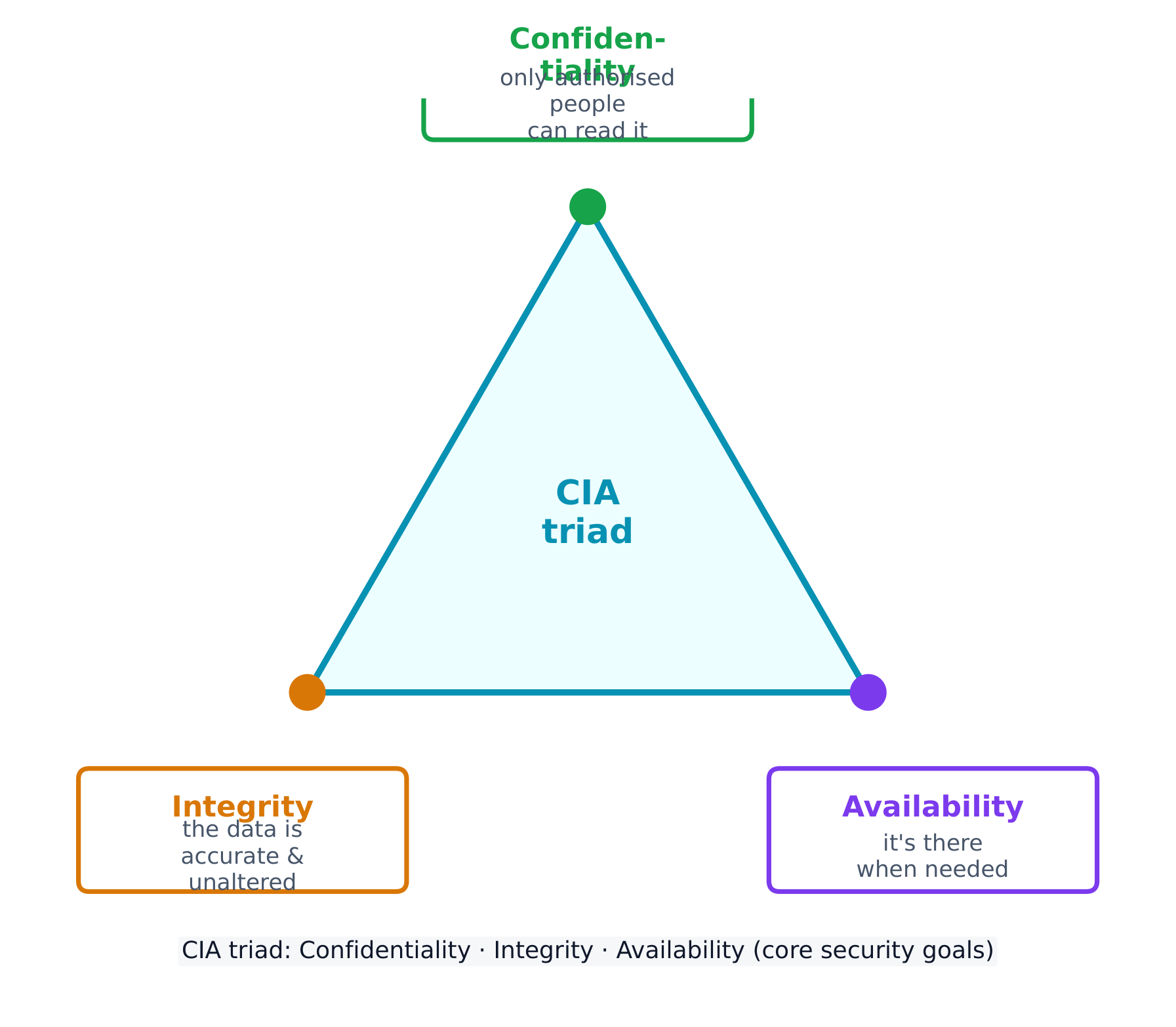
每个安全控制都保护 CIA 三要素(CIA triad)的至少一部分——安全的三个目标:

  • 保密性(confidentiality)——只有授权的人能读数据。
  • 完整性(integrity)——数据是准确的和未被更改的。
  • 可用性(availability)——数据和服务在需要时在那里。
CIA 三要素:每个安全控制支持的三个目标

攻击来自不同的对手,按他们的目标分类。一个脚本小子(script kiddie)为贪婪或认可重用其他人构建的工具;一个黑客活动分子(hacktivist)为一个政治的、社会的或个人的事业行动;一个内部人员(insider)已经持有合法的访问并可能出于复仇或贪婪行动;一个网络恐怖分子(cyberterrorist)破坏像一个电网或水厂这样的关键基础设施;而跨国犯罪组织(transnational criminal organisations)通过勒索软件和窃取的数据追逐金钱。

大多数攻击以阶段(phases)展开:侦察(reconnaissance)(收集信息,常常从公开的 公开来源情报(OSINT) 来源)、初始访问、持久化、横向移动(lateral movement)(通过提升权限扩散到更多系统)、对目标采取行动,和逃避检测。命名一个攻击者已经到达的阶段帮助一个防御者选择正确的响应。

Social engineering: the seven tactics

大多数攻击不是从代码开始的,而是从社会工程(social engineering)开始 —— 用心理伎俩操纵一个人去做攻击者想让他做的事。考试会点名这七种伎俩,并要求你判断一个情景展示的是哪一种:

伎俩 手法
借口(pretexting) 编造一个可信的理由来接触目标("我是 IT 部门的,来核实你的账户")
权威(authority) 冒充有权势的人,或转达"老板"的指示
恐吓(intimidation) 威胁说不满足要求就会有负面后果
从众(consensus) 声称别人都已经在做了,以制造社会压力
稀缺(scarcity) 编造有限供应("只剩 2 个了")
熟悉(familiarity) 假装自己是、或认识与目标亲近的人
紧迫(urgency) 强加一个紧迫的截止时间,让目标不假思索就行动

它们共同的核心是:这七种全都通过触发一种自动的情绪反应 —— 恐惧、信任、匆忙,或想要合群 —— 来绕过目标的判断力。防御方法每次都一样:在行动前通过另一条可信的渠道去核实

一个风险(risk)在一个威胁(threat)能利用一个漏洞(vulnerability)来危害一个资产(asset)(任何有价值的东西——数据、金钱、硬件、声誉)时出现。我们通过权衡两样东西评估风险:一个攻击的可能性(likelihood)和损害的严重性(severity)。

可能性本身取决于目标的价值(攻击者追逐看起来值得偷的东西)、利用该漏洞所需的技能(有完备公开利用方法的漏洞几乎不需要技能,所以更多攻击者用得了它),以及可能的攻击者的动机与能力。严重性通常用财务成本来衡量,但也包括声誉运营上的损害。

最终的评级可以用两种方式表述,考试要你能把它们区分开:

  • 定量(quantitative)—— 一个数字:某个标度上的分数(例如 1-10),或一个金额(例如"每年 $10,000 的风险")。
  • 定性(qualitative)—— 一个标签:低 / 中 / 高 / 严重,或者一张网格,例如很可能-高影响不太可能-低影响

一份书面的风险评估(risk assessment)对每一项风险都应记录:易受攻击的资产及其价值、可能的威胁、该具体漏洞会如何被利用、一旦被攻破的严重性,以及一个最终的定量或定性评级。

一旦一个风险被衡量,一个组织有四种方式来管理它:

  • 规避(avoid)——停止有风险的活动(只在它不是必需的时候可能)。
  • 转移(transfer)——把负担转移给别人,例如一个保险公司。
  • 缓解(mitigate)——添加控制以降低可能性或影响。
  • 接受(accept)——忍受剩下的剩余风险(residual risk),因为完美的安全不可能。

安全控制以两种方式分组。按类型:物理(physical)(锁、栅栏、警卫)、技术(technical)(防火墙、反恶意软件、加密),和管理(managerial)(政策和程序)。按功能:预防性(preventative)(阻止一个攻击,像一把锁)、检测性(detective)(发现一个攻击,像一个摄像头),和纠正性(corrective)(修复和恢复,像打补丁)。

Worked example. 一家医院把患者记录存储在一个未上锁房间里的一个未加密的服务器上。给风险评级:资产高度敏感(患者数据,受法律保护)漏洞容易利用(没有加密、没有访问控制),所以这是一个风险。现在分类一个修复——一个门锁:按类型它是一个物理控制,而按功能它是预防性的(它在一个攻击甚至开始之前就阻止进入)。

最好的策略层叠许多控制——一个纵深防御(defense-in-depth)方法。若一个对手绕过一层,另一层仍然屹立。层包括人、物理、网络、设备、应用和数据。
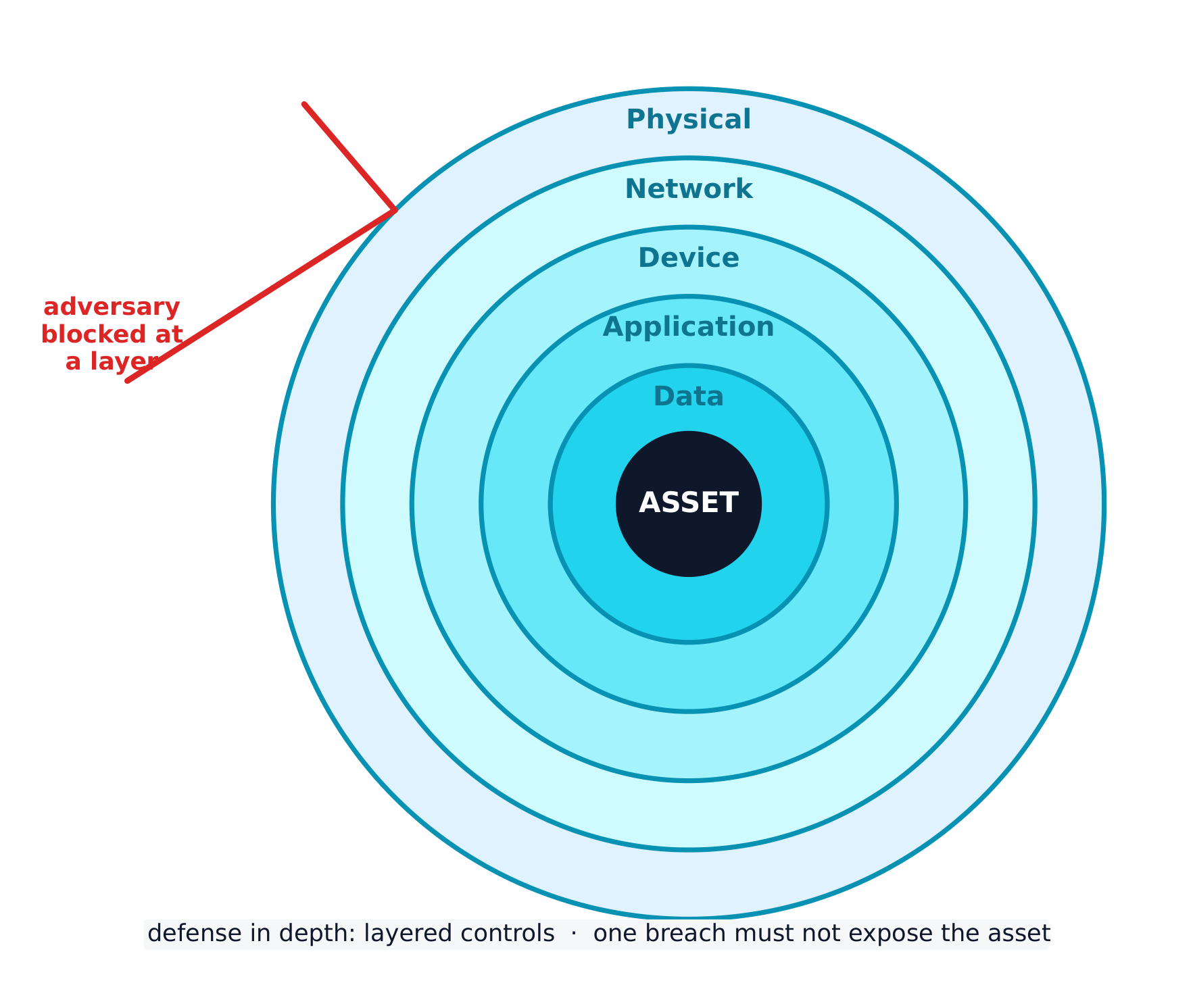
纵深防御:许多层,以便一次入侵不暴露资产
探索

Classify each security control by function

A preventative control stops an attack, a detective control spots one in progress, and a corrective control fixes the damage and restores the system.

探索

Classify each security control by type

A physical control guards the physical space, a technical control works in the digital space, and a managerial control is a rule, policy, or procedure.

词汇表 训练
英文 中文 拼音
CIA triad 信息安全三要素 xìn xī ān quán sān yào sù
Confidentiality 保密性 bǎo mì xìng
Integrity 完整性 wán zhěng xìng
Availability 可用性 kě yòng xìng
script kiddie 脚本小子 jiǎo běn xiǎo zi
hacktivist 黑客活动分子 hēi kè huó dòng fèn zǐ
insider 内部人员 nèi bù rén yuán
cyberterrorist 网络恐怖分子 wǎng luò kǒng bù fèn zi
transnational criminal organisations 跨国犯罪组织 kuà guó fàn zuì zǔ zhī
phases 阶段 jiē duàn
reconnaissance 侦察 zhēn chá
OSINT 公开来源情报 gōng kāi lái yuán qíng bào
lateral movement 横向移动 héng xiàng yí dòng
social engineering 社会工程学 shè huì gōng chéng xué
Pretexting 借口 jiè kǒu
Authority 权威 quán wēi
Intimidation 恐吓 kǒng hè
Consensus 从众 cóng zhòng
Scarcity 稀缺 xī quē
Familiarity 熟悉 shú xī
Urgency 紧迫感 jǐn pò gǎn
risk 风险 fēng xiǎn
threat 威胁 wēi xié
vulnerability 漏洞 lòu dòng
asset 资产 zī chǎn
likelihood 可能性 kě néng xìng
severity 严重性 yán zhòng xìng
quantitative 定量 dìng liàng
qualitative 定性 dìng xìng
risk assessment 风险评估 fēng xiǎn píng gū
Avoid 规避 guī bì
Transfer 转移 zhuǎn yí
Mitigate 缓解 huǎn jiě
Accept 接受 jiē shòu
residual risk 剩余风险 shèng yú fēng xiǎn
physical 物理 wù lǐ
technical 技术 jì shù
managerial 管理 guǎn lǐ
preventative 预防性 yù fáng xìng
detective 检测性 jiǎn cè xìng
corrective 纠正性 jiū zhèng xìng
defense-in-depth 纵深防御 zòng shēn fáng yù
2.2

物理漏洞与攻击

大纲
Learning ObjectiveEssential Knowledge

2.2.A
Identify common physical attacks.

  • 2.2.A.1 Adversaries often use social engineering when conducting a physical attack.
  • 2.2.A.2 Piggybacking is the name for an attack where an adversary uses social engineering to manipulate an authorized individual to grant the adversary access to a restricted area. Common piggybacking tactics include carrying something large to entice an authorized person to hold the door open, pretending to be an authorized person who has forgotten their access token, or pretending to be a maintenance person who needs to get into a certain area to perform an inspection or repair.
  • 2.2.A.3 Tailgating is the name for an attack where an adversary gains unauthorized access to a restricted area by following close behind an authorized individual without that individual’s awareness or knowledge.
  • 2.2.A.4 Shoulder surfing is the name for an attack where an adversary watches as a user accesses sensitive information so the adversary can use it later. Sometimes adversaries use a camera to record the target accessing the sensitive information for later analysis.
  • 2.2.A.5 Dumpster diving is the name for an attack where an adversary goes through a target’s physical trash to look for information that could be used to help the adversary reach their goal.
  • 2.2.A.6 Card cloning is the name for an attack where an adversary makes a copy of an authorized user’s access card so they can gain access to all the resources the user is authorized to access.

2.2.B
Explain how threats can exploit common physical vulnerabilities to cause loss, damage, disruption, or destruction to assets.

  • 2.2.B.1 Threats include human adversaries seeking to cause harm or disruption as well as natural disasters. Natural disasters can cause physical damage or destruction to computers and data as well as disruption of digital services provided by computers.
  • 2.2.B.2 Vulnerabilities are weaknesses or flaws that could allow an asset to be compromised. Common compromises include:
    • Unauthorized access to sensitive data or restricted physical spaces
    • Disruption of services
    • Theft or destruction of digital or physical resources
    • Unauthorized modification of data
  • 2.2.B.3 When adversaries disrupt power to a device, the device and any services it provides become unavailable. To disrupt power, adversaries may damage fuses or breakers in an electrical box, unplug or cut electrical wiring, or damage power distribution systems like substations and transformers.
  • 2.2.B.4 When adversaries gain access to an area with sensitive information, they can steal or copy sensitive information.
  • 2.2.B.5 When adversaries gain physical access to a device and its ports, they can plug in a keylogger or external drive containing malware, which could allow them to collect data from a user or possibly even to gain control of the device. With direct physical access adversaries can also physically destroy a device, making the device itself, any data stored on it, and any services it provides unavailable.

2.2.C
Assess and document risks from physical vulnerabilities.

  • 2.2.C.1 Physical access to devices can allow adversaries to bypass many technical controls and layers of security.
  • 2.2.C.2 High risks from physical vulnerabilities arise when sensitive information or systems are exposed in physical spaces without sufficiently restricted and controlled access.
    • Illustrative examples for 2.2.C.2:
      • A server that stores customer data is in a room with no lock which is accessed via an unmonitored hallway.
  • 2.2.C.3 Moderate risks from physical vulnerabilities arise when a noncritical or nonsensitive part of an organization is left unprotected in a way that it could act as a foothold for an adversary to gain initial access to other resources.
    • Illustrative examples for 2.2.C.3:
      • An office has a reception area beyond which access is controlled; the receptionist has a computer that connects to the office’s internal wireless network and the computer has exposed USB ports.
  • 2.2.C.4 Low risks from physical vulnerabilities arise when a vulnerable asset is of low value and the vulnerability is unlikely to be exploited.
    • Illustrative examples for 2.2.C.4:
      • Employees in an office that requires badge access have laptop computers that they leave on their desks unattended when they all go to lunch together. The computers do not contain any sensitive information, but there are no cables securing the devices to the desks.

来源:美国大学理事会 AP 课程与考试说明

若一个对手能简单地走进来,数字安全就毫无意义。常见的物理攻击(physical attacks)常常以社会工程学开始:

  • 尾随(获许可)(piggybacking)——诱骗一个授权的人为你把门开着(例如,通过搬一个重箱子)。
  • 尾随(未察觉)(tailgating)——在某人不知情的情况下跟在他们后面溜过一扇安全的门。
  • 肩窥(shoulder surfing)——观看某人打一个密码或读敏感信息。
  • 翻垃圾搜集情报(dumpster diving)——搜索一个目标的垃圾以找有用的信息。
  • 门禁卡复制(card cloning)——复制一张访问卡以进入受限区域。

有了物理访问,一个对手能切断电源、窃取或复制数据,或插入一个键盘记录器(keylogger)。当敏感系统坐落在一个没有受控访问的空间时我们把物理风险评为,当一个不重要的区域能作为一个立足点(foothold)去到达其他资源时评为中等,而当资产没有价值且不太可能被攻击时评为

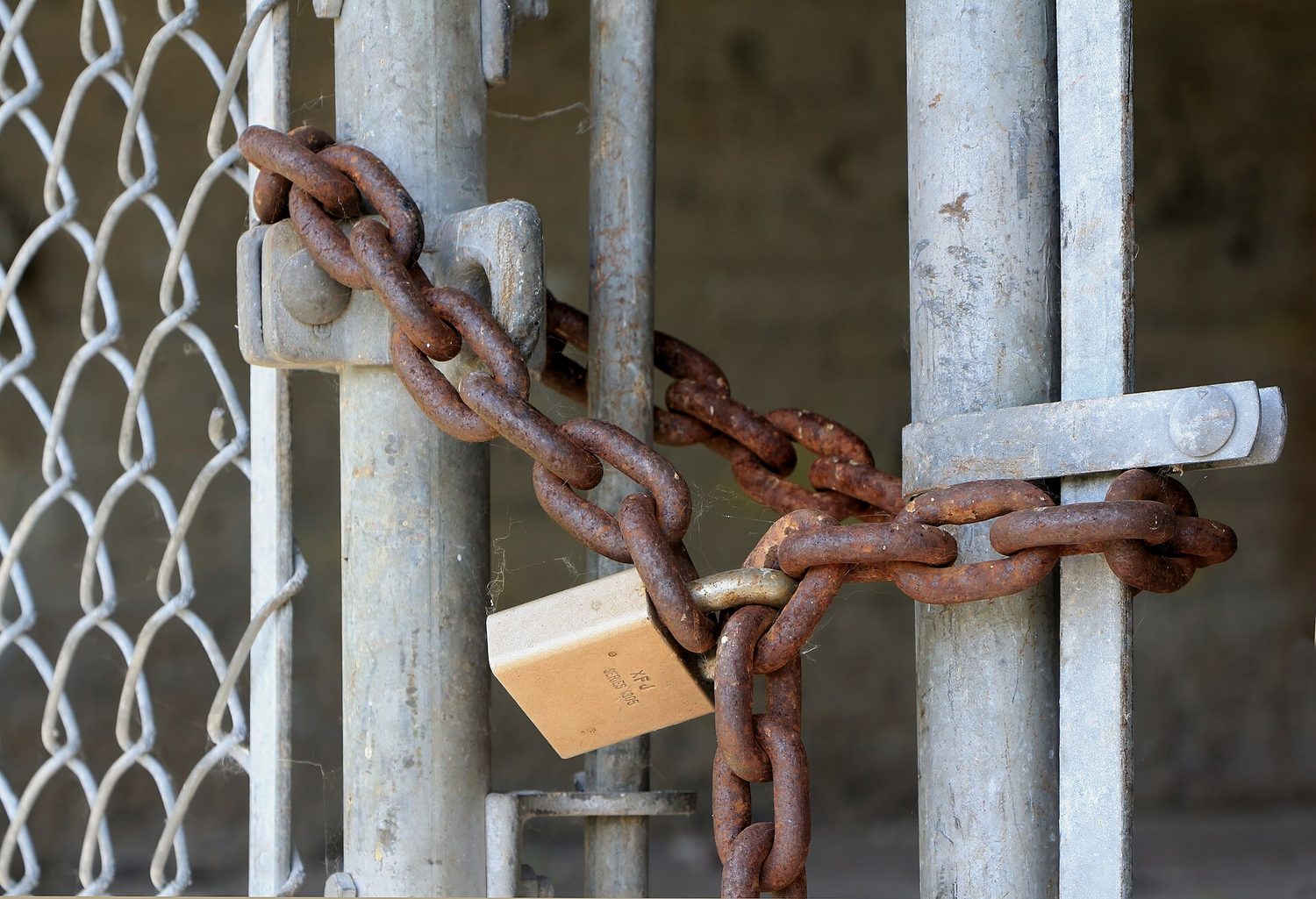
A padlock on a chain: physical security is the first layer — locks, doors and barriers matter
词汇表 训练
英文 中文 拼音
physical attacks 物理攻击 wù lǐ gōng jī
Piggybacking 尾随(获许可) wěi suí ( huò xǔ kě )
Tailgating 尾随(未察觉) wěi suí ( wèi chá jué )
Shoulder surfing 肩窥 jiān kuī
Dumpster diving 翻垃圾搜集情报 fān lā jī sōu jí qíng bào
Card cloning 门禁卡复制 mén jìn kǎ fù zhì
keylogger 键盘记录器 jiàn pán jì lù qì
foothold 立足点 lì zú diǎn
2.3

保护物理场所

大纲
Learning ObjectiveEssential Knowledge

2.3.A
Identify managerial controls related to physical security.

  • 2.3.A.1 Organizations should conduct employee security awareness training to educate employees about how they can contribute to the organization’s security by:
    • Detecting social engineering attempts like phishing
    • Not badging other people into restricted areas
    • Preventing device theft
  • 2.3.A.2 Organizations should have a workstation security policy that outlines the measures necessary to protect a physical workplace. The policy may have tiers of workstation security based on the type of data handled at a workstation. Workstation policies often require:
    • Locking devices before leaving workstations unattended to prevent unauthorized access
    • Clearing sensitive documents off workstations before leaving them unattended (sometimes called a clean desk policy)
    • Using a privacy screen filter or other physical barrier to prevent others from viewing information on the screen
    • Connecting devices to surge protectors or uninterruptible power supplies (UPS)

2.3.B
Determine mitigation strategies for risks from physical vulnerabilities.

  • 2.3.B.1 To determine a relevant control, a cyber defender considers how an adversary could take advantage of a vulnerability to attack a system and how to prevent, detect, or correct the attack.
  • 2.3.B.2 Installing physical controls like fencing, gates, and bollards around a building can deter adversaries from trying to physically access an organization’s buildings.
  • 2.3.B.3 Locks on doors, server cabinets, and computers can prevent devices from being accessed or stolen.
  • 2.3.B.4 Card readers can record which employee badges are being used to access different entries at specific times and deny access to unauthorized badges.
  • 2.3.B.5 Access control vestibules and turnstiles can prevent an authorized person from intentionally or accidentally admitting an unauthorized person into a restricted area.
  • 2.3.B.6 Organizations can disable USB ports to prevent external drives from loading malware onto a computer.
  • 2.3.B.7 An uninterruptible power supply (UPS) provides a backup power source for a device in the event of a power outage. Organizations can also use power generators to provide power at a larger scale to a building or set of critical devices.
  • 2.3.B.8 Organizations prioritize risk mitigations based on the severity of the risks and the cost of the recommended mitigations.

来源:美国大学理事会 AP 课程与考试说明

管理控制先来:安全意识培训教员工不要给陌生人刷卡进入,而一个工作站安全政策要求锁定设备、清理桌面(一个清桌政策(clean desk policy)),和使用隐私屏。

物理控制然后加固建筑:栅栏、大门和防撞柱(bollards)阻止访问;锁保护门和柜子;读卡器(card readers)记录和限制进入;一个门禁前室(access control vestibule)(一个两门的气闸)阻止尾随;禁用 USB 端口阻止恶意软件驱动器;而一个不间断电源(UPS)(uninterruptible power supply)在一次断电中保持设备运行。组织通过把一个控制的成本匹配到风险的严重性来给这些排优先级。

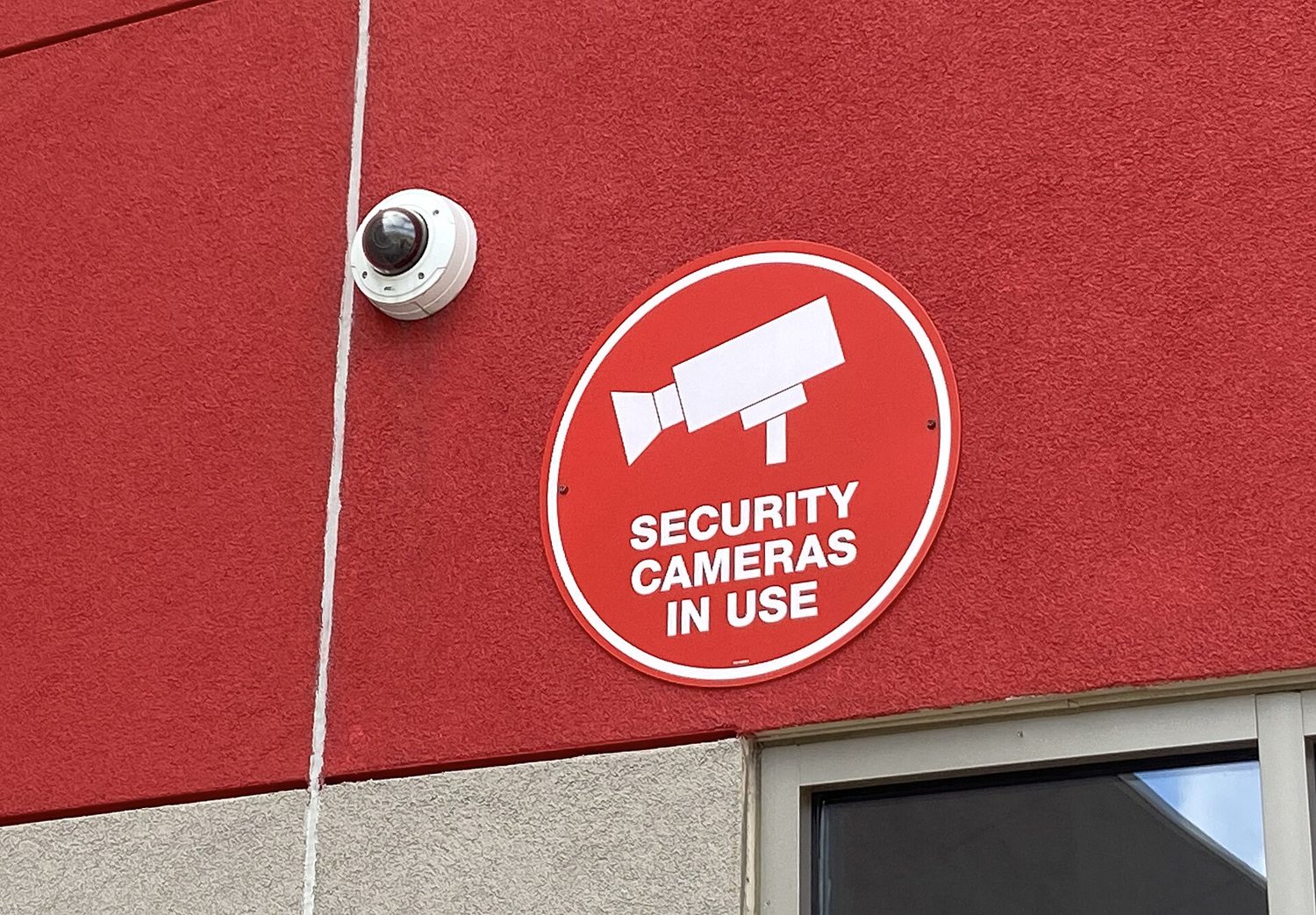
A dome security camera: physical controls and monitoring protect spaces as well as networks
词汇表 训练
英文 中文 拼音
clean desk policy 清桌政策 qīng zhuō zhèng cè
bollards 防撞柱 fáng zhuàng zhù
card readers 读卡器 dú kǎ qì
access control vestibule 门禁前室 mén jìn qián shì
uninterruptible power supply (UPS) 不间断电源 bù jiàn duàn diàn yuán
2.4

检测物理攻击

大纲
Learning ObjectiveEssential Knowledge

2.4.A
Identify ways security controls can detect physical attacks.

  • 2.4.A.1 Cameras can capture a visual record of an adversary’s malicious activity. The feed from a camera should be recorded and monitored for maximum effect. Recordings can be especially helpful in after-incident investigations.
  • 2.4.A.2 Security guards can monitor activity in an area and respond to suspicious activity once detected.
  • 2.4.A.3 Motion sensors can alert security to movement in an area.
  • 2.4.A.4 Employees that work in a physical space are often the first to notice the presence of an unauthorized person and can alert security.

2.4.B
Determine effective placement of security controls for detecting physical attacks.

  • 2.4.B.1 When placing cameras, consideration should be given to visual coverage, angle, and the ability to be tampered with by an adversary. Consideration should also be given to what a camera in a specific area could capture an adversary doing and how that information would be helpful. Points of ingress and egress are often monitored by camera.
  • 2.4.B.2 Motion sensors should be placed in areas where traffic is unexpected, like server rooms, or areas where sensitive materials are stored and few people have access. Motion sensors in high-traffic areas create many false alarms, making the alarms less likely to be taken seriously when there is a real security event.
  • 2.4.B.3 Locks should be placed on all entries to areas containing sensitive information or systems. For areas with particularly sensitive information or systems, an organization could use an access control vestibule at the entry point to prevent piggybacking or tailgating.
  • 2.4.B.4 Security guards can be stationary or patrolling. Stationary guards can provide constant protection for a specific area, entrance, or high-value item. Patrolling guards are more difficult for an adversary to plan around and can create time pressure for an adversary. Placing stationary guards at places that funnel traffic (e.g., entry gates, main entrances or lobbies, and entrances to more secure access areas) can be highly effective, while patrolling guards are better suited for perimeters and exterior areas.

2.4.C
Apply detection techniques to identify physical attacks.

  • 2.4.C.1 Cameras provide visual monitoring and a visual record of activity within a designated space. Cameras can be paired with facial recognition software that can provide alerts when unauthorized individuals enter controlled areas. Once a physical breach has been detected, defenders can use live and recorded camera footage to track an adversary’s path and actions.
  • 2.4.C.2 Motion detectors work best when paired with cameras. When a security alert is raised because a motion detector has been activated, defenders can use cameras to check the space visually and verify a physical security breach.
  • 2.4.C.3 When employees are required to use an electronic badge to unlock a door to a restricted area, a sensor can record how long the door was open. In reviewing entry logs for the door, potential piggybacking or tailgating can be detected by doors being open for longer than normal lengths of time.

来源:美国大学理事会 AP 课程与考试说明

一些控制检测攻击而不是预防它们。摄像头记录活动并帮助事后调查;保安对他们看到的响应;运动传感器(motion sensors)向员工警报移动;而员工自己常常最先注意到一个入侵者。

放置重要。摄像头属于出入口(points of ingress and egress)(入口和出口)。运动传感器在像服务器机房这样的低流量区域工作最好——把它们放在一条繁忙的走廊里,持续的误报会使每个人忽略它们。固定的警卫保护一个固定的高价值点,而巡逻的警卫对一个对手来说更难围绕计划。审查进入日志里的开门时间甚至能揭示尾随,因为一扇被开着太久的门是可疑的。

词汇表 训练
英文 中文 拼音
motion sensors 运动传感器 yùn dòng chuán gǎn qì
points of ingress and egress 出入口 chū rù kǒu
2.4

考试技巧

  • 记住 CIA 三要素并准备好说一个控制保护哪个目标——加密服务于保密性、一个哈希检查完整性、一个备份恢复可用性
  • 知道四种风险响应(规避、转移、缓解、接受)和分类控制的两种方式(按类型:物理/技术/管理;按功能:预防性/检测性/纠正性)。
  • 尾随(获许可)(带同意、被诱骗)与尾随(未察觉)(在那人不知情的情况下)区分开——考试问题考查这个确切的一对。
  • 对于风险评级问题,高风险需要既高价值又容易利用;一个"到其他系统的立足点"是经典的中等风险。
  • 每当一个问题问为什么一个控制不够时,纵深防御是标准答案。

本主题的互动课程

逐步学习,并即时检测练习。

AP 网络安全的更多主题

登录或创建账号

IGCSE, A-Level & AP