跳到主要内容

安全导论

AP 网络安全 · 第 1 主题

训练
讲义 词汇表
1.1

理解社会工程学

大纲
Learning ObjectiveEssential Knowledge

1.1.A
Identify common indicators of social engineering tactics.

  • 1.1.A.1 Social engineering attacks employ psychological tactics to manipulate users into revealing sensitive information (elicitation), downloading a malicious file, or clicking on a malicious link. Social engineering can be performed in person but is often done by email, by text message, or through social media messages.
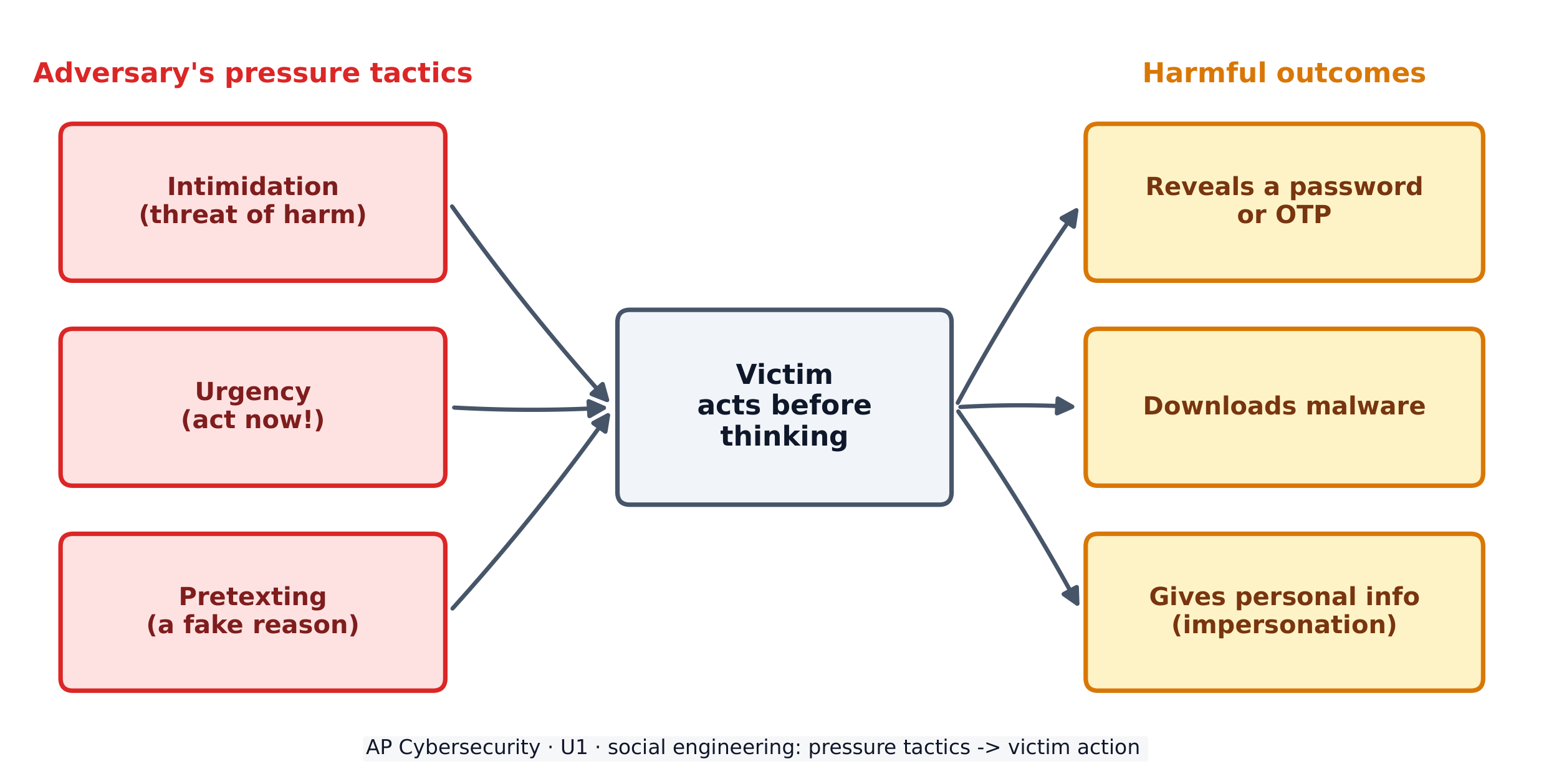
  • 1.1.A.2 Adversaries often use psychological tactics like intimidation and urgency to achieve their goals. Intimidation is when an adversary threatens a target with negative consequences if they don’t comply. Urgency is when an adversary creates reasons why a target should act quickly.

1.1.B
Explain how social engineering tactics influence victims to perform a desired action.

  • 1.1.B.1 Social engineering tactics rely on common psychological principles that influence human behavior.
  • 1.1.B.2 Intimidation leverages a natural human aversion to negative consequences. By drawing attention to possible negative consequences, adversaries use fear to incite targets to act.
  • 1.1.B.3 Urgency leverages a natural human response to react quickly to time-sensitive needs. When targets detect a sense of urgency in a message, they feel pressured to respond or act quickly, which can prevent them from taking the time to consider whether an action is reasonable or safe.

1.1.C
Describe possible impacts for victims of social engineering attacks.

  • 1.1.C.1 Victims may give an adversary personal information that could lead to impersonation, such as name, phone number, address, workplace, pets’ names, or birthdate. These types of information, and information like them, are often used on websites as challenge questions to verify a user’s identity.
  • 1.1.C.2 Victims may give an adversary secure information like a one-time password (OTP) or authentication login code, which could allow an adversary to log in to a service as the victim.
  • 1.1.C.3 Victims may download malware or click a link that installs malware on their device, steals information from their web browser, or directs them to a website where their login credentials can be captured by an adversary.

来源:美国大学理事会 AP 课程与考试说明

钓鱼:假邮件如何窃取密码

任何计算机系统最弱的部分常常是使用它的社会工程学(social engineering)是诱骗人们破坏安全的艺术——泄露一个密码、打开一个坏文件,或点击一个坏链接。攻击者(我们把他们称为一个对手(adversary))不需要破解代码;他们只需要愚弄一个人。

大多数社会工程学通过电子邮件、短信或社交媒体发生,尽管它也能亲自或通过电话发生。目标是套取信息(elicitation)——在某人没有意识到的情况下从他们那里获得敏感信息。

对手依靠两种强大的感觉:

  • 恐吓(intimidation)——对手威胁若你不服从会有一个坏结果。恐惧推动你行动。
  • 紧迫感(urgency)——对手发明一个截止期("在下一个小时内回复否则你的账户关闭")。当我们感到匆忙时,我们停止仔细思考一个行动是否安全。
社会工程学使用心理压力使一个受害者在思考之前行动

对一个受害者的影响(impact)能是严重的。他们可能透露个人细节(名字、地址、宠物的名字、生日),它们后来被用来回答安全安全问题(challenge questions)并冒充(impersonate)他们。他们可能交出一个一次性密码(OTP)(one-time password),让对手作为他们登录。或他们可能下载从他们浏览器窃取数据的恶意软件(malware)。

Worked example. 一封钓鱼电子邮件写道:"超过 90% 的员工已经验证了他们的账户——在下一个小时内确认你的,否则失去工资访问。" 两种策略在这里堆叠。"在下一个小时内"是紧迫感(一个催促你的截止期),而"超过 90% 的员工已经"是共识(consensus)(跟随人群的社会压力)。命名每种策略——不只是把这封电子邮件称为"可疑"——正是一个考试答案所需要的。

探索

Which social-engineering tactic is it?

Intimidation threatens harm, urgency invents a deadline, consensus claims everyone else is doing it, and authority pretends to have power over you.

词汇表 训练
英文 中文 拼音
Social engineering 社会工程学 shè huì gōng chéng xué
adversary 对手 duì shǒu
elicitation 套取信息 tào qǔ xìn xī
Intimidation 恐吓 kǒng hè
Urgency 紧迫感 jǐn pò gǎn
impact 影响 yǐng xiǎng
challenge questions 安全问题 ān quán wèn tí
impersonate 冒充 mào chōng
one-time password (OTP) 一次性密码 yí cì xìng mì mǎ
malware 恶意软件 è yì ruǎn jiàn
phishing 钓鱼 diào yú
1.2

可疑的网站登录

大纲
Learning ObjectiveEssential Knowledge

1.2.A
Identify common signs of a password attack.

  • 1.2.A.1 In an online password attack, adversaries try logging in to a device or service using common passwords, common password patterns, or stolen passwords.
  • 1.2.A.2 Signs of an online password attack include:
    • Many failed attempts to log in over a short duration
    • Login attempts at unusual times
    • Login attempts from unknown devices

1.2.B
Explain how adversaries take advantage of weak authentication.

  • 1.2.B.1 Many people use common patterns when creating passwords, such as:
    • Starting a password with one or two words, adding a two-digit number (often signifying a year), and putting a special character at the end
    • Including the names of family or pets in their passwords
    • Including personally significant dates in their passwords
  • 1.2.B.2 Adversaries often construct a dictionary of possible passwords based on personal information gathered about a target (e.g., birthday, anniversary, names of pets and family) and use an automated tool to submit potential passwords.

1.2.C
Explain how to make authentication stronger.

  • 1.2.C.1 Users should create passwords that are long, random, and unique. A password manager can be used to generate and store strong passwords, or a user may create long, unique passphrases for their accounts.
  • 1.2.C.2 When creating passwords, users should avoid names, dates, or other personally meaningful words or numbers.
  • 1.2.C.3 When available, users should enable multifactor authentication (MFA), which will require the user to provide extra proof of identity—such as a one-time code—in addition to the password as an extra layer of security.

来源:美国大学理事会 AP 课程与考试说明

一个密码攻击(password attack)是任何用猜测或窃取的密码登录的尝试。在一个在线密码攻击中对手对一个真实的登录页面尝试密码。警告迹象在日志里可见:

  • 短时间内许多失败的登录,
  • 在异常时间的登录尝试,
  • 来自未知设备的登录尝试。

对手成功是因为人们选择(weak)密码。常见的模式包括一个词加一个两位数的年份加一个特殊字符(像 Summer24!),或一个宠物或家庭成员的名字。因为这些模式如此常见,一个对手能从收集到的关于你的信息构建一个可能密码的字典(dictionary)并让一个自动化工具尝试每一个。

要使身份验证(authentication)更强:

  • 创建长、随机和唯一的密码——一个密码管理器(password manager)能为你生成和存储它们。
  • 避免名字、日期和有意义的词。
  • 打开多因素身份验证(MFA)(multifactor authentication),它在密码之上要求额外的证明(像一个发短信的代码)。
词汇表 训练
英文 中文 拼音
password attack 密码攻击 mì mǎ gōng jī
weak ruò
dictionary 字典 zì diǎn
authentication 身份验证 shēn fèn yàn zhèng
password manager 密码管理器 mì mǎ guǎn lǐ qì
multifactor authentication (MFA) 多因素身份验证 duō yīn sù shēn fèn yàn zhèng
1.3

公共网络的最佳实践

大纲
Learning ObjectiveEssential Knowledge

1.3.A
Identify the type of adversary conducting a cyberattack.

  • 1.3.A.1 Adversaries can be classified by their skill levels.
    • Low-skilled adversaries rely on malicious cyber tools created by others that can be purchased online. The tools they use exploit known vulnerabilities.
    • High-skilled adversaries have the capacity to create new malicious cyber tools or modify existing ones to adapt to new defensive techniques and tools. They also have the capacity to discover undocumented vulnerabilities, known as zero days.
  • 1.3.A.2 Adversaries have a variety of motivations, including greed, desire for recognition, dedication to a cause, revenge, politics, or beliefs.

1.3.B
Identify types of wireless cyberattacks.

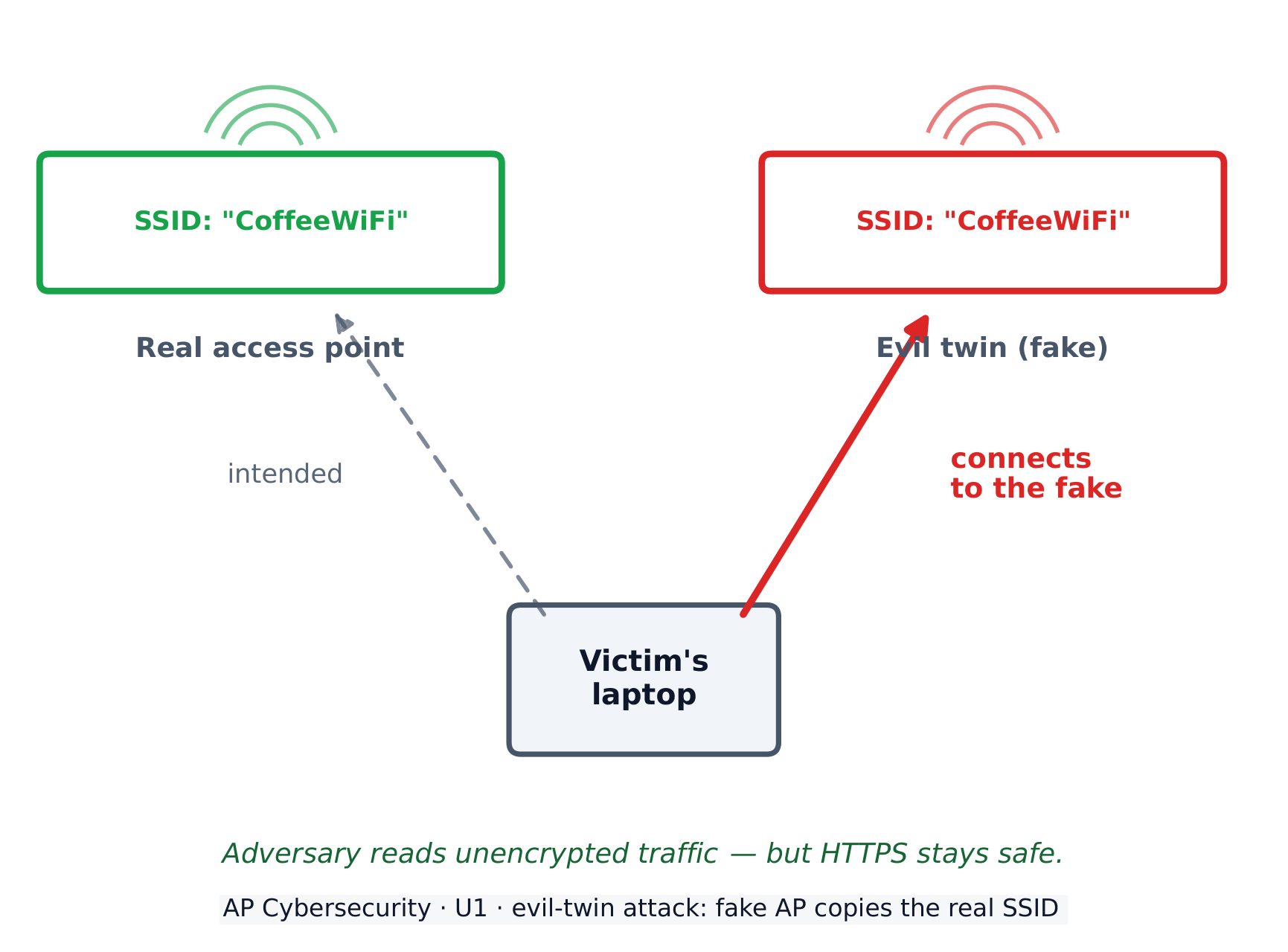
  • 1.3.B.1 In an evil twin attack, an adversary sets up their own wireless access point (WAP) with a service set identifier (SSID) similar or identical to a target network; the adversary’s network is called the evil twin. Victims of this attack could select to unknowingly connect to the evil twin, allowing the adversary to capture their network traffic. The adversary cannot read traffic that uses an encrypted protocol like HTTPS.
  • 1.3.B.2 In a jamming attack, an adversary floods an area with a strong electromagnetic (EM) signal in the same frequency range as the wireless network, which prevents legitimate traffic between the access point (AP) and users. This type of attack that prevents users from accessing resources is called a denial of service (DoS) attack.
  • 1.3.B.3 In a war driving attack, adversaries try to detect wireless network beacons while driving or walking around a target. If a wireless signal is detected, the adversary can gather information about the type of wireless network used and find areas where the wireless signal extends outside the physical building.

1.3.C
Describe actions individuals can take to increase protection of sensitive data when using the internet and Wi-Fi.

  • 1.3.C.1 Individuals should verify that the name of any wireless network they join exactly matches the name of the network they intend to join.
  • 1.3.C.2 Most internet protocols are encrypted to protect network traffic. However, individuals may consider the sensitivity of their data in choosing whether to join unencrypted Wi-Fi networks to protect vulnerable data such as DNS queries.
  • 1.3.C.3 Individuals may consider using a virtual private network (VPN), which encrypts all their traffic to the VPN operator’s system. Although this action prevents a service provider from viewing traffic, the VPN provider can view the traffic.

来源:美国大学理事会 AP 课程与考试说明

不是所有对手都相同。我们按技能给他们分类:低技能的攻击者在网上购买现成的工具并重用已知的漏洞利用(exploits),而高技能的攻击者写他们自己的工具并能发现全新的洞叫零日漏洞(zero days)。他们的动机(motivation)也不同——贪婪、复仇、政治,或信仰。

公共 Wi-Fi 是一个最爱的猎场。你必须知道的三种无线攻击:

  • 双胞胎恶意热点(evil twin)——对手设置一个假的接入点(access point),名字(SSID(服务集标识符))从真实的网络复制。受害者连接到假的,而对手读他们的流量(尽管像 HTTPS 这样加密的(encrypted)网站保持安全)。
  • 干扰攻击(jamming)——对手用一个强的无线电信号淹没空中,所以没有人能连接。这是一种拒绝服务(DoS)(denial of service)攻击。
  • 战争驾驶(war driving)——对手四处驾驶,检测无线网络以及它们的信号在哪里泄漏到一栋建筑之外。
一个双胞胎恶意接入点复制真实网络的名字,所以受害者连接到攻击者

要在公共网络上保护你自己:检查网络名字与你打算加入的恰好匹配、偏好加密的网站,并考虑一个虚拟专用网络(VPN)(virtual private network),它把你所有的流量加密给 VPN 运营商。

词汇表 训练
英文 中文 拼音
exploits 漏洞利用 lòu dòng lì yòng
zero days 零日漏洞 líng rì lòu dòng
motivation 动机 dòng jī
Evil twin 双胞胎恶意热点 shuāng bāo tāi è yì rè diǎn
access point 接入点 jiē rù diǎn
SSID 服务集标识符 fú wù jí biāo shí fú
encrypted 加密的 jiā mì de
Jamming 干扰攻击 gān rǎo gōng jī
denial of service (DoS) 拒绝服务 jù jué fú wù
War driving 战争驾驶 zhàn zhēng jià shǐ
virtual private network (VPN) 虚拟专用网络 xū nǐ zhuān yòng wǎng luò
1.4

基于AI的网络安全攻击

大纲
Learning ObjectiveEssential Knowledge

1.4.A
Explain how adversaries use AI-powered tools to augment cyberattacks.

  • 1.4.A.1 Adversaries can use AI-powered tools that leverage existing voice and image samples of a person to create a digital avatar of that person. The use of these technologies enables adversaries to impersonate someone over the phone or even on a video call, which can lead to financial loss or the sharing of sensitive or private information. As more organizations adopt voice-based authentication, the impact of voice-impersonation has a larger potential impact.
  • 1.4.A.2 Adversaries can use generative AI tools, like large language models (LLMs), to create convincing phishing messages in any target language. Because traditional phishing messages are sometimes written by non-native speakers of the target’s language, unnatural language is a feature that has been used to distinguish phishing messages from legitimate messages. However, with AI tools, adversaries can now craft phishing messages in any language that read as though they were written by a native speaker.
  • 1.4.A.3 Adversaries can craft prompts that extract secure or sensitive information from LLMs. Secure or sensitive information in LLMs can come from user input and the large data sets used to train LLMs.
  • 1.4.A.4 Adversaries can publish websites or modify existing websites to contain false information so that the false information will be included in the training sets for LLMs, causing the LLMs to repeat the false information.
  • 1.4.A.5 Adversaries can perform reconnaissance on a target using AI-powered tools that scan the internet to gather information posted on social media and public websites.
  • 1.4.A.6 Adversaries can use AI-enhanced coding tools to help them write new malware, modify existing application code to perform malicious activities, or to find vulnerabilities in large code bases.

1.4.B
Explain how to protect against some AI-augmented cyberattacks.

  • 1.4.B.1 Shared secrets with close friends and relatives that can be used to verify each other’s identities should be established. A secret word or phrase known only to two parties can be used to authenticate identities in high-stakes situations.
  • 1.4.B.2 Multifactor authentication (MFA) should be enabled. If an adversary clones a target’s voice to access a system with voice authentication, requiring a second authentication factor could prevent an adversary from gaining access to accounts.
  • 1.4.B.3 Personal or sensitive data should not be entered into any AI-powered tools, such as chatbots or virtual assistants. Some AI-powered tools feed user input back into the model to provide continuous training. Adversaries could extract data that users have included in prompts.
  • 1.4.B.4 Output from AI-powered tools should be carefully evaluated. Verify information from AI-powered tools using reputable, stable, non-AI-based sources.

来源:美国大学理事会 AP 课程与考试说明

人工智能给对手强大的新工具。有足够的语音和图像样本,一个对手能构建一个深度伪造(deepfake)化身在一个通话中冒充某人。大语言模型(LLMs)(large language models)让他们能以完美的、听起来像母语的语言写有说服力的钓鱼(phishing)电子邮件——去除曾经暴露骗局的笨拙措辞。

AI 也在后端帮助对手:制作从一个 LLM 拉出秘密数据的提示、在网站上植入虚假信息以便它毒害一个 LLM 的训练数据、扫描互联网以收集关于一个目标的事实,甚至写新的恶意软件。

你能防御许多 AI 增强的攻击:与亲密联系人商定一个共享秘密(shared secret)词以验证身份、启用 MFA(所以一个克隆的声音单独不能登录)、绝不把敏感数据输入一个聊天机器人,并总是对照可靠的、非 AI 的来源仔细检查 AI 输出。

词汇表 训练
英文 中文 拼音
deepfake 深度伪造 shēn dù wěi zào
Large language models (LLMs) 大语言模型 dà yǔ yán mó xíng
shared secret 共享秘密 gòng xiǎng mì mì
1.5

在网络防御中运用AI

大纲
Learning ObjectiveEssential Knowledge

1.5.A
Explain how cyber defenders can leverage AI-powered tools to protect networks, applications, and data.

  • 1.5.A.1 AI tools can review current security configurations, like firewall rules and access controls, and recommend more secure options. Recommendations should always be checked by a knowledgeable security technician before being implemented.
  • 1.5.A.2 AI-powered tools can analyze application code to identify vulnerabilities and recommend mitigations. Recommendations should always be reviewed by a knowledgeable programmer before being implemented.
  • 1.5.A.3 AI-powered tools can suggest rules for automated detection systems. Detection rules should always be reviewed by a knowledgeable detection engineer before being added to a system.

1.5.B
Explain how AI-powered tools are enabling faster and more accurate threat detection and response.

  • 1.5.B.1 Of the millions of digital events that happen on networks daily, some likely represent an adversary conducting malicious activity. Humans cannot carefully examine all those events to identify the malicious activity.
  • 1.5.B.2 AI-powered tools can be trained to quickly analyze digital events and sort the events that are likely malicious activity from those that are harmless.
  • 1.5.B.3 AI-powered tools can be programmed to alert human cybersecurity personnel when likely malicious activity is detected or to take specific corrective actions based on the type of malicious activity detected.
  • 1.5.B.4 AI-powered tools enable threat-detection and response teams to catch malicious activity and intervene quickly to prevent loss, harm, damage, and destruction to digital infrastructure and data.

来源:美国大学理事会 AP 课程与考试说明

同样的技术保护我们。AI 工具能审查防火墙规则和访问设置并推荐更安全的选项——尽管一个人类专家必须总是在应用之前检查建议。AI 能扫描应用代码的弱点并建议检测规则。

它最大的优势是规模。一个中型网络每天产生数百万个事件——远太多人无法阅读。AI 能快速地把无害的事件从可能恶意的中分类、警报人类员工,或采取一个自动的行动。这让防御者能在几秒而不是几天内捕捉一个攻击并响应,防止损失和损害。

1.5

考试技巧

  • 当一个问题要求你给风险排名时,记住高风险 = 高影响并且容易利用。一个停车场 Wi-Fi 泄漏比一个让对手能伪造一个设备的开放内部端口重要性更低。
  • 按名字学社会工程学策略——恐吓、紧迫感、伪装借口(pretexting)、权威(authority)、共识、稀缺(scarcity)、熟悉(familiarity)——并准备好发现一封电子邮件在使用哪一个。
  • 加密在一个双胞胎恶意热点上仍然保护你:对手看到你的流量但不能读 HTTPS。说什么被暴露,不只是"它不安全"。
  • 对于"如何使身份验证更强",MFA 几乎总是答案的一部分,加上来自一个管理器的长/唯一密码。
  • AI 是双重用途的:同样的工具(LLM、代码分析)出现在攻击和防御两侧。仔细读问题以看它问哪一侧。

本主题的互动课程

逐步学习,并即时检测练习。

AP 网络安全的更多主题

登录或创建账号

IGCSE, A-Level & AP