跳到主要内容

计算机系统与网络

AP 计算机科学原理 · 第 4 主题

训练
讲义 词汇表
4.1

互联网

大纲
Enduring UnderstandingLearning ObjectiveEssential Knowledge

CSN-1
Computer systems and networks facilitate the transfer of data.

CSN-1.A
Explain how computing devices work together in a network. [Skill 5.A]

  • CSN-1.A.1 A computing device is a physical artifact that can run a program. Some examples include computers, tablets, servers, routers, and smart sensors.
  • CSN-1.A.2 A computing system is a group of computing devices and programs working together for a common purpose.
  • CSN-1.A.3 A computer network is a group of interconnected computing devices capable of sending or receiving data.
  • CSN-1.A.4 A computer network is a type of computing system.
  • CSN-1.A.5 A path between two computing devices on a computer network (a sender and a receiver) is a sequence of directly connected computing devices that begins at the sender and ends at the receiver.
  • CSN-1.A.6 Routing is the process of finding a path from sender to receiver.
  • CSN-1.A.7 The bandwidth of a computer network is the maximum amount of data that can be sent in a fixed amount of time.
  • CSN-1.A.8 Bandwidth is usually measured in bits per second.

CSN-1.B
Explain how the Internet works. [Skill 5.A]

  • CSN-1.B.1 The Internet is a computer network consisting of interconnected networks that use standardized, open (nonproprietary) communication protocols.
  • CSN-1.B.2 Access to the Internet depends on the ability to connect a computing device to an Internet-connected device.
  • CSN-1.B.3 A protocol is an agreed-upon set of rules that specify the behavior of a system.
  • CSN-1.B.4 The protocols used in the Internet are open, which allows users to easily connect additional computing devices to the Internet.
  • CSN-1.B.5 Routing on the Internet is usually dynamic; it is not specified in advance.
  • CSN-1.B.6 The scalability of a system is the capacity for the system to change in size and scale to meet new demands.
  • CSN-1.B.7 The Internet was designed to be scalable.

CSN-1.C
Explain how data are sent through the Internet via packets. [Skill 5.A]

  • CSN-1.C.1 Information is passed through the Internet as a data stream. Data streams contain chunks of data, which are encapsulated in packets.
  • CSN-1.C.2 Packets contain a chunk of data and metadata used for routing the packet between the origin and the destination on the Internet, as well as for data reassembly.
  • CSN-1.C.3 Packets may arrive at the destination in order, out of order, or not at all.
  • CSN-1.C.4 IP, TCP, and UDP are common protocols used on the Internet.

CSN-1.D
Describe the differences between the Internet and the World Wide Web. [Skill 5.A]

  • CSN-1.D.1 The World Wide Web is a system of linked pages, programs, and files.
  • CSN-1.D.2 HTTP is a protocol used by the World Wide Web.
  • CSN-1.D.3 The World Wide Web uses the Internet.

来源:美国大学理事会 AP 课程与考试说明

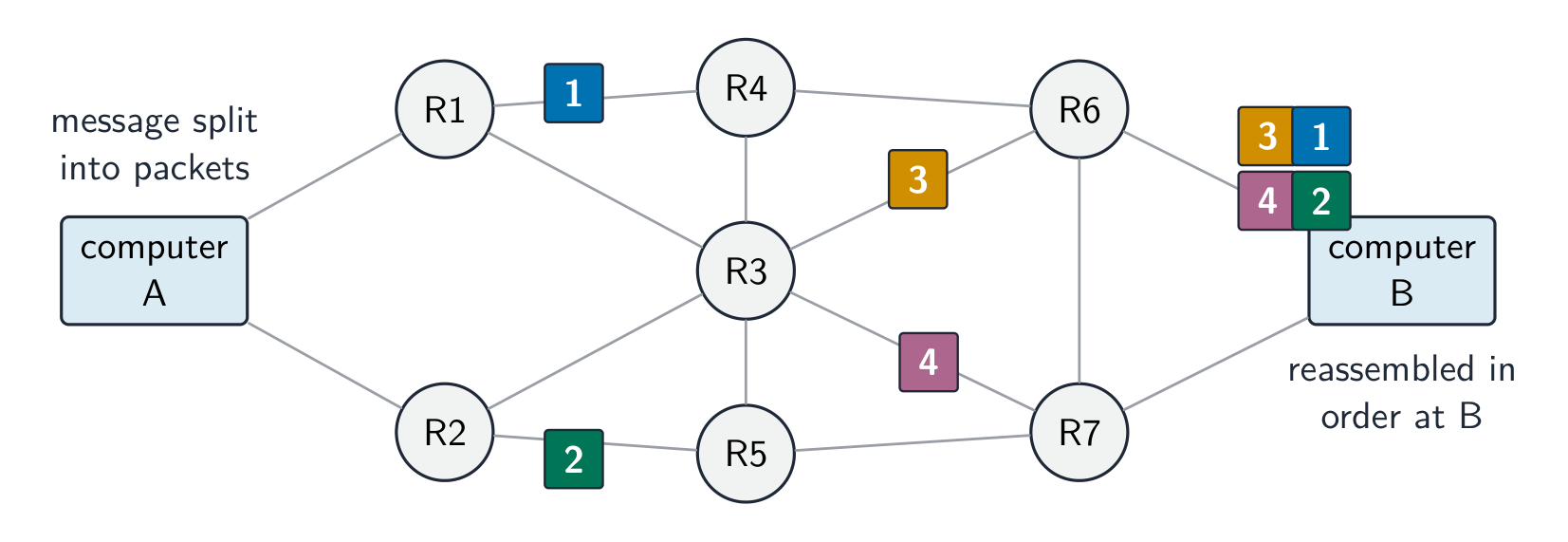
互联网(Internet)是一个网络的全球网络。数据作为数据包(packets)传播——被分开发送并在目的地重新组装的小块。两个思想使它在规模上起作用:

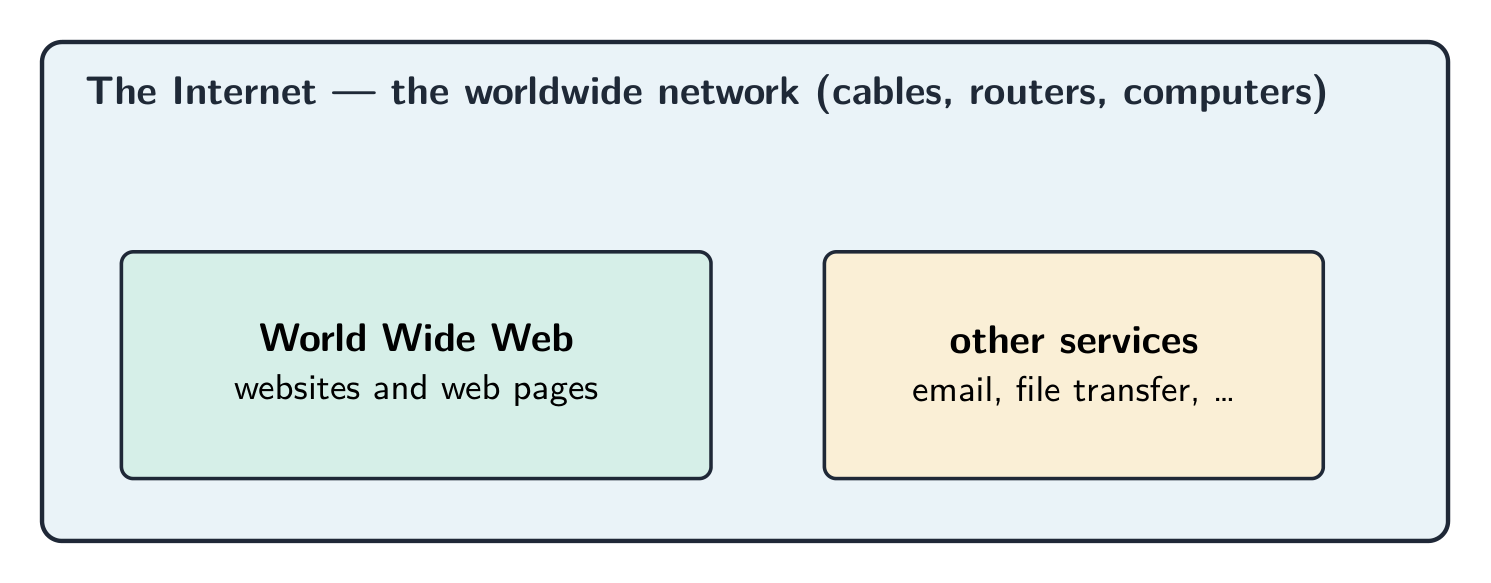
互联网是全世界的网络;万维网是运行在它上面的一个服务
  • 协议(protocols)是通信的约定规则。IP(网际协议,Internet Protocol)寻址和路由数据包;TCP 按顺序重新组装它们并重新请求丢失的;HTTP 携带网页;DNS 把一个像 example.com 的名字翻译成一个 IP 地址。
  • 冗余(redundancy)和路由:两点之间有许多可能的路径,所以若一条路径失败,数据包走另一条。这使互联网容错(fault-tolerant)。

互联网被设计为开放(open)和可扩展(scalable)——建立在任何人都能使用的标准上,所以随着数十亿设备加入它继续工作。带宽(bandwidth)是一个连接每秒能携带的数据量。

探索

How data crosses the Internet in packets

The Internet breaks a message into numbered packets, each addressed and routed independently (often by different paths), then reassembled at the destination. That design makes it fault-tolerant — if one route fails, packets take another.

词汇表 训练
英文 中文 拼音
Internet 互联网 hù lián wǎng
packets 数据包 shù jù bāo
Protocols 协议 xié yì
Redundancy 冗余 rǒng yú
fault-tolerant 容错 róng cuò
Bandwidth 带宽 dài kuān
4.2

容错

大纲
Enduring UnderstandingLearning ObjectiveEssential Knowledge

CSN-1
Computer systems and networks facilitate the transfer of data.

CSN-1.E
For fault-tolerant systems, like the Internet:
a. Describe the benefits of fault tolerance. [Skill 1.D]
b. Explain how a given system is fault-tolerant. [Skill 5.A]
c. Identify vulnerabilities to failure in a system. [Skill 1.D]

  • CSN-1.E.1 The Internet has been engineered to be fault-tolerant, with abstractions for routing and transmitting data.
  • CSN-1.E.2 Redundancy is the inclusion of extra components that can be used to mitigate failure of a system if other components fail.
  • CSN-1.E.3 One way to accomplish network redundancy is by having more than one path between any two connected devices.
  • CSN-1.E.4 If a particular device or connection on the Internet fails, subsequent data will be sent via a different route, if possible.
  • CSN-1.E.5 When a system can support failures and still continue to function, it is called fault-tolerant. This is important because elements of complex systems fail at unexpected times, often in groups, and fault tolerance allows users to continue to use the network.
  • CSN-1.E.6 Redundancy within a system often requires additional resources but can provide the benefit of fault tolerance.
  • CSN-1.E.7 The redundancy of routing options between two points increases the reliability of the Internet and helps it scale to more devices and more people.

来源:美国大学理事会 AP 课程与考试说明

一个系统是容错(fault-tolerant)的,若它即使在它的一部分失败时也继续工作。互联网通过冗余(redundant)连接实现这个:因为数据包能沿多条路径路由,一个路由器或电缆的失败不停止通信——流量只是重新路由。容错花费额外的资源(冗余的路径)但大大改善可靠性(reliability)。一条没有备份的单一路径不是容错的。

数据包交换按独立的路由发送数据包,所以网络容忍一个失败的链路
词汇表 训练
英文 中文 拼音
reliability 可靠性 kě kào xìng
4.3

并行与分布式计算

大纲
Enduring UnderstandingLearning ObjectiveEssential Knowledge

CSN-2
Parallel and distributed computing leverage multiple computers to more quickly solve complex problems or process large data sets.

CSN-2.A
For sequential, parallel, and distributed computing:
a. Compare problem solutions. [Skill 1.D]
b. Determine the efficiency of solutions. [Skill 1.D]

  • CSN-2.A.1 Sequential computing is a computational model in which operations are performed in order one at a time.
  • CSN-2.A.2 Parallel computing is a computational model where the program is broken into multiple smaller sequential computing operations, some of which are performed simultaneously.
  • CSN-2.A.3 Distributed computing is a computational model in which multiple devices are used to run a program.
  • CSN-2.A.4 Comparing efficiency of solutions can be done by comparing the time it takes them to perform the same task.
  • CSN-2.A.5 A sequential solution takes as long as the sum of all of its steps.
  • CSN-2.A.6 A parallel computing solution takes as long as its sequential tasks plus the longest of its parallel tasks.
  • CSN-2.A.7 The "speedup" of a parallel solution is measured in the time it took to complete the task sequentially divided by the time it took to complete the task when done in parallel.

CSN-2.B
Describe benefits and challenges of parallel and distributed computing. [Skill 1.D]

  • CSN-2.B.1 Parallel computing consists of a parallel portion and a sequential portion.
  • CSN-2.B.2 Solutions that use parallel computing can scale more effectively than solutions that use sequential computing.
  • CSN-2.B.3 Distributed computing allows problems to be solved that could not be solved on a single computer because of either the processing time or storage needs involved.
  • CSN-2.B.4 Distributed computing allows much larger problems to be solved quicker than they could be solved using a single computer.
  • CSN-2.B.5 When increasing the use of parallel computing in a solution, the efficiency of the solution is still limited by the sequential portion. This means that at some point, adding parallel portions will no longer meaningfully increase efficiency.

来源:美国大学理事会 AP 课程与考试说明

  • 顺序计算(sequential computing)一次运行一个操作。
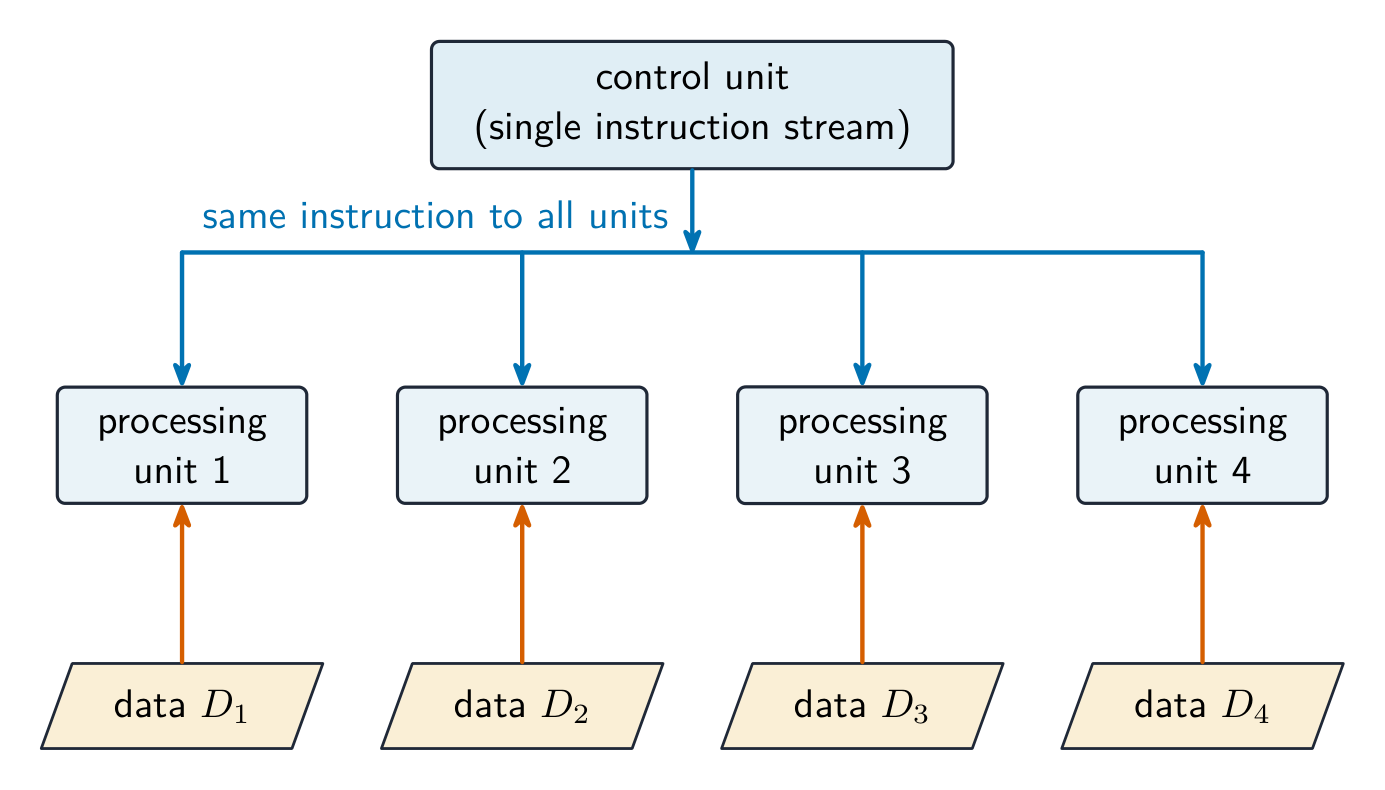
  • 并行计算(parallel computing)把一个任务分成同时在多个处理器上运行的部分,更快地完成。
  • 分布式计算(distributed computing)使用由一个网络连接的许多计算机来处理一个问题——对于对单台机器太大的问题至关重要。
并行计算:许多处理器同时工作
并行计算:许多处理器同时工作

一个并行解决方案的加速比(speedup)是顺序时间除以并行时间。加速比是有限的:必须按顺序运行的部分不能通过添加处理器加速,所以把处理器加倍很少使速度加倍。

Worked example. 一个任务有一个必须按顺序运行的部分,取 $40$ 秒,加一个在一个处理器上取 $60$ 秒的可并行部分——所以在单个处理器上整个任务取 $40+60=100$ 秒。把并行部分分散到 $3$ 个处理器上它取 $\tfrac{60}{3}=20$ 秒,所以总并行时间是 $40+20=60$ 秒而加速比是 $\tfrac{100}{60}\approx1.67$。这 $40$ 秒的顺序部分是一个下限:即使有无穷多个处理器任务也从不能在 $40$ 秒以下完成。

考试技能: 给定一个任务顺序和并行部分的时间,能够计算总并行时间和加速比。

词汇表 训练
英文 中文 拼音
Sequential computing 顺序计算 shùn xù jì suàn
Parallel computing 并行计算 bìng xíng jì suàn
Distributed computing 分布式计算 fēn bù shì jì suàn
speedup 加速比 jiā sù bǐ
4.3

考试技巧

  • 描述数据如何在一个冗余的、容错的独立路由器网络上以数据包传播。
  • 知道协议(IP、TCP、HTTP)是约定的规则,以及开放的标准让不同的系统互操作。
  • 解释可扩展性以及互联网如何在没有中央控制的情况下增长。
  • 对比带宽(速率)与延迟(latency)(时延),并描述 DNS 名字到地址的查找。
  • 用平实的措辞讨论数字鸿沟(digital divide)和安全基础(加密、身份验证)。

本主题的互动课程

逐步学习,并即时检测练习。

AP 计算机科学原理历年真题

AP 计算机科学原理的更多主题

登录或创建账号

IGCSE, A-Level & AP