跳到主要内容

RW.6 · Key writing: a message of at least 25 words

Cambridge English A2 Key(KET) · 知识点 3

本主题的视频课程 打开视频页面
4:18

A2参考答案 · 写作第6部分:25词留言

第六部分是一则至少二十五词的简短留言,需回复朋友的信息,且朋友的原始信息中总是包含三件要做的事。该……

英文讲解 · 可切换中英文字幕

3.1

本主题涵盖的内容

English

Part 6 of the Reading & Writing paper: write a short message 留言 — an email or a note — of 25 words or more. Sometimes you answer a friend's message; sometimes the task just sets the scene (You are going to a picnic with your English friend Sam. Write an email to Sam.). Either way, the task gives you three things to do — to say, to ask, to explain, to suggest.
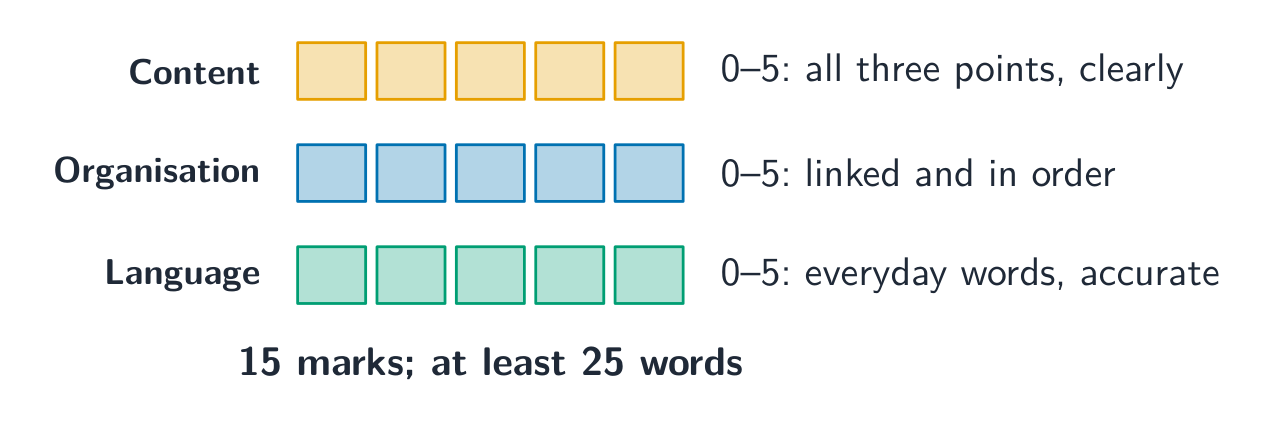
Three scales from 0 to 5: content, organisation and language, 15 marks for an email of at least 25 words
How the email is marked
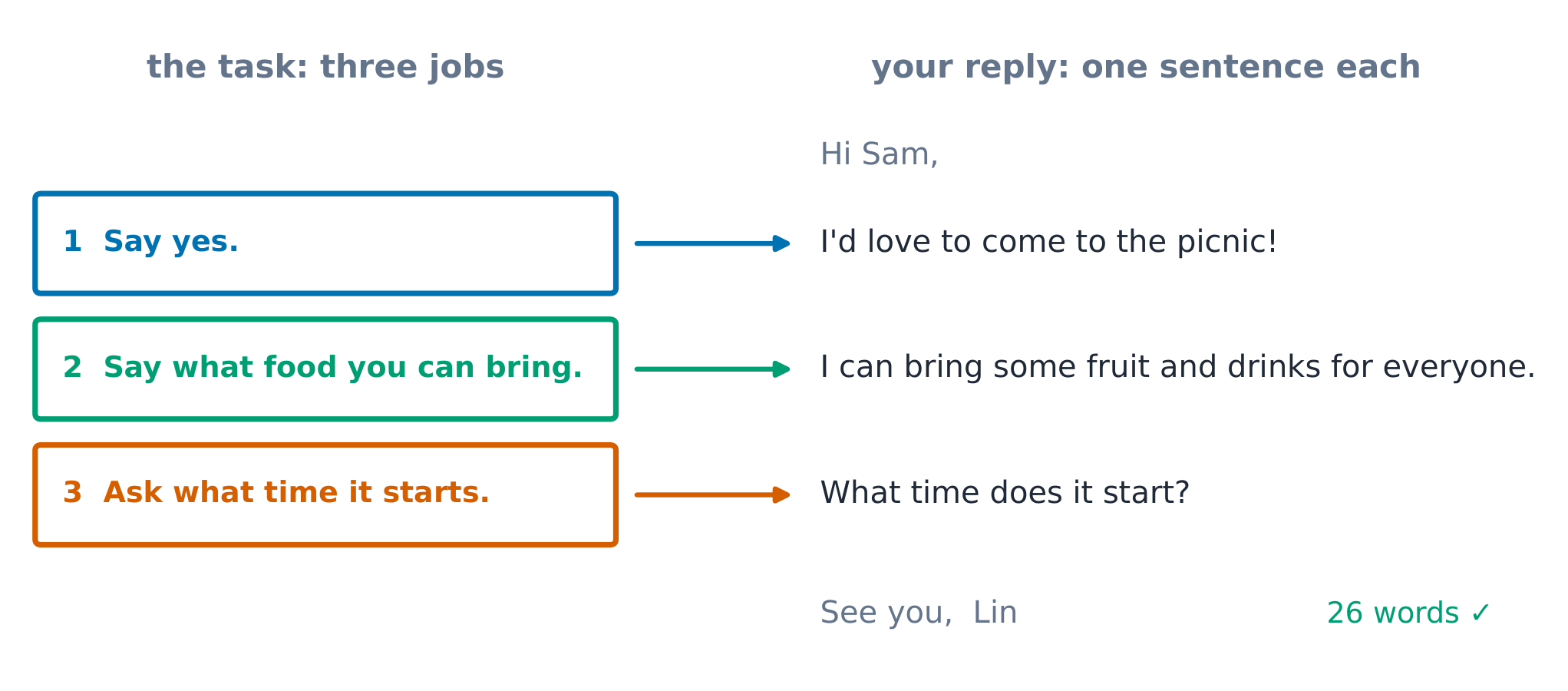
  • Example task: your friend invites you to a picnic. Say yes. Say what food you can bring. Ask what time it starts.
  • How it is marked: 0–5 marks each for Content (all three points, clearly), Organisation (linked, in order, with a greeting and an ending) and Language (everyday words and simple grammar used correctly). That is 15 marks, the same as Part 7.
  • Memory hook: the task is a menu with three dishes 三道菜. Serve all three, in order, and the marks follow.
  • ⚠ The task says 25 words or more, and a very short answer almost always leaves a point out or says it too thinly. Aim for 30–45 and count.
  • The tone is friendly: short forms are welcome (I'm, can't, let's). This is the one exam where I'm is not just allowed but encouraged.
词汇 训练
English 中文 拼音
message/ˈmesɪdʒ/ 留言 liú yán
3.2

菜单法

English
  1. Circle the three jobs in the task before writing a word.
  2. Write one or two sentences per job, in order.
  3. Open with Hi / Dear + name and close with See you / Best / Write soon + your name.
A short message by hand: cover the three things the task asks for, and keep each to one or two sentences

A full answer to the picnic task:

Hi Sam,
I'd love to come to the picnic! I can bring some fruit and drinks for everyone. What time does it start?
See you,
Lin

Three jobs, three sentences — and 26 words, counting Hi Sam and Lin. That just reaches the line, so give each job one small extra detail:

Hi Sam,
Thanks for asking me! I'd love to come to the picnic on Saturday. I can bring some fruit and a big bottle of orange juice for everyone. What time does it start, and where shall we meet?
See you soon,
Lin

Now it is 43 words, and every extra word does a job: on Saturday, a big bottle of orange juice, where shall we meet. The exam rewards completeness 完整性 over beauty — a correct boring answer beats a beautiful one that forgot the drinks.

Weak, then strong. The same picnic task, answered badly:

Hi Sam, yes picnic is good. I bring fruit. See you, Lin

Criterion What the examiner sees
Content Point 3 (ask what time it starts) is missing; point 1 is barely there.
Organisation Greeting and ending are fine, but the ideas are not linked.
Language I bring should be I can bring or I'll bring; picnic is good needs the and sounds odd.

Twelve words, one missing point, two errors. The strong version above fixes all three criteria, and none of it is difficult English.

The three jobs in the picnic task, each joined by an arrow to the one sentence of the reply that does it.
One job, one sentence: the reply is complete before it is long
词汇 训练
English 中文 拼音
completeness/kəmˈpliːtnəs/ 完整性 wán zhěng xìng
3.3

实用句型库

English
Job The sentence
accept I'd love to come. / That sounds great!
refuse politely I'm sorry, but I can't come.
offer I can bring some drinks. / Shall I bring anything?
ask What time does it start? / Where shall we meet?
suggest Let's meet at the gate. / How about the park?
thank Thanks for your email! / Thank you for inviting me.
say sorry and explain I'm sorry I can't come — I have a piano lesson.
describe It's a small red bag with my name on it.
give a time or place Let's meet outside the cinema at four o'clock.
  • Questions are free marks: What time? Where? Who else is coming? — one per task, word-for-word from the A1 question machine.
  • ⚠ Every question needs its flip: "What time it starts?" ✗ → What time does it start? Topic A1-9's flip still collects marks.
She likes cats becomes Does she like cats: does takes the -s and the verb goes back to its base form; Does she likes cats is wrong
Does takes the -s: What time does it start?
3.4

注意:中国考生的陷阱

English
  • ⚠ Don't skip a job. Three jobs = the shape of the marks. One missing job is a missing dish; the examiners notice the empty plate.
  • ⚠ Don't write a novel. 30–45 words is the sweet spot 最佳点. A 120-word masterpiece spends time Part 7 needs, and long answers grow error trees.
  • ⚠ Register 语域: friendly, not formal. No Dear Sir, no Yours faithfully. It's a friend: Hi Sam — See you — Lin.
  • ⚠ Check the three classics: third-person -s (it starts), articles (a picnic, the park), and verb forms after can/can't (I can bring). Sixty seconds of checking is worth more than a fourth sentence.
A word gauge from 0 to 120 with 30 to 45 words shaded as the sweet spot and 120 words marked as time lost for Part 7; below it, job 1 done, job 2 done and job 3 missing, an empty plate the examiners notice
All three jobs, in 30 to 45 words
词汇 训练
English 中文 拼音
sweet spot/swiːt spɒt/ 最佳点 zuì jiā diǎn
register/ˈredʒɪstə/ 语域 yǔ yù
3.5

尝试一下

English

Three tasks, from guided to on your own. Write each one before reading the model, then count your words.

Task 1 (guided). Your friend Mia writes: "I'm having a birthday dinner on Friday. Can you come? Tell me what food you like. And could you bring your guitar?" Cover: yes/no, the food, the guitar.

Model: Hi Mia, I'd love to come to your birthday dinner! I really like fish and rice, but not spicy food, please. Yes, I'll bring my guitar and play a song for you. See you on Friday! Alex (37 words; all three dishes served.)

Task 2 (saying no). Your English friend Ben wants to go to the cinema with you on Saturday. Write an email to Ben. Say sorry you can't go. Explain why. Suggest another day.

Model: Hi Ben, I'm sorry, but I can't come to the cinema on Saturday because I have a swimming competition. Are you free on Sunday afternoon? We could see the film then. Lucy (32 words.) Notice the three different jobs: I'm sorry (apologise), because (explain), Are you free…? We could… (suggest).

Task 3 (on your own, a teacher). You missed your art class yesterday. Write a note to your teacher, Ms Green. Say sorry. Explain why you were not there. Ask about the homework.

Model: Dear Ms Green, I'm sorry I missed the art class yesterday. I had a bad cold, so I stayed at home. Could you tell me what homework I need to do? Thank you, Kai (34 words.) Dear and Thank you fit a teacher; Hi and See you fit a friend. Same three-job menu, different table manners.

Task 4 (a scene, not a reply). Your English friend Leo is coming to stay with you next weekend. Write an email to Leo. Say how you feel about his visit. Tell him what you will do together. Tell him what to bring.

Model: Hi Leo, I'm really happy you're coming to stay! We'll go to the new water park on Saturday and have a barbecue in my garden on Sunday. Bring your swimming things and a warm jacket, because it's cold at night. See you soon, Ming (44 words.)

3.6

自我检测

English

Answer first, then read the explanation.

  1. How many jobs in a Part 6 task? — Three. Serve all three.
  2. Which three things are marked? — Content, Organisation, Language, 0–5 each.
  3. "What time it starts?" — ✗ → What time does it start? The flip collects marks.
  4. 20 words — too few. The task asks for 25 or more; count.
  5. Dear Sir / Yours faithfully to a friend — ✗ → Hi Sam / See you. A friend, not a bank. (To a teacher, Dear Ms Green … Thank you is right.)
  6. A perfect answer that forgot the guitar — loses Content marks. Completeness over beauty.
  7. The task says Suggest another day. — a suggestion, not a question about the weather: Are you free on Sunday? We could…

Vocabulary card meanings

message: A short note left for someone who is away. a menu with three dishes: An example of a food list that names three dishes, which may share one course rather than forming three courses. completeness: Having every required part, with nothing left out. sweet spot: The point at which a choice works best.

词汇 训练
English 中文 拼音
a menu with three dishes/ə ˈmenjuː wɪð θriː ˈdɪʃɪz/ 三道菜 sān dào cài

该知识点的互动课程

逐步完成,配合即时检查练习。

更多 Cambridge English A2 Key(KET) 知识点

登录或创建账户

IGCSE, A-Level & AP