Principles of physical examination
Đã giới thiệu| English | Ý nghĩa |
|---|---|
| inspection | inspection |
| palpation | palpation |
| percussion | percussion |
| auscultation | auscultation |
| pleural effusion | pleural effusion |
Look before you touch
- A student presses on a sore belly first. The patient tenses every muscle, and for the rest of the examination nothing can be felt or heard clearly.
- Physical examination has a fixed order, so that each step leaves the patient ready for the next one.
Four steps, least intrusive first
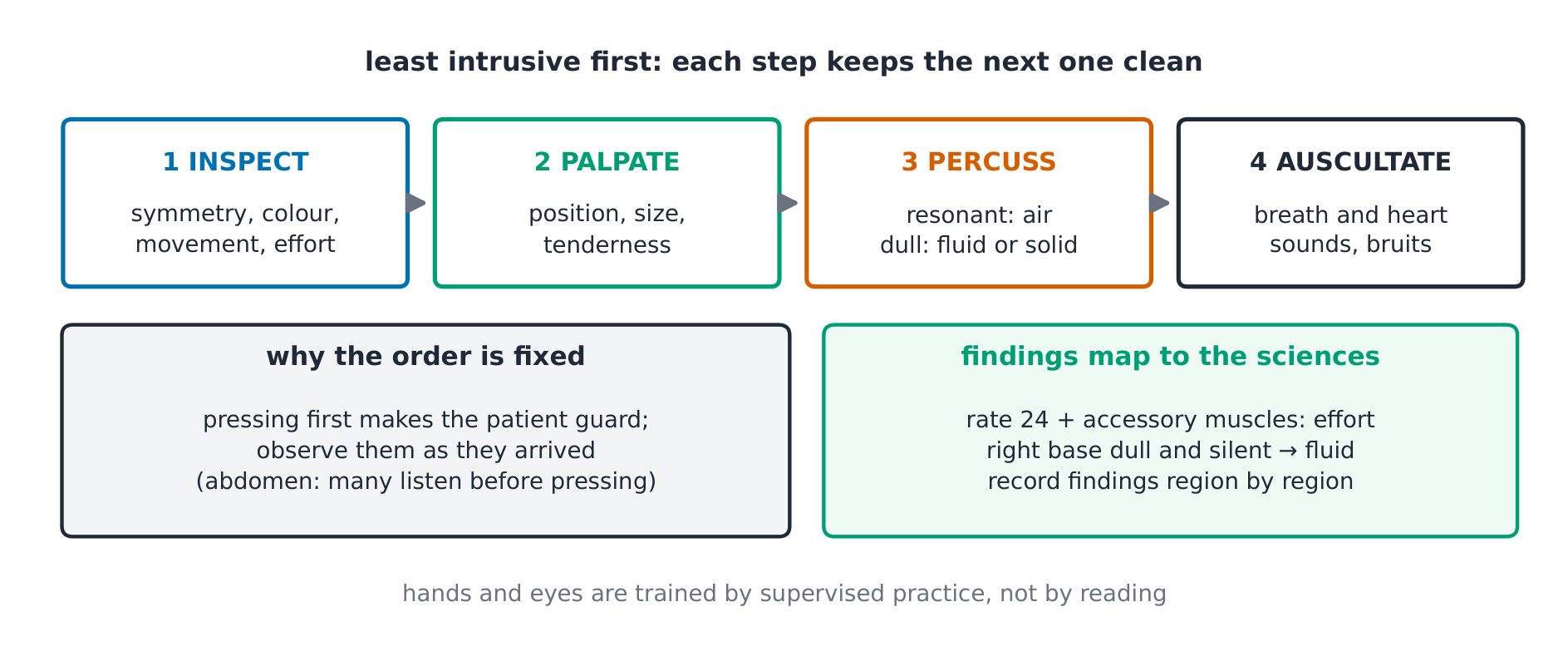
- Inspection 视诊 (look), palpation 触诊 (feel), percussion 叩诊 (tap) and auscultation 听诊 (listen). For the chest and most systems, always in that order.
- Each step disturbs the patient a little more, so each finding is recorded in the state the patient arrived in. In the abdomen many clinicians listen before pressing, for the same reason.
Put the four examination steps in order.
Độ khó 3/5 · 200 xu + phần thưởng nhỏ khi hoàn thành lần đầu tiên hôm nay
Least intrusive first, so each step finds the patient as they arrived.
Inspection and palpation
- Inspection: symmetry, colour, movement and effort of breathing, before any contact. It is the step most often skipped and one of the most useful.
- Palpation feels position, size, tenderness and texture. Examine the painful area last, because pain makes the patient guard and spoils every later step.
In a patient with abdominal pain, the painful area should be palpated first, because it is the most important.
Độ khó 1/5 · 100 xu + phần thưởng nhỏ khi hoàn thành lần đầu tiên hôm nay
Examine it last. Pain causes guarding, which hides findings in every other region.
Percussion: what the note means
- Tapping over air-filled lung gives a resonant note; over fluid or solid tissue the note is dull; over gas-filled gut it is tympanic (drum-like).
- A dull note at a lung base where resonance is expected suggests fluid or collapse there.
Match each percussion note to what lies underneath.
Độ khó 2/5 · 140 xu + phần thưởng nhỏ khi hoàn thành lần đầu tiên hôm nay
Air resonates, fluid and solid deaden the note, and a gas-filled bowel sounds like a drum.
Auscultation and comparing sides
- Listen to breath sounds, heart sounds and bruits (the noise of turbulent blood flow). Listen on the skin, not through clothes.
- Always compare: left against right, and the patient against what is expected. A difference between sides is often the finding.
- (Fictional) Breathing rate 24 at rest, accessory muscles working, less chest movement on the right, dull percussion and absent breath sounds at the right base.
- Each step adds a piece: together they point to fluid around the right lung, a pleural effusion 胸腔积液.
(Fictional) Reduced movement on the right, dull percussion and absent breath sounds at the right base. The most likely cause is —
Độ khó 1/5 · 100 xu + phần thưởng nhỏ khi hoàn thành lần đầu tiên hôm nay
Dullness means fluid or solid tissue; absent breath sounds mean sound is not reaching the surface. Air would sound more resonant, not dull.
The single most useful habit when listening to the chest is to —
Độ khó 1/5 · 100 xu + phần thưởng nhỏ khi hoàn thành lần đầu tiên hôm nay
A difference between the two sides is often the finding; listening on bare skin, after inspection, keeps the sounds clear.
Record what you examined
- Write findings by region: "chest: equal expansion, resonant, vesicular breath sounds". "Exam normal" tells the next doctor nothing about what was checked.
- Reading teaches the order and the meaning; the skill in the hands and eyes comes only from supervised practice.
Which records of a chest examination are acceptable? Select all that apply.
Độ khó 2/5 · 140 xu + phần thưởng nhỏ khi hoàn thành lần đầu tiên hôm nay
Good records say what was examined and what was found, region by region.
Common slips
- Skipping inspection. It is quick and gives some of the most useful information.
- Touching the painful area first. Guarding spoils everything after it.
- Writing "exam normal". Record what was examined and found, region by region.
Recap
- Inspect → palpate → percuss → auscultate, least intrusive first.
- Percussion: resonant (air), dull (fluid or solid), tympanic (gas in gut).
- Compare sides, examine the painful area last and record findings by region.