Excitable cells and muscle
Đã giới thiệu| English | Ý nghĩa |
|---|---|
| action potential/ˈækʃn pəˈtenʃl/ | action potential |
| refractory period/rɪˈfræktəri ˈpɪərɪəd/ | refractory period |
| saltatory conduction/ˈsɒltətəri kənˈdʌkʃn/ | saltatory conduction |
| tetanus | tetanus |
One sentence of electricity
- Rest −70 mV (K⁺-built). The action potential: Na⁺ upstroke (positive feedback) overshoots to +30 mV; K⁺ repolarises; brief hyperpolarisation. The refractory period (~1 ms in nerve) caps firing at ~1000/s ✓; myelin makes conduction saltatory conduction (jumping node to node), up to ~100 m/s ✓.
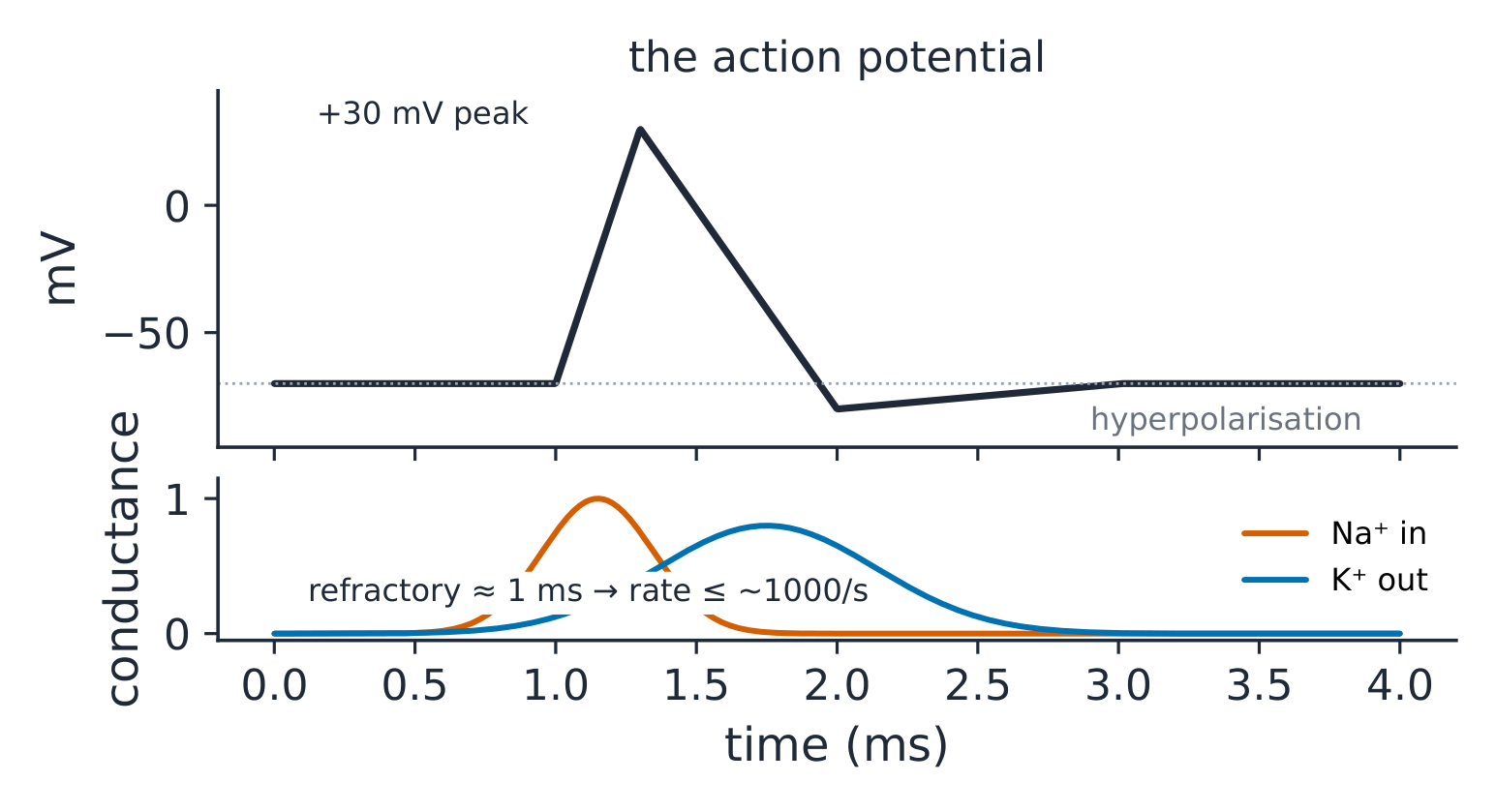
Skeletal muscle: spike → Ca²⁺ release → the MED04 sarcomere contracts. Twitch ~100 ms vs refractory ~2 ms: stimuli at 20/s give tetanus — smooth maximal force ✓ (never in the heart: its long refractory forbids it).
{exercise:uni-med0502-phases}
The upstroke overshoots to positive potentials because —
Độ khó 1/5 · 100 xu + phần thưởng nhỏ khi hoàn thành lần đầu tiên hôm nay
Threshold is where Na⁺ positive feedback beats K⁺: above it, the spike runs away to +30 mV.
A nerve refractory period of ~1 ms caps the firing rate near —
Độ khó 1/5 · 100 xu + phần thưởng nhỏ khi hoàn thành lần đầu tiên hôm nay
One spike per refractory period: 1 ms → 1000 Hz ceiling. Refractory also guarantees one-way propagation.
The channel that fails
- Fictional periodic paralysis: insulin drives K⁺ into cells, ECF K⁺ falls, and a borderline Na⁺-channel gate cannot reach threshold — a Nernst shift of millivolts silences a muscle.
{exercise:uni-med0502-rate} {exercise:uni-med0502-myelin}
Saltatory conduction raises conduction speed by —
Độ khó 1/5 · 100 xu + phần thưởng nhỏ khi hoàn thành lần đầu tiên hôm nay
Myelin insulates; channels cluster at nodes, so the spike jumps — speed ×100 at no extra diameter cost.