Resistance, electrical energy and power
Đã giới thiệu| English | Ý nghĩa |
|---|---|
| resistance/rɪˈzɪstəns/ | Điện trở |
| ohms/əʊmz/ | Ôm |
| filament lamp/ˈfɪləmənt læmp/ | Bóng đèn dây tóc |
| diode/ˈdaɪəʊd/ | Diode |
| fixed resistor/fɪkst rɪˈzɪstə/ | Điện trở cố định |
| kilowatt-hour/ˈkɪləwɒt ˈaʊə/ | Kilowatt-giờ |
Slowing the flow
- Push current through a thin wire and it gets hot; through a thick one, less so.
- Resistance 电阻 measures how hard it is for current to flow.
- It controls the current, heats your toaster, and sets your electricity bill.
Resistance
- Resistance $R$ is measured in ohms 欧姆 ($\Omega$). A bigger resistance gives a smaller current:
- To measure it: an ammeter in series reads $I$, a voltmeter across the component reads $V$, then divide.
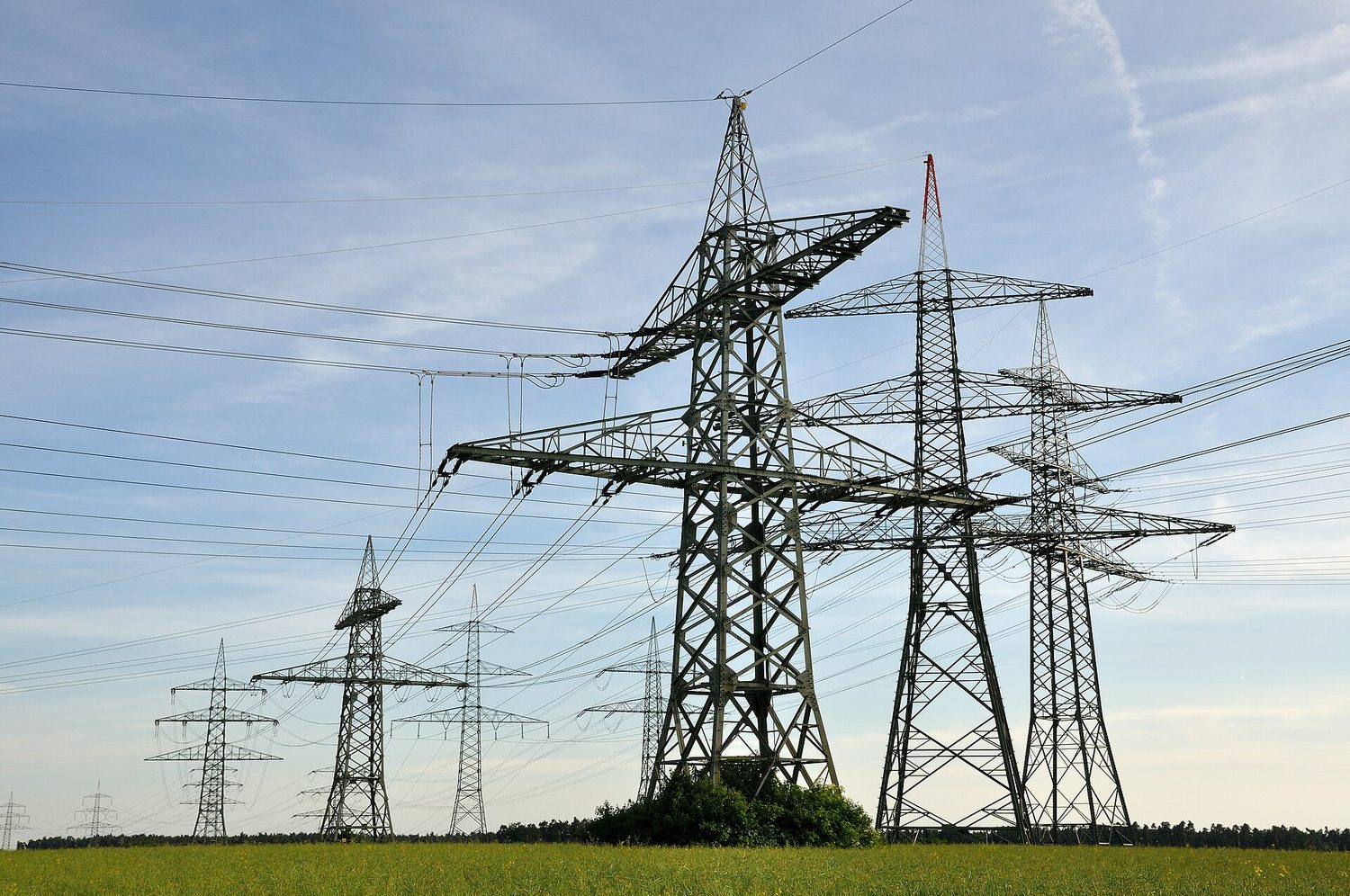
A pylon carries the cables that bring electricity at very high voltage
Resistance
V = R·I
Ohm's law: voltage is proportional to current — the gradient is the resistance R.
A component has $12\ \text{V}$ across it and a current of $3.0\ \text{A}$ through it. What is its resistance, in Ω?
Độ khó 2/5 · 140 xu + một phần thưởng nhỏ cho lần hoàn thành đầu tiên trong ngày
$R = \dfrac{V}{I} = \dfrac{12}{3.0} = 4.0\ \Omega$.
What changes a wire's resistance
- A longer wire has more resistance — resistance is proportional to length ($R \propto l$).
- A thicker wire has less resistance — resistance is inversely proportional to the cross-sectional area ($R \propto \tfrac{1}{A}$).
- So doubling the length doubles $R$; doubling the area halves it.

I-V graphs for a resistor, a filament lamp 灯丝灯泡 and a diode 二极管
I–V characteristics
A resistor gives a straight line; a filament lamp and a diode do not. Pick a component and read I and R off the curve.
A wire is made twice as long (same thickness). Its resistance:
Độ khó 1/5 · 100 xu + một phần thưởng nhỏ cho lần hoàn thành đầu tiên trong ngày
Resistance is proportional to length, so doubling the length doubles the resistance.
Match each electrical relationship to its formula.
Độ khó 2/5 · 140 xu + một phần thưởng nhỏ cho lần hoàn thành đầu tiên trong ngày
Each item links the term to its correct meaning.
Current–voltage graphs
- A fixed resistor 定值电阻: a straight line through the origin — resistance is constant, so $I \propto V$.
- A filament lamp: an S-shape that gets flatter — the wire heats up, so its resistance rises.
- A diode: current one way only — very high resistance the "wrong" way.

The I–V graph of a fixed resistor (at constant temperature) is:
Độ khó 1/5 · 100 xu + một phần thưởng nhỏ cho lần hoàn thành đầu tiên trong ngày
A fixed resistor has constant resistance, so $I \propto V$ — a straight line through the origin.
Electrical power and energy
- Power is the energy transferred each second, in watts (W):
- The energy transferred in a time $t$, in joules (J), is:
A device runs at $12\ \text{V}$ and draws $2.0\ \text{A}$. What is its power, in W?
Độ khó 2/5 · 140 xu + một phần thưởng nhỏ cho lần hoàn thành đầu tiên trong ngày
$P = IV = 2.0 \times 12 = 24\ \text{W}$.
The kilowatt-hour 千瓦时
- Electricity bills use a bigger unit, the kilowatt-hour (kWh): the energy a $1\ \text{kW}$ appliance uses in $1$ hour.
- Example: a $2\ \text{kW}$ heater for $3$ hours uses $6\ \text{kWh}$.
A $2.0\ \text{kW}$ heater is on for $3.0$ hours. How much energy does it use, in kWh?
Độ khó 2/5 · 140 xu + một phần thưởng nhỏ cho lần hoàn thành đầu tiên trong ngày
energy = power × time = $2.0 \times 3.0 = 6.0\ \text{kWh}$.
If one kWh costs $20$ cents, what does $6.0\ \text{kWh}$ cost, in cents?
Độ khó 2/5 · 140 xu + một phần thưởng nhỏ cho lần hoàn thành đầu tiên trong ngày
cost = energy × price = $6.0 \times 20 = 120$ cents.
Worked examples
1. A kettle on a $230\ \text{V}$ supply draws $9.0\ \text{A}$. $P = IV = 9.0 \times 230 = 2070\ \text{W} \approx 2.1\ \text{kW}$, and its resistance is $R = \dfrac{V}{I} = \dfrac{230}{9.0} = 26\ \Omega$.
2. A $2.0\ \text{kW}$ heater runs for $15$ minutes, which is $0.25\ \text{h}$. Energy $= 2.0 \times 0.25 = 0.50\ \text{kWh}$; at ¥0.60 per kWh the cost is $0.50 \times 0.60 =$ ¥0.30.
A component has 18 V across it and carries 2.0 A. What are its resistance and power? How many kilowatt-hours does a 1.5 kW heater use in 2.0 hours?
18 divided by 2 is 9 ohms. Current times voltage is 36 watts. 1.5 kilowatts times 2.0 hours is 3.0 kilowatt-hours.
What is the resistance?
Độ khó 1/5 · 100 xu + một phần thưởng nhỏ cho lần hoàn thành đầu tiên trong ngày
18 divided by 2.0 is 9 ohms.
You've got it
- $R = \dfrac{V}{I}$ (ohms); longer wire → more $R$, thicker wire → less $R$
- I–V graphs: resistor = straight line; lamp = S-curve (heats up); diode = one way
- power $P = IV$ (watts); energy $E = IVt$ (joules)
- kWh = power (kW) × time (h); cost = kWh × price
Write from a resistance of 9 ohms
- A component has 18 V across it and a current of 2.0 A.
- Find the resistance and the power. A 1.5 kW heater runs for 2.0 hours.