Mass, weight and density
Đã giới thiệu| English | Ý nghĩa |
|---|---|
| mass/mæs/ | khối lượng |
| weight/weɪt/ | trọng lượng |
| density/ˈdensɪti/ | mật độ |
| matter/ˈmætə/ | chất |
| gravity/ˈɡrævɪti/ | lực hấp dẫn |
| gravitational field strength/ˌɡrævɪˈteɪʃənl fiːld streŋθ/ | cường độ trường trọng lực |
| displacement/dɪˈspleɪsmənt/ | sự dời vị trí |
Same you, lighter on the Moon
- An astronaut on the Moon can leap high and feels light.
- Yet they are made of exactly the same stuff as on Earth.
- The puzzle is solved by two different ideas: mass 质量 and weight 重力. Then we measure density 密度.
Mass
- Mass is the amount of matter 物质 in an object.
- It is measured in kilograms (kg).
- Mass does not change when you move the object — to the Moon, into space, anywhere.
- A balance compares an unknown mass with known masses.

Weight and mass
W = mg
Weight is proportional to mass — the gradient is the gravitational field strength g (about 10 N/kg on Earth).
Weight
- Weight is the force of gravity 引力 on a mass. It is measured in newtons (N).
- Weight can change: it is smaller on the Moon because the Moon's gravity is weaker.
- Gravitational field strength 重力场强度 is the force per unit mass:
- So weight is $W = mg$. On Earth $g \approx 9.8\ \text{N/kg}$ — the same number as the acceleration of free fall.
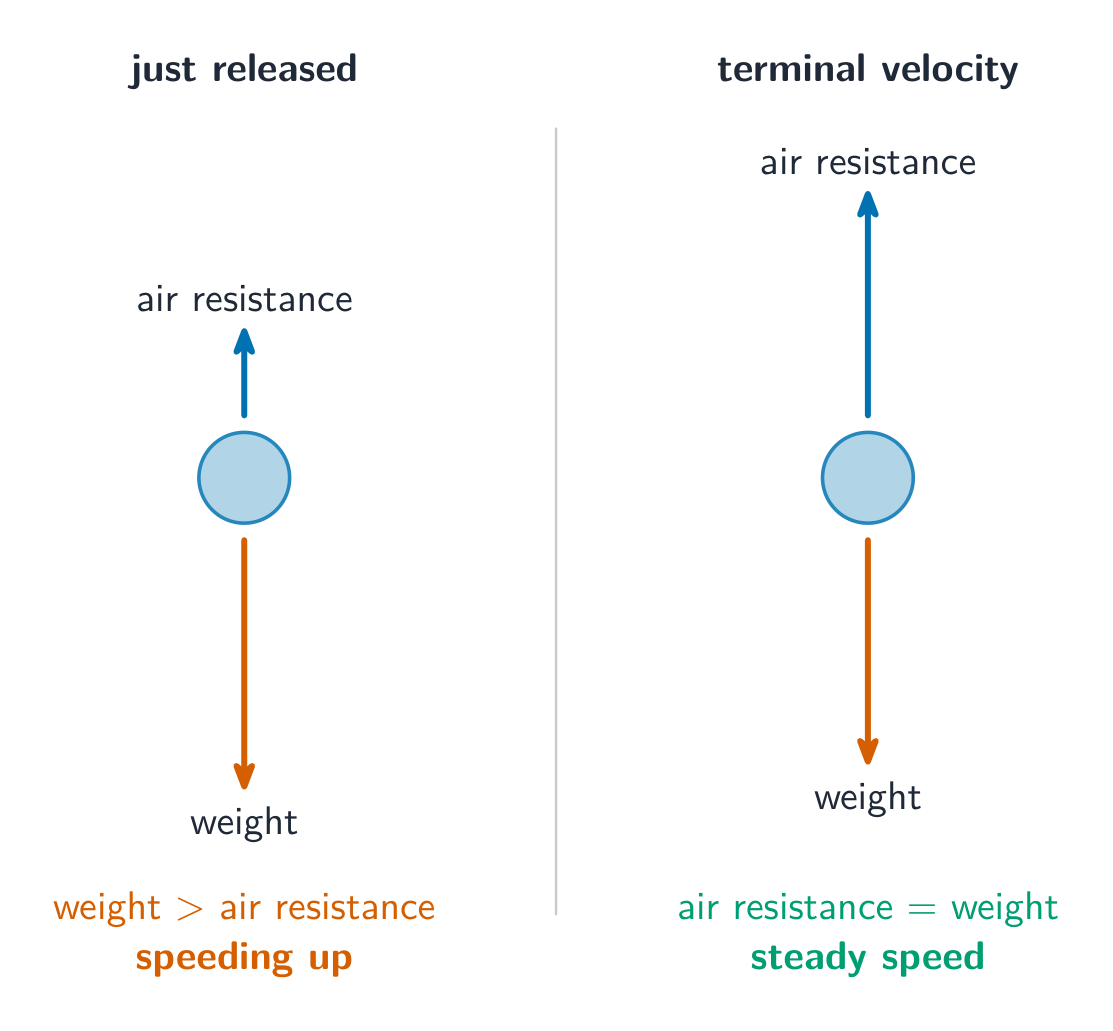
A falling object speeds up until air resistance grows to equal its weight
Floating and density
Change the object's density and the liquid: it floats if it's less dense, and the denser it is the more sits underwater. Iron sinks in water but floats on mercury.
An astronaut travels from Earth to the Moon. What happens to their mass and weight?
Độ khó 1/5 · 100 xu + một phần thưởng nhỏ cho lần hoàn thành đầu tiên trong ngày
Mass (amount of matter) never changes. Weight is the force of gravity, and the Moon's gravity is weaker, so the weight is smaller.
A bag has a mass of $5.0\ \text{kg}$. What is its weight on Earth, in N? (Use $g = 9.8\ \text{N/kg}$.)
Độ khó 2/5 · 140 xu + một phần thưởng nhỏ cho lần hoàn thành đầu tiên trong ngày
$W = mg = 5.0 \times 9.8 = 49\ \text{N}$.
Density
- Density is the mass packed into each unit of volume:
- The symbol $\rho$ is the Greek letter "rho". The unit is $\text{kg/m}^3$ or $\text{g/cm}^3$.
- To measure it: find the mass with a balance, find the volume, then divide.
- Regular solid (a box): measure the sides and calculate the volume.
- Irregular solid (a stone): lower it into water in a measuring cylinder — the rise in water level is its volume (the displacement 排水法 method).
A metal block has a mass of $240\ \text{g}$ and a volume of $30\ \text{cm}^3$. What is its density, in g/cm³?
Độ khó 2/5 · 140 xu + một phần thưởng nhỏ cho lần hoàn thành đầu tiên trong ngày
$\rho = \dfrac{m}{V} = \dfrac{240}{30} = 8.0\ \text{g/cm}^3$.
How do you find the volume of a small, oddly-shaped stone?
Độ khó 1/5 · 100 xu + một phần thưởng nhỏ cho lần hoàn thành đầu tiên trong ngày
The stone pushes the water up. The rise in the water level equals the stone's volume — the displacement method.
Water in a measuring cylinder reads $50\ \text{cm}^3$. After a stone is added it reads $74\ \text{cm}^3$. What is the volume of the stone, in cm³?
Độ khó 2/5 · 140 xu + một phần thưởng nhỏ cho lần hoàn thành đầu tiên trong ngày
The volume is the rise in level: $74 - 50 = 24\ \text{cm}^3$.
Floating and sinking
- An object floats if its density is less than the density of the liquid.
- It sinks if its density is greater.
- Ice floats on water because ice is slightly less dense than water.
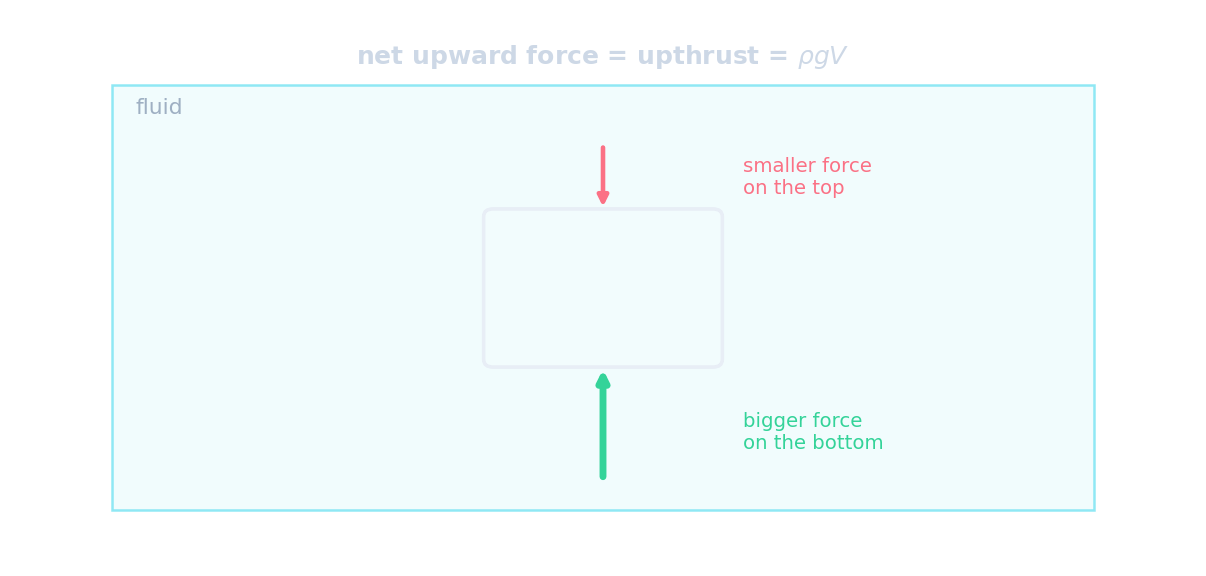
An object floats on a liquid if its density is less than the density of the liquid.
Độ khó 1/5 · 100 xu + một phần thưởng nhỏ cho lần hoàn thành đầu tiên trong ngày
Less dense than the liquid → it floats; denser than the liquid → it sinks.
Worked examples
1. A metal block has mass $200\ \text{g}$ and measures $4.0\ \text{cm} \times 5.0\ \text{cm} \times 2.0\ \text{cm}$. Volume $= 40\ \text{cm}^3$, so $\rho = \dfrac{m}{V} = \dfrac{200}{40} = 5.0\ \text{g/cm}^3$, which is $5000\ \text{kg/m}^3$.
2. Its weight on Earth: convert the mass to kilograms first. $W = mg = 0.200 \times 9.8 = 1.96\ \text{N} \approx 2.0\ \text{N}$.
A block has mass 180 g and volume 20 cubic centimetres. What is its density, and what happens to its mass if it is taken to the Moon?
180 divided by 20 is 9. Mass does not depend on the local gravitational field strength.
What is the density of the block?
Độ khó 1/5 · 100 xu + một phần thưởng nhỏ cho lần hoàn thành đầu tiên trong ngày
180 divided by 20 is 9 grams per cubic centimetre.
You've got it
- mass = amount of matter (kg), never changes; weight = force of gravity (N), $W = mg$
- $g = \dfrac{W}{m} \approx 9.8\ \text{N/kg}$ on Earth
- density $\rho = \dfrac{m}{V}$; find an odd shape's volume by displacement
- floats if its density is less than the liquid's
Write from a density of 9 grams per cubic centimetre
- A block has mass 180 g and volume 20 cubic centimetres.
- Find the density. Say what happens to the mass on the Moon.