Combined events
Đã giới thiệu| English | Ý nghĩa |
|---|---|
| independent/ˌɪndɪˈpendənt/ | độc lập |
| mutually exclusive/ˈmjuːtʃuːəli eksˈkluːsɪv/ | tương hỗ |
| sample space/ˈsæmpl speɪs/ | không gian mẫu |
| tree diagram/triː ˈdaɪəɡræm/ | sơ đồ cây |
| replacement/rɪˈpleɪsmənt/ | có hoàn lại |
Two events at once
- You roll a die and flip a coin. What's the chance of a six AND heads?
- Combined events need two rules: AND (multiply) and OR (add).
AND — multiply (independent 独立的 events)
- For two independent events (one doesn't affect the other):
$\text{P}(\text{six and heads}) = \dfrac{1}{6} \times \dfrac{1}{2} = \dfrac{1}{12}$.
Combined events
P(A ∩ B) = P(A)·P(B|A)
Combine two events: the area model shows AND (overlap) versus OR (union).
For two independent events both happening (AND), you:
Độ khó 1/5 · 100 xu + một phần thưởng nhỏ cho lần hoàn thành đầu tiên trong ngày
P(A and B) = P(A) × P(B) for independent events.
OR — add (mutually exclusive 互斥 events)
- For two mutually exclusive events (they can't both happen):
Probability tree
Multiply the probabilities along each branch; the four outcomes always add up to 1.
For mutually exclusive events, P(A or B) = P(A) + P(B).
Độ khó 1/5 · 100 xu + một phần thưởng nhỏ cho lần hoàn thành đầu tiên trong ngày
Mutually exclusive events cannot both happen, so you add their probabilities.
Three ways to show outcomes
- Sample space 样本空间 diagram: a table of every outcome (two dice → $36$ cells).
- Venn diagram: sorts outcomes into overlapping sets.
- Tree diagram 树状图: a branch per stage; multiply along branches, then add the paths you want.
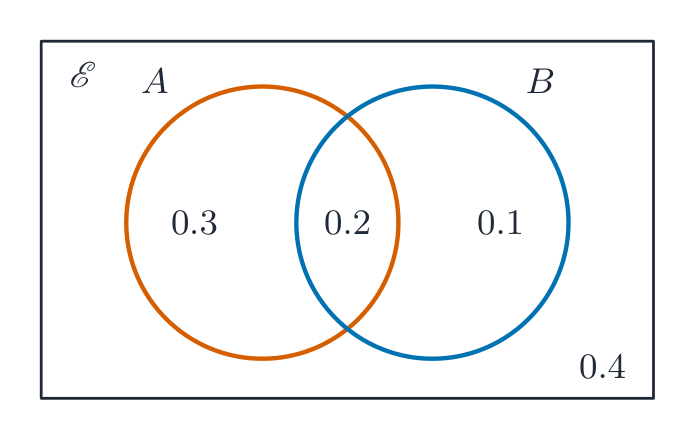
A Venn diagram sorts outcomes: the overlap is $\text{P}(A\text{ and }B)$, and everything inside either circle is $\text{P}(A\text{ or }B)$
Multiply along, add between. On a tree diagram: multiply probabilities along each branch (to get that path's probability), then add the paths you want (to get the total probability).
On the 6 by 6 grid of two dice (36 cells), how many cells give a total of 7?
Độ khó 2/5 · 140 xu + một phần thưởng nhỏ cho lần hoàn thành đầu tiên trong ngày
1+6, 2+5, 3+4, 4+3, 5+2, 6+1 — six cells, so P(7) = 6/36 = 1/6.
On a tree diagram, you ______ along branches and add between paths.
Độ khó 1/5 · 100 xu + một phần thưởng nhỏ cho lần hoàn thành đầu tiên trong ngày
Multiply along each branch to get that path probability, then add the wanted paths.
With and without replacement 放回
- With replacement: chances stay the same each time.
- Without replacement (Extended): the total and the count change after each draw.
- Bag of $3$ red, $5$ blue: P(red, red) with replacement $= \dfrac{3}{8} \times \dfrac{3}{8} = \dfrac{9}{64}$. Without replacement $= \dfrac{3}{8} \times \dfrac{2}{7} = \dfrac{3}{28}$.
Venn diagrams show combined events: the overlap (intersection) is AND, the whole region (union) is OR.
Bag of 3 red, 5 blue, two draws WITH replacement. P(red, red) = 9/b. What is b?
Độ khó 2/5 · 140 xu + một phần thưởng nhỏ cho lần hoàn thành đầu tiên trong ngày
(3/8) × (3/8) = 9/64, so b = 64.
Same bag, WITHOUT replacement. After one red is taken, how many reds remain?
Độ khó 2/5 · 140 xu + một phần thưởng nhỏ cho lần hoàn thành đầu tiên trong ngày
Started with 3 red; one taken leaves 2 red (out of 7 counters).
Exactly one means two paths
- Draw twice from 2 red and 3 blue counters with replacement. Each stage has red $2/5$ and blue $3/5$. Exactly one red includes RB and BR, so $p=(2/5)(3/5)+(3/5)(2/5)=12/25$.
- At least one red is easier by complement: $p=1-(3/5)^2=16/25$. This includes RR as well as the two mixed paths; do not confuse exactly one with at least one.

With replacement from 2 red and 3 blue counters, find the probability of exactly one red in two draws.
Độ khó 2/5 · 140 xu + một phần thưởng nhỏ cho lần hoàn thành đầu tiên trong ngày
RB and BR give 6/25 + 6/25 = 12/25 = 0.48.
You've got it
- AND → multiply (independent); OR → add (mutually exclusive)
- on a tree: multiply along branches, add the wanted paths
- without replacement, the second probability changes ($\dfrac{3}{8} \to \dfrac{2}{7}$)
Write from 4 ways to score 9
- Two ordinary dice are thrown.
- Count the outcomes with a sum of 9.
Two dice are thrown. How many of the 36 equally likely outcomes give a sum of 9?
Four ordered pairs add to 9.
How many outcomes sum to 9?
Độ khó 1/5 · 100 xu + một phần thưởng nhỏ cho lần hoàn thành đầu tiên trong ngày
Only four cells show a sum of 9.