Kế hoạch học tập của bạn · Tiếp tục · Ôn tập →
成语 set: feelings and reactions (迫不及待, 恍然大悟, 无可奈何 …)
Đã giới thiệuVị trí đã lưu của bạn vẫn nằm trong trình duyệt này. Việc tiếp tục sẽ không hoàn thành bài học hay trả lời các câu hỏi của nó.
How did they feel?
- Stories in HSK 6 reading and the abbreviation缩写 essay often describe feelings with a idiom (four-character)成语.
- he / him他can't wait迫不及待(adverb -ly)地to open打开(completed / change)了gift礼物。 — "He couldn't wait to open the present."
- Goal: learn nine idiom (four-character)成语 for feelings and reactions, and use them to bring a story to life.
Excited and eager
- delighted兴高采烈 delighted, in high spirits (delighted兴高采烈(adverb -ly)地 + verb) · full of enthusiasm兴致勃勃 full of enthusiasm
- can't wait迫不及待 can't wait: he / him他can't wait迫不及待(adverb -ly)地to open打开(completed / change)了gift礼物。
the children孩子们happily兴高采烈地ran跑了out出去。
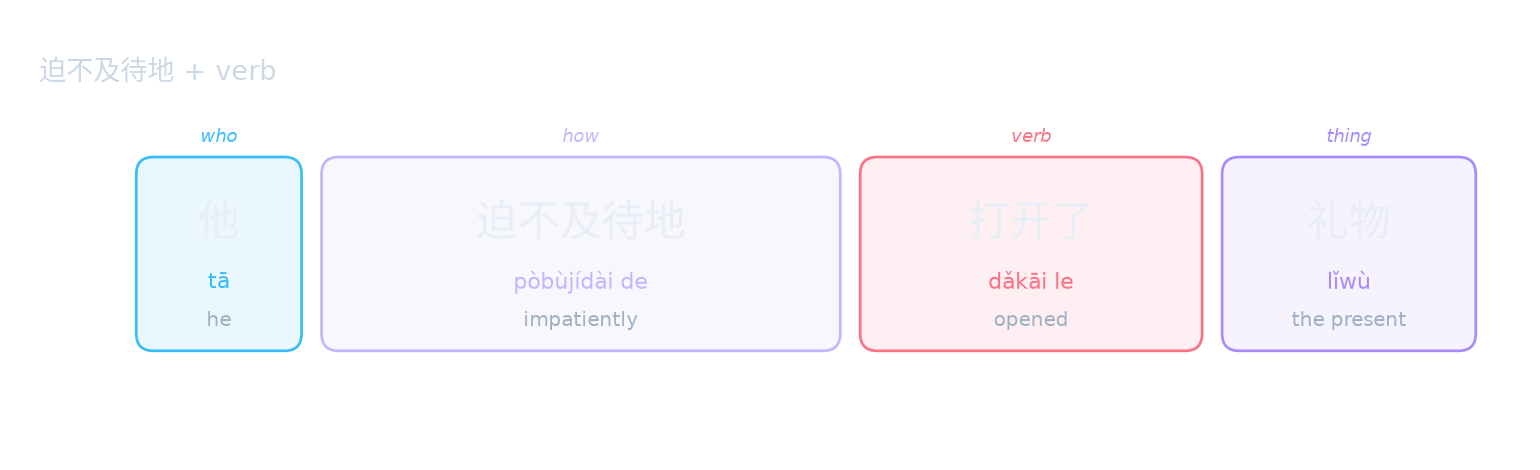
Complete: “He couldn't wait to open the present.” 他____地打开了礼物。
Độ khó 1/5 · 100 xu + phần thưởng nhỏ khi hoàn thành lần đầu tiên hôm nay
迫不及待地 + verb.
Tired, helpless, moved
- listless无精打采 listless, low on energy · helpless; nothing to be done无可奈何 have no choice, helpless · powerless无能为力 powerless (to / towards / correct对……powerless无能为力)
- eyes filled with tears热泪盈眶 eyes filled with tears (of emotion): to hear听到this这个news; message消息,mum; mother妈妈eyes filled with tears热泪盈眶。 — "Hearing the news, Mum's eyes filled with tears."
After a long, boring day, a student sits in class with no energy. He is …
Độ khó 1/5 · 100 xu + phần thưởng nhỏ khi hoàn thành lần đầu tiên hôm nay
无精打采 = listless.
Build: “Hearing the news, Mum's eyes filled with tears.”
Độ khó 3/5 · 200 xu + phần thưởng nhỏ khi hoàn thành lần đầu tiên hôm nay
热泪盈眶 ends the sentence.
Suddenly understanding — or not
- to suddenly understand恍然大悟 suddenly see the light: to listen to听(completed / change)了teacher老师(modifier / structural particle)的to explain / explanation解释,I / me我to suddenly understand恍然大悟。 — "After the teacher explained, it suddenly made sense."
- baffling莫名其妙 baffling, for no clear reason: he / him他baffling莫名其妙(adverb -ly)地to get angry生气(completed / change)了。 — "He got angry for no clear reason."
after hearing听了the teacher's老师的explanation解释,I我suddenly understood恍然大悟。
听了老师的解释,我恍然大悟。What does it mean?
Độ khó 1/5 · 100 xu + phần thưởng nhỏ khi hoàn thành lần đầu tiên hôm nay
恍然大悟 = suddenly understand.
莫名其妙 describes something that happens for no clear reason.
Độ khó 1/5 · 100 xu + phần thưởng nhỏ khi hoàn thành lần đầu tiên hôm nay
他莫名其妙地生气了.
helpless; nothing to be done无可奈何 vs powerless无能为力
- helpless; nothing to be done无可奈何 = there's nothing you can do, so you accept it (a feeling): he / him他helpless; nothing to be done无可奈何(adverb -ly)地笑了笑。
- to / towards / correct对……powerless无能为力 = you don't have the power to help: doctor医生to / towards / correct对this kind of这种illness / ill病also也powerless无能为力。 — "Even the doctors can do nothing about this illness."
“Even the doctors can do nothing about this illness.” Which fits?
Độ khó 1/5 · 100 xu + phần thưởng nhỏ khi hoàn thành lần đầu tiên hôm nay
对……无能为力 = powerless to help.
Recap
- Happy, eager: delighted兴高采烈, full of enthusiasm兴致勃勃, can't wait迫不及待. Low, helpless, moved: listless无精打采, helpless; nothing to be done无可奈何, powerless无能为力, eyes filled with tears热泪盈眶.
- Understanding: to suddenly understand恍然大悟; baffling: baffling莫名其妙. Many take (adverb -ly)地 before a verb.
Write a four-sentence story about waiting for exam results. Use at least three 成语 from this lesson to show how the feelings change.
Your answer need not copy the model.