Kế hoạch học tập của bạn · Tiếp tục · Ôn tập →
尚且 … 何况 … (even …, let alone — formal)
Đã giới thiệuVị trí đã lưu của bạn vẫn nằm trong trình duyệt này. Việc tiếp tục sẽ không hoàn thành bài học hay trả lời các câu hỏi của nó.
Too heavy for anyone
- Two adults try to lift an old piano and fail. A child offers to help.
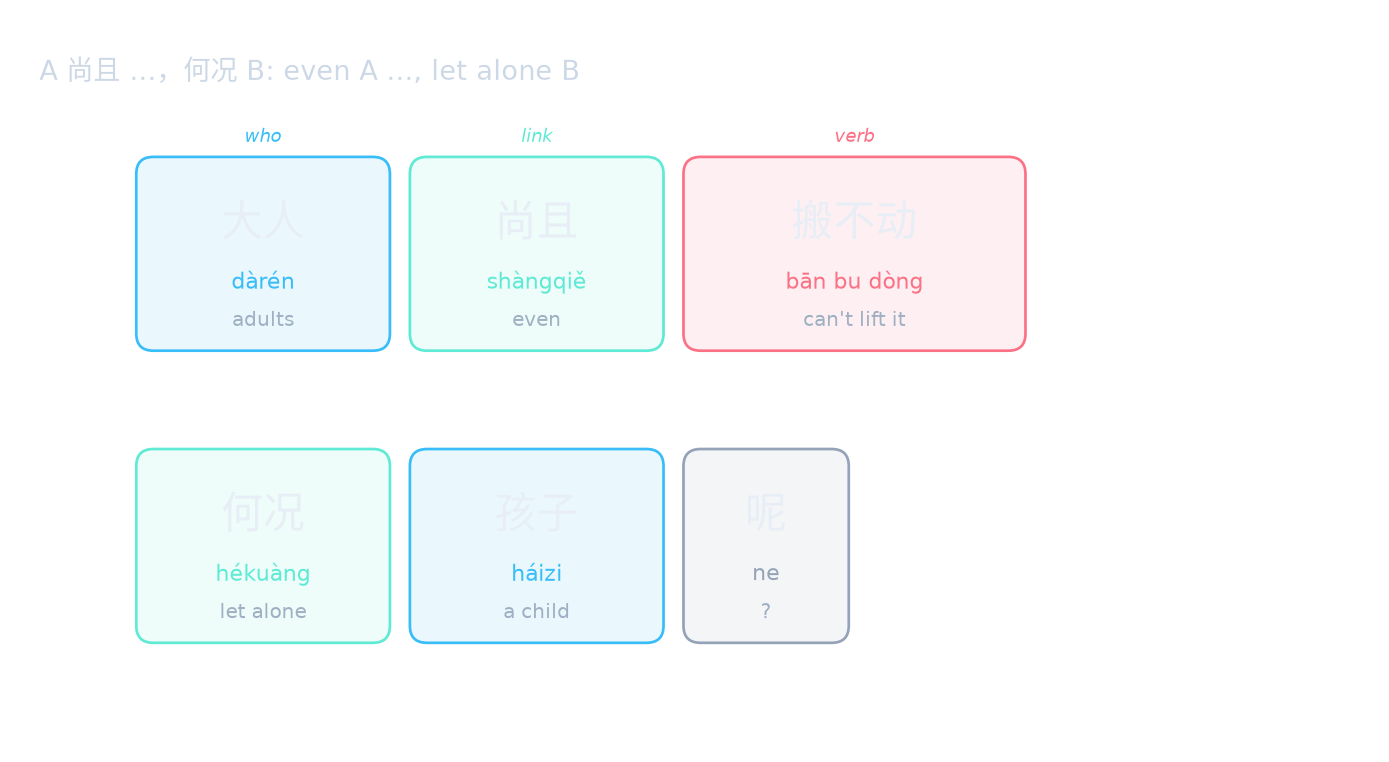
- 这架piano钢琴adults大人even尚且can't move it搬不动,let alone何况a child孩子(and …? / softener)呢? — "Even adults can't move this piano, let alone a child."
- Goal: argue "even A …, let alone B" in formal style with A even尚且 …,let alone何况 B.
A even尚且 …,let alone何况 B ((and …? / softener)呢)?
- even尚且 (shàngqiě) = "even", a formal even连 … all / both都. It marks the case where you would least expect the result.
- let alone何况 then adds a case where the result is even more obvious, often as a question with (and …? / softener)呢.
adults大人even尚且can't move it搬不动,let alone何况a child孩子呢?
Complete: “Even adults can't move it, let alone a child.” 大人____搬不动,何况孩子呢?
Độ khó 1/5 · 100 xu + phần thưởng nhỏ khi hoàn thành lần đầu tiên hôm nay
A 尚且 …,何况 B.
In 专家尚且不懂,何况我们呢?, who is the case you'd least expect not to understand?
Độ khó 1/5 · 100 xu + phần thưởng nhỏ khi hoàn thành lần đầu tiên hôm nay
尚且 marks the least expected case; 何况 adds the case where it's even more obvious.
more更needless to say不用说 and more更 + adj.
- Instead of let alone何况, use more更needless to say不用说 or more更 + adjective: 这道题the teacher老师even尚且needs要want / think / miss想degree / adjective linker很for a long time久,more更needless to say不用说the students学生(completed / change)了。 — "Even the teacher needs a long time on this question, not to mention the students."
- usually; normally平时even尚且so much这么busy忙,weekend周末more更busy忙。 — "It's this busy even on normal days; at weekends it's busier still."
the teacher老师even尚且needs要to think long想很久,not to mention更不用说the students学生了。
Build: “Even the teacher needs a long time, not to mention the students.”
Độ khó 3/5 · 200 xu + phần thưởng nhỏ khi hoàn thành lần đầu tiên hôm nay
更不用说 … 了 can replace 何况.
After the subject, with a follow-up
- even尚且 comes after the subject: ✓ adults大人even尚且can't move it搬不动 ✗ even尚且adults大人can't move it搬不动 (even连 comes before: even连adults大人all / both都to move搬motionless不动).
- even尚且 is almost always followed by a second clause (let alone何况 / more更needless to say不用说 / more更 …) that draws the conclusion.
Which sentence is correct?
Độ khó 1/5 · 100 xu + phần thưởng nhỏ khi hoàn thành lần đầu tiên hôm nay
尚且 goes right after the subject, before the verb.
even尚且 or even连 … all / both都?
- even连 A all / both都 …,let alone何况 B = everyday style: even连adults大人all / both都to move搬motionless不动,let alone何况a child孩子.
- A even尚且 …,let alone何况 B = the same idea, formal, common in essays.
大人尚且搬不动 means the same as 连大人都搬不动.
Độ khó 1/5 · 100 xu + phần thưởng nhỏ khi hoàn thành lần đầu tiên hôm nay
尚且 is the formal partner of 连 … 都.
Recap
- A even尚且 + result,let alone何况 / more更needless to say不用说 B = even A …, let alone B (formal).
- even尚且 after the subject; even连 before it with all / both都.
Read the full reference: HSK 6 grammar — Let alone.
Write one essay sentence with A 尚且 …,何况 B. Topic: learning a language well takes time.
Your answer need not copy the model.